Plotting compasses
Definition
Plotting compass
A plotting compass is a small magnetised needle on a pivot that is free to turn and comes to rest along the magnetic field line at its position.
- A plotting compass is simply a very small bar magnet mounted on a low-friction pivot inside a clear case, so it is free to swing round in the horizontal plane.
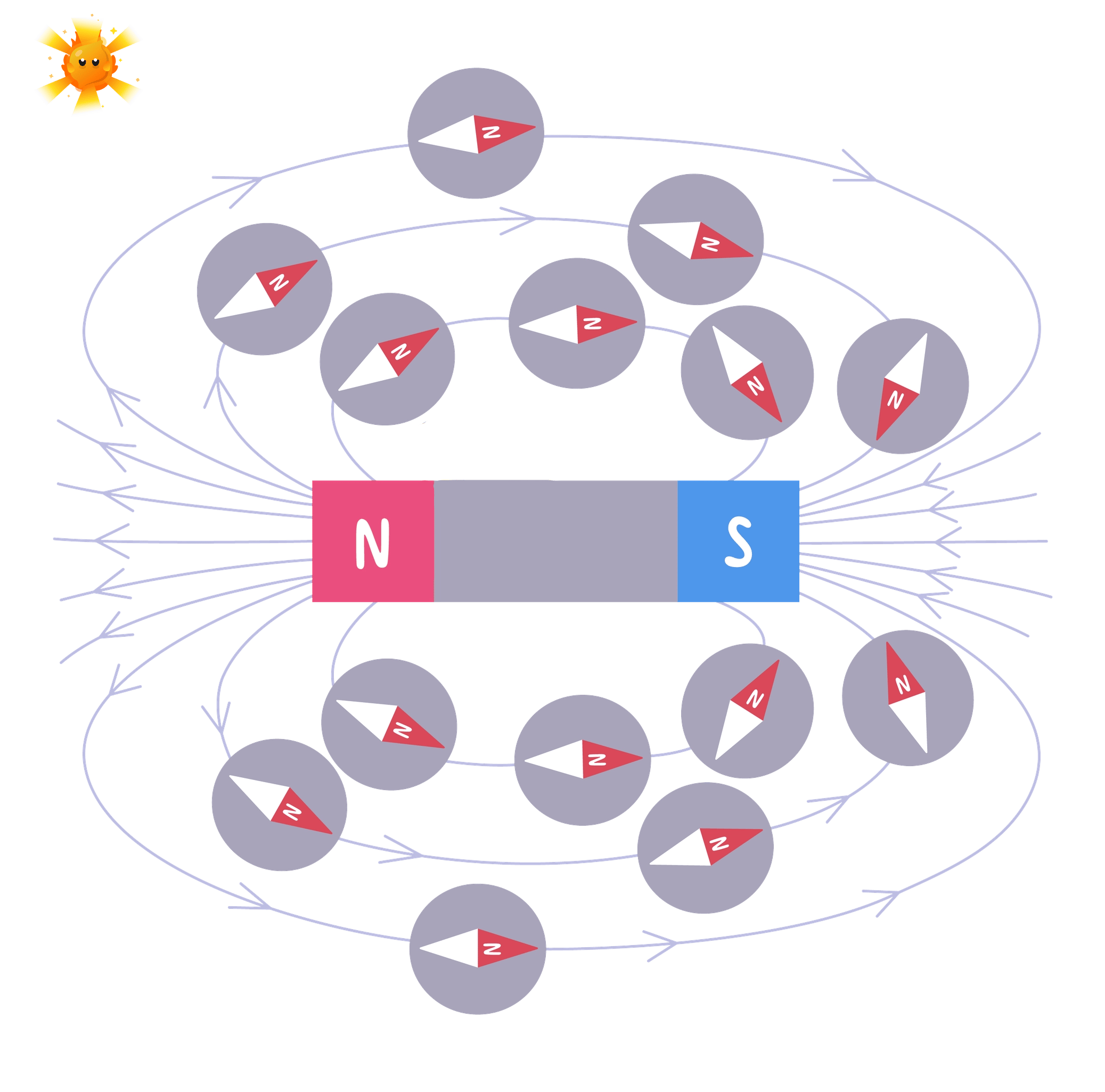
- Placed in a magnetic field, the needle turns until it lies along the field line passing through that point, and then it stops.
- It turns because the field pulls the needle's north pole one way and its south pole the opposite way. These two forces act at opposite ends of the needle, so they twist it rather than dragging it sideways.
- Once the needle is lined up with the field the two forces are directly opposed, the twist disappears, and the needle settles.
- The north-seeking end of the needle, usually the coloured or arrow-shaped end, points the way the field is directed at that point.
- Near a bar magnet the compass therefore points away from the magnet's north pole and towards its south pole, matching the arrows drawn on a field-line diagram.
- A compass measures direction only. It gives no reading for how strong the field is, so the shape of a whole field has to be built up by moving the compass from point to point.
- Ring several compasses round a magnet at once and each needle points a slightly different way, because each one is responding to the field at its own position.
- This is the advantage the compass has over iron filings. The filings line up with the field but give no arrows, while the compass needle carries its own arrowhead.
Practical
Mapping a magnetic field with a plotting compass
- Aim: to plot the shape and the direction of the magnetic field around a bar magnet, and to locate the field's direction at chosen points.
- Apparatus: a bar magnet, a plotting compass, a large sheet of plain A3 paper, a sharp pencil, a wooden ruler, a drawing board or wooden bench, and a soft pencil for shading in the finished lines.
- Variables: the starting position of the compass is the independent variable, the direction taken up by the needle is the dependent variable, and the magnet, its position on the paper and the absence of other magnets nearby are all kept the same.
- Method, setting up:
- Work on a wooden bench well away from radiators, steel table frames, other magnets and mains cables, all of which pull the needle off the true direction.
- Lay the paper flat, place the bar magnet near the middle and draw round it in pencil so that its outline and its pole positions are recorded permanently.
- Label the outline with N and S, and do not move the magnet again until the whole map is finished.
- Method, tracing one field line:
- Put the compass on the paper with its tail end just touching the north pole of the magnet, and wait for the needle to come fully to rest.
- Mark a pencil dot on the paper at the tip of the north-seeking end of the needle, and a second dot at the tail.
- Slide the compass forward until its tail sits exactly on the dot you made at the tip, then let the needle settle again and mark a new dot at the new tip.
- Keep leapfrogging the compass in this way, one needle length at a time, until the trail of dots arrives back at the south pole of the magnet.
- Join the dots with a single smooth curve rather than a set of straight dashes, and add arrowheads pointing from the north pole towards the south pole.
- Method, completing the map:
- Start again from a different point on the north pole and trace a second line, then a third, until at least six or eight lines cover both sides of the magnet.
- Include lines that start at the corners and along the sides of the magnet, not only from the very ends, so that the full loop shape appears.
- As a check, place the compass at three or four random points on the finished map and confirm that the needle lies along the line already drawn there.
- Expected pattern: the completed sheet shows curved closed loops running from the north pole round to the south pole, symmetrical about the magnet, and crowded together at the two poles.
- Why one line is not enough: a single traced line gives the field direction along one path only, so several lines from different starting points are needed before the overall shape can be seen.
- Watch out: nudging the magnet part-way through, reading the needle before it has stopped swinging, marking the dot beside the needle rather than at its tip, working over a steel bench, and leaving off the arrowheads at the end.
- Safety: this is a low-hazard practical, but keep the magnet away from phones, bank cards and laptops, and store bar magnets in pairs with a keeper so they do not gradually demagnetise.
The Earth's magnetic field
Definition
Earth's magnetic field
The Earth's magnetic field is the magnetic field produced by the Earth itself, which outside the planet has a shape similar to the field of a bar magnet.
- A magnetic compass carried outdoors, far from any magnet, still swings round and settles with its north-seeking end pointing roughly towards geographic north.
- It does this anywhere on the planet, at any time of day, and it returns to the same direction every time it is disturbed.
- The Earth's field has a shape much like the field of a bar magnet buried inside the planet and tilted slightly from the axis the Earth spins about.
- That imagined magnet has to be the other way round from what people expect. A compass north-seeking pole is attracted towards the far north, so the magnetic south pole of the Earth's field lies near geographic north.
- The reasoning that links this to the Earth's core runs as a chain, and each link is worth a mark:
- A compass needle is itself a small magnet that is free to rotate.
- A freely pivoted magnet only turns and settles like this when it is sitting in a magnetic field.
- The compass behaves this way with no other magnet anywhere near it, so the field must be coming from the Earth.
- The Earth's surface rocks are not magnetic enough to produce a field of this size and steadiness, so it must be generated deeper down.
- This is evidence that the core of the Earth must be magnetic.
- This is indirect evidence. Nobody has ever reached the core, so a conclusion about it is drawn from an observation made at the surface.
- The core is far too hot for a solid permanent magnet to survive, so the field is instead produced by the movement of molten iron and nickel in the outer core.
- The Earth's field is weak compared with a laboratory bar magnet, which is why a plotting compass sitting close to a bar magnet ignores the Earth almost entirely and lines up with the magnet instead.
- That weakness matters in the laboratory. Move the compass a long way from the bar magnet and the Earth's field starts to win, which is why traced field lines go astray at the edges of the paper.
Example
Building the evidence for a magnetic core
- A walker in the middle of open moorland takes a compass out of a rucksack and watches the needle swing and settle pointing north.
- Start from what the needle is: a small magnet on a pivot, free to turn.
- A magnet turns like this only when a magnetic field is acting on it, so a field must be present out on the moor.
- There is no other magnet in sight, and the same thing happens on the next hill and the next day, so the field is not local and not temporary.
- The only remaining source large enough and steady enough is the Earth itself, and the surface rocks cannot account for it.
- The conclusion is that the Earth produces a magnetic field, which is evidence that its core is magnetic.
Exam technique
Writing the compass and Earth answers
- A method question on plotting a field is marked on four separate actions: moving the compass to several positions, marking the direction of its north-seeking end, joining the marks into smooth lines, and adding arrows from north to south.
- Say that the magnet is drawn round and left in place. Examiners look for the idea that the magnet does not move while the field is being mapped.
- For the Earth question, write the chain as separate sentences and use the word aligns rather than points, because alignment is what the field actually causes.
- The mark most often dropped is the last one. Finish with the phrase that this is evidence the Earth's core is magnetic, rather than stopping at the compass pointing north.
- If a question mentions a compass giving an odd reading indoors, the answer is interference from nearby iron, steel or another magnetic field, not a faulty needle.
Common Mistake
- Do not write that a compass is pulled towards the North Pole. The needle aligns with the Earth's magnetic field where it stands.
- Do not claim that a plotting compass measures how strong a field is. It shows direction and nothing more.
- Do not say there is a real bar magnet inside the Earth. The field only has a similar shape, and it is produced by movement in the molten outer core.
- Do not trace a field line by moving the compass in a straight line across the paper. Each new position must be set by the direction the needle has just shown.
Self review
- Explain why a plotting compass needle turns when it is placed near a bar magnet.
- State which end of the compass needle shows the direction of the magnetic field.
- Describe how a plotting compass is used to trace one complete field line around a bar magnet.
- Explain why several field lines must be traced rather than just one.
- Give the full chain of reasoning that links the behaviour of a compass to the conclusion that the Earth's core is magnetic.
- Explain why this conclusion is described as indirect evidence.
