Magnetic fields and field lines
Magnetic field
A magnetic field is the region around a magnet or a current-carrying conductor in which a magnetic material or another magnet experiences a force.
Magnetic field line
A magnetic field line is a line drawn to represent a magnetic field, whose arrow gives the direction of the force on the north pole of a small test magnet placed at that point.
- A magnetic field fills the space around a magnet. It cannot be seen, so it is drawn using magnetic field lines, which are a model rather than real threads in the air.
- A field-line diagram carries three separate pieces of information at once:
- the shape of the field, given by the paths the lines follow
- the direction of the field, given by the arrowheads drawn on the lines
- the relative strength of the field, given by how closely the lines are packed together
- The arrow on a field line points the way a free north pole would be pushed if it were placed at that point.
- Field strength is read from the spacing of the lines and nothing else. Closely packed lines mean a strong field, widely spaced lines mean a weak field.
- Two field lines never cross. If they did, the field at the crossing point would have two directions at once, which is impossible.
- The number of lines drawn is a choice made by whoever draws the diagram. Only the way the spacing changes from place to place carries any meaning.
The closer together the magnetic field lines are drawn, the stronger the magnetic field is at that point.
The field around a bar magnet
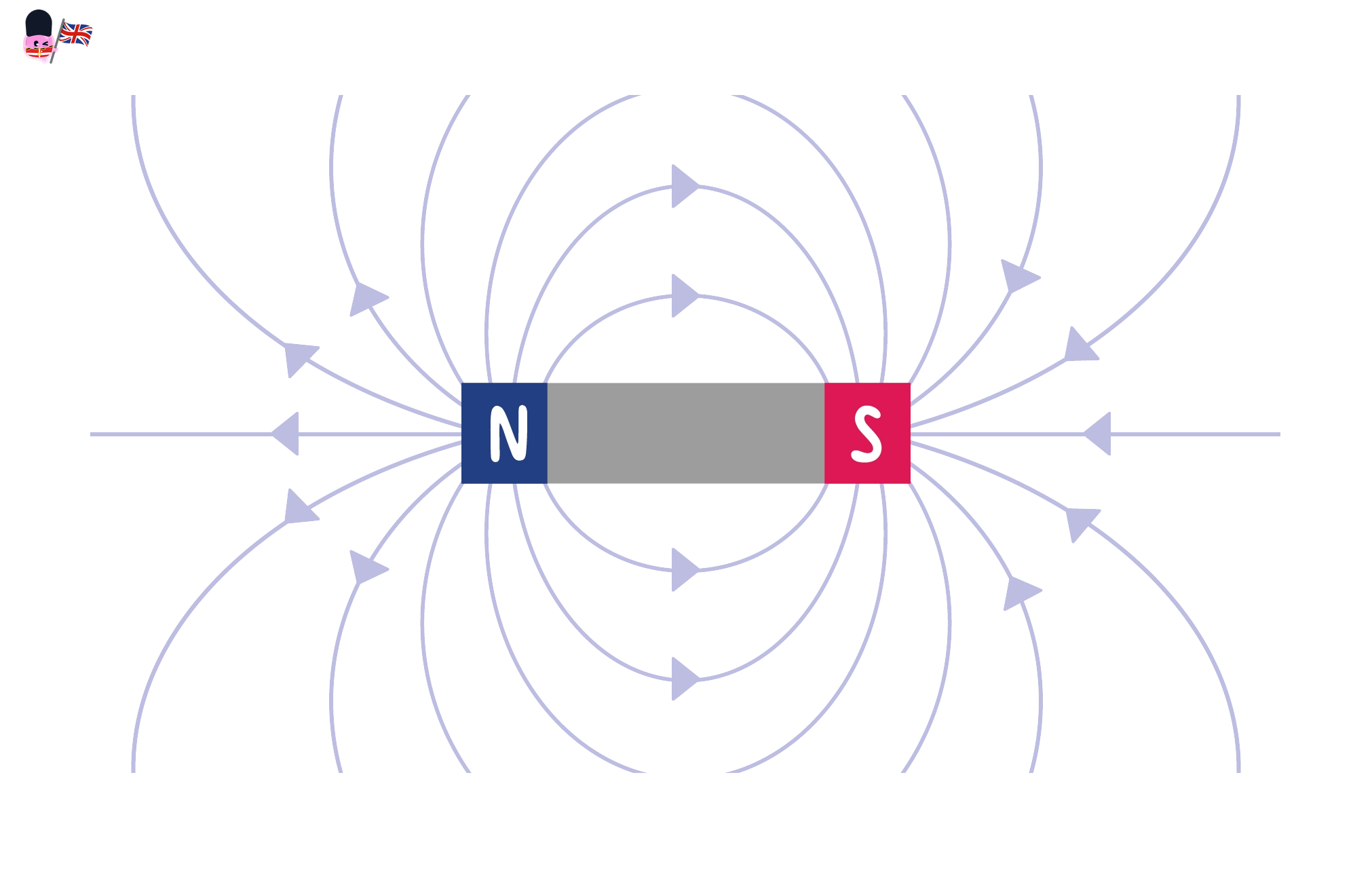
- Outside a bar magnet the field lines are curved and they always run from the north pole to the south pole.
- The lines leave the magnet at the north pole, sweep round through the space beside the magnet, and return to it at the south pole, forming closed loops.
- The pattern is symmetrical about the long axis of the magnet, so the loops on one side mirror the loops on the other.
- The lines are packed most tightly at the two poles, which is why the field is strongest there and why a bar magnet picks up the most paper clips at its ends.
- Moving away from the magnet the lines spread apart, so the field gets weaker with distance. At the midpoint of the long side the field is at its weakest.
- When you are asked to draw the field around a bar magnet, four things earn the marks: curved lines, arrows pointing from north to south, lines closest together at the poles, and no lines crossing.
- A horseshoe magnet is a bar magnet bent round so that its two poles face each other, which crowds the field lines into the narrow gap and gives a strong field in a small space.
Fields between two magnets
Uniform magnetic field
A uniform magnetic field is a magnetic field that has the same strength and the same direction at every point within a region.
Neutral point
A neutral point is a position where two overlapping magnetic fields are equal in size and opposite in direction, so the overall field there is zero.
- When two magnets are placed near each other, their fields combine into a single pattern, and the shape of that pattern depends on which poles face each other.
- Unlike poles facing: the field lines run straight across the gap from the north pole of one magnet into the south pole of the other, and the two magnets are pulled together.
- Like poles facing: the field lines curve sharply away from each other and bulge outwards, because the two fields push in opposite directions in the gap.
- Directly between two equal like poles there is a neutral point. The two fields cancel exactly, so no field lines pass through it and a plotting compass placed there would not settle in any particular direction.
- The narrow region between two unlike poles held a short distance apart is close to a uniform magnetic field, which is why this arrangement is used whenever a steady, even field is needed.
- A uniform field is drawn with lines that are:
- straight rather than curved
- parallel to one another, because the direction is the same everywhere
- equally spaced, because the strength is the same everywhere
- all arrowed in the same direction, from the north pole towards the south pole
- The field near the open ends of the gap bends outwards and stops being uniform, so the uniform region is only the central part between the pole faces.
- Every field that is not uniform is called non-uniform. The field around a single bar magnet is non-uniform, because both the direction and the spacing change from point to point.
Comparing field strength at two points
- A field diagram of a bar magnet is marked with point X just beyond the north pole and point Y level with the middle of the magnet and the same distance from its surface.
- Look only at the spacing of the lines, not at their length or their curvature.
- At X the lines are crowded close together, because every line leaving the magnet is funnelled through the pole.
- At Y the same lines have spread out sideways, so the gaps between them are wider.
- The field is therefore stronger at X, because the field lines there are more closely spaced.
Revealing the field shape with iron filings
- Aim: to make the shape of the magnetic field around a bar magnet visible, and to compare the patterns produced when two magnets are arranged to attract and to repel.
- Apparatus: two bar magnets, a stiff sheet of white card or a clear acrylic sheet, a pepper-pot shaker of fine iron filings, a sheet of clingfilm or a thin polythene bag, a wooden ruler and a camera or phone.
- Variables: the arrangement of the magnets is the independent variable, the pattern taken up by the filings is the dependent variable, and the magnets used, the amount of filings, the height of the card and the tapping are all kept the same.
- Method, one magnet:
- Wrap the bar magnet loosely in clingfilm so that filings can be shaken off cleanly at the end, then lay it flat on the bench.
- Rest the card centrally over the magnet so it lies flat and does not rock, and lightly pencil round the magnet on the card so its position is recorded.
- Sprinkle the iron filings thinly and evenly over the whole card from a height of about 20 cm20\ \text{cm}20 cm. A thick pile clumps together and hides the pattern.
- Tap the edge of the card gently and repeatedly with the ruler. Each tap lifts the filings just clear of the surface so that friction stops holding them and they can swing into line with the field.
- Photograph the pattern from directly above, then sketch it onto the card outline.
- Method, two magnets:
- Clear the filings back into the shaker, then set the two magnets end to end with a gap of about 3 cm3\ \text{cm}3 cm and a north pole facing a south pole.
- Weight or tape the magnets down so they cannot snap together, replace the card, sprinkle and tap as before, and record the pattern.
- Turn one magnet round so that two like poles now face across the same gap, and repeat the whole procedure.
- Expected pattern: one magnet gives curved loops that are densest at the poles. Unlike poles give lines running straight across the gap and a dense, nearly even region between the pole faces. Like poles give lines that bend away from the gap and a bare patch at the neutral point where almost no filings settle.
- Limitation: iron filings show the shape of the field but they carry no arrowheads, so the pattern alone cannot tell you which way round the field points.
- Watch out: too many filings, tapping too hard so the pattern scatters, a card that is bowed or lifted off the magnet, and stray filings left on the bench from a previous group.
- Safety: keep iron filings well away from eyes and never blow them off a surface, wash your hands afterwards, and use the clingfilm so the filings do not become stuck fast to the magnets.
Describing a field diagram
- A describe question about a field pattern is usually marked on three things: the shape of the lines, the direction of the arrows, and what the spacing tells you about strength.
- Say from north to south and add the words outside the magnet, since that is where the rule applies.
- The mark students most often lose is the strength one. Write that the lines are closest together at the poles, so the field is strongest there.
- In a drawing question, put an arrowhead on every line before you hand it in. Unarrowed lines show shape only and cannot score the direction mark.
- For a uniform field, the three words that earn credit are straight, parallel and equally spaced.
- Do not draw or describe the field outside a magnet as running from south to north. Outside the magnet the direction is north to south.
- Do not judge field strength from how long or how thick a line is drawn. Strength is shown only by how close the lines are to each other.
- Do not let field lines cross or stop in mid-air. Every line outside the magnet begins at a north pole and ends at a south pole.
- Do not call the field around a single bar magnet uniform. Its lines are curved and unevenly spaced, so it is non-uniform.
- State the three pieces of information a magnetic field line diagram gives you.
- Describe the shape and direction of the field lines outside a bar magnet.
- Explain how a field diagram shows where the field is strongest.
- Give the three features of the field lines drawn for a uniform magnetic field, and explain what each one represents.
- Explain what a neutral point is and where one is found between two magnets.
- State why iron filings on their own cannot show the direction of a magnetic field.
