9.2.1 Rotational effects of forces and moments
Forces that make objects turn
Pivot
A pivot is the fixed point about which an object turns.
Line of action
The line of action of a force is the straight line drawn through the point where the force acts, extended in the direction in which the force acts.
- A force does not always move an object in a straight line, because an object held at one fixed point will turn about that point instead.
- That fixed point is the pivot, and identifying it is the first step in every turning question.
- Pushing the handle of a door swings the door about its hinges, which act as the pivot.
- Pulling on a spanner turns the nut about the centre of the nut.
- Pushing down on one end of a seesaw turns the plank about the central support.
- Pushing a bicycle pedal turns the crank about the centre of the chain wheel.
- Turning a tap, a steering wheel, a wheelbarrow handle or the lid of a jar are the same idea applied to different pivots.
- Whether a force actually turns the object depends on its line of action, the straight line drawn through the force in the direction in which it acts.
- If the line of action passes through the pivot, the force produces no turning effect at all, because the distance from the pivot to that line is zero.
- Pushing a door exactly along the line through its hinges is the everyday version of this, because the door will not move however hard it is pushed.
Calculating the moment of a force
Moment of a force
The moment of a force is the turning effect of that force about a pivot, equal to the force multiplied by the distance normal to the direction of the force.
- The size of the turning effect is called the moment of a force.
- The equation is moment of a force=force×distance normal to the direction of the force\text{moment of a force} = \text{force} \times \text{distance normal to the direction of the force}moment of a force=force×distance normal to the direction of the force, written in symbols as M=F dM = F\,dM=Fd.
- The symbols mean the following.
- MMM is the moment, measured in newton metres, N m\text{N m}N m.
- FFF is the force, measured in newtons, N\text{N}N.
- ddd is the distance from the pivot measured normal to the direction of the force, in metres, m\text{m}m.
- Normal means at 90∘90^\circ90∘, so ddd is the perpendicular distance from the pivot to the line of action of the force, and not simply the length of the handle.
- When the force is applied at right angles to a spanner, that perpendicular distance is the whole length from the nut to the hand, which is why pushing at 90∘90^\circ90∘ is the most effective way to use one.
- Tilting the force away from 90∘90^\circ90∘ shortens the perpendicular distance, so the moment falls even though the size of the force has not changed.
- The moment reaches zero when the force acts straight along the handle, because the line of action then runs through the pivot.
- There are two ways to produce a larger moment.
- Apply a larger force.
- Apply the same force at a greater perpendicular distance from the pivot.
- This is why a long spanner loosens a stiff nut that a short one cannot, and why a door handle is fitted at the edge furthest from the hinges.
- The equation rearranges to F=MdF = \dfrac{M}{d}F=dM and to d=MFd = \dfrac{M}{F}d=FM, which are the forms needed when the moment is the quantity given.
- Distances must be converted into metres before substituting, so 30 cm30\ \text{cm}30 cm becomes 0.30 m0.30\ \text{m}0.30 m.
- A moment is written in N m\text{N m}N m and never in joules, because a moment is a turning effect and not an amount of energy transferred.
Moment of a force on a spanner
- A mechanic pushes at right angles to a spanner with a force of 45 N45\ \text{N}45 N, at a distance of 30 cm30\ \text{cm}30 cm from the centre of the nut.
- Convert the distance into metres, so 30 cm=0.30 m30\ \text{cm} = 0.30\ \text{m}30 cm=0.30 m.
- State the equation, M=F dM = F\,dM=Fd.
- Substitute the values, M=45 N×0.30 mM = 45\ \text{N} \times 0.30\ \text{m}M=45 N×0.30 m.
- The moment of the force is 13.5 N m13.5\ \text{N m}13.5 N m.
Finding the force needed for a given moment
- A bolt needs a moment of 24 N m24\ \text{N m}24 N m before it will turn, and the spanner is gripped 0.40 m0.40\ \text{m}0.40 m from the centre of the bolt.
- Rearranging M=F dM = F\,dM=Fd gives F=MdF = \dfrac{M}{d}F=dM.
- Substituting gives F=240.40F = \dfrac{24}{0.40}F=0.4024.
- The force needed is 60 N60\ \text{N}60 N, applied at right angles to the spanner.
- Gripping the spanner at 0.80 m0.80\ \text{m}0.80 m instead would halve this to 30 N30\ \text{N}30 N, because the moment required stays the same.
- Do not confuse moment with momentum, because a moment is a turning effect measured in N m\text{N m}N m while momentum is mass multiplied by velocity in kg m/s\text{kg m/s}kg m/s.
- Do not use the full length of a spanner or a door as ddd unless the force is applied at the far end and at right angles to it.
- Do not leave a distance in centimetres, because multiplying newtons by centimetres gives an answer one hundred times too large.
- Do not give a moment in joules, since a moment is not an energy transfer even though both units come from a newton and a metre.
Setting out a moment calculation
- Write M=F dM = F\,dM=Fd before substituting anything, because the equation itself often carries a mark.
- Mark the pivot on the diagram, then measure the perpendicular distance from it to the line of action of the force.
- Convert every distance into metres on its own line, so that a unit slip is easy to spot.
- Write the unit N m\text{N m}N m next to the final number rather than leaving the answer bare.
- In a description question, name the pivot and then say that the moment increases when either the force or the perpendicular distance increases.
- State what is meant by the moment of a force.
- Write the equation linking moment, force and distance, and give the unit of each quantity.
- Explain what the word normal means in the phrase distance normal to the direction of the force.
- Explain why a force whose line of action passes through the pivot produces no turning effect.
- Calculate the moment produced by a force of 20 N20\ \text{N}20 N acting at right angles to a lever at 0.25 m0.25\ \text{m}0.25 m from the pivot.
9.2.2 The principle of moments
Clockwise and anticlockwise moments
Principle of moments
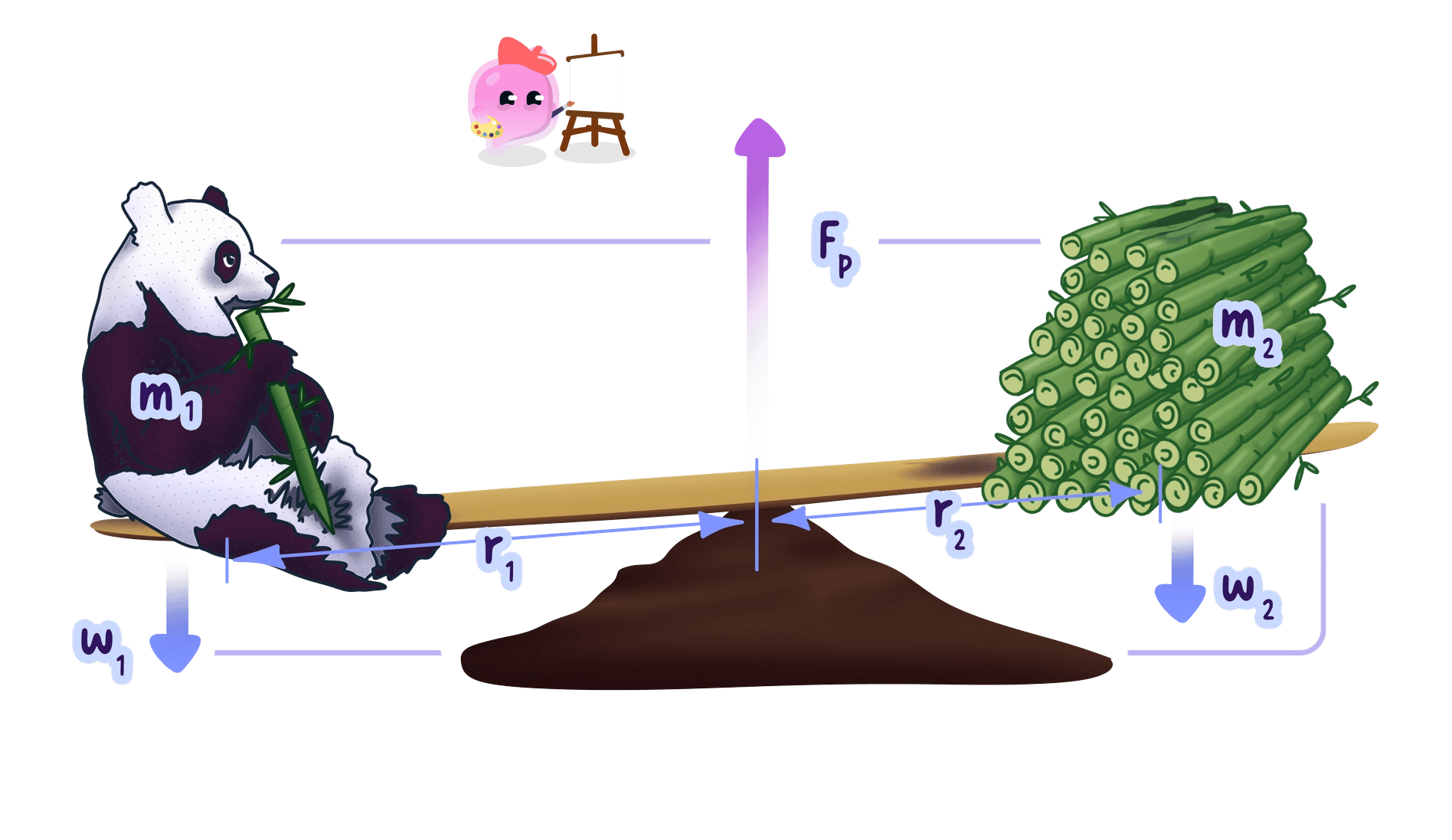
The principle of moments states that for rotational forces in equilibrium, the sum of the clockwise moments about a pivot equals the sum of the anticlockwise moments about that same pivot.
- Every moment turns an object one of two ways about its pivot, either clockwise or anticlockwise.
- The direction is found by picturing which way the object would begin to rotate if that force acted on its own.
- On a seesaw with a central pivot, a weight on the right-hand side produces a clockwise moment and a weight on the left-hand side produces an anticlockwise moment.
- Several forces can turn the object the same way, so a beam may carry two or three clockwise moments at once and they are added together.
- When the total turning effect one way exactly matches the total the other way, there is no resultant moment and the object will not start to rotate.
- The principle of moments states that for rotational forces in equilibrium, sum of clockwise moments=sum of anticlockwise moments\text{sum of clockwise moments} = \text{sum of anticlockwise moments}sum of clockwise moments=sum of anticlockwise moments.
- Every moment in that statement must be taken about the same pivot, because a moment has no meaning until the pivot it turns about has been named.
- Equilibrium here does not mean that there are no moments, only that the clockwise total and the anticlockwise total are equal in size.
- If the two totals are not equal there is a resultant moment, and the object turns in the direction of the larger total.
- The pivot itself pushes on the object, but its line of action passes through the pivot, so it contributes no moment to either total.
Using the principle in a calculation
- Each moment in the sum is worked out from M=F dM = F\,dM=Fd, using the perpendicular distance from the pivot to that particular force.
- The working follows a fixed order.
- Mark the pivot and label every force with its distance from it.
- Decide whether each force turns the object clockwise or anticlockwise.
- Calculate every clockwise moment and add them together.
- Calculate every anticlockwise moment and add them together.
- Set the two totals equal to each other, because the object is in equilibrium.
- Rearrange to find the unknown force or distance, and give the unit.
- When a load is given as a mass, turn it into a weight with W=m gW = m\,gW=mg before taking any moments, using the gravitational field strength stated in the question.
- The weight of a uniform beam acts at its centre of mass, which is the middle of the beam, so the beam's own weight produces a moment whenever the pivot is not at that point.
- A force whose line of action passes through the pivot contributes nothing to either total, so it can be left out of the sum entirely.
- A useful check is that the heavier load always sits closer to the pivot, because a larger force needs a smaller distance to give the same moment.
Balancing a seesaw
- A child of weight 300 N300\ \text{N}300 N sits 1.2 m1.2\ \text{m}1.2 m to the left of the pivot of a seesaw, and a second child of weight 450 N450\ \text{N}450 N sits at an unknown distance ddd to the right, so that the seesaw balances.
- The anticlockwise moment is 300 N×1.2 m=360 N m300\ \text{N} \times 1.2\ \text{m} = 360\ \text{N m}300 N×1.2 m=360 N m.
- The clockwise moment is 450 N×d450\ \text{N} \times d450 N×d.
- Applying the principle of moments gives 450 d=360450\,d = 360450d=360.
- Rearranging gives d=360450=0.80 md = \dfrac{360}{450} = 0.80\ \text{m}d=450360=0.80 m.
- The heavier child sits 0.80 m0.80\ \text{m}0.80 m from the pivot, which is closer in than the lighter child, as expected.
A beam carrying several moments
- A beam rests on a central pivot and carries two loads on the left and two on the right.
- The two left-hand loads produce anticlockwise moments of 18 N m18\ \text{N m}18 N m and 7 N m7\ \text{N m}7 N m.
- One right-hand load produces a clockwise moment of 9 N m9\ \text{N m}9 N m, and the second produces an unknown clockwise moment MMM.
- The anticlockwise total is 18+7=25 N m18 + 7 = 25\ \text{N m}18+7=25 N m.
- The clockwise total is 9+M9 + M9+M.
- Setting the totals equal gives 25=9+M25 = 9 + M25=9+M, so M=16 N mM = 16\ \text{N m}M=16 N m.
- Both totals now come to 25 N m25\ \text{N m}25 N m, which confirms that the beam is in rotational equilibrium.
- Do not compare only one moment on each side when a question gives several forces, because every moment about the pivot belongs in the totals.
- Do not take moments about a different point for each force, since the principle only holds when all the moments are about one named pivot.
- Do not ignore the weight of a heavy uniform beam, because it acts at the centre of mass and produces a moment whenever the pivot is somewhere else.
- Do not describe a balanced beam as having no forces on it, because the pivot pushes upwards with a force equal to the total downward force.
Laying out a moments answer
- State the principle of moments in words or symbols before substituting any numbers into it.
- Label each moment as clockwise or anticlockwise as you calculate it, so the two totals stay separate.
- Keep every distance in metres and every force in newtons, and write N m\text{N m}N m on the final answer.
- Convert a mass into a weight before taking moments, because a mass in kilograms cannot be used in M=F dM = F\,dM=Fd.
- If the question asks why something balances, say that the clockwise and anticlockwise moments about the pivot are equal rather than saying that the forces are equal.
- State the principle of moments in full.
- Explain why every moment in the sum must be taken about the same pivot.
- Explain why a heavier child must sit closer to the pivot of a seesaw in order to balance a lighter one.
- Calculate the distance at which a 200 N200\ \text{N}200 N weight balances a 400 N400\ \text{N}400 N weight placed 0.50 m0.50\ \text{m}0.50 m from the pivot.
- Explain where the weight of a uniform beam acts and when it produces a moment.
9.2.3 Levers and gears
How a lever transmits a turning effect
Lever
A lever is a rigid object that turns about a pivot, so that an input force applied at one point produces an output force at another point.
- A lever is a rigid bar or handle that turns about a pivot, and it carries the turning effect of a force from one place to another.
- The force applied by the user is the input force, sometimes called the effort, and the force the lever applies to the load is the output force.
- The input force acts at a distance from the pivot, so it produces a moment, and it is that moment which is passed along the rigid lever to the load.
- Because a moment is force multiplied by perpendicular distance, applying the input force further from the pivot produces a larger moment for the same effort.
- A lever therefore acts as a force multiplier whenever the input force acts further from the pivot than the load does, so a small input force produces a large output force.
- The gain in force is paid for in distance, because the end you push moves much further than the load moves, so the lever redistributes force and movement rather than creating energy.
- Common levers all work in the same way.
- A crowbar prising up a floorboard, with the pivot at the point resting on the floor.
- A spanner turning a nut, with the pivot at the centre of the nut.
- A bottle opener lifting a cap, with the pivot at the lip resting on the cap.
- A wheelbarrow, with the pivot at the wheel and the load between the wheel and the hands.
- A pair of scissors, which is two levers sharing a single pivot.
- In every case it is the moment of the input force about the pivot that is transmitted, so naming the pivot is the first step in any explanation.
How gears transmit a turning effect
Gear
A gear is a toothed wheel that transmits a turning effect to another gear when their teeth interlock.
- A gear is a toothed wheel, and gears are used in pairs whose teeth interlock so that neither can turn without turning the other.
- The gear that is turned first is the driving gear, and the gear it turns is the driven gear.
- The teeth of the driving gear push on the teeth of the driven gear, and that contact force acts at a distance from the centre of the driven gear, so it produces a moment on it.
- Because the two sets of teeth push each other in opposite directions, two gears that mesh directly always rotate in opposite directions.
- Adding a third gear between them, called an idler gear, reverses the direction a second time, so the first and last gears then turn the same way.
- A small driving gear turning a large driven gear makes the large gear rotate more slowly but with a larger moment, because the force from the teeth acts at a greater distance from its centre.
- A large driving gear turning a small driven gear makes the small gear rotate faster but with a smaller moment.
- Low gear on a bicycle uses exactly this trade off to climb a hill, because a small chain wheel driving a large rear sprocket gives a big turning effect at the wheel at the cost of pedalling faster for less road speed.
- Car gearboxes, hand drills and clock mechanisms all rely on the same exchange between the size of the moment and the rate of rotation.
Force multiplied by a crowbar
- A crowbar is used to lift a floorboard, with the pivot 0.10 m0.10\ \text{m}0.10 m from the board and the hands 0.90 m0.90\ \text{m}0.90 m from the pivot on the other side.
- A downward force of 50 N50\ \text{N}50 N on the handle gives a moment of 50 N×0.90 m=45 N m50\ \text{N} \times 0.90\ \text{m} = 45\ \text{N m}50 N×0.90 m=45 N m about the pivot.
- The board is lifted by the same moment acting on the other side of the pivot, at a distance of 0.10 m0.10\ \text{m}0.10 m.
- Rearranging M=F dM = F\,dM=Fd gives the output force as F=450.10=450 NF = \dfrac{45}{0.10} = 450\ \text{N}F=0.1045=450 N.
- The lever has multiplied the force by nine, which is the ratio of the two distances from the pivot.
Rotation transmitted between two gears
- A driving gear with 101010 teeth meshes with a driven gear with 303030 teeth.
- Three complete turns of the small gear move 303030 teeth past the contact point, so the large gear makes exactly one turn.
- The large gear therefore rotates at one third of the rate of the small gear, and it rotates the opposite way.
- The force between the meshing teeth is the same on both gears, but it acts three times further from the centre of the large gear.
- The moment on the large gear is therefore about three times greater, which is the turning effect gained by rotating more slowly.
- Do not write that a lever or a gear creates force or energy, because both only transmit the turning effect of the force applied to them.
- Do not describe two meshing gears as turning the same way, because directly meshed gears always rotate in opposite directions.
- Do not answer a lever question without naming the pivot, since a moment has no meaning until the pivot is stated.
- Do not claim that a larger gear always gives a larger turning effect at the same rate of rotation, because the gain in moment is paid for by turning more slowly.
Explaining how a turning effect is transmitted
- Build the answer as a chain, moving from the force applied, to its distance from the pivot, to the moment produced, to the output force.
- Name the pivot for a lever, and name the driving gear and the driven gear for a pair of gears.
- Quote the distances or the tooth numbers printed on the diagram instead of writing in general terms about big and small.
- State the change of direction whenever a question mentions direction, because that is usually a separate mark.
- Explain how a lever transmits the rotational effect of an input force to a load.
- Explain why applying the input force further from the pivot reduces the effort needed.
- Describe how the teeth of two gears transmit a turning effect from one to the other.
- State the directions in which two directly meshing gears rotate.
- Explain what happens to the rate of rotation and to the moment when a small gear drives a large one.
