Wave type depends on oscillation direction
Definition
Transverse wave
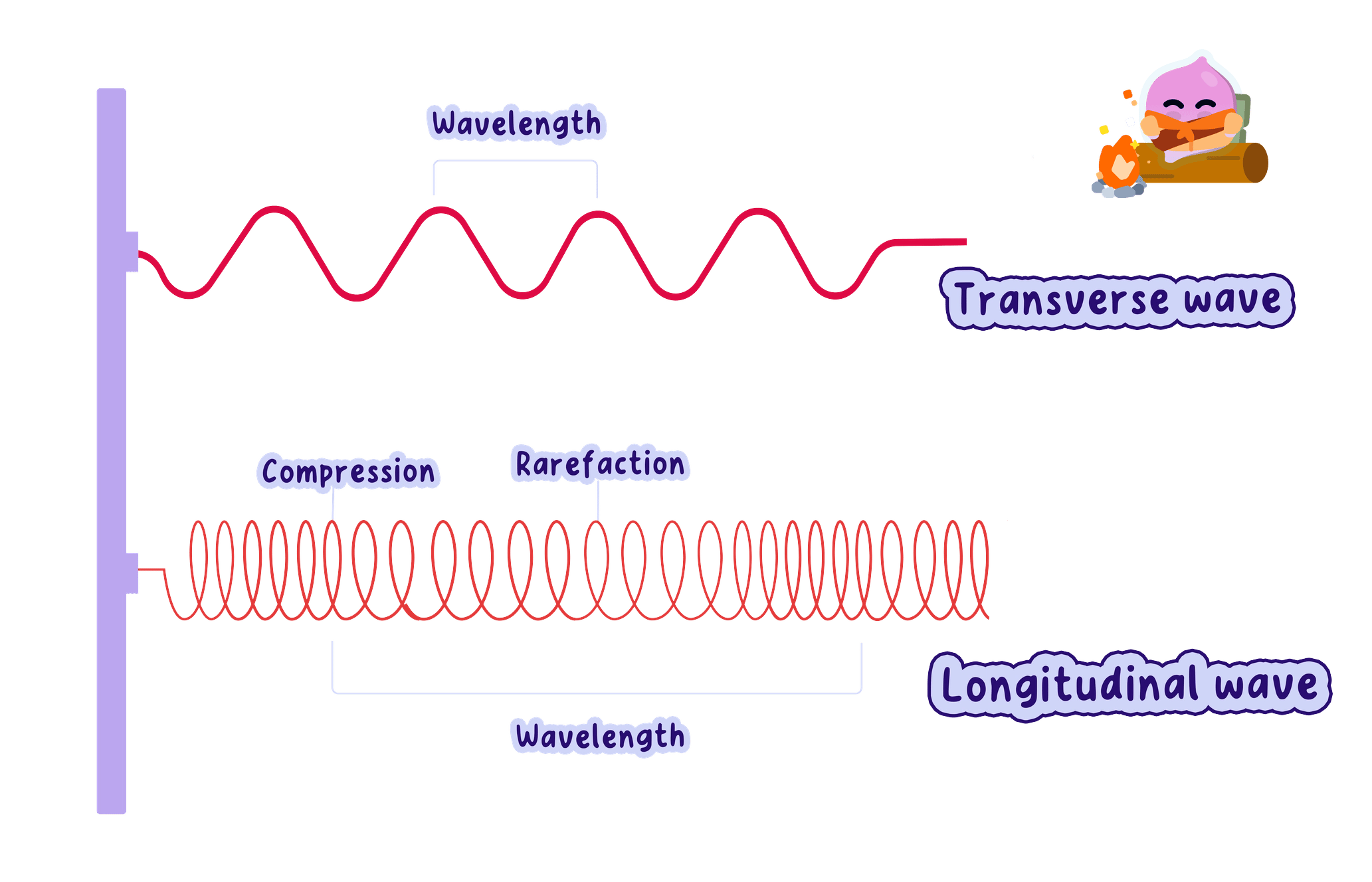
A wave in which the oscillations are perpendicular to the direction of energy transfer.
Definition
Longitudinal wave
A wave in which the oscillations are parallel to the direction of energy transfer.
- Transverse waves have crests and troughs when shown as displacement diagrams.
- Electromagnetic waves, seismic S waves and water surface waves are transverse examples.
- Longitudinal waves contain compressions, where particles are closer together, and rarefactions, where particles are farther apart.
- Sound waves in air and seismic P waves are longitudinal examples.
Compare oscillation with energy transfer
- For a transverse wave, the vibration arrow is at 90∘90^\circ90∘ to the direction of travel.
- For a longitudinal wave, the vibration arrow lies along the direction of travel.
- Both types transfer energy without a net transfer of matter.
Example
Classifying a wave from its motion
- Particles vibrate left and right while the disturbance travels to the right.
- The oscillations are parallel to the direction of energy transfer.
- The wave is longitudinal, with compressions and rarefactions.
Common Mistake
- Do not classify a wave from whether its diagram is curved; compare oscillation direction with energy-transfer direction.
- Sound is longitudinal, while every electromagnetic wave is transverse.
Exam technique
- State perpendicular for transverse waves and parallel for longitudinal waves.
- Pair every named example with its wave type.
Self review
- Define a transverse wave.
- Define a longitudinal wave.
- What are compressions and rarefactions?
- Classify sound, electromagnetic, seismic P and seismic S waves.
- How do water surface particles move relative to energy transfer?
