Wave quantities describe size, spacing and timing
Definition
Frequency
The number of complete waves or oscillations passing a point each second.
Definition
Wavelength
The distance between consecutive points on a wave that are at the same stage of an oscillation.
Definition
Amplitude
The maximum displacement of a point on a wave from its undisturbed position.
- Frequency has symbol fff and unit hertz, Hz\text{Hz}Hz, where 1 Hz1\ \text{Hz}1 Hz means one complete oscillation each second.
- Wavelength has symbol λ\lambdaλ and SI unit metre, m\text{m}m.
- Measure wavelength from crest to crest, trough to trough or compression to compression.
- Measure amplitude from the equilibrium line to a crest or trough.
- The crest-to-trough height is twice the amplitude.
Common Mistake
Do not use the full crest-to-trough height as the amplitude; divide that height by two.
Period is the time for one oscillation
Definition
Period
The time taken for one complete oscillation or for one complete wave to pass a fixed point.
- Period has symbol TTT and SI unit second, s\text{s}s.
- Frequency and period are reciprocals: f=1Tf=\dfrac{1}{T}f=T1 and T=1fT=\dfrac{1}{f}T=f1.
Example
Finding frequency from period
- A wave has period 0.0040 s0.0040\ \text{s}0.0040 s.
- Use f=1Tf=\dfrac{1}{T}f=T1.
- f=10.0040=250 Hzf=\dfrac{1}{0.0040}=250\ \text{Hz}f=0.00401=250 Hz.
Wavefronts join points moving in step
Definition
Wavefront
A line joining points on a wave that are at the same stage of an oscillation.
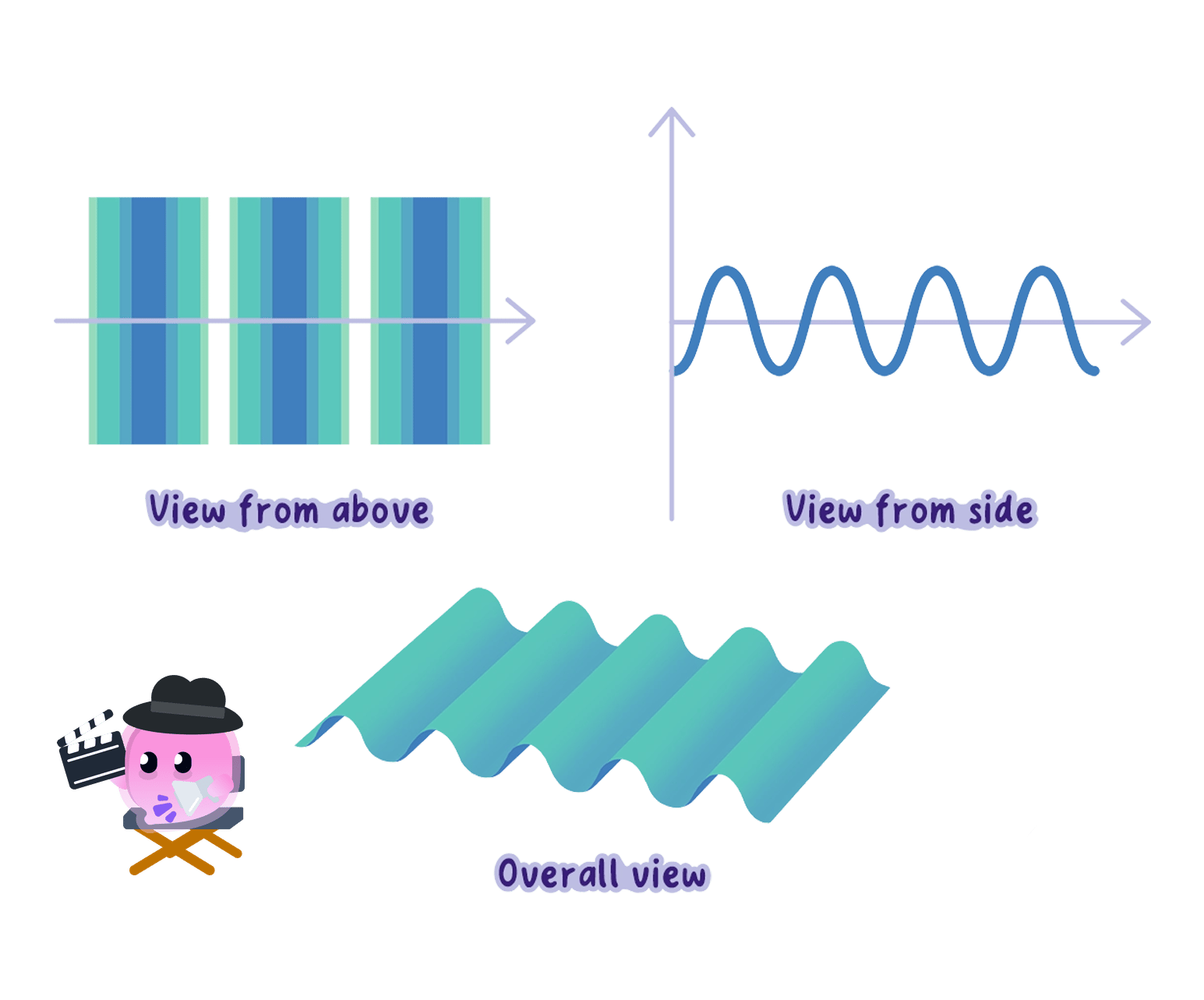
- Neighbouring wavefronts are one wavelength apart, and the direction of travel is perpendicular to the wavefronts.
- A straight source produces plane wavefronts, while a point source produces circular wavefronts.
Exam technique
- Measure between matching points and use the diagram scale.
- Measure across several wavelengths and divide by their number to reduce percentage uncertainty.
Self review
- Define frequency and state its unit.
- Define wavelength and state two valid measurement points.
- Define amplitude.
- State the relationship between frequency and period.
- What does a wavefront represent?
