The kinetic theory model
Definition
Kinetic theory
Kinetic theory is the model that explains the properties of solids, liquids and gases in terms of the separation, arrangement and movement of their particles.
Definition
State of matter
A state of matter is one of the three physical forms in which a substance can exist, namely solid, liquid or gas.
- Every substance is made of an enormous number of tiny particles, which are atoms or molecules.
- The model describes a substance using three features: how far apart the particles are, whether their arrangement is regular or irregular, and how they move.
- Each particle is held near its neighbours by forces of attraction, and the state of a substance depends on how strong those forces are compared with the movement of the particles.
- Particles are far too small to see, so a particle diagram is a model: the circles represent spacing and arrangement, not the true size or shape of an atom.
- The particles themselves are identical in all three states of one substance, so ice, liquid water and steam all contain the same water molecules.
- The model explains observable properties such as shape, volume and flow, and it works for any substance rather than only for one material.
Particles in a solid
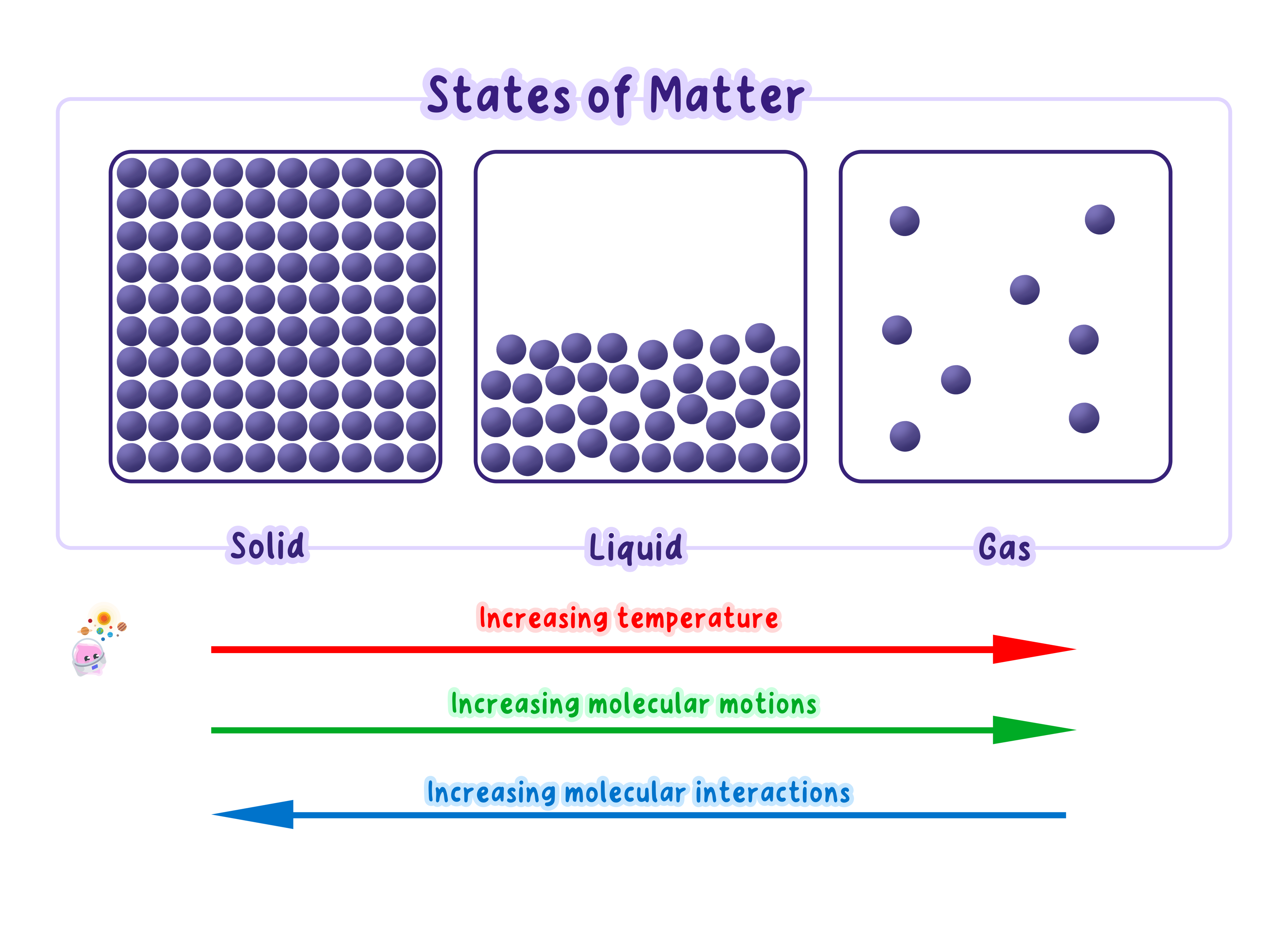
- The particles are packed very close together, so there is almost no empty space between them.
- Their arrangement is regular, which means they sit in a repeating pattern.
- Each particle stays in a fixed position relative to its neighbours and vibrates about that position.
- The forces of attraction between the particles are strong enough to stop the particles moving from place to place.
- A solid therefore has a fixed shape, because its particles cannot slide past one another.
- A solid also has a fixed volume, because the particles are already as close together as the forces between them allow.
- Ice, copper and glass are solids at room temperature.
Particles in a liquid
- The particles are still close together, usually only a little further apart than in the solid.
- Their arrangement is irregular, so there is no repeating pattern.
- The particles move continuously and slide past one another instead of staying in fixed positions.
- A liquid has a fixed volume, because the forces between the particles still hold them close together.
- A liquid has no fixed shape, so it flows and takes the shape of the part of the container it fills.
- Pouring a liquid into a wider container gives a shallower depth, but the volume of liquid is unchanged.
- Water and cooking oil are liquids at room temperature.
Particles in a gas
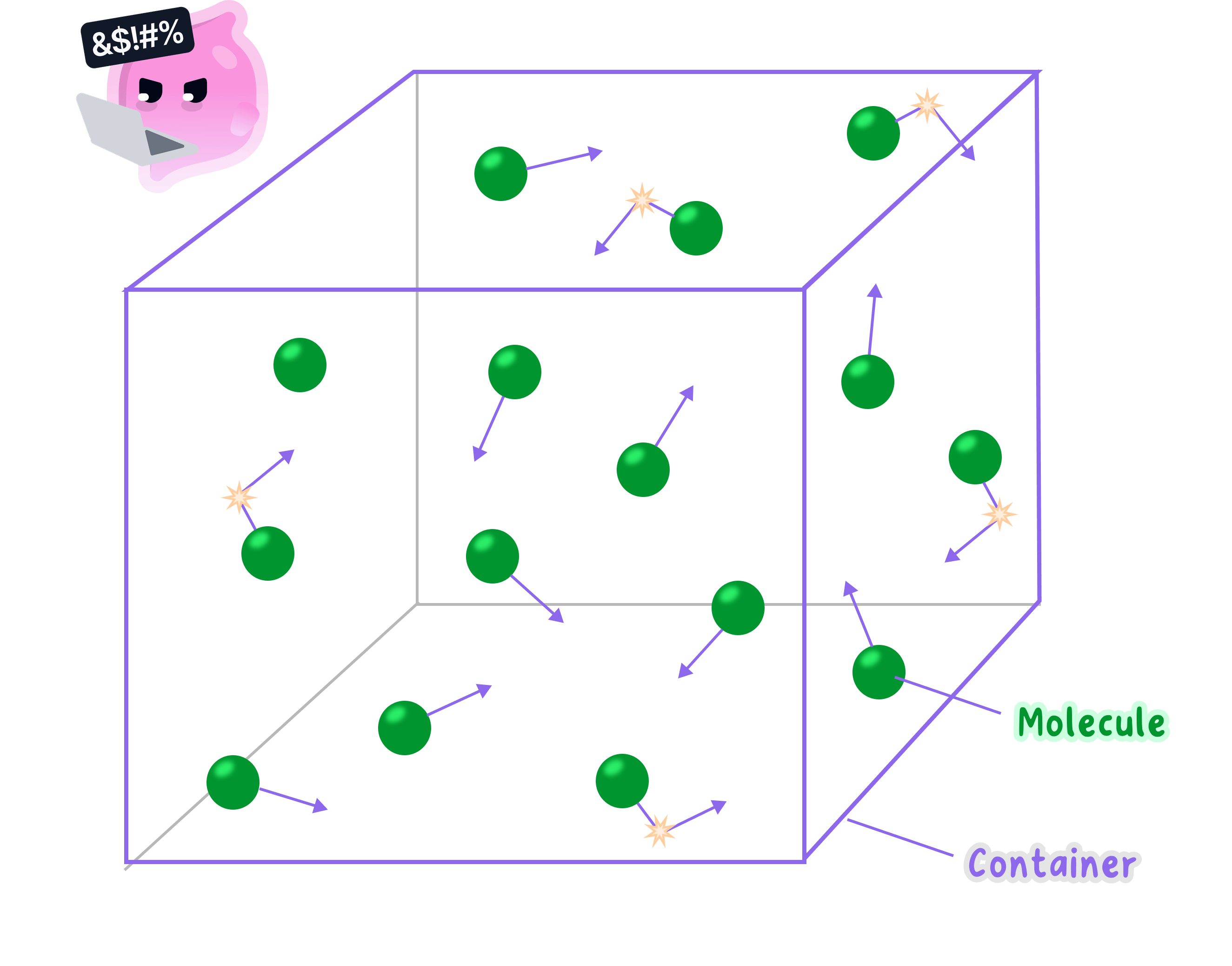
- The particles are widely spaced, so most of the volume occupied by a gas is empty space.
- Their arrangement is random and it changes from moment to moment.
- The particles move rapidly and randomly in all directions, travelling in straight lines between collisions.
- The forces of attraction between the particles are very weak, because the particles spend most of their time far apart.
- A gas has no fixed shape and no fixed volume, so it spreads out until it fills the whole of its container.
- Oxygen and carbon dioxide are gases at room temperature.
Comparing the three states
- Separation increases from solid to liquid to gas, and the step from liquid to gas is much the larger of the two.
- Order falls from regular in a solid, to irregular in a liquid, to random in a gas.
- Movement changes from vibration about fixed positions, to sliding past neighbours, to free motion in all directions.
- A fixed shape needs particles locked in place, so only a solid has one.
- A fixed volume needs particles held close together, so solids and liquids have one but gases do not.
Example
Explaining a property from particles
- A steel spanner keeps the same shape when it is picked up and put down.
- Its particles are close together in a regular arrangement and only vibrate about fixed positions, so they cannot move past one another.
- Water poured from a jug into a glass changes shape but not volume.
- Its particles stay close together, which fixes the volume, but they slide past one another, which lets the liquid take the shape of the glass.
- Air let out of a balloon spreads through the whole room.
- Its particles move rapidly and randomly in all directions and are only weakly attracted to one another, so they travel throughout the space available.
Exam technique
Answering particle questions
- Give both the arrangement and the movement of the particles, because a separate mark is usually available for each.
- Join the particle detail to the observable property with a linking word such as so or therefore, since the explanation mark depends on the link.
- Describe both states when a question asks you to compare, because an answer about only one state cannot reach full marks.
- Write vibrate about fixed positions for a solid, which is the wording that earns the movement mark.
- Label a particle diagram with the state it shows, and keep the circles the same size in all three diagrams.
Common Mistake
- Do not write that the particles in a solid are stationary, because they vibrate about fixed positions.
- Do not draw gas particles bigger than solid particles, because it is the spacing that changes and not the particles.
- Do not write that a liquid has no fixed volume, because a liquid has a fixed volume and only its shape changes.
- Do not treat a particle diagram as a photograph, because it shows spacing and arrangement rather than real particle shapes.
Self review
- Name the three features of a substance that the kinetic theory model describes.
- Describe the arrangement and the movement of the particles in a liquid.
- Explain why a gas fills its container but a liquid does not.
- Explain why a solid has both a fixed shape and a fixed volume.
- State what a particle diagram represents and what it does not represent.
