Counting half-lives
Definition
Half-life
The half-life of a radioactive isotope is the time taken for half the undecayed nuclei in a sample to decay, or for the activity of a source to fall by half.
Definition
Undecayed nuclei
Undecayed nuclei are the nuclei in a sample that have not yet decayed at a given moment.
- Every half-life calculation turns on one number: how many half-lives have passed.
- The number of half-lives is n=tt1/2n = \dfrac{t}{t_{1/2}}n=t1/2t, where ttt is the total elapsed time and t1/2t_{1/2}t1/2 is the half-life.
- Both times must be in the same unit before dividing, so a time given in hours and a half-life given in minutes must be converted first.
- Each half-life multiplies whatever is left by 12\dfrac{1}{2}21, so after nnn half-lives the fraction remaining is (12)n=12n\left(\dfrac{1}{2}\right)^{n} = \dfrac{1}{2^{n}}(21)n=2n1.
- It is worth knowing the first few values by sight: 12\dfrac{1}{2}21, 14\dfrac{1}{4}41, 18\dfrac{1}{8}81, 116\dfrac{1}{16}161, 132\dfrac{1}{32}321, 164\dfrac{1}{64}641 for n=1n = 1n=1 to 666.
- The same fraction applies whether the quantity being tracked is the activity, the count rate or the number of undecayed nuclei, because all three fall together in proportion.
- For activity, this gives A=A0×(12)nA = A_{0} \times \left(\dfrac{1}{2}\right)^{n}A=A0×(21)n, where A0A_{0}A0 is the starting activity and AAA is the activity after nnn half-lives.
- For nuclei, the same relationship is N=N0×(12)nN = N_{0} \times \left(\dfrac{1}{2}\right)^{n}N=N0×(21)n.
- The fraction that has decayed is whatever is left over, so it is 1−12n1 - \dfrac{1}{2^{n}}1−2n1; after 333 half-lives, 18\dfrac{1}{8}81 remains and 78\dfrac{7}{8}87 has decayed.
- Reading the question carefully matters here, because it may ask for the amount remaining, the amount decayed, or the ratio between them, and these are three different answers.
The four question types
- Type one: find the amount left after a given time. Work out nnn, then halve the starting value nnn times, or multiply it by 12n\dfrac{1}{2^{n}}2n1.
- Type two: find the time for a given fall. Count how many halvings take the starting value to the final value, then multiply that count by the half-life, since t=n×t1/2t = n \times t_{1/2}t=n×t1/2.
- Type three: find the half-life. Count the halvings between the two given values to get nnn, then divide the elapsed time by it, since t1/2=tnt_{1/2} = \dfrac{t}{n}t1/2=nt.
- Type four: express the fall as a ratio. Give the answer in the form final to initial, such as 1:81 : 81:8, or as the fraction 18\dfrac{1}{8}81, whichever the question asks for.
- When nnn is not a whole number, halving repeatedly will not reach the answer exactly, and the value must be read from a graph instead.
- Working in whole halvings is the quickest and safest route whenever the numbers allow it, because it needs no power key on the calculator.
Example
Finding the activity after a given time
- A source has a starting activity of 6400 Bq6400\ \text{Bq}6400 Bq and a half-life of 151515 minutes, and the activity after 111 hour is required.
- Converting to a common unit gives t=60t = 60t=60 minutes and t1/2=15t_{1/2} = 15t1/2=15 minutes.
- The number of half-lives is n=6015=4n = \dfrac{60}{15} = 4n=1560=4.
- The fraction remaining is 124=116\dfrac{1}{2^{4}} = \dfrac{1}{16}241=161.
- Substituting gives A=6400×116=400 BqA = 6400 \times \dfrac{1}{16} = 400\ \text{Bq}A=6400×161=400 Bq.
- Halving four times checks this: 6400→3200→1600→800→400 Bq6400 \rightarrow 3200 \rightarrow 1600 \rightarrow 800 \rightarrow 400\ \text{Bq}6400→3200→1600→800→400 Bq.
Example
Finding the half-life from two readings
- A count rate falls from 960960960 counts per second to 606060 counts per second in 121212 hours, and the half-life is required.
- Halving from the start gives 960→480→240→120→60960 \rightarrow 480 \rightarrow 240 \rightarrow 120 \rightarrow 60960→480→240→120→60 counts per second.
- That is four halvings, so n=4n = 4n=4.
- Substituting into t1/2=tnt_{1/2} = \dfrac{t}{n}t1/2=nt gives t1/2=124=3t_{1/2} = \dfrac{12}{4} = 3t1/2=412=3 hours.
- Checking the fraction confirms it: 60960=116=124\dfrac{60}{960} = \dfrac{1}{16} = \dfrac{1}{2^{4}}96060=161=241, which needs exactly four half-lives.
Example
Finding the time for a given fall
- An isotope has a half-life of 888 days, and the time for its activity to fall to one eighth of its starting value is required.
- Writing the fraction as a power of a half gives 18=123\dfrac{1}{8} = \dfrac{1}{2^{3}}81=231, so n=3n = 3n=3.
- Substituting into t=n×t1/2t = n \times t_{1/2}t=n×t1/2 gives t=3×8=24t = 3 \times 8 = 24t=3×8=24 days.
- Stated as a ratio, the activity has changed from 888 to 111, so the final to initial ratio is 1:81 : 81:8.
- The fraction that has decayed is 1−18=781 - \dfrac{1}{8} = \dfrac{7}{8}1−81=87 of the original nuclei.
Example
Working with a number of nuclei
- A sample starts with 4.8×10124.8 \times 10^{12}4.8×10¹² undecayed nuclei of an isotope whose half-life is 252525 years, and the number left after a century is required.
- The number of half-lives is n=10025=4n = \dfrac{100}{25} = 4n=25100=4.
- The fraction remaining is 124=116\dfrac{1}{2^{4}} = \dfrac{1}{16}241=161.
- Substituting gives N=4.8×1012×116=3.0×10¹¹N = 4.8 \times 10^{12} \times \dfrac{1}{16} = 3.0 \times 10^{11}N=4.8×1012×161=3.0×10¹¹.
- The number that has decayed is 4.8×10¹²−3.0×1011=4.5×10124.8 \times 10^{12} - 3.0 \times 10^{11} = 4.5 \times 10^{12}4.8×10¹²−3.0×1011=4.5×10¹².
- Keeping the answer in standard form avoids a power of ten error, which is the commonest slip in questions of this kind.
Reading a decay curve
Definition
Decay curve
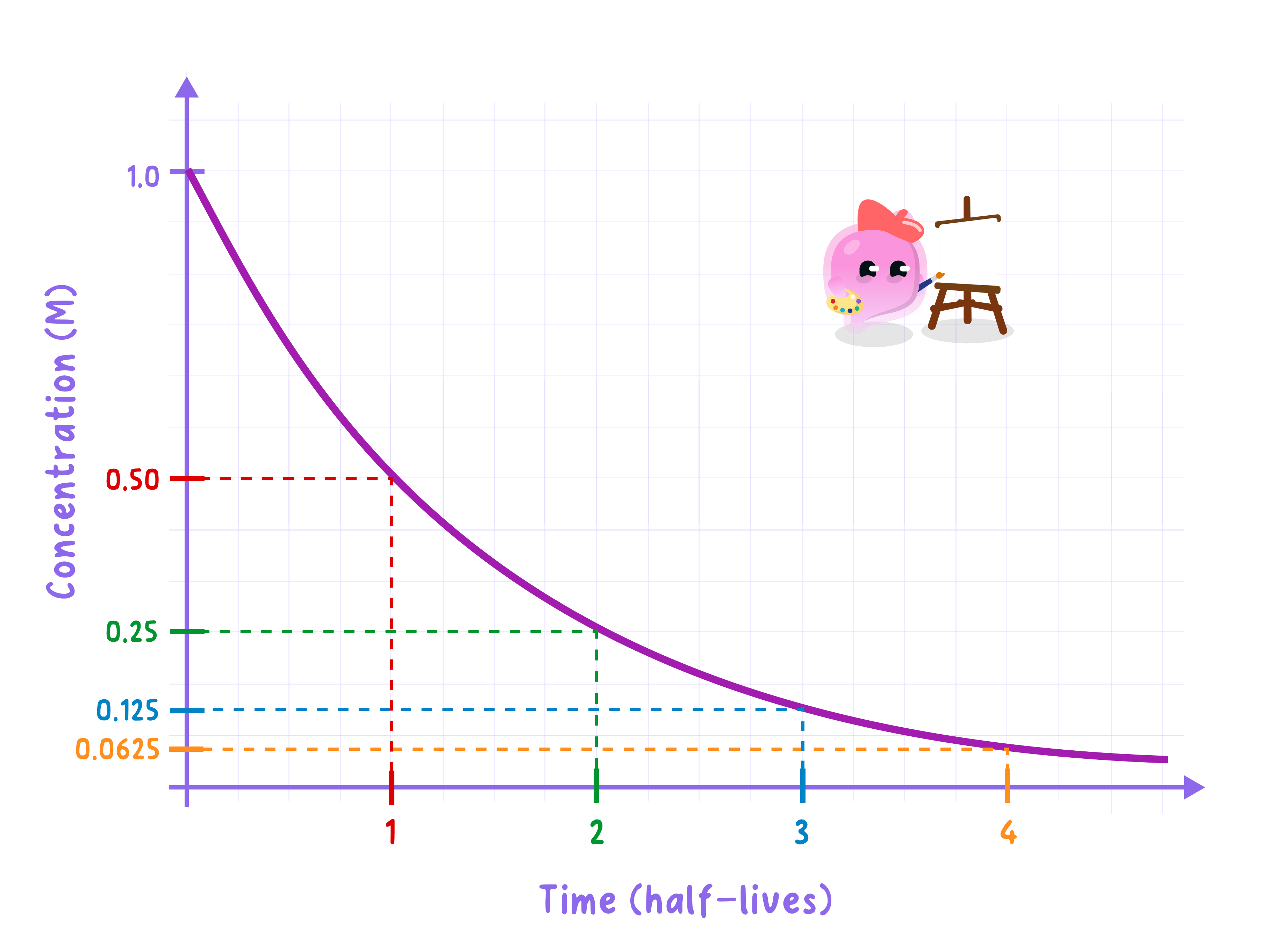
A decay curve is a graph of activity, count rate or number of undecayed nuclei against time for a radioactive source.
- A decay curve plots activity, count rate or number of undecayed nuclei on the vertical axis against time on the horizontal axis.
- Start by reading the value on the vertical axis at t=0t = 0t=0, which is the starting value A0A_{0}A0.
- Halve that value, find the halved value on the vertical axis, and draw a horizontal construction line across to the curve.
- From that meeting point, drop a vertical construction line down to the time axis and read off the time, which is the half-life.
- Repeat the same steps starting from a different point on the curve, for instance from the half value down to the quarter value, and check that the two times agree.
- Averaging two or three such readings gives a better value than one, because the curve is drawn through scattered points.
- Leave the construction lines on the graph, since they show the method and are what a marker looks for.
- Where the vertical axis is a count rate, subtract any background count rate the question supplies before halving, otherwise the halving is applied to the wrong starting value.
- To read the value at a time between plotted points, go up from the time axis to the curve and across, rather than trying to calculate it.
Example
Taking a half-life from a graph
- A decay curve of count rate against time starts at 808080 counts per second at t=0t = 0t=0.
- Half of 808080 is 404040, so a horizontal line is drawn from 404040 on the vertical axis across to the curve.
- Dropping a vertical line from that point meets the time axis at 666 minutes, giving a first half-life value of 666 minutes.
- For a second reading, half of 404040 is 202020, and the same construction gives a time of 121212 minutes.
- The interval between the two readings is 12−6=612 - 6 = 612−6=6 minutes, which agrees with the first value.
- Since both readings give 666 minutes, the half-life is 666 minutes.
Exam technique
Setting out a half-life calculation
- Show the number of half-lives as a separate line of working, because nnn is usually worth a mark of its own.
- Print the substitution with the numbers in it, such as A=6400×116A = 6400 \times \dfrac{1}{16}A=6400×161, rather than only the rearranged formula.
- Convert both times into the same unit before dividing, and state the unit you converted to.
- Give the unit with the final answer, since a bare number can be marked down where the unit carries a mark.
- Write out the successive halvings when the numbers are friendly, because each halving is visible working that can earn credit if the final value slips.
- Answer the question that was asked: remaining, decayed, or a ratio are three different answers from the same value of nnn.
- For a graph question, draw and leave the construction lines, and take two readings from different parts of the curve.
- Keep large or small numbers in standard form throughout, because a power of ten error can cost every mark after it.
Common Mistake
- Do not multiply the starting value by nnn or divide it by 2n2n2n, because each half-life multiplies what is left by 12\dfrac{1}{2}21 and the effect compounds.
- Do not assume the activity is zero once several half-lives have passed, because a fraction always remains.
- Do not divide the elapsed time by the half-life and then treat the result as the answer, because that quotient is nnn and not the activity.
- Do not give the fraction remaining when the question asks for the fraction that has decayed, since the two add to 111.
- Do not read a half-life from a graph without halving the starting value first, because the interval must run between a value and its half.
- Do not forget to subtract a stated background count rate before halving, or the starting value will be too high.
- Do not mix units, because a half-life in minutes with a time in hours gives an answer wrong by a factor of 606060.
Self review
- Write the equation linking the number of half-lives, the elapsed time and the half-life.
- What fraction of the original nuclei remains after 555 half-lives?
- A source of activity 1200 Bq1200\ \text{Bq}1200 Bq has a half-life of 202020 minutes. What is its activity after 111 hour?
- A count rate falls from 640640640 to 404040 counts per second in 181818 hours. What is the half-life?
- An isotope has a half-life of 555 days. How long does its activity take to fall to one sixteenth of its starting value?
- Describe how to find a half-life from a graph of count rate against time.
- After 444 half-lives, what fraction of the original nuclei has decayed?
