Definition
Gravitational potential energy
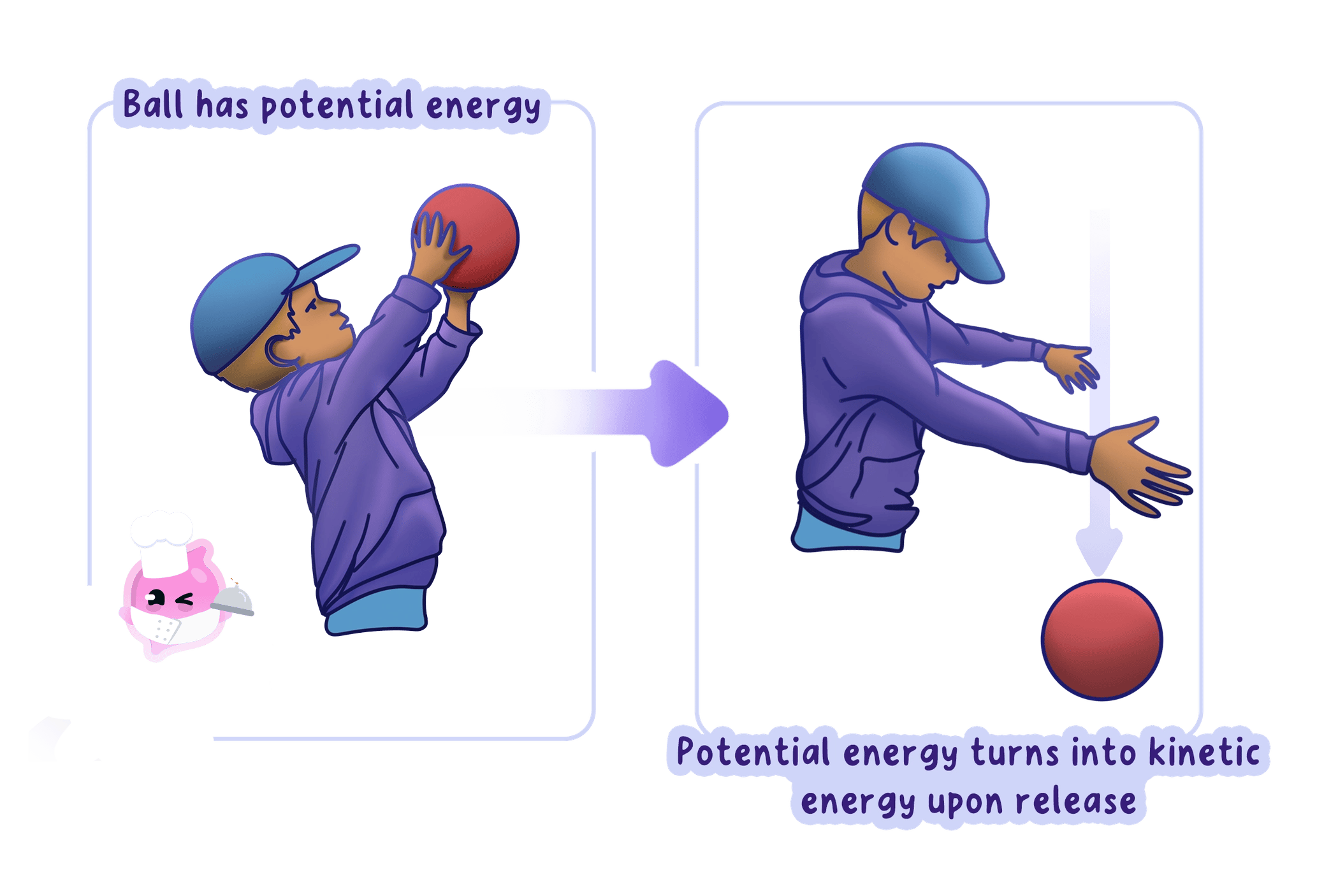
Gravitational potential energy is energy stored by an object because of its position in a gravitational field.
- Raising an object transfers energy to its gravitational store. A force must act upwards while the object moves through a vertical height.
- Lowering or falling transfers energy out of the gravitational store. The energy may enter a kinetic store or be dissipated by air resistance and deformation.
Calculating the energy change
Definition
Gravitational field strength
Gravitational field strength is the force per unit mass acting on an object placed in a gravitational field, measured in newtons per kilogram (N/kg).
- Use ΔEg=mgΔh\Delta E_{\mathrm{g}}=mg\Delta hΔEg=mgΔh. Here mmm is mass in kg\text{kg}kg, ggg is gravitational field strength in N kg−1\text{N kg}^{-1}N kg−1, and Δh\Delta hΔh is the change in vertical height in m\text{m}m.
- The answer is measured in joules. The units combine as kg×N kg−1×m=N m=J\text{kg}\times\text{N kg}^{-1}\times\text{m}=\text{N m}=\text{J}kg×N kg−1×m=N m=J.
- Use vertical height, not distance travelled. Moving up a slope changes gravitational potential energy according to the vertical rise only.
- The sign describes the direction of the energy change. A rise gives Δh>0\Delta h>0Δh>0 and an increase in gravitational potential energy, while a fall gives Δh<0\Delta h<0Δh<0 and a decrease.
- Near Earth's surface, use the stated value of ggg. If no value is supplied in an Edexcel GCSE calculation, g=10 N kg−1g=10\ \text{N kg}^{-1}g=10 N kg−1 is normally used.
Example
Lifting an object
- Situation: a 12 kg12\ \text{kg}12 kg crate is lifted vertically by 1.8 m1.8\ \text{m}1.8 m where g=10 N kg−1g=10\ \text{N kg}^{-1}g=10 N kg−1.
- Substitution: ΔEg=12×10×1.8\Delta E_{\mathrm{g}}=12\times10\times1.8ΔEg=12×10×1.8.
- Energy change: ΔEg=216 J\Delta E_{\mathrm{g}}=216\ \text{J}ΔEg=216 J.
Example
Rearranging for height
- Situation: a 55 kg55\ \text{kg}55 kg gymnast gains 2695 J2695\ \text{J}2695 J of gravitational potential energy where g=9.8 N kg−1g=9.8\ \text{N kg}^{-1}g=9.8 N kg−1.
- Rearrangement: Δh=ΔEgmg\Delta h=\dfrac{\Delta E_{\mathrm{g}}}{mg}Δh=mgΔEg.
- Height gained: Δh=269555×9.8=5.0 m\Delta h=\dfrac{2695}{55\times9.8}=5.0\ \text{m}Δh=55×9.82695=5.0 m.
Exam technique
Using the equation accurately
- Write the equation before substituting values.
- Convert mass to kilograms and height to metres.
- Select the change in vertical height from a diagram rather than the length of a ramp.
- Give the final energy change in joules and include a sensible number of significant figures.
Common Mistake
- Do not use weight in newtons for mmm. The equation requires mass in kilograms.
- Do not use total height when the object starts above ground. Use Δh=hfinal−hinitial\Delta h=h_{\mathrm{final}}-h_{\mathrm{initial}}Δh=hfinal−hinitial.
- Do not write ggg in m s−1\text{m s}^{-1}m s−1. Gravitational field strength is measured in N kg−1\text{N kg}^{-1}N kg−1.
Self review
- What is gravitational potential energy?
- What does each symbol mean in ΔEg=mgΔh\Delta E_{\mathrm{g}}=mg\Delta hΔEg=mgΔh?
- Why is the length of a slope not used as Δh\Delta hΔh?
- What sign does ΔEg\Delta E_{\mathrm{g}}ΔEg have when an object falls?
