14.3.1 Gas pressure and particle motion
Where gas pressure comes from
Gas pressure
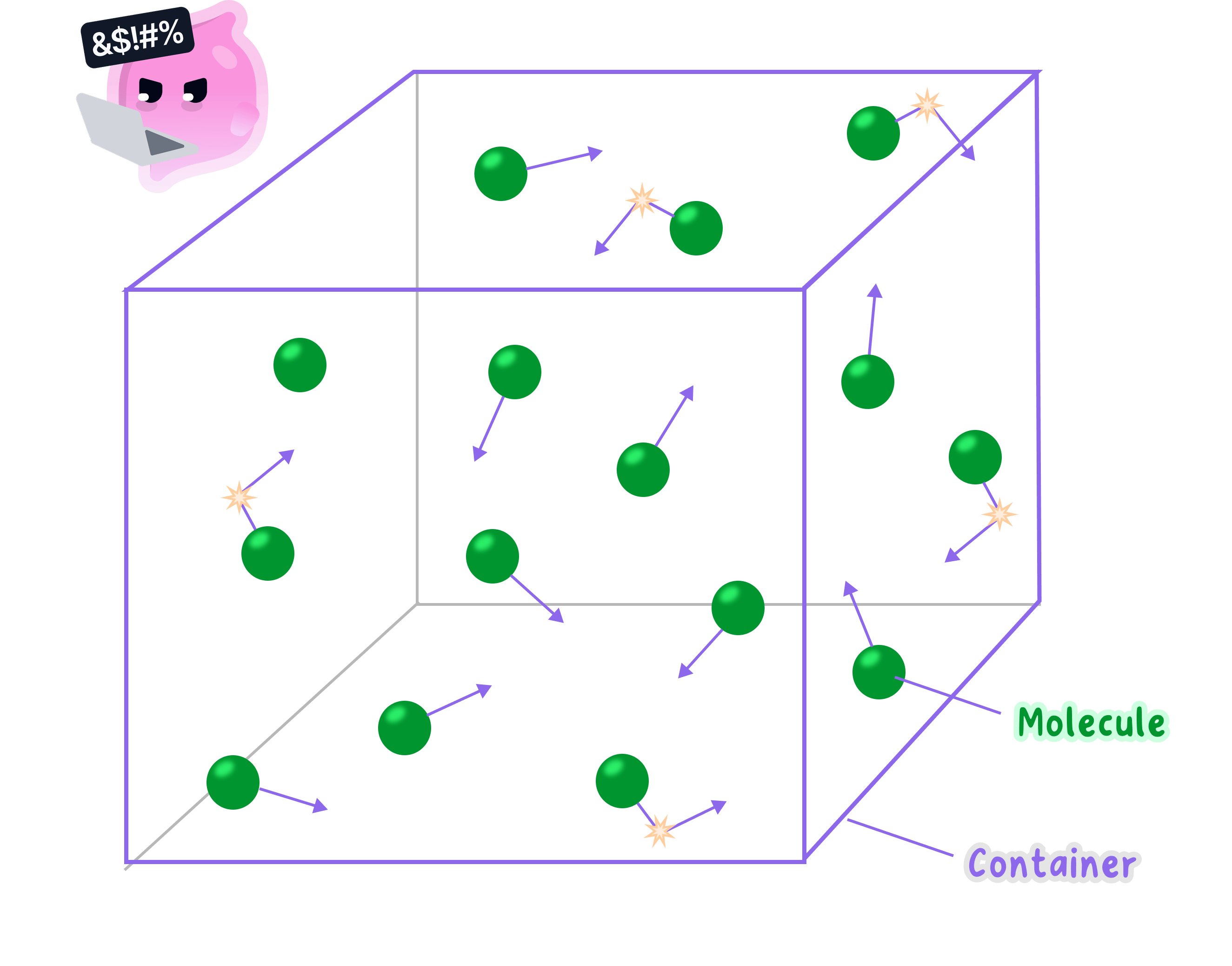
Gas pressure is the force per unit area that gas particles exert on a surface as a result of their collisions with it.
- The particles of a gas move rapidly and randomly in all directions, and they have a wide spread of speeds rather than all moving at one speed.
- Between collisions each particle travels in a straight line, because the forces between widely separated gas particles are very weak.
- When a particle reaches a wall it collides with it and rebounds, so the direction of its motion is reversed.
- Changing the direction of a moving particle requires a force from the wall, and the particle exerts an equal and opposite force back on the wall.
- One collision gives an extremely small force lasting an extremely short time, so a single particle produces no measurable effect.
- A gas contains an enormous number of particles, so an enormous number of collisions happen on every part of the wall every second.
- Those separate impacts add up to a steady total force on the wall rather than a series of noticeable jolts.
- The pressure of the gas is that total force spread over the area of the surface it acts on.
What the pressure depends on
- Two features of the collisions set the pressure: how often particles hit the wall, and how hard each one hits it.
- Faster particles hit the wall harder and rebound more forcefully, so each collision contributes more to the total force.
- Adding more particles to the same container increases the number of collisions each second, which is why a bicycle tyre becomes harder as it is pumped up.
- Removing particles has the opposite effect, so a gas at low pressure produces fewer collisions each second on the same area of wall.
- Because the motion is random, particles reach every part of the container, so the pressure acts on the whole inner surface and not only on the base.
- The pressure inside a small container of gas is effectively the same at every point in it, unlike the pressure in a liquid, which increases with depth.
- Atmospheric pressure at sea level is about 1.0×10⁵ Pa1.0\times10^{5}\ \text{Pa}1.0×10⁵ Pa, produced by air particles colliding with every exposed surface.
Pressure, force and area
- Pressure is defined by p=FAp=\dfrac{F}{A}p=AF, where ppp is the pressure, FFF is the force acting on the surface and AAA is the area of that surface.
- The units are pascals for pressure, newtons for force and square metres for area, and 1 Pa=1 N/m21\ \text{Pa}=1\ \text{N/m}^{2}1 Pa=1 N/m2.
- Rearranging gives F=p×AF=p\times AF=p×A, which is how the force on a piston, a window or a wall is worked out from the pressure.
- The same pressure produces a larger force on a larger area, so a wide door in a pressurised cabin experiences a very large total force.
- Convert areas into square metres before substituting, because 1 cm2=1×10⁻⁴ m21\ \text{cm}^{2}=1\times10^{-4}\ \text{m}^{2}1 cm2=1×10⁻⁴ m2.
Force produced by a gas on a piston
- A gas at a pressure of 1.5×10⁵ Pa1.5\times10^{5}\ \text{Pa}1.5×10⁵ Pa acts on a piston of area 2.0×10⁻³ m22.0\times10^{-3}\ \text{m}^{2}2.0×10⁻³ m2.
- Rearranging p=FAp=\dfrac{F}{A}p=AF gives F=p×AF=p\times AF=p×A.
- Substituting gives F=1.5×105×2.0×10−3F=1.5\times10^{5}\times2.0\times10^{-3}F=1.5×105×2.0×10−3.
- The force on the piston is F=300 NF=300\ \text{N}F=300 N.
- That force is the combined effect of countless particle collisions with the piston every second.
Explaining gas pressure
- Build the answer as a chain: random motion, collisions with the wall, a force on the wall, then force divided by area.
- Use the word collisions explicitly, because an answer that only says the particles push on the wall misses the mechanism mark.
- Say that there are very many collisions each second, since the step from one tiny force to a steady pressure depends on that number.
- Mention both how often and how hard the particles hit when a question asks what the pressure depends on.
- Write p=FAp=\dfrac{F}{A}p=AF before substituting, and convert any area given in square centimetres into square metres.
- Do not write that gas particles push on the walls all the time, because the force comes from separate collisions.
- Do not write that particles repel one another to create the pressure, because the forces between widely separated gas particles are negligible.
- Do not confuse force with pressure, because the same force spread over a larger area gives a smaller pressure.
- Do not say the gas pushes hardest on the bottom of the container, because the random motion sends particles to every wall equally.
- Describe how the particles of a gas move.
- Explain how the collisions of gas particles produce a force on a container wall.
- State the two features of the collisions that decide the pressure.
- State the equation that links pressure, force and area, with the unit of each quantity.
- Calculate the force produced by a pressure of 2.0×10⁵ Pa2.0\times10^{5}\ \text{Pa}2.0×10⁵ Pa on an area of 0.010 m20.010\ \text{m}^{2}0.010 m2.
- Explain why the pressure on a container wall is steady rather than jerky.
14.3.2 Temperature and pressure at constant volume
Temperature and particle speed
Temperature
Temperature is a measure of the average kinetic energy of the particles in a substance.
Gas pressure
Gas pressure is the force per unit area that gas particles exert on a surface as a result of their collisions with it.
- The temperature of a gas is a measure of the average kinetic energy of its particles.
- Heating a gas increases that average kinetic energy, and since the mass of each particle cannot change, the average speed of the particles increases.
- The particles never all move at the same speed, so temperature describes the average of a wide spread of speeds.
- Raising the temperature shifts that whole spread of speeds upwards, so a larger share of the particles are moving quickly.
- Cooling a gas reduces the average kinetic energy, so the average speed of the particles falls.
- The direction of each particle stays random at every temperature, so warming a gas makes the motion faster rather than more organised.
Heating a gas at constant volume
- A fixed mass of gas in a sealed rigid container has the same number of particles and the same volume throughout, so nothing but the temperature is changing.
- Raising the temperature increases the average speed of the particles.
- Faster particles cross the container in less time, so they reach the walls more often and the number of collisions each second increases.
- Faster particles also rebound more forcefully, so each individual collision exerts a larger force on the wall.
- Both effects push in the same direction, so the total force on the walls increases.
- The area of the walls has not changed, so a greater total force on the same area means a greater pressure.
- The pressure keeps climbing for as long as the temperature keeps rising, and the container can eventually fail if the pressure grows too large.
Cooling a gas at constant volume
- Lowering the temperature of the same sealed container reduces the average speed of the particles.
- Slower particles take longer to cross the container, so they collide with the walls less often.
- Each collision also exerts a smaller force, because the particles arrive at the wall more slowly.
- The total force on the walls therefore falls, and with the area unchanged the pressure falls too.
- The relationship works both ways, so a measurement of pressure in a sealed rigid container can be used to tell you the temperature of the gas inside it.
Everyday situations
- An aerosol can carries a warning against heating it, because the metal cannot expand, so heating the gas raises the pressure until the can bursts.
- A pressure cooker traps steam in a fixed volume, so heating raises the pressure inside and the water boils at a temperature above 100 ∘C100\,^\circ\text{C}100∘C.
- Car tyres read a higher pressure at the end of a long motorway journey, because friction and flexing have warmed the air inside them.
- The same tyres read a lower pressure on a cold winter morning, which is why they should be checked when they are cold.
- A sealed glass jar taken straight from a hot dishwasher becomes hard to open once it cools, because the pressure of the trapped air inside has dropped below atmospheric pressure.
A gas cylinder left in the sun
- A sealed rigid steel cylinder of gas is left outside and warms from 15 ∘C15\,^\circ\text{C}15∘C to 45 ∘C45\,^\circ\text{C}45∘C.
- The cylinder is rigid and sealed, so the volume of the gas and the number of particles in it are both unchanged.
- The average kinetic energy of the particles increases, so their average speed increases.
- The particles reach the walls more often, so more collisions happen on each square metre every second.
- Each collision exerts a larger force, because the particles rebound more forcefully.
- The total force on the same wall area is greater, so the pressure inside the cylinder rises.
Writing the pressure chain
- Open by saying that the volume and the number of particles are constant, because that sets up the rest of the answer.
- Follow the chain in order: average kinetic energy, average speed, rate of collisions, force per collision, total force, pressure.
- Give both collision effects, because most candidates mention the frequency of collisions and forget that each collision is also harder.
- Use the phrase collisions per second rather than more collisions, since a rate is what actually changes.
- Keep the answer in words, because this relationship is examined qualitatively and no calculation is expected.
- Do not write that the particles expand or grow when a gas is heated, because their size never changes.
- Do not write that the gas takes up more space here, because the container is rigid and the volume is fixed.
- Do not say more particles are produced, because a fixed mass of gas keeps the same number of particles throughout.
- Do not stop at the particles moving faster, because the marks are for the collisions and the force that follow from that.
- Explain what happens to the average speed of gas particles when the gas is heated.
- Explain why the pressure of a fixed mass of gas rises when it is heated at constant volume.
- State the two ways in which the collisions change when the temperature rises.
- Explain why the pressure in a sealed rigid container falls when it is cooled.
- Explain why an aerosol can must not be thrown onto a fire.
- Explain why car tyre pressures should be checked when the tyres are cold.
14.3.3 Absolute zero and the kelvin scale
Absolute zero
Absolute zero
Absolute zero is the lowest temperature possible, at which the particles of a substance have the least kinetic energy they can have and stop moving.
- Cooling a substance reduces the average kinetic energy of its particles, so the particles move or vibrate more slowly.
- Kinetic energy cannot fall below zero, so there is a lowest possible temperature that no amount of further cooling can get past.
- At that temperature the particles have the least kinetic energy they can possibly have, so their movement effectively stops.
- This temperature is called absolute zero, and on the Celsius scale it is −273 ∘C-273\,^\circ\text{C}−273∘C.
- Nothing can be cooled below absolute zero, because there is no state of motion slower than no motion at all.
- A gas at absolute zero would exert no pressure, since particles that are not moving cannot collide with the walls of a container.
- Absolute zero has never been reached in practice, although research laboratories have cooled small samples to within a tiny fraction of a degree of it.
- The value of absolute zero is the same for every substance, because it describes the movement of particles rather than a property of one material.
The kelvin scale
Kelvin scale
The kelvin scale is the temperature scale whose zero is absolute zero and whose divisions are the same size as degrees Celsius.
- The kelvin scale starts at absolute zero, so 0 K0\ \text{K}0 K is the same temperature as −273 ∘C-273\,^\circ\text{C}−273∘C.
- A temperature in kelvin is never negative, because there is no temperature below absolute zero.
- The unit symbol is K\text{K}K and it is written without a degree sign, so a temperature is written as 300 K300\ \text{K}300 K.
- One kelvin is exactly the same size as one degree Celsius, so the two scales differ only in where their zero sits.
- A temperature change therefore has the same value on both scales, so a rise of 20 ∘C20\,^\circ\text{C}20∘C is also a rise of 20 K20\ \text{K}20 K.
- At atmospheric pressure water freezes at 273 K273\ \text{K}273 K and boils at 373 K373\ \text{K}373 K, and comfortable room temperature is about 293 K293\ \text{K}293 K.
- A kelvin temperature is called an absolute temperature, because it is measured from the true zero of particle movement.
- That is what makes the scale useful, because doubling the absolute temperature of a gas genuinely doubles the average kinetic energy of its particles, while doubling a Celsius reading does not.
Converting between the scales
- To convert from Celsius to kelvin, add 273273273, which gives T=θ+273T=\theta+273T=θ+273.
- To convert from kelvin to Celsius, subtract 273273273, which gives θ=T−273\theta=T-273θ=T−273.
- In these equations TTT is the temperature in kelvin and θ\thetaθ is the temperature in degrees Celsius.
- A negative Celsius temperature still converts to a positive kelvin value, so −40 ∘C-40\,^\circ\text{C}−40∘C becomes −40+273=233 K-40+273=233\ \text{K}−40+273=233 K.
- Convert individual temperatures but never convert a temperature difference, because a difference already has the same numerical value on both scales.
- Check the size of your answer as a quick test, since a kelvin value should always be larger than the Celsius value by 273273273.
Converting Celsius into kelvin
- A gas is at a temperature of 30 ∘C30\,^\circ\text{C}30∘C.
- Using T=θ+273T=\theta+273T=θ+273 gives T=30+273T=30+273T=30+273.
- The temperature is T=303 KT=303\ \text{K}T=303 K.
- The same gas cooled to −18 ∘C-18\,^\circ\text{C}−18∘C would be at −18+273=255 K-18+273=255\ \text{K}−18+273=255 K.
Converting kelvin into Celsius
- Liquid nitrogen boils at about 77 K77\ \text{K}77 K.
- Using θ=T−273\theta=T-273θ=T−273 gives θ=77−273\theta=77-273θ=77−273.
- The boiling point is θ=−196 ∘C\theta=-196\,^\circ\text{C}θ=−196∘C.
- The negative sign is expected here, because 77 K77\ \text{K}77 K is far colder than the freezing point of water.
Handling temperature scales
- Describe absolute zero using the movement of the particles, because a bare value of −273 ∘C-273\,^\circ\text{C}−273∘C answers only half of the question.
- Write the phrase least possible kinetic energy rather than no energy, which is the safer wording for a description mark.
- Show the addition or subtraction of 273273273 in your working, so a slip in arithmetic still leaves the method visible.
- Write K\text{K}K without a degree symbol, since the notation itself is sometimes credited.
- Read whether a question gives a temperature or a temperature change, because only a temperature needs converting.
- Do not write 273 ∘K273\,^\circ\text{K}273∘K, because the kelvin scale uses no degree symbol.
- Do not subtract 273273273 when converting a Celsius temperature into kelvin, because the kelvin value is always the larger of the two numbers.
- Do not give a negative answer in kelvin, because it would describe a temperature below absolute zero.
- Do not add 273273273 to a temperature difference, because a change of 10 ∘C10\,^\circ\text{C}10∘C is a change of 10 K10\ \text{K}10 K.
- Do not claim absolute zero has been reached, because it can only be approached.
- State the value of absolute zero in degrees Celsius.
- Describe absolute zero in terms of the movement of particles.
- Convert 85 ∘C85\,^\circ\text{C}85∘C into kelvin.
- Convert 200 K200\ \text{K}200 K into degrees Celsius.
- Explain why a temperature in kelvin can never be negative.
- Explain why a temperature change has the same value in kelvin as in degrees Celsius.
14.3.4 Compressing and expanding gases
Gases can be compressed
Compression of a gas
Compression of a gas is a decrease in the volume of a gas caused by an increase in the pressure acting on it.
- The particles of a gas are widely separated, so most of the space a gas occupies is empty.
- That empty space can be taken away, which is why a gas can be squeezed into a much smaller volume.
- Pushing a piston inwards increases the pressure applied to the trapped gas, so the gas is compressed into a smaller volume.
- The compression continues until the pressure of the gas has risen enough to balance the pressure being applied to it.
- The number of particles does not change while a gas is compressed, so the same particles are simply packed closer together.
- Solids and liquids can barely be compressed at all, because their particles are already in contact and there is almost no space to remove.
- This difference is put to work in machinery, because compressed air can be stored in a cylinder and released to drive a tool, while hydraulic systems rely on a liquid that will not compress.
- A diver's cylinder is another example, holding a large mass of air in a small volume because the air inside has been compressed to a high pressure.
Gases can be expanded
Expansion of a gas
Expansion of a gas is an increase in the volume of a gas caused by a decrease in the pressure acting on it.
- Reducing the pressure acting on a gas allows it to expand into a larger volume.
- Pulling the plunger of a sealed syringe outwards lowers the pressure inside, and the trapped gas expands to fill the extra space.
- The expansion continues until the pressure of the gas has fallen enough to balance the reduced pressure pushing in on it.
- A weather balloon swells as it climbs, because atmospheric pressure falls with height and so the gas inside meets less opposition.
- A gas has no volume of its own, so its volume is set by the pressure acting on it and by the container holding it.
- The number of particles is again unchanged, so an expanded gas is the same gas with its particles spread further apart.
- Compression and expansion are opposite processes, and a gas can be taken back and forth between them by raising and lowering the pressure applied to it.
Pressure acts at right angles
Normal to a surface
A normal to a surface is a line drawn at right angles to that surface at the point being considered.
- Gas particles reach a surface from every direction, because their motion inside the container is random.
- For every particle striking the surface at an angle from one side, another arrives at a matching angle from the other side.
- The sideways effects of all those collisions therefore cancel out on average, leaving no overall push along the surface.
- What remains is a net force at right angles to the surface, in other words along the normal to it.
- This holds for every surface the gas touches, whatever the angle at which that surface is set.
- On a curved surface the direction of the net force changes from point to point, staying perpendicular to the surface at each point.
- An inflated balloon shows this clearly, since the gas pushes outwards over the whole of the inner surface and the balloon settles into a rounded shape.
- The size of that outward force grows with the area of the surface, so a large flat panel in a pressurised container carries a very large total force.
Compressing air in a sealed syringe
- A syringe with its nozzle sealed holds air at atmospheric pressure, with the plunger resting at the 20 cm320\ \text{cm}^{3}20 cm3 mark.
- Pressing the plunger inwards applies a greater pressure to the trapped air.
- The air is compressed and the plunger comes to rest at the 12 cm312\ \text{cm}^{3}12 cm3 mark, where the pressure of the air balances the pressure being applied.
- No air has entered or left, so the same particles now occupy a volume that is smaller by 8 cm38\ \text{cm}^{3}8 cm3.
- Releasing the plunger removes the extra applied pressure, so the trapped air expands and pushes the plunger back out towards the 20 cm320\ \text{cm}^{3}20 cm3 mark.
- The trapped air pushes on the face of the plunger at right angles to it, which is why the plunger travels straight along the barrel rather than jamming to one side.
Answering compression questions
- Refer to the empty space between the particles when explaining why a gas can be compressed, since that is the reason a gas differs from a liquid.
- State clearly that the number of particles stays the same, because answers often drift into suggesting gas has been added or lost.
- Use the words at right angles to the surface or along the normal, because outwards on its own is too vague for the mark.
- Explain the right angle using the cancelling of the sideways collisions, which is the step that turns a description into an explanation.
- Draw force arrows perpendicular to the surface, and space them evenly around a curved container rather than pointing them all one way.
- Do not write that the particles themselves get smaller when a gas is compressed, because only the spaces between them shrink.
- Do not write that a liquid can be compressed like a gas, because its particles are already touching.
- Do not draw the force from a gas at a slant to the surface, because the net force is always perpendicular to it.
- Do not describe the force as acting on one wall only, because a gas pushes on every surface it is in contact with.
- Explain why a gas can be compressed but a liquid cannot.
- Describe what happens to the volume of a gas when the pressure applied to it is reduced.
- Explain why a weather balloon expands as it rises through the atmosphere.
- State the direction of the net force that a gas exerts on a surface.
- Explain why the sideways effects of gas particle collisions cancel out.
- Explain why an inflated balloon takes a rounded shape.
14.3.5 Volume and pressure at constant temperature
Volume and the rate of collisions
Gas pressure
Gas pressure is the force per unit area that gas particles exert on a surface as a result of their collisions with it.
- Consider a fixed mass of gas held at constant temperature, so the number of particles and their average speed both stay the same.
- Reducing the volume brings the walls closer together, so each particle travels a shorter distance between one wall collision and the next.
- The particles therefore reach the walls more often, so the number of collisions each second on every square metre of wall increases.
- The force of each individual collision is unchanged, because the temperature and therefore the average speed of the particles has not changed.
- More collisions of the same strength on each square metre give a greater total force on each square metre, so the pressure increases.
- Increasing the volume reverses every step, so the particles hit the walls less often and the pressure decreases.
- Squeezing a sealed balloon becomes harder as you go, because the pressure inside climbs as the volume of the trapped gas falls.
- An air bubble released at the bottom of a deep tank grows as it rises, because the pressure of the water around it falls and the bubble expands in response.
The pressure and volume equation
- For a fixed mass of gas at constant temperature the relationship is p1V1=p2V2p_{1}V_{1}=p_{2}V_{2}p1V1=p2V2.
- In this equation p1p_{1}p1 and V1V_{1}V1 are the pressure and volume before the change, and p2p_{2}p2 and V2V_{2}V2 are the pressure and volume after it.
- The units only need to be consistent, so both pressures must be in the same unit and both volumes must be in the same unit.
- The equation says that the product of pressure and volume stays constant, so pressure and volume are inversely proportional.
- Halving the volume therefore doubles the pressure, and doubling the volume halves it.
- Rearranging for the new pressure gives p2=p1V1V2p_{2}=\dfrac{p_{1}V_{1}}{V_{2}}p2=V2p1V1.
- Rearranging for the new volume gives V2=p1V1p2V_{2}=\dfrac{p_{1}V_{1}}{p_{2}}V2=p2p1V1.
- The equation fails if the temperature changes or if gas leaks in or out, so check both conditions before using it.
Graphs of pressure and volume
- A graph of pressure against volume is a curve that falls steeply at small volumes and flattens at large ones, never touching either axis.
- That curved shape is the signature of an inverse relationship rather than a proportional one.
- A graph of pressure against 1V\dfrac{1}{V}V1 is a straight line through the origin, which is the standard way of showing that the relationship really is inverse.
- The gradient of that straight line equals the constant product pVpVpV for the sample of gas being tested.
- Multiplying each pressure reading by its volume reading is a quick numerical check, because every pair should give the same product within experimental uncertainty.
Finding the new pressure
- A sealed syringe holds 250 cm3250\ \text{cm}^{3}250 cm3 of gas at a pressure of 1.0×10⁵ Pa1.0\times10^{5}\ \text{Pa}1.0×10⁵ Pa, and the plunger is pushed in until the volume is 100 cm3100\ \text{cm}^{3}100 cm3.
- The temperature is unchanged and no gas escapes, so p1V1=p2V2p_{1}V_{1}=p_{2}V_{2}p1V1=p2V2 applies.
- Rearranging gives p2=p1V1V2=1.0×105×250100p_{2}=\dfrac{p_{1}V_{1}}{V_{2}}=\dfrac{1.0\times10^{5}\times250}{100}p2=V2p1V1=1001.0×105×250.
- The new pressure is p2=2.5×10⁵ Pap_{2}=2.5\times10^{5}\ \text{Pa}p2=2.5×10⁵ Pa.
- The volume was cut to two fifths of its original value, so the pressure rose to two and a half times its original value, as an inverse relationship requires.
Finding the new volume
- A gas occupies 0.50 m30.50\ \text{m}^{3}0.50 m3 at a pressure of 2.0×10⁵ Pa2.0\times10^{5}\ \text{Pa}2.0×10⁵ Pa and is then compressed to a pressure of 5.0×10⁵ Pa5.0\times10^{5}\ \text{Pa}5.0×10⁵ Pa at the same temperature.
- Rearranging gives V2=p1V1p2=2.0×105×0.505.0×105V_{2}=\dfrac{p_{1}V_{1}}{p_{2}}=\dfrac{2.0\times10^{5}\times0.50}{5.0\times10^{5}}V2=p2p1V1=5.0×1052.0×105×0.50.
- The new volume is V2=0.20 m3V_{2}=0.20\ \text{m}^{3}V2=0.20 m3.
- Checking the products gives 2.0×105×0.50=1.0×1052.0\times10^{5}\times0.50=1.0\times10^{5}2.0×105×0.50=1.0×10⁵ and 5.0×105×0.20=1.0×1055.0\times10^{5}\times0.20=1.0\times10^{5}5.0×105×0.20=1.0×10⁵, which confirms the answer.
A bubble rising through water
- A bubble of volume 2.0 cm32.0\ \text{cm}^{3}2.0 cm3 is released where the pressure is 3.0×10⁵ Pa3.0\times10^{5}\ \text{Pa}3.0×10⁵ Pa and rises to where the pressure is 1.0×10⁵ Pa1.0\times10^{5}\ \text{Pa}1.0×10⁵ Pa.
- Assuming the water is at one temperature throughout, p1V1=p2V2p_{1}V_{1}=p_{2}V_{2}p1V1=p2V2 can be used.
- Substituting gives V2=3.0×105×2.01.0×105V_{2}=\dfrac{3.0\times10^{5}\times2.0}{1.0\times10^{5}}V2=1.0×1053.0×105×2.0.
- The bubble reaches the surface with a volume of V2=6.0 cm3V_{2}=6.0\ \text{cm}^{3}V2=6.0 cm3.
- The pressure fell to one third of its starting value, so the volume grew to three times its starting value.
Using the equation confidently
- List the four quantities with their subscripts before substituting, so the before and after values do not get swapped.
- State that the temperature is constant and the mass of gas is fixed, since a question about conditions is looking for exactly that.
- Check the direction of the answer, because a smaller volume must give a larger pressure and a larger volume must give a smaller one.
- Give the reasoning in two steps for an explanation question: the collisions per second change, then the pressure changes.
- Say that the force per collision is unchanged, which is the detail that separates this explanation from the one about heating a gas.
- Use inversely proportional only when the product pVpVpV is constant, and reserve directly proportional for a straight line through the origin.
- Do not write that the particles move faster when the volume is reduced, because the temperature and the average speed are unchanged.
- Do not use this equation when the temperature also changes, because the relationship only holds at constant temperature.
- Do not mix pressure units within one calculation, because the two pressures must be expressed in the same unit.
- Do not describe pressure and volume as directly proportional, because one rises as the other falls.
- Do not draw a straight line for a pressure against volume graph, because that graph is a curve.
- Explain why reducing the volume of a fixed mass of gas raises its pressure at constant temperature.
- State what happens to the force of each collision when only the volume changes.
- State the equation linking pressure and volume for a fixed mass of gas at constant temperature.
- Calculate the new pressure when 400 cm3400\ \text{cm}^{3}400 cm3 of gas at 1.0×10⁵ Pa1.0\times10^{5}\ \text{Pa}1.0×10⁵ Pa is compressed to 160 cm3160\ \text{cm}^{3}160 cm3.
- Name the two conditions that must hold before the equation can be used.
- Describe the shape of a graph of pressure against volume and of pressure against one over volume.
14.3.6 Doing work on a gas
Doing work on a gas
Work done on a gas
Work done on a gas is the energy transferred to the gas when an external force pushes a surface inwards and reduces the volume of the gas.
Internal energy
Internal energy is the total kinetic energy and potential energy of all the particles in a system.
- Work is done whenever a force moves an object in the direction of that force, and the work done equals the energy transferred.
- Pushing a piston inwards against the pressure of a trapped gas moves the piston in the direction of the applied force, so work is done on the gas.
- This transfers energy mechanically rather than by heating, so the gas gains energy without ever being placed next to anything hotter than itself.
- The energy transferred is added to the internal energy of the gas, so the internal energy increases.
- The piston is moving towards the particles while this happens, so a particle that collides with it is struck by a surface coming to meet it.
- Each such particle therefore rebounds faster than it arrived, in the same way that a tennis ball leaves a moving racket faster than it leaves a stationary one.
- The average kinetic energy of the particles rises as a result, so the temperature of the gas rises.
- Compressing a gas quickly produces the largest temperature rise, because there is little time for energy to escape from the gas to its surroundings.
- Compressing the same gas very slowly gives almost no temperature rise, because the energy transferred leaks away to the surroundings as fast as it is supplied.
The bicycle pump
- Pushing the handle of a bicycle pump down applies a force to the piston and moves it along the barrel, so work is done on the air inside.
- The air is compressed into a smaller volume, and the energy transferred mechanically increases its internal energy.
- The average kinetic energy of the air particles increases, so the temperature of the air in the barrel rises.
- Energy is then transferred by conduction from the warm air to the metal barrel, which is why the pump feels noticeably warm after use.
- Pumping rapidly makes the barrel much warmer than pumping gently, because energy is being supplied faster than it escapes.
- Friction between the piston seal and the barrel adds a little to the warming, but the main cause is the work done in compressing the air.
- The same effect is used deliberately in a diesel engine, where air is compressed so sharply that it becomes hot enough to ignite the fuel without a spark.
When a gas does the work
- An expanding gas pushes a surface outwards and moves it, so the gas does work on its surroundings.
- The energy for that work comes out of the internal energy of the gas, so the internal energy falls.
- Particles bouncing off a surface that is moving away from them rebound more slowly than they arrived.
- The average kinetic energy of the particles therefore falls, so a rapidly expanding gas cools.
- Gas released from an aerosol can or from a bicycle tyre valve feels cold on the skin for exactly this reason.
- Both directions are mechanical energy transfers, so neither of them involves heating the gas or cooling it with a colder object.
Why the pump barrel gets warm
- A cyclist pumps hard for thirty seconds and then finds that the barrel of the pump is warm to the touch.
- Each downstroke applies a force to the piston and moves it, so work is done on the air trapped in the barrel.
- That work transfers energy mechanically into the internal energy of the air.
- The average kinetic energy of the air particles increases, so the temperature of the air rises.
- The warm air is in contact with the metal barrel, so energy is transferred to the barrel by conduction and the barrel warms up.
- Pumping quickly rather than slowly makes the barrel hotter, because the energy is supplied faster than it can escape to the surroundings.
Building the explanation
- Use the phrase work is done on the gas, because this topic is about a mechanical transfer and the wording is credited.
- Follow the chain in order: work done on the gas, internal energy increases, average kinetic energy increases, temperature rises.
- Mention the conduction step when a question asks why the pump itself feels warm, since the barrel is warmed by the air rather than directly by the work.
- Say that the transfer is not by heating when a question contrasts this with warming something on a hob.
- Reverse every step of the same chain if the question is about an expanding gas cooling down.
- Do not write that the gas is heated by the pump, because the energy is transferred by doing work rather than by heating.
- Do not put friction forward as the main reason the barrel warms, because the work done compressing the air is the larger effect.
- Do not say the particles get hotter, because temperature is a property of the gas as a whole rather than of one particle.
- Do not leave out the internal energy step, because the link from work done to temperature runs through it.
- Do not assume every compression raises the temperature noticeably, because a very slow compression lets the energy escape as fast as it arrives.
- Explain what is meant by doing work on a gas.
- Explain why doing work on a gas raises its temperature.
- Describe the full chain of energy transfer that makes a bicycle pump barrel warm.
- Explain why a fast compression warms a gas more than a slow one.
- Explain why gas released from an aerosol can feels cold.
- State the difference between transferring energy by heating and transferring it by doing work.
