Forces between charged objects
Definition
Electrostatic force
An electrostatic force is the non-contact force of attraction or repulsion that acts between charged objects.
Definition
Non-contact force
A non-contact force is a force that acts between two objects that are not touching, through a gravitational, electrostatic or magnetic field.
Definition
Like charges
Like charges are two charges of the same sign, either both positive or both negative.
Definition
Unlike charges
Unlike charges are two charges of opposite sign, one positive and one negative.
- Any two charged objects exert an electrostatic force on each other, even when there is a gap between them.
- The force is a non-contact force, so the objects do not have to be touching for it to act.
- The force acts on both objects at once, equal in size and opposite in direction, so a charged rod that pushes a charged balloon away is pushed away by the balloon just as hard.
- Whether that force is a push or a pull is decided only by the signs of the two charges.
- Like charges repel, so two positive charges are pushed apart and two negative charges are pushed apart.
- Unlike charges attract, so a positive charge and a negative charge are pulled together.
- The rule works either way round: a negative charge next to a positive charge attracts in exactly the same way as a positive charge next to a negative one.
- Repel means the force pushes the objects apart, and attract means the force pulls them towards each other, so an answer must name one of these rather than just saying that a force acts.
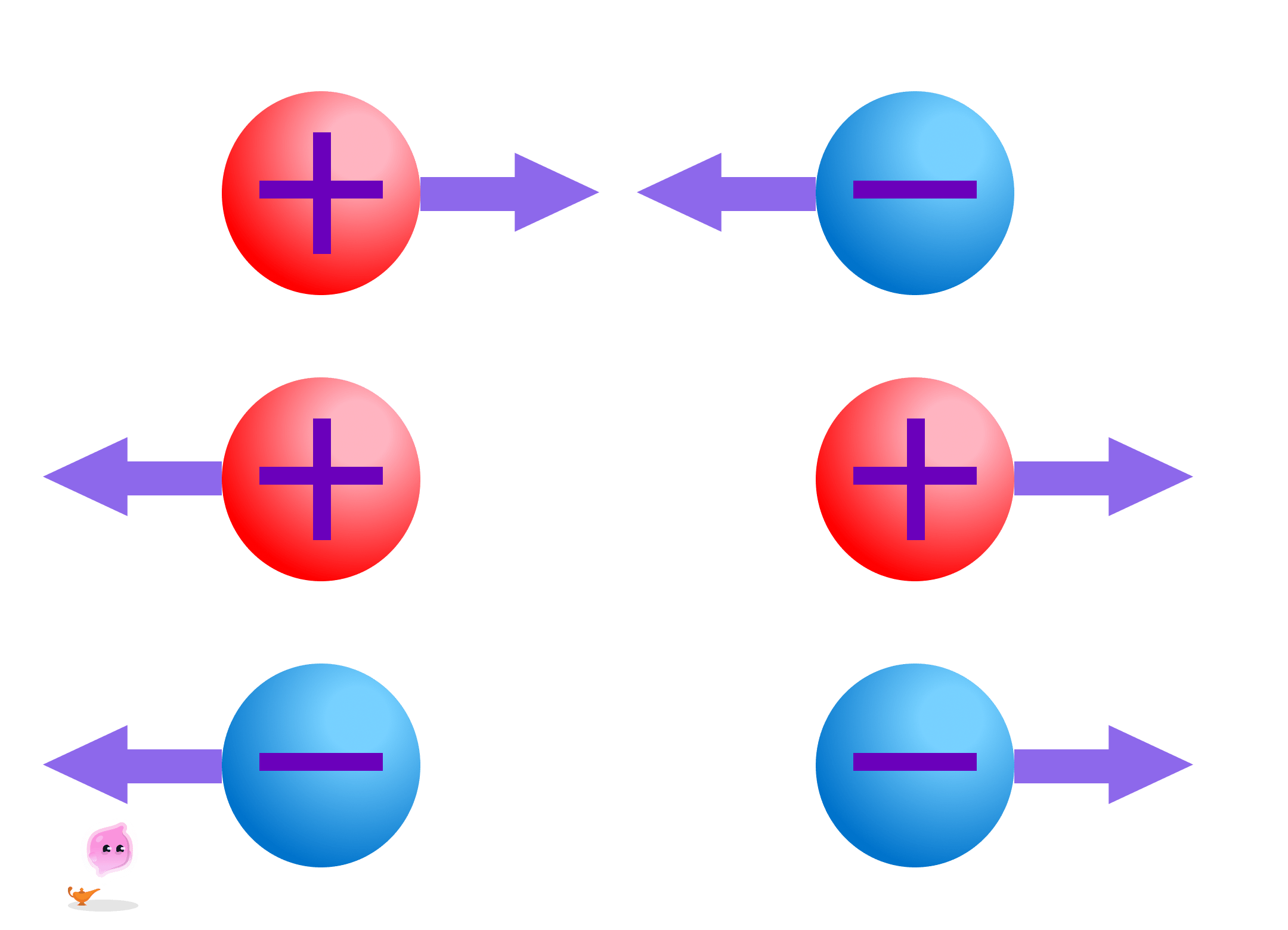
What changes the size of the force
- The sign of each charge decides the direction of the force, while the size of each charge and the separation between the objects decide how large that force is.
- Increasing the charge on either object increases the force, which is why a rod that has been rubbed for longer makes a suspended rod swing further.
- Increasing the separation decreases the force, which is why a charged rod has no measurable effect from the far side of the bench.
- The decrease with separation is steep, so halving the gap between two charged objects makes a much larger difference than doubling one of the charges.
- Both objects always feel the same size of force, even when one of them carries far more charge than the other.
- At this level you are asked to state the direction of the force and whether it becomes larger or smaller, rather than to calculate a value in newtons.
Using the rule to work out charges
- Repulsion is the reliable test for charge, because only two charged objects can push each other apart.
- If two suspended objects move apart when brought close, both must be charged and both charges must have the same sign.
- If two charged objects move together, their charges must have opposite signs.
- Attraction on its own does not prove that both objects are charged, because a charged object can also attract an object that carries no overall charge.
- Two rods of the same material, rubbed with the same cloth in the same way, always repel each other, because identical treatment gives them the same sign of charge.
- A rod that repels a known negative rod must itself be negative, and a rod that attracts it must be positive, so a rod of known charge can be used to identify an unknown one.
Example
Predicting attraction and repulsion
- Sphere A carries a charge of +3 nC+3\ \text{nC}+3 nC and sphere B carries a charge of +8 nC+8\ \text{nC}+8 nC.
- Both charges have the same sign, so A and B are like charges.
- Like charges repel, so each sphere is pushed away from the other.
- Sphere B is now replaced by a sphere carrying −8 nC-8\ \text{nC}−8 nC.
- The two charges now have opposite signs, so they are unlike charges and the spheres attract.
- In both cases the force on A is the same size as the force on B, even though the two charges are different sizes.
- Moving the spheres from 10 cm10\ \text{cm}10 cm apart to 5 cm5\ \text{cm}5 cm apart leaves the direction unchanged but makes both forces much larger.
Exam technique
Stating and explaining the force
- Give the effect first: write attract or repel, because “there is a force” does not say which.
- Add the reason using the phrase like charges or unlike charges whenever the command word is explain.
- Name the two objects, since “they repel” leaves the examiner to guess which pair you mean.
- If the question provides a diagram, draw a force arrow on each object, pointing apart for repulsion and towards each other for attraction.
- Do not describe the movement in place of the force; saying the rod swings away earns nothing unless you also state that the rods repel.
- For a one-mark question the single word attract or repel is often enough, so save the full explanation for questions that ask for one.
Common Mistake
- Do not assume that any two charged objects attract, because two charges of the same sign always repel.
- Do not reverse the rule; like charges never attract and unlike charges never repel.
- Do not use attraction on its own as proof that an object is charged, because an uncharged object can be attracted as well.
- Do not confuse the sign of a charge with its size, because only the signs decide whether the force is a push or a pull.
- Do not say that the larger charge feels the larger force, because the two forces are always equal in size.
Self review
- State what happens when two negatively charged spheres are brought close together.
- State what happens when a positively charged sphere is brought close to a negatively charged sphere.
- Explain why repulsion is a more reliable test for charge than attraction.
- Describe how the size of the electrostatic force changes as two charged objects are moved further apart.
- Two identical rods are rubbed with the same cloth in the same way. Explain whether they attract or repel.
