Charge, insulators and static electricity
Definition
Electric charge
Electric charge is a property of particles such as protons and electrons that makes them attract or repel one another, measured in coulombs.
Definition
Electrical insulator
An electrical insulator is a material with almost no free charges, so it does not allow a current to flow through it.
Definition
Static electricity
Static electricity is electric charge that has built up on an object and stays in place instead of flowing away.
- Every atom contains protons, which carry positive charge, electrons, which carry negative charge, and neutrons, which carry no charge at all.
- Charge is measured in coulombs, symbol C\text{C}C, and one proton and one electron carry equal amounts of charge with opposite signs.
- An atom with as many electrons as protons is neutral, so an object built from neutral atoms has no overall charge.
- Electrons sit in the outer parts of an atom and some of them can be pulled away, while protons are locked inside the nucleus and never leave during charging.
- Only electrons move, so every explanation of static electricity is written in terms of electron transfer and never in terms of moving protons.
- In an insulator such as polythene, perspex, rubber, nylon or dry hair there are almost no free charges, so charge that arrives at one part of the surface stays at that part.
- Charge trapped in this way is static electricity, and it is why an insulator can stay charged for many seconds after it has been rubbed.
- A metal held in your bare hand never appears charged, because a metal is a conductor and any charge given to it flows away through your body.
Charging by friction
Definition
Charging by friction
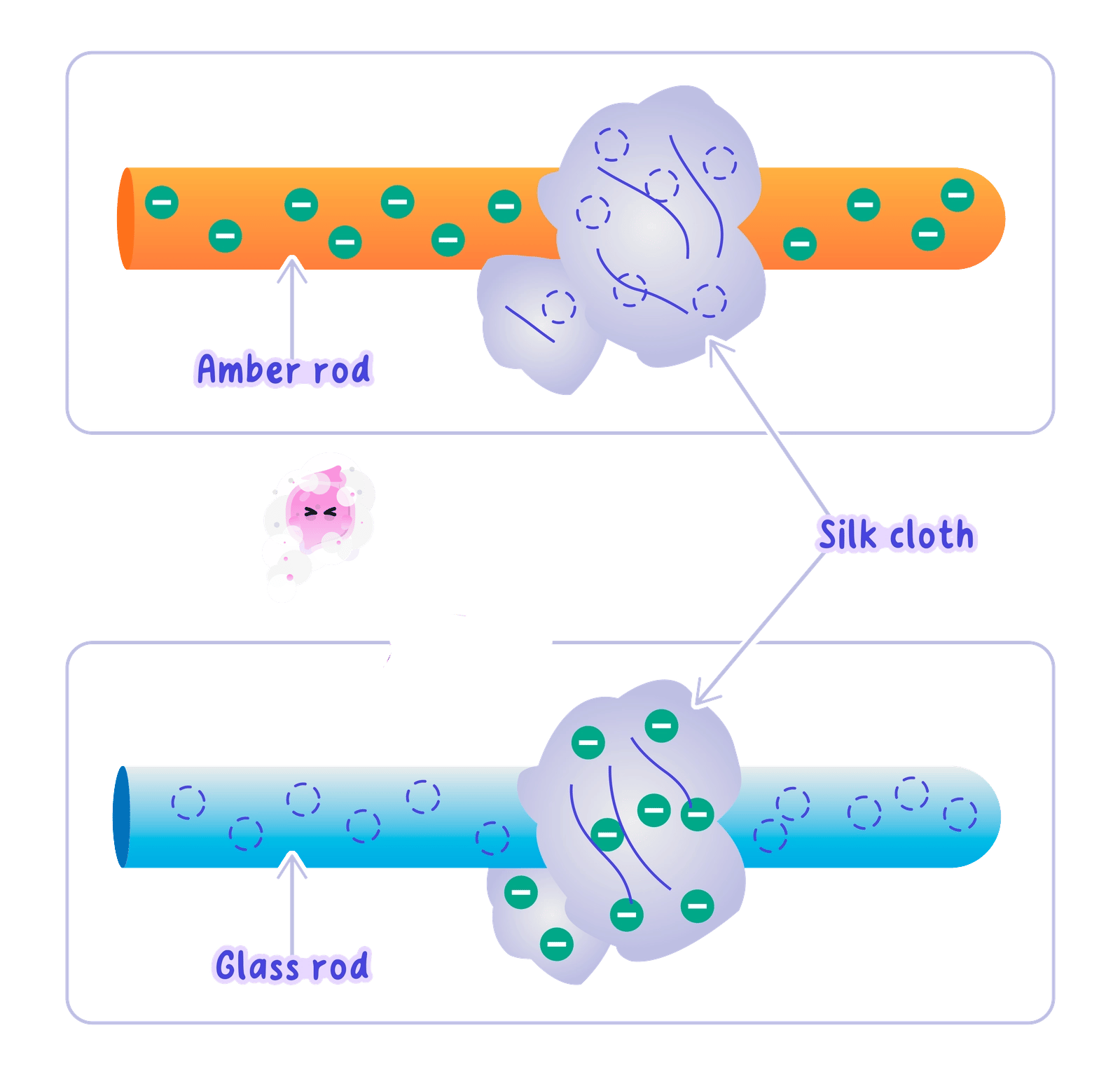
Charging by friction is the transfer of electrons between two insulating materials that are rubbed together, leaving one negatively charged and the other with an equal positive charge.
- Two insulating surfaces touch only at a small number of high points, and rubbing them together repeats that close contact thousands of times.
- At each contact, electrons on the surface of one material are held less tightly than the atoms of the other material would hold them, so those electrons are transferred across.
- Rubbing supplies the energy needed to pull the electrons away from one surface, but it does not make any new charge.
- The transfer always runs the same way for a given pair of materials, so the same pair always ends up charged the same way round.
- A polythene rod rubbed with a woollen duster gains electrons, so the rod becomes negatively charged and the duster is left positively charged.
- A perspex or acetate rod rubbed with the same duster loses electrons, so the rod becomes positively charged and the duster is left negatively charged.
- Which material becomes negative depends only on the pair chosen, which is why a question always tells you the materials or tells you the final charge on one of them.
- Rubbing harder or for longer transfers more electrons, so the charge on the rod is larger, although the sign of that charge does not change.
Practical
Charging insulating rods by friction
- Aim: to charge insulating rods by friction and show that the rod and the duster end up with equal and opposite charges.
- Apparatus: polythene rod, perspex or acetate rod, woollen duster or dry paper towel, coulombmeter with a metal collecting plate, insulating stand for the plate, connecting lead to earth the plate, dry cloth, and a dry, warm room.
- Variables: the material being rubbed is the independent variable, the sign and size of the charge measured is the dependent variable, and the duster, the number and firmness of strokes, the length of rod rubbed and the room conditions are controlled.
- Method, set-up:
- Wipe both rods, the duster and the collecting plate with a dry cloth, because a film of moisture on a surface conducts charge away.
- Connect the coulombmeter to the metal collecting plate and set it to its most sensitive range, in nanocoulombs.
- Zero the coulombmeter, then touch the plate briefly to an earthed point so it starts each test uncharged.
- Decide in advance how the rods will be rubbed, for example ten firm strokes along the last 10 cm10\ \text{cm}10 cm of the rod, and keep to that every time.
- Method, charging and measuring the rod:
- Hold the polythene rod at one end and rub the other end with the duster, using the agreed number of strokes, and keep your fingers off the rubbed end.
- Hold the rubbed end just above the collecting plate without touching it, and read the sign and size of the charge.
- Record the reading straight away, because charge leaks from the rod within a few seconds.
- Earth the plate, rezero the meter, recharge the rod and repeat twice more, then take a mean of the three readings.
- Repeat the whole sequence with the perspex rod, using the same duster and the same number of strokes.
- Method, measuring the duster:
- Recharge the polythene rod with the duster, then put the rod down without touching its rubbed end.
- Hold the duster just above the earthed and rezeroed plate and read the sign and size of its charge.
- Repeat for the duster used on the perspex rod, so that both pairs of readings can be compared.
- Results: the polythene rod reads negative and its duster reads positive, while the perspex rod reads positive and its duster reads negative, and the two readings in each pair are close to equal in size.
- Processing: compare the mean magnitude of the charge on each rod with the mean magnitude on its duster, and compare the two signs. Readings that are equal in size and opposite in sign show that electrons have been transferred from one material to the other rather than created.
- Watch out: charge leaks away quickly in damp air, so take readings promptly and recharge often. Touching the rubbed end earths the charge through you. Leaving the plate charged from a previous test makes the next reading too large or too small, so earth and rezero every time. Rubbing with a different force each time changes the size of the charge, so the magnitudes only match closely when the routine is kept identical.
- Safety: low risk. Keep the charged rods away from faces and eyes, keep them well clear of mains sockets and sensitive electronics, and clear the bench so nothing can be knocked over.
Equal and opposite charges
- Before rubbing, both materials are neutral, so each holds as much negative charge as positive charge.
- Rubbing transfers a number of electrons off one material, and exactly that number of electrons arrives on the other material.
- The material that gains electrons now has more negative charge than positive charge, so its overall charge is negative.
- The material that loses electrons is left with more positive charge than negative charge, so its overall charge is positive.
- Because the electrons lost by one object are the same electrons gained by the other, the two charges are equal in size and opposite in sign.
- Calling the charge on one object −Q-Q−Q and the charge on the other +Q+Q+Q makes this clear, since (−Q)+(+Q)=0(-Q)+(+Q)=0(−Q)+(+Q)=0 and the pair together is still neutral.
- No charge has been made or destroyed anywhere in the process; charge has only been separated between the two objects.
- This is why a question that gives the charge on the rod as −6 nC-6\ \text{nC}−6 nC expects the charge on the cloth to be +6 nC+6\ \text{nC}+6 nC.
Example
Charging a polythene rod
- A dry polythene rod is rubbed along one end with a woollen duster, and a charge detector shows the rod carries −4 nC-4\ \text{nC}−4 nC.
- The reading is negative because electrons have been transferred from the duster onto the rod.
- The rod now holds more electrons than it needs to balance its protons, so its overall charge is negative.
- The duster has lost exactly those electrons, so it is left with more positive charge than negative charge.
- The charge on the duster is therefore positive and equal in size, which is +4 nC+4\ \text{nC}+4 nC.
- Nothing was created: the 4 nC4\ \text{nC}4 nC of negative charge on the rod is the charge that used to be on the duster.
Exam technique
Writing a charge transfer answer
- Name the particle that moves. Write electrons, not protons and not simply charge.
- Give the direction of the transfer, for example from the duster to the rod, rather than saying that charge moves.
- Link the transfer to the sign in the same sentence: gaining electrons makes an object negative, losing electrons leaves it positive.
- Add that the two charges are equal in size and opposite in sign whenever the question mentions both objects.
- Use the names given in the question, such as rod and cloth, instead of writing “it”, so the examiner can see which object you mean.
- If a value is given for one object, quote the matching value for the other, such as −6 nC-6\ \text{nC}−6 nC and +6 nC+6\ \text{nC}+6 nC.
Common Mistake
- Do not write that protons move between the materials, because protons are held in the nucleus and stay where they are.
- Do not write that friction creates or makes charge, because rubbing only separates charge that was already present.
- Do not give both objects the same sign of charge, because the object that gains electrons and the object that loses them always end up with opposite signs.
- Do not describe an object as having gained protons when it becomes positive, because it has lost electrons instead.
- Do not try to charge a metal rod held in your bare hand by rubbing it, because the charge flows away through you as fast as it is produced.
Self review
- Name the only particle that is transferred when an insulator is charged by friction.
- Explain why a polythene rod rubbed with a woollen duster becomes negatively charged.
- Explain why the duster is left with a positive charge of exactly the same size.
- Explain why charge stays where it is placed on an insulator but not on a metal rod held in the hand.
- Describe how you would use a coulombmeter to show that a rod and the duster used to charge it carry opposite charges.
