Question 18
FThe Figure shows a cross-section through the outside wall of a house.
Figure
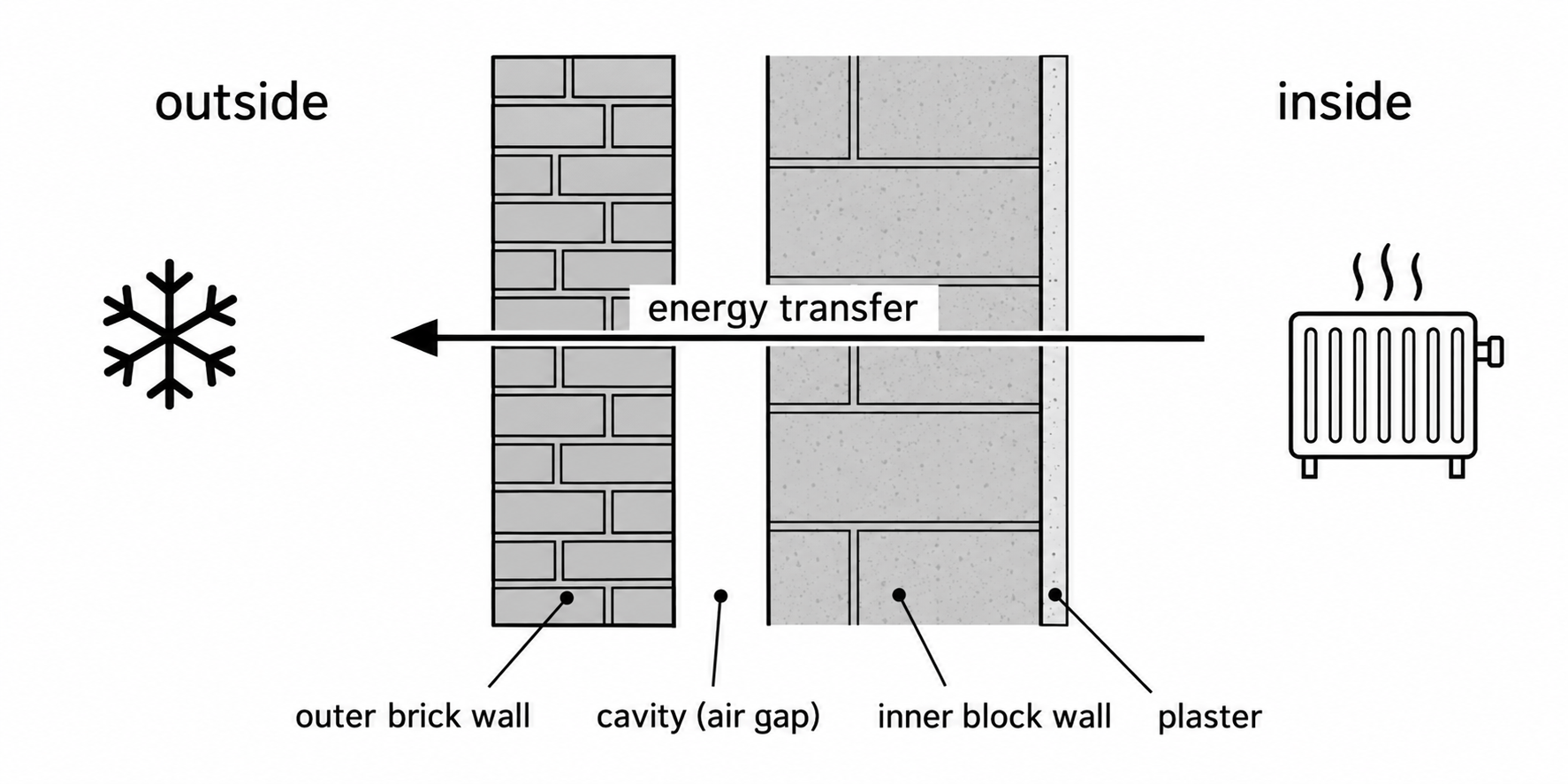
The owner of the house has the cavity filled with foam insulation.
a.[2]
Explain how filling the cavity with foam insulation reduces the rate of cooling of the house.
b.[2]
Before the cavity was filled, the heating system supplied 45 000 MJ45\,000\ \text{MJ}45000 MJ of energy each year to keep the house warm.
After the cavity was filled, the heating system supplied 36 000 MJ36\,000\ \text{MJ}36000 MJ of energy each year.
Calculate the percentage decrease in the energy supplied each year.
c.[2]
Give two other ways the owner could reduce the rate of energy transfer from the house.
d.[2]
The owner says:
'Now that the cavity is filled, my heating system is more efficient.'
Explain why the owner is wrong.
3.2 Dissipation and efficiency Questions
100 exam-style questions on Edexcel GCSE Physics 3.2 Dissipation and efficiency, covering 3.2.1 Dissipation of energy, 3.2.2 Reducing unwanted energy transfers, 3.2.3 Efficiency, and 3.2.4 Increasing efficiency. Each one has a worked solution and a mark scheme showing where the marks go.