The nuclear model
Definition
Atom
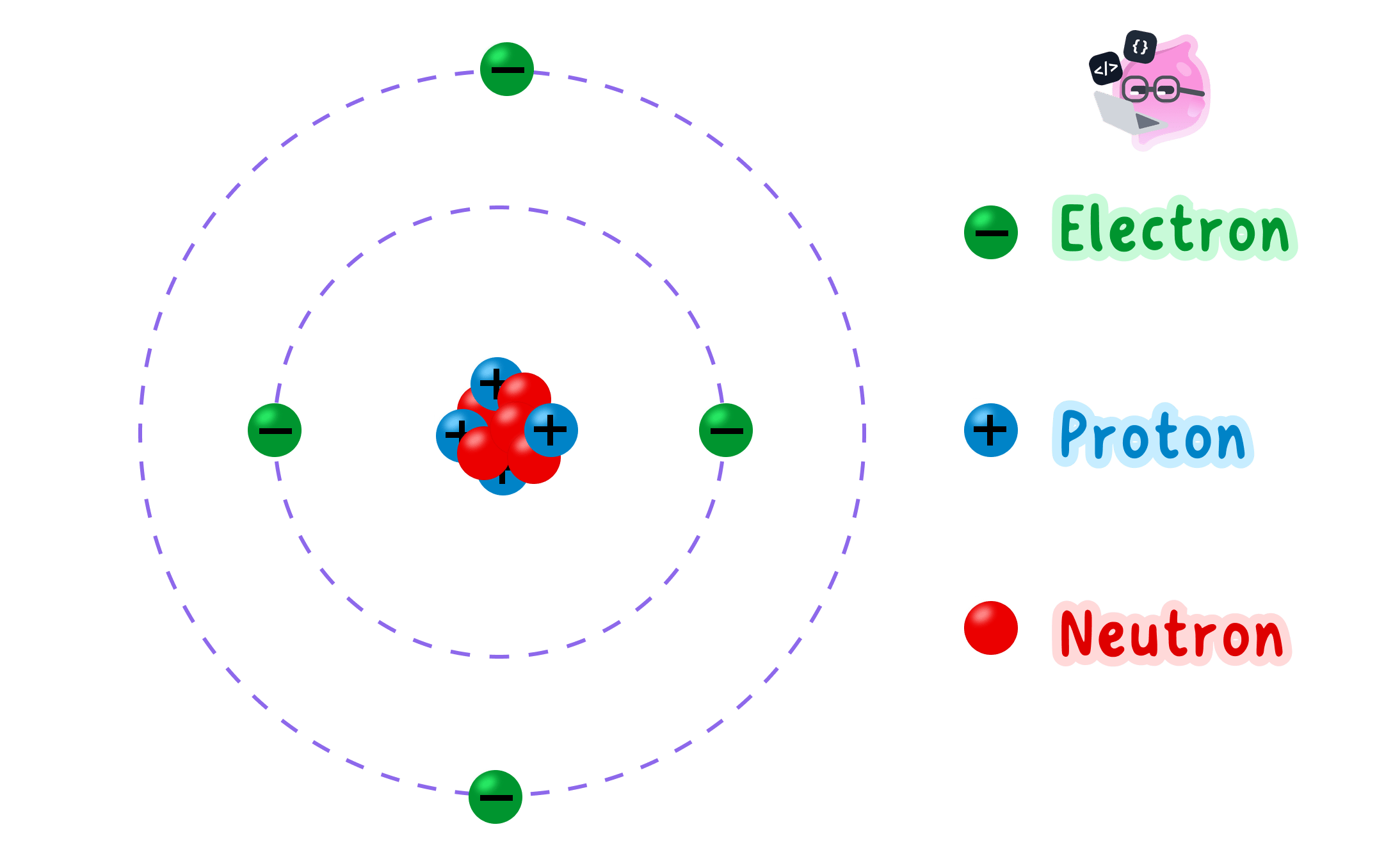
An atom is the smallest particle of an element, made of a central nucleus containing protons and neutrons with electrons arranged around it.
Definition
Nucleus (atom)
The nucleus is the small positively charged centre of an atom that contains the protons and neutrons and almost all of the atom's mass.
- In the nuclear model, every proton and every neutron in an atom is packed into a very small central nucleus, and the electrons are found in the space around that nucleus.
- Protons and neutrons are the only particles inside the nucleus, which is why they are together called nucleons.
- Electrons are never inside the nucleus. They move around it in shells, which are fixed regions at different distances from the centre.
- The electrons are held in place by the attraction between their negative charge and the positive charge of the nucleus, so the atom holds together without the electrons flying off.
- The three particles are not arranged evenly through the atom: the mass is concentrated at the centre while the volume is set by how far out the electron shells reach.
- Almost all of the inside of an atom is empty space. The electrons themselves are far too small to fill the region they move through.
Relative mass and charge
Definition
Relative mass
The relative mass of a particle is its mass compared with the mass of a proton, which is taken as 111.
Definition
Relative charge
The relative charge of a particle is its electric charge compared with the charge on a proton, which is taken as +1+1+1.
- A proton has a relative mass of 111 and a relative charge of +1+1+1.
- A neutron has a relative mass of 111 and a relative charge of 000, so it is uncharged.
- An electron has a relative mass of about 11836\frac{1}{1836}18361 and a relative charge of −1-1−1.
- Relative mass compares a particle with a proton, and relative charge compares a particle with the size of the charge on a proton. Both are ratios, so they are written as plain numbers.
- In actual units a proton has a mass of about 1.67×10⁻²⁷ kg1.67\times10^{-27}\ \text{kg}1.67×10⁻²⁷ kg while an electron has a mass of about 9.11×10⁻³¹ kg9.11\times10^{-31}\ \text{kg}9.11×10⁻³¹ kg, and dividing one by the other gives the factor of about 183618361836.
- The charge on an electron is exactly equal in size to the charge on a proton and opposite in sign, even though the two particles have hugely different masses.
- Because a neutron carries no charge, adding neutrons to a nucleus changes the mass of the atom but leaves its charge completely unchanged.
Note
Relative mass and relative charge are comparisons rather than measurements, so they never carry a unit such as kg\text{kg}kg or C\text{C}C.
Where the mass sits
- The relative mass of a nucleus is the number of protons added to the number of neutrons, because each of those particles counts as 111.
- Each electron adds only about 11836\frac{1}{1836}18361 to the total, which is roughly 0.0005450.0005450.000545.
- Even in an atom with many electrons, their combined relative mass stays far below 111, so it never becomes a significant share of the total.
- Almost all of the mass of an atom is therefore in the nucleus, and for calculations at this level the mass of the electrons is treated as negligible.
- The nucleus is also extremely small, so it holds a large mass in a tiny volume and is by far the densest part of the atom.
- When the mass of an atom is quoted, that figure is effectively the mass of its protons and neutrons alone.
Example
Mass carried by the electrons
- A lithium atom contains 333 protons, 444 neutrons and 333 electrons.
- The relative mass of the nucleus is 3+4=73+4=73+4=7, since each proton and each neutron counts as 111.
- The relative mass of the three electrons is 3×11836=1.63×10⁻³³\times\frac{1}{1836}=1.63\times10^{-3}3×18361=1.63×10⁻³.
- The total relative mass of the atom is 7+1.63×10−3=7.001637+1.63\times10^{-3}=7.001637+1.63×10−3=7.00163.
- The fraction of the mass carried by the electrons is 1.63×10−37.00163=2.3×10⁻⁴\frac{1.63\times10^{-3}}{7.00163}=2.3\times10^{-4}7.001631.63×10−3=2.3×10⁻⁴.
- That fraction is about 0.023%0.023\%0.023%, so the nucleus holds effectively all of the mass of the atom.
Why an atom is neutral
- Each proton contributes +1+1+1 and each neutron contributes 000, so the relative charge of a nucleus is simply the number of protons inside it.
- A nucleus is therefore always positively charged, and its charge grows as the number of protons grows.
- In a neutral atom the number of electrons is equal to the number of protons.
- Every +1+1+1 from a proton is then matched by a −1-1−1 from an electron, so the positive and negative charges cancel exactly.
- The total relative charge of a neutral atom is 000, which is what is meant by saying it has no overall charge.
- A carbon atom, for instance, has 666 protons giving +6+6+6 and 666 electrons giving −6-6−6, and +6−6=0+6-6=0+6−6=0.
- This cancelling depends only on the numbers of particles and their charges, not on their masses, so the very light electrons balance the much heavier protons perfectly.
Common Mistake
- Do not place electrons inside the nucleus. Only protons and neutrons are found there.
- Do not state that an electron has zero mass. Its relative mass is about 11836\frac{1}{1836}18361, which is very small but not nothing.
- Do not write the relative charge of a proton as 1 C1\ \text{C}1 C, because relative charge has no unit.
- Do not say the nucleus is uncharged because it contains neutrons. The protons make it positive and the neutrons leave that charge unchanged.
- Do not confuse the two ideas of size: the nucleus carries nearly all of the mass but occupies almost none of the volume.
Size of the atom
- The radius of an atom is about 1×10⁻¹⁰ m1\times10^{-10}\ \text{m}1×10⁻¹⁰ m.
- The radius of a nucleus is about 1×10⁻¹⁵ m1\times10^{-15}\ \text{m}1×10⁻¹⁵ m, which is roughly 1100000\frac{1}{100000}1000001 of the radius of the whole atom.
- Dividing one radius by the other gives 1×10−101×10−15=1×10⁵\frac{1\times10^{-10}}{1\times10^{-15}}=1\times10^{5}1×10−151×10−10=1×10⁵, so the atom is about a hundred thousand times wider than its nucleus.
- Because volume depends on the cube of the radius, the nucleus occupies only about 1×10−151\times10^{-15}1×10⁻¹⁵ of the volume of the atom.
- On a scale where the nucleus is the size of a pea at the centre of a large sports stadium, the nearest electrons would be out at the seats.
- The atom is therefore mostly empty space, with all of its mass at the centre and all of its volume mapped out by the electron shells.
- In a metal the outermost electrons are held only weakly, so they break away from individual atoms and become free to move through the whole structure, and it is the movement of these free electrons that makes an electric current possible.
Exam technique
Describing atomic structure
- Name each particle, say where it is found, then give its relative mass and its relative charge, in that order.
- Give relative mass and relative charge as plain numbers such as 111, 000, +1+1+1 and −1-1−1, with no unit attached.
- Write atomic sizes in standard form, such as 1×10⁻¹⁰ m1\times10^{-10}\ \text{m}1×10⁻¹⁰ m for an atom, rather than as a long string of decimal places.
- To explain why an atom is neutral, state that the number of protons equals the number of electrons and that their charges are equal in size and opposite in sign.
- To explain why the mass is in the nucleus, compare the relative mass of 111 for a nucleon with the 11836\frac{1}{1836}18361 of an electron.
Self review
- State where protons, neutrons and electrons are found in an atom.
- Give the relative mass and relative charge of each of the three particles.
- Explain why almost all of the mass of an atom is in its nucleus.
- Explain why a neutral atom has no overall charge.
- Compare the radius of an atom with the radius of its nucleus.
