5.5.1a Pressure in a fluid
What counts as a fluid
Definition
Fluid
A fluid is a substance that can flow because its particles move past one another; it can be a liquid or a gas.
- In an answer, say liquid or gas, not just “a liquid”.
- A solid cannot flow because its particles are held in fixed positions and can only vibrate.
- In a liquid the particles touch but slide over each other; in a gas they are far apart and move quickly in random directions.
- Both take the shape of their container and both press on every surface they touch.
Pressure in a fluid acts normal to a surface
- The pressure in a fluid causes a force normal (at right angles) to any surface it touches.
- This follows from the particle model: the fluid’s particles constantly move and collide with any surface, each collision exerting a tiny force.
- The collisions come from every direction, so the sideways pushes cancel and the resultant force acts at right angles to the surface.
- So fluid pressure acts in all directions, not just downwards: a gas presses outwards on the top, sides and bottom of its container, and water presses inwards on every face of a submerged object.
- The direction of the force depends only on how the surface is orientated: tilt the surface and the force stays at right angles to it.
Key Idea
The pressure in a fluid causes a force normal (at right angles) to any surface.
Calculating the pressure at a surface
Definition
Pressure
Pressure is the force normal to a surface divided by the area of that surface.
- The equation is p=FAp = \dfrac{F}{A}p=AF.
- ppp is the pressure in pascals (Pa\text{Pa}Pa).
- FFF is the force normal to the surface in newtons (N\text{N}N).
- AAA is the area of that surface in metres squared (m2\text{m}^2m2).
- 1 Pa=1 N/m21\ \text{Pa} = 1\ \text{N/m}^21 Pa=1 N/m2, so a pressure of 250 Pa250\ \text{Pa}250 Pa means each square metre feels a force of 250 N250\ \text{N}250 N at right angles.
- Rearranged, the equation gives F=p×AF = p \times AF=p×A and A=FpA = \dfrac{F}{p}A=pF.
- Areas are often given in cm2\text{cm}^2cm2, but the equation needs m2\text{m}^2m2: divide an area in cm2\text{cm}^2cm2 by 10 00010\,00010000, because 1 m2=10 000 cm21\ \text{m}^2 = 10\,000\ \text{cm}^21 m2=10000 cm2.
Example
- Compressed gas pushes on a piston with a force of 4500 N4500\ \text{N}4500 N normal to the piston. The piston area is 0.030 m20.030\ \text{m}^20.030 m2. Calculate the pressure of the gas at the piston.
- Write the equation: p=FAp = \dfrac{F}{A}p=AF.
- Check the units: force is in N\text{N}N and area is in m2\text{m}^2m2, so no conversion is needed.
- Substitute the values: p=4500 N0.030 m2p = \dfrac{4500\ \text{N}}{0.030\ \text{m}^2}p=0.030 m24500 N.
- Calculate the pressure: p=150 000 Pa=1.5×10⁵ Pap = 150\,000\ \text{Pa} = 1.5 \times 10^5\ \text{Pa}p=150000 Pa=1.5×10⁵ Pa.
Finding a force from a pressure
- When the pressure and area are given, rearrange to F=p×AF = p \times AF=p×A to find the force normal to the surface.
- Convert the area to m2\text{m}^2m2 before substituting.
Example
- Water in a tank exerts a pressure of 12 000 Pa12\,000\ \text{Pa}12000 Pa on an inspection hatch in the side of the tank. The hatch area is 250 cm2250\ \text{cm}^2250 cm2. Calculate the force the water exerts on the hatch.
- Rearrange the equation: F=p×AF = p \times AF=p×A.
- Convert the area: A=25010 000=0.025 m2A = \dfrac{250}{10\,000} = 0.025\ \text{m}^2A=10000250=0.025 m2.
- Substitute the values: F=12 000 Pa×0.025 m2F = 12\,000\ \text{Pa} \times 0.025\ \text{m}^2F=12000 Pa×0.025 m2.
- Calculate the force: F=300 NF = 300\ \text{N}F=300 N, acting normal to the hatch (horizontally outwards, at right angles to the side of the tank).
Exam technique
- Do not treat pressure and force as the same: a large force over a large area gives a small pressure, and a small force over a tiny area gives a huge pressure, so always ask “over what area?”.
- Do not assume fluid pressure only pushes downwards; it acts in every direction and, on any surface, at right angles to it.
- Convert areas in cm2\text{cm}^2cm2 to m2\text{m}^2m2 before substituting, or the answer will be 10 00010\,00010000 times too big.
- Only the force normal to the surface goes into p=FAp = \dfrac{F}{A}p=AF, and AAA is the area of that same surface, not the whole object.
- To describe the direction, use “the pressure in a fluid causes a force normal (at right angles) to the surface”; “downwards” or “outwards” alone will not score.
Self review
- What is a fluid?
- In which direction does the force from fluid pressure act on a surface, and why?
- State the equation for pressure and the units of each quantity.
- What is 1 Pa1\ \text{Pa}1 Pa in N/m2\text{N/m}^2N/m2, and how many cm2\text{cm}^2cm2 are in 1 m21\ \text{m}^21 m2?
- How do you find the force on a surface from the pressure and area?
5.5.1b Pressure due to a column of liquid and upthrust
Pressure due to a column of liquid
Definition
Pressure due to a liquid column
The pressure caused by the weight of the liquid above a point.
- The pressure due to a column of liquid is p=hρgp = h\rho gp=hρg.
- ppp is the pressure in pascals (Pa\text{Pa}Pa).
- hhh is the vertical height (depth) of the liquid column in metres (m\text{m}m).
- ρ\rhoρ is the density of the liquid in kilograms per metre cubed (kg/m3\text{kg/m}^3kg/m3).
- ggg is the gravitational field strength in newtons per kilogram (N/kg\text{N/kg}N/kg), and its value is given in the question.
- The height hhh is the vertical depth of the point below the surface; at the bottom of a swimming pool, hhh is the distance from the water’s surface to the bottom.
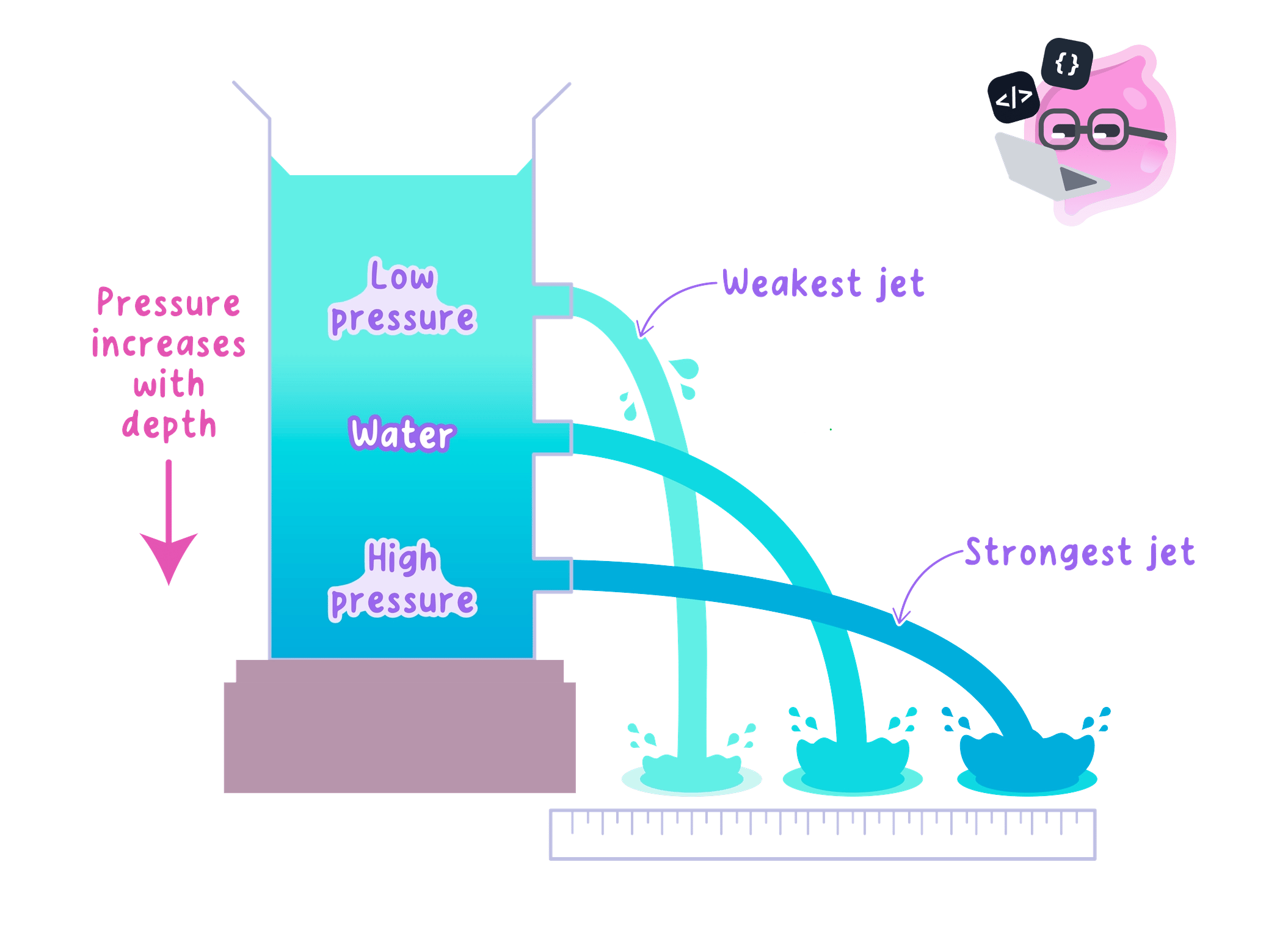
Why pressure increases with depth and density
- A deeper point has a taller column of liquid above it, which contains more liquid and so has a greater weight, giving a greater pressure.
- p=hρgp = h\rho gp=hρg shows pressure is directly proportional to depth: double the depth, with ρ\rhoρ and ggg constant, and the pressure doubles.
- A denser liquid has more mass in the same volume, so its column weighs more and produces a greater pressure at the same depth.
Differences in pressure
- For the pressure difference between two points in the same liquid, first find the difference in depth: Δh=h2−h1\Delta h = h_2 - h_1Δh=h2−h1.
- Then use Δp=Δh ρg\Delta p = \Delta h\,\rho gΔp=Δhρg.
Example
- Two points in water are at depths of 0.40 m0.40\ \text{m}0.40 m and 1.70 m1.70\ \text{m}1.70 m. The density of water is 1000 kg/m31000\ \text{kg/m}^31000 kg/m3 and g=9.8 N/kgg = 9.8\ \text{N/kg}g=9.8 N/kg. Calculate the difference in pressure between the two points.
- Write the equation: Δp=Δh ρg\Delta p = \Delta h\,\rho gΔp=Δhρg.
- Find the difference in depth: Δh=1.70−0.40=1.30 m\Delta h = 1.70 - 0.40 = 1.30\ \text{m}Δh=1.70−0.40=1.30 m.
- Substitute the values: Δp=1.30 m×1000 kg/m3×9.8 N/kg\Delta p = 1.30\ \text{m} \times 1000\ \text{kg/m}^3 \times 9.8\ \text{N/kg}Δp=1.30 m×1000 kg/m3×9.8 N/kg.
- Calculate the pressure difference: Δp=12 740 Pa=1.27×10⁴ Pa\Delta p = 12\,740\ \text{Pa} = 1.27 \times 10^4\ \text{Pa}Δp=12740 Pa=1.27×10⁴ Pa, with the deeper point at the greater pressure.
Upthrust
Definition
Upthrust
Upthrust is the resultant upward force exerted by a fluid on an object that is partially or totally submerged.
- Liquid pressure acts on every submerged surface; the bottom is deeper than the top, so the pressure on the bottom is greater.
- The upward force on the bottom is therefore greater than the downward force on the top, and this pressure difference produces a resultant upward force called upthrust.
Key Idea
Upthrust is caused by the difference in liquid pressure between the lower and upper surfaces of a submerged object.
Floating and sinking
- Whether an object floats or sinks depends on its weight compared with the upthrust acting on it.
- If weight is greater than upthrust, there is a resultant downward force and the object sinks.
- If upthrust is greater than weight, there is a resultant upward force and the object rises.
- If upthrust equals weight, the forces are balanced and the object floats at a constant level or stays suspended.
- Density matters too: an object with a lower average density than the liquid can float, while one with a greater average density sinks.
- Increasing the liquid’s density increases the upthrust and makes floating more likely.
- A floating object settles where the upthrust equals its weight; a heavier object displaces more liquid, so it floats with more of its volume submerged.
Exam technique
- A floating object is not force-free: it has an upward upthrust and a downward weight, which are equal when it floats at rest.
- Use the vertical depth below the surface for hhh, and convert centimetres to metres before using p=hρgp = h\rho gp=hρg.
- To explain upthrust, give the full chain: the bottom is deeper, so the pressure there is greater, so the upward force on the bottom is larger than the downward force on the top, leaving a resultant upward force.
- For floating and sinking, compare upthrust with weight and state the direction of the resultant force.
Self review
- State the equation linking pressure, depth, density and gravitational field strength.
- Why does liquid pressure increase with depth?
- Why does a denser liquid give greater pressure at the same depth?
- How do you calculate a pressure difference between two depths?
- How does a pressure difference create upthrust, and how do you predict floating or sinking?
