Pressure in a fluid 2 (HT only)
What you'll learn
- How to calculate pressure caused by a column of liquid using p=hρgp = h \rho gp=hρg.
- Why liquid pressure increases with depth and with liquid density.
- How to calculate pressure differences between two depths.
- How unequal pressures create upthrust, and how that affects floating and sinking.
Starting point: pressure and fluids
You already know that pressure is linked to force spread over an area. A large force on a small area gives a large pressure; the same force spread out gives a smaller pressure.
Pressure
Pressure is the force acting per unit area. It is measured in pascals, Pa, where 1 pascal means 1 newton per square metre.
A fluid is something that can flow. In GCSE Physics, this usually means a liquid or a gas. In this section, we are focusing on liquids.
Liquids are different from solid blocks because they can push in all directions. At a point inside a liquid, the pressure acts in every direction, not just downwards. However, the pressure gets bigger as you go deeper.
Why pressure increases with depth
Imagine a point inside a tank of water. Above that point is a column of water. That water has weight, because gravity pulls on its mass.
The deeper the point is, the taller the column of liquid above it. A taller column has more liquid in it, so it has more weight. That extra weight causes a larger pressure.
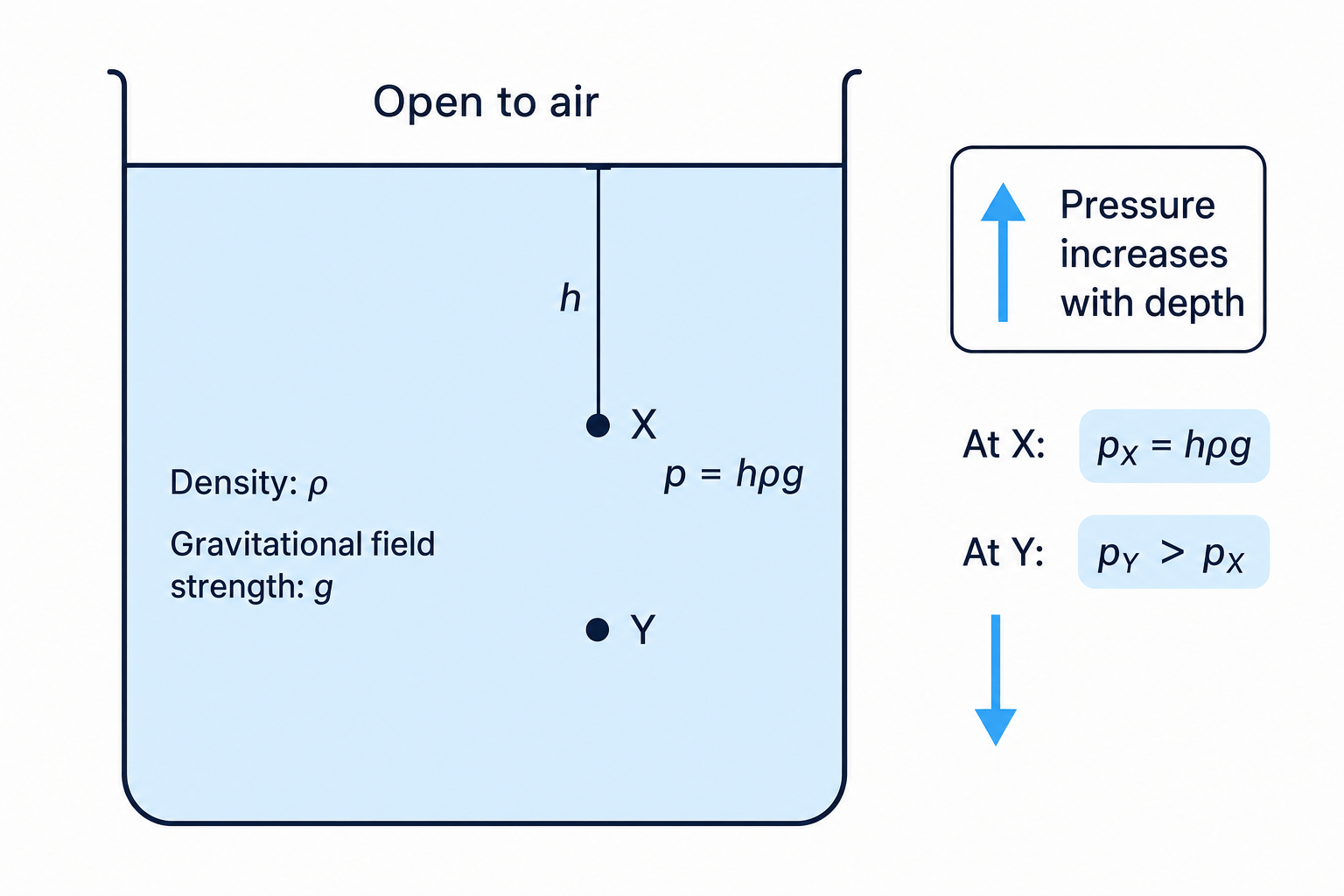
Pressure depends on the column above
In a liquid, pressure at a point increases when the height of liquid above the point increases.
Density also matters. If two liquids have the same depth, the denser liquid has more mass in each cubic metre. More mass means more weight, so the pressure is greater.
Density
Density, symbol ρ\rhoρ, tells you how much mass there is in a certain volume. It is measured in kilograms per metre cubed, kg/m3\text{kg/m}^3kg/m3.
The liquid pressure equation
For Higher Tier, you need to use this equation:
p=hρgp = h \rho gp=hρgwhere:
- ppp is the pressure due to the liquid column, in pascals, Pa
- hhh is the height of the liquid column above the point, in metres, m
- ρ\rhoρ is the density of the liquid, in kilograms per metre cubed, kg/m3\text{kg/m}^3kg/m3
- ggg is the gravitational field strength, in newtons per kilogram, N/kg
Gravitational field strength
Gravitational field strength, symbol ggg, is the force of gravity on each kilogram of mass. In calculations, the value of ggg will be given.
This equation is on the GCSE Physics equation sheet, but you still need to know when and how to use it.
What height means
In p=hρgp = h \rho gp=hρg, the height hhh is the vertical depth below the liquid surface, not the total height of the container.
Calculating pressure at a depth
A diver is 3.0 m below the surface of fresh water. The density of water is 1000 kg/m3\text{kg/m}^3kg/m3 and g=9.8 N/kgg = 9.8 \text{ N/kg}g=9.8 N/kg. Calculate the pressure due to the water.
-
The pressure is caused by the liquid column above the diver, so use p=hρgp = h \rho gp=hρg with h=3.0 mh = 3.0 \text{ m}h=3.0 m.
-
Substitute the values:
p=3.0×1000×9.8p = 3.0 \times 1000 \times 9.8p=3.0×1000×9.8 -
Calculate the pressure:
p=29400 Pap = 29400 \text{ Pa}p=29400 Pa
So the pressure due to the water is 29 400 Pa.
Forgetting the units
Make sure height is in metres and density is in kg/m3\text{kg/m}^3kg/m3. If the question gives centimetres or grams per cubic centimetre, convert them before using the equation.
Pressure due to the liquid, not always total pressure
The equation p=hρgp = h \rho gp=hρg gives the pressure caused by the liquid column itself.
If a container is open to the air, the liquid surface also has atmospheric pressure pushing on it. So the total pressure at a point would be atmospheric pressure plus the pressure due to the liquid.
Check what the question asks for
If the question asks for “pressure due to the liquid”, use p=hρgp = h \rho gp=hρg. If it asks for “total pressure”, you may need to add atmospheric pressure if it is given.
Pressure differences at different depths
Often, you are not asked for the pressure at one point. Instead, you may need the difference in pressure between two depths.
Pressure difference
A pressure difference is how much bigger the pressure is at one point compared with another point.
If both points are in the same liquid, the pressure difference depends only on the vertical difference in depth:
Δp=Δhρg\Delta p = \Delta h \rho gΔp=ΔhρgHere, Δp\Delta pΔp means “change in pressure” and Δh\Delta hΔh means “change in depth”.
Only the depth difference matters
For two points in the same liquid, the pressure difference depends on how much lower one point is than the other, not on their sideways separation.
Calculating a pressure difference
A submarine moves from a depth of 40 m to a depth of 65 m in seawater. The density of seawater is 1030 kg/m3\text{kg/m}^3kg/m3 and g=10 N/kgg = 10 \text{ N/kg}g=10 N/kg. Calculate the increase in pressure.
-
Find the increase in depth:
Δh=65−40=25 m\Delta h = 65 - 40 = 25 \text{ m}Δh=65−40=25 m -
Use the pressure difference equation:
Δp=Δhρg\Delta p = \Delta h \rho gΔp=Δhρg -
Substitute and calculate:
Δp=25×1030×10=257500 Pa\Delta p = 25 \times 1030 \times 10 = 257500 \text{ Pa}Δp=25×1030×10=257500 Pa
The pressure increases by 257 500 Pa.
Using the deeper depth instead of the difference
If the question asks for the difference in pressure between two depths, use the difference in depths, not just the larger depth.
Why submerged objects experience upthrust
Now think about an object underwater, like a block.
The bottom of the block is deeper than the top. Since pressure increases with depth, the pressure on the bottom surface is greater than the pressure on the top surface.
Pressure causes force. So:
- the liquid pushes down on the top of the object
- the liquid pushes up on the bottom of the object
- the upward force on the bottom is larger than the downward force on the top
This creates a resultant upward force.
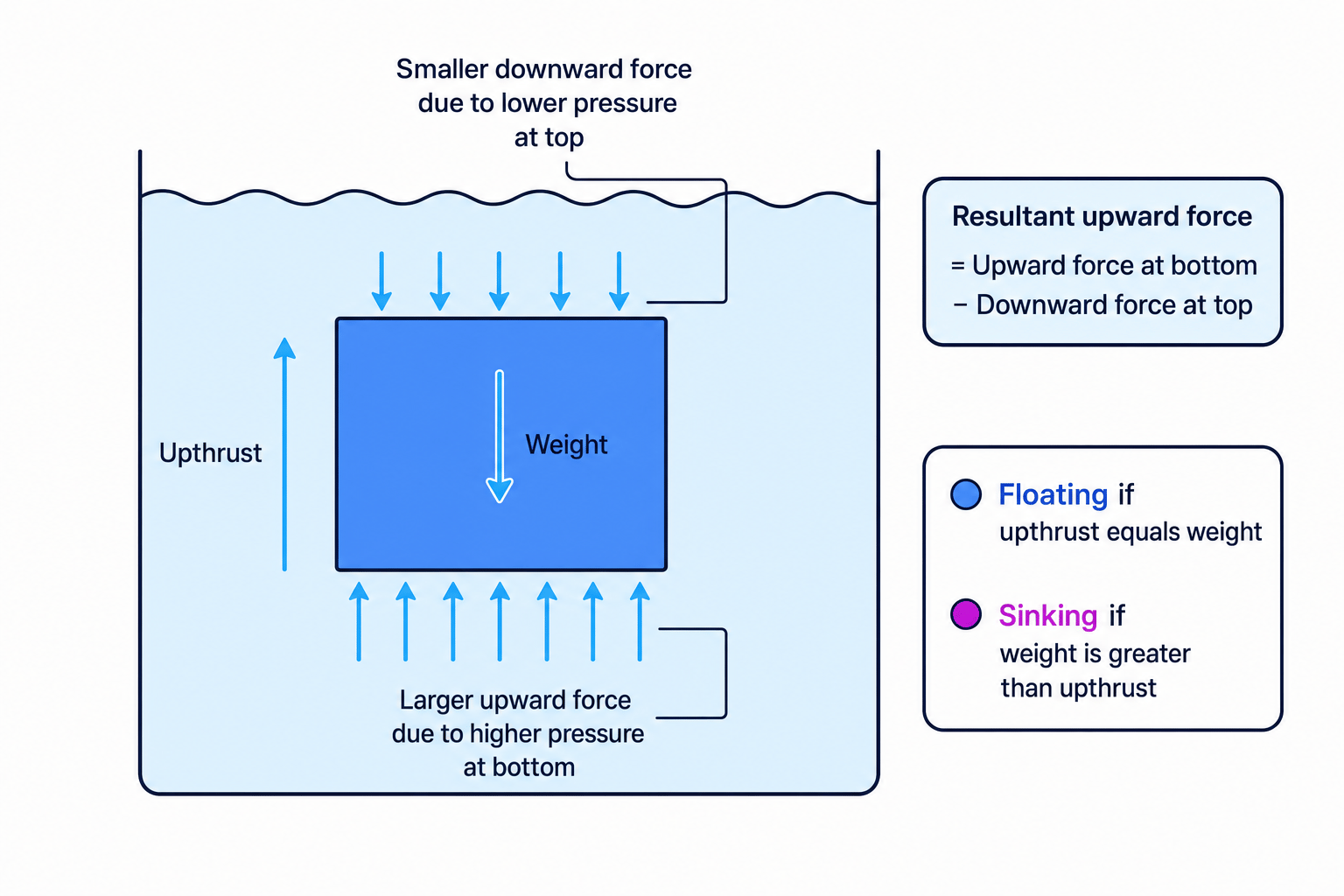
Upthrust
Upthrust is the resultant upward force on an object that is partially or totally submerged in a fluid.
The side forces usually cancel out because the pressure on opposite sides at the same depth is the same. The important imbalance is between the top and bottom surfaces.
Calculating upthrust from pressure difference
A rectangular block is fully submerged in water. The top face is 0.80 m below the surface and the bottom face is 1.20 m below the surface. The area of the top and bottom faces is 0.15 m2\text{m}^2m2. The density of water is 1000 kg/m3\text{kg/m}^3kg/m3 and g=10 N/kgg = 10 \text{ N/kg}g=10 N/kg. Calculate the upthrust.
-
Find the vertical depth difference between the bottom and top faces:
Δh=1.20−0.80=0.40 m\Delta h = 1.20 - 0.80 = 0.40 \text{ m}Δh=1.20−0.80=0.40 m -
Calculate the pressure difference between the bottom and top:
Δp=0.40×1000×10=4000 Pa\Delta p = 0.40 \times 1000 \times 10 = 4000 \text{ Pa}Δp=0.40×1000×10=4000 Pa -
Use pressure as force per unit area, so F=pAF = pAF=pA:
F=4000×0.15=600 NF = 4000 \times 0.15 = 600 \text{ N}F=4000×0.15=600 N
The upthrust is 600 N upwards.
Floating and sinking
Whether an object floats or sinks depends on the balance between two forces:
- weight, acting downwards
- upthrust, acting upwards
Weight
Weight is the force of gravity on an object. It acts downwards and is measured in newtons, N.
If an object is floating at rest, the forces are balanced:
upthrust=weight\text{upthrust} = \text{weight}upthrust=weightIf the weight is greater than the upthrust, there is a resultant force downwards, so the object sinks.
If the upthrust is greater than the weight, there is a resultant force upwards, so the object rises. As it rises and becomes less submerged, the upthrust usually decreases until it balances the weight.
Floating is a force balance
An object floats when the upward upthrust balances the downward weight.
Density helps explain the pattern:
- An object with a lower average density than the liquid tends to float.
- An object with a higher average density than the liquid tends to sink.
- If the average density is equal to the liquid’s density, it may stay suspended.
This is why a steel ship can float even though steel itself is denser than water. The ship contains lots of air, so its overall average density is low enough for it to displace enough water and get enough upthrust.
Thinking floating means no weight
A floating object still has weight. It floats because the upward upthrust is equal to its downward weight, not because gravity has disappeared.
Deciding whether an object floats or sinks
A fully submerged object has a weight of 75 N. The upthrust acting on it is 60 N. Decide what happens to the object.
-
Compare the two vertical forces: weight is 75 N downwards and upthrust is 60 N upwards.
-
Find the resultant force:
Fresultant=75−60=15 NF_\text{resultant} = 75 - 60 = 15 \text{ N}Fresultant=75−60=15 N -
The larger force is the weight, so the resultant force is 15 N downwards.
The object sinks.
In the exam
- Decide whether the question wants pressure at one depth, or a pressure difference between two depths.
- Use the correct height: hhh for one depth, or Δh\Delta hΔh for a difference in depth.
- For floating and sinking, compare the upward upthrust with the downward weight.
Check yourself
- Why does pressure increase when the liquid above a point is deeper?
- How would increasing the density of a liquid affect the pressure at the same depth?
- What force comparison tells you whether an object will float or sink?
You've reached the end
Test yourself on this topic, or move on to the next guide.
How was this guide?