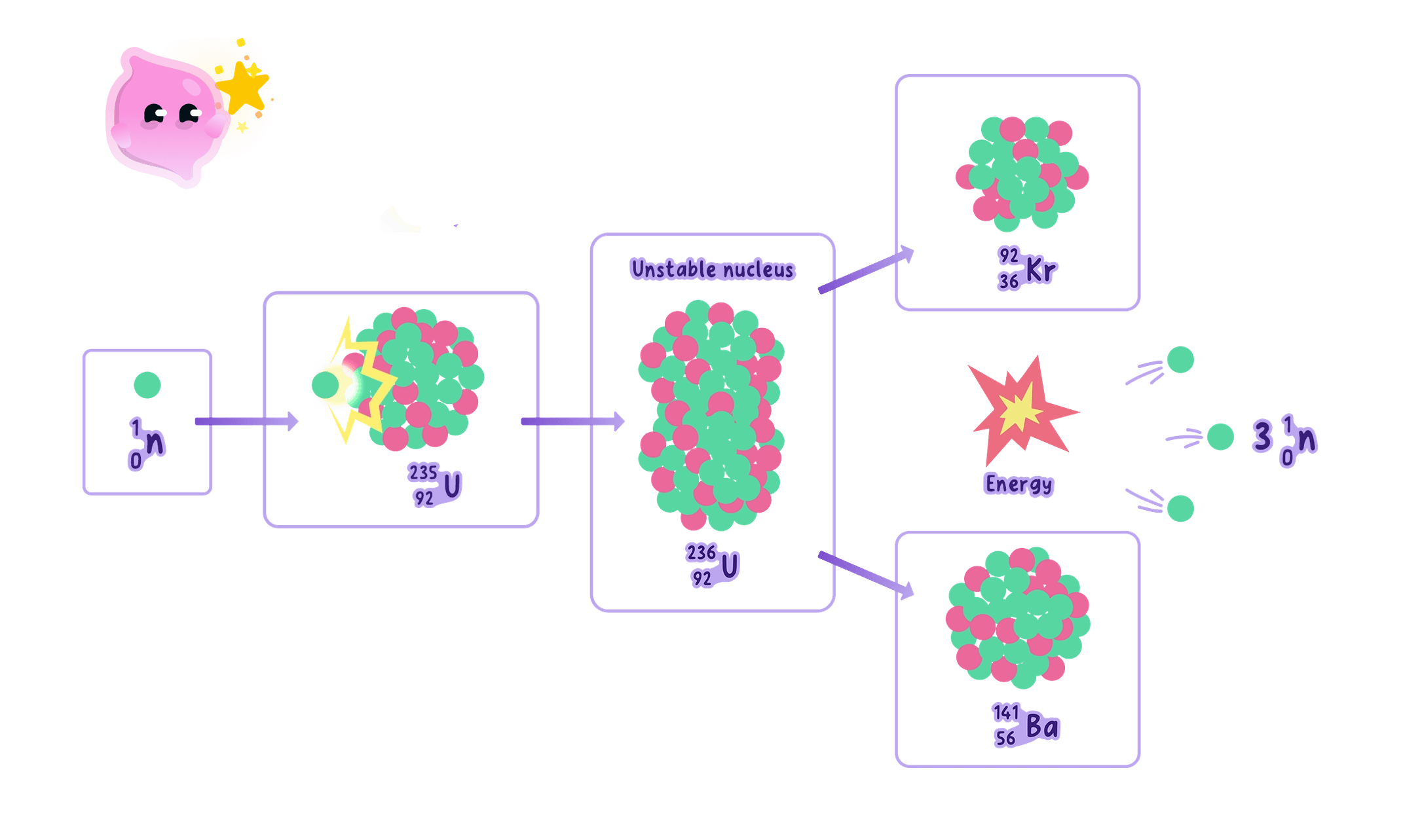
Induced nuclear fission
Nuclear fission is the splitting of a large, unstable nucleus into two smaller nuclei. For example, when a uranium-235 nucleus absorbs a neutron, it forms an unstable uranium-236 nucleus, which splits into a barium-141 nucleus and a krypton-92 nucleus, releasing three neutrons and gamma radiation. The barium and krypton nuclei recoil rapidly away from each other. Most of the released energy is transferred as kinetic energy to these two daughter nuclei, with some kinetic energy also carried by the emitted neutrons.
Step-by-step lessons covering AQA GCSE Physics 4.4.1 Nuclear fission for Foundation and Higher tier. Each lesson works through exam-style questions in Paper 1 and Paper 2 format. Build a strong grip on equations, units and Key Stage 3 fundamentals before tackling the more demanding topics like electromagnetism, the particle model of matter and space physics.