6.7.1 Nuclear power: advantages and disadvantages
Weighing up nuclear power
- A nuclear power station generates electricity using energy released inside its uranium fuel, so no fuel is burned and the station's advantages and disadvantages are quite different from those of a coal or gas station.
- An evaluation is not a list; it sets advantages against disadvantages, gives a reason for each, and ends with a judgement that follows from those reasons.
- Several of the arguments turn on risk, which combines how likely harm is with how serious that harm would be if it happened.
- Nuclear power sits at one extreme of that combination: the probability of a major release is very small, but the consequences would be very large, which is why people disagree about it so strongly.
- Five areas have to be covered in a full answer: carbon dioxide emissions, reliability, the risk of an accident, radioactive waste and safety, together with how the public sees all of these.
Carbon dioxide emissions
- Nothing is burned while the station is running, so generating the electricity releases no carbon dioxide, and no sulfur dioxide or smoke particles either.
- Carbon dioxide is a greenhouse gas, so electricity generated this way makes a much smaller contribution to climate change than the same electricity from coal or gas.
- Nor does it release the sulfur dioxide that causes acid rain, which is a further advantage over burning coal.
- Looked at over the whole life of the station, though, the emissions are low rather than zero.
- Mining, processing and enriching the uranium all use energy that today mostly comes from fossil fuels.
- Making the enormous quantities of concrete and steel for the buildings releases carbon dioxide.
- Fuel and waste have to be transported, and the station has to be dismantled at the end of its life.
- Even counting all of that, the carbon dioxide released for each unit of electricity is far below that of a fossil-fuel station, so the advantage is real; the accurate phrase is low carbon rather than carbon free.
Reliability and fuel
- The output does not depend on the weather, so a nuclear station can run at close to full power day and night for months at a time, which wind turbines and solar panels cannot.
- This makes nuclear useful for the base load, the steady demand that never goes away, so a country using a lot of renewable generation still has a supply when the wind drops.
- An enormous amount of energy is released from each kilogram of fuel compared with coal, so only a small mass of fuel has to be mined, transported and stored each year.
- Because so little fuel is needed, the cost of the fuel is a small part of the running cost, so the price of electricity is not pushed about by fuel prices in the way gas generation is.
- Uranium is a finite resource that has to be imported, so nuclear power is not renewable and does not remove every question about long-term supply.
- A reactor is also slow to start up and shut down, so it is poorly suited to following sudden changes in demand.
- The case for nuclear power rests on reliable low-carbon electricity on a large scale.
- The case against rests on long-lived radioactive waste and the consequences of a rare accident.
Risk of an accident
- A working station holds a very large quantity of intensely radioactive material inside its reactor and its fuel stores.
- If the containment failed, radioactive material could escape into the air and into rivers or the sea, spreading over a wide area as dust and rain.
- People nearby would receive a large dose, and thousands might have to leave their homes, in some cases permanently.
- Where the escaping isotopes are long-lived, farmland, water supplies and buildings can stay unusable for decades.
- The accidents at Chernobyl in 1986 and Fukushima in 2011 are the events usually quoted, and both led to large exclusion zones.
- Such accidents are very rare, and measured against the electricity generated worldwide the number of deaths caused by nuclear power is far smaller than the number caused by air pollution from burning coal.
- A fair judgement therefore uses both halves of the risk: a very low probability combined with a very severe consequence.
Radioactive waste
Radioactive waste
Radioactive waste is used fuel and other material from a nuclear process that still contains unstable nuclei and therefore continues to emit ionising radiation.
- Waste is sorted by how active it is, and the three levels are handled very differently.
- Low level waste, such as used gloves, tools and packaging, is only slightly active and is compacted and buried in lined, monitored surface sites.
- Intermediate level waste, such as reactor components and metal fuel cladding, needs shielding and is set in concrete inside steel drums.
- High level waste, the used fuel itself, is intensely radioactive and generates so much thermal energy that it has to be cooled for years before it can be moved.
- Used fuel is first stored under water in cooling ponds on the site, where the water absorbs the radiation and carries the thermal energy away.
- It is then sealed into glass or ceramic blocks inside corrosion-resistant containers, which stops the material dissolving or blowing away.
- The long-term plan in most countries is deep geological disposal, burying the containers hundreds of metres down in stable rock away from groundwater.
- Some of the isotopes in the waste have half-lives of thousands of years, so it must stay isolated for longer than any human structure has ever survived.
- This is the strongest argument against nuclear power: the electricity is used now, but the cost and responsibility of guarding the waste fall on future generations who gained nothing from it.
Safety systems and cost
- Because the consequences of a release are so serious, a station is built with several independent barriers rather than relying on any single one.
- The fuel is sealed in metal cladding, which is enclosed in a thick steel pressure vessel, which sits inside a reinforced concrete containment building.
- There are separate emergency shutdown systems and back-up cooling with its own back-up electricity supply.
- Radiation levels are monitored continuously on the site and in the surrounding area.
- Staff are trained and the whole site is inspected by an independent regulator with the power to shut it down.
- All of this makes a nuclear station expensive and slow to build, often taking well over a decade from decision to first electricity.
- At the end of its life the station has to be decommissioned, which means dismantling radioactive structures over several decades and paying to store what is removed.
- So although the fuel is cheap, the electricity is not cheap once building, safety and decommissioning are counted across the whole life of the station.
Public perception
- Public perception is how large people believe the risk to be, and it is often quite different from the risk the measurements show.
- People judge a hazard as worse when it is unfamiliar, when it is invisible, when the harm might appear years later, and when a single event could affect very many people at once, and nuclear power has all four of these features.
- Major accidents are reported worldwide for years afterwards, whereas the steady harm done by air pollution from fossil fuels is rarely reported at all, so the two are not judged on the same scale.
- Perception has real effects: local opposition can delay or block a new station or a waste repository, and public opinion after an accident abroad has led some countries to close their reactors early.
- Opinion is not simply an obstacle to be argued away, because the people who live near a station are the ones who would carry the consequences, and in a democracy they have a say in the decision.
- The scientific evidence on emissions, doses and accident rates informs the decision, but it does not make it; that is a choice for society.
Evaluating a proposed station
- A council has to decide whether to support a new nuclear station on its coastline, replacing an ageing gas-fired station.
- In favour: the station would supply electricity continuously without releasing carbon dioxide as it generates, so the region's emissions would fall compared with keeping the gas station running.
- Also in favour: the output does not depend on the weather, so the supply is secure on a still winter evening when wind generation is low.
- Against: the used fuel will stay dangerously radioactive for thousands of years, and no repository is yet open to take it, so the waste would be stored on the site for decades.
- Also against: the chance of a major release is very small, but a coastal release would contaminate fishing grounds and farmland, and residents may not accept even a small chance of that.
- Weighing the two sides, the emissions benefit is large, measurable and certain, whereas the accident risk is severe but very unlikely, and the waste problem is certain but manageable if it is funded.
- A supported judgement is therefore that the station should go ahead only if a funded plan for long-term waste disposal is in place and the independent regulator is satisfied with the safety case.
Answering an evaluate question
- Give points on both sides and then a judgement, because an answer with no judgement cannot reach the top level however many facts it contains.
- Turn each bare fact into a reason, for example that no carbon dioxide is released during generation, so the contribution to climate change is smaller than that of a gas station.
- This is one of the longer written answers on the paper, so cover several different areas rather than writing at length about waste alone.
- Use the language of probability and consequence when you write about accidents, since claiming that a station is either perfectly safe or bound to fail is not credited.
- Make the judgement conditional where the evidence is mixed, for example that nuclear power is worth using provided that long-term waste disposal is funded.
- Do not write that nuclear power produces no carbon dioxide at all; none is produced while generating, but mining, building and decommissioning all release some.
- Do not call nuclear power renewable; uranium is a finite resource that has to be mined.
- Do not describe the hazard as smoke or pollution from a chimney; the hazards are ionising radiation, radioactive material escaping and long-lived waste.
- Do not say a power station could explode like a nuclear weapon; the fuel is nothing like concentrated enough for that, and the danger is the escape of radioactive material.
- Do not treat public opinion as the same thing as measured risk, and do not dismiss it either; both belong in a full evaluation.
- Do not end with a list of points and no conclusion, since the judgement is where the final marks are.
- Explain why nuclear power is described as low carbon rather than carbon free.
- Give two reasons why a nuclear station is a reliable source of electricity.
- Explain why a very unlikely accident can still be treated as a serious risk.
- Describe how high level waste is dealt with, and explain why it must be isolated for so long.
- Explain why the electricity is expensive even though the fuel is cheap.
- Explain how public perception can differ from the measured risk, and why it still affects decisions.
6.7.2 Nuclear reactions and the fission of U-235
Nuclear reactions as energy sources
Nuclear reaction
A nuclear reaction is a change to the nucleus of an atom.
- A chemical reaction only rearranges the electrons on the outside of atoms, so every nucleus is exactly the same before and after it.
- A nuclear reaction changes the nucleus itself, so the number of protons or neutrons is different afterwards and the atom can end up as a different element.
- A nucleus is written as ZAX^{A}_{Z}\text{X}ZAX, where AAA is the mass number, the total number of protons and neutrons, and ZZZ is the atomic number, the number of protons.
- Nuclear reactions release enormously more energy per atom than chemical reactions, which is why a few kilograms of nuclear fuel can do the work of thousands of tonnes of coal.
- Three kinds of nuclear reaction can be used as a source of energy, and you need to be able to recall all three.
- Nuclear fission, in which a large nucleus splits into two smaller ones.
- Nuclear fusion, in which small nuclei join to make a larger one.
- Radioactive decay, in which an unstable nucleus emits an alpha particle, a beta particle or a gamma ray.
- Of these three, the one you must be able to explain in detail is the fission of uranium-235.
The uranium-235 nucleus
- Uranium-235 is written as 92235U^{235}_{\ 92}\text{U} 92235U, so it holds 929292 protons and 235−92=143235-92=143235−92=143 neutrons.
- That is one of the largest nuclei found in nature, and the more protons a nucleus contains the harder it is to hold together, because every proton repels every other proton.
- A uranium-235 nucleus is therefore only just stable, and absorbing one extra neutron is enough to tip it over the edge.
- A nucleus that will split after absorbing a neutron in this way is described as fissile.
- Most natural uranium is uranium-238, which is not fissile in the same way, so reactor fuel is processed to raise the proportion of uranium-235 it contains.
The fission of uranium-235
Nuclear fission
Nuclear fission is the splitting of a large unstable nucleus into two smaller daughter nuclei, with the emission of two or more neutrons and a release of energy.
Daughter nucleus
A daughter nucleus is one of the two smaller nuclei formed when a large nucleus splits during nuclear fission.
- A slow-moving neutron reaches a uranium-235 nucleus and is absorbed by it rather than bouncing off or passing through.
- The nucleus now has one more neutron, making it 92236U^{236}_{\ 92}\text{U} 92236U, and this new nucleus is highly unstable.
- Within a tiny fraction of a second the unstable nucleus splits into two smaller daughter nuclei.
- At the same instant two or more neutrons are thrown out, because a large nucleus needs proportionally more neutrons to hold it together than the two smaller ones do.
- A large amount of energy is released, mostly as the kinetic energy of the two daughter nuclei flying apart, with some carried away as gamma radiation.
- The fast-moving daughter nuclei collide with surrounding atoms and are slowed down, so that kinetic energy ends up as an increase in the thermal energy of the fuel.
- In words, the whole process is U-235 nucleus+neutron→two daughter nuclei+two or more neutrons+energy\text{U-235 nucleus}+\text{neutron}\rightarrow\text{two daughter nuclei}+\text{two or more neutrons}+\text{energy}U-235 nucleus+neutron→two daughter nuclei+two or more neutrons+energy.
- One possible split is 92235U+01n→ 56141Ba+3692Kr+3 01n^{235}_{\ 92}\text{U}+^{1}_{0}\text{n}\rightarrow{}^{141}_{\ 56}\text{Ba}+^{92}_{36}\text{Kr}+3\,^{1}_{0}\text{n} 92235U+01n→ 56141Ba+3692Kr+301n, and both the mass numbers and the atomic numbers balance across the arrow.
- The two daughter nuclei are not equal halves, and the same nucleus can split in many different ways, so barium and krypton are only one of the possible pairs.
- This kind of fission is described as induced, because a neutron has to arrive and trigger it, unlike radioactive decay, which happens on its own.
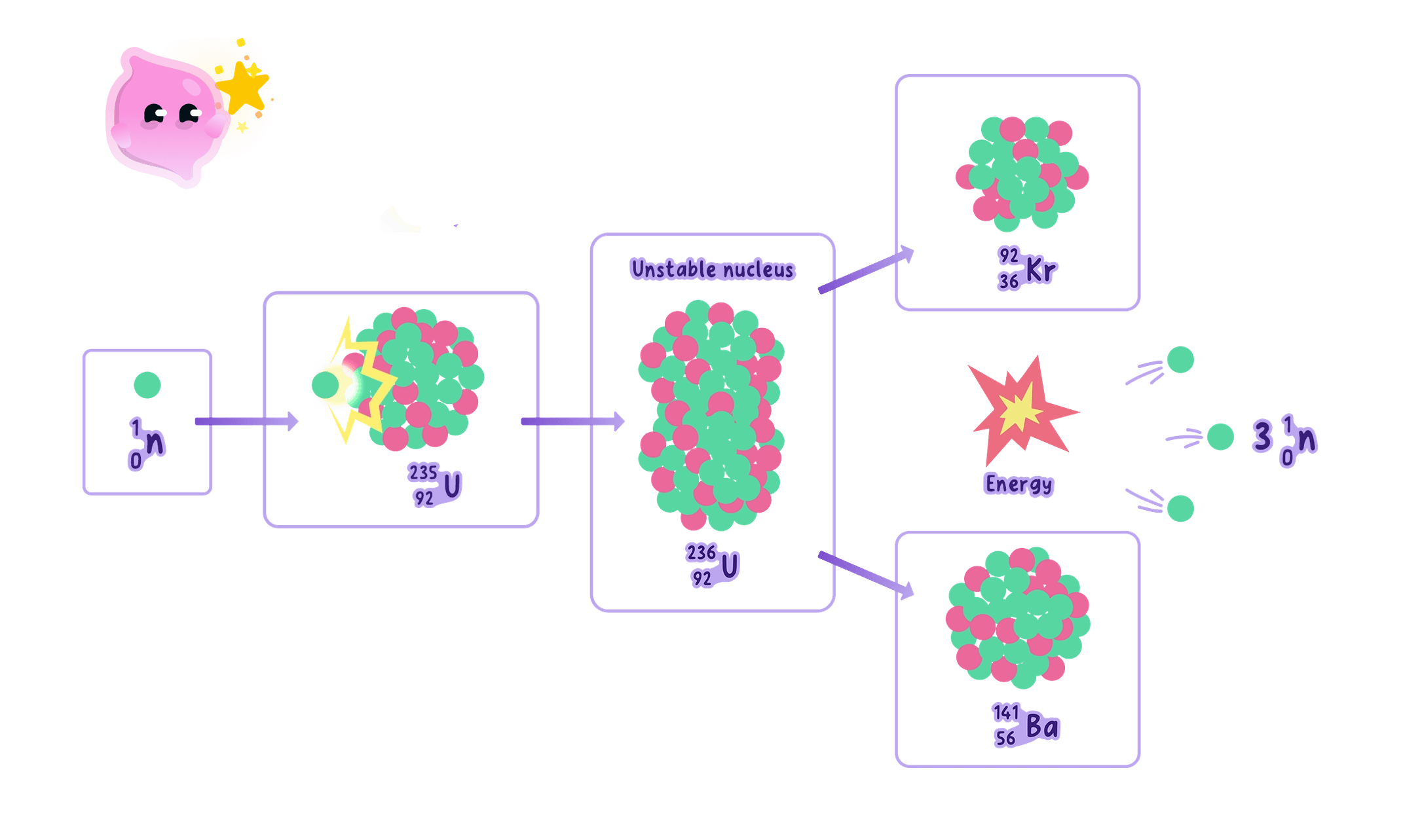
- A complete description of the fission of uranium-235 names three products: two daughter nuclei, two or more neutrons and energy.
- It also names the trigger: a neutron is absorbed first, and the nucleus becomes unstable before it splits.
Where the energy comes from
- Add up the masses of everything produced by one fission and the total is very slightly less than the mass of the uranium nucleus and the neutron that went in.
- That missing mass is the source of the energy released, so the reaction does not create energy from nothing.
- The fractional loss of mass is tiny, but because so many nuclei are involved the energy adds up to an enormous amount from a very small mass of fuel.
- One fission of uranium-235 releases roughly a million times as much energy as burning one carbon atom, which is the reason a nuclear station needs so little fuel.
Balancing a fission equation
- A uranium-235 nucleus absorbs a neutron and splits into strontium-90, one other nucleus and three neutrons, and the missing nuclide has to be identified.
- The unbalanced equation is 92235U+01n→3890Sr+ZAX+3 01n^{235}_{\ 92}\text{U}+^{1}_{0}\text{n}\rightarrow{}^{90}_{38}\text{Sr}+^{A}_{Z}\text{X}+3\,^{1}_{0}\text{n} 92235U+01n→3890Sr+ZAX+301n.
- Mass numbers must balance, so 235+1=90+A+3235+1=90+A+3235+1=90+A+3, which gives A=236−93=143A=236-93=143A=236−93=143.
- Atomic numbers must balance, so 92+0=38+Z+092+0=38+Z+092+0=38+Z+0, which gives Z=54Z=54Z=54.
- The element with atomic number 545454 is xenon, so the missing nuclide is 54143Xe^{143}_{\ 54}\text{Xe} 54143Xe.
- The balanced equation is 92235U+01n→3890Sr+ 54143Xe+3 01n^{235}_{\ 92}\text{U}+^{1}_{0}\text{n}\rightarrow{}^{90}_{38}\text{Sr}+^{143}_{\ 54}\text{Xe}+3\,^{1}_{0}\text{n} 92235U+01n→3890Sr+ 54143Xe+301n, and checking gives 90+143+3=23690+143+3=23690+143+3=236 and 38+54=9238+54=9238+54=92.
Describing fission for marks
- Write the stages in order and do not skip the middle one: a neutron is absorbed, the nucleus becomes unstable, it splits, neutrons are emitted, energy is released.
- Use the word nucleus throughout, because saying that the atom splits is not accepted.
- Write two or more neutrons rather than a fixed number, unless the question or the equation in front of you gives one.
- Always state that energy is released, since a description of the particles alone leaves out a marking point.
- In an equation question, balance the mass numbers first and the atomic numbers second, then use the periodic table to name the element from its atomic number.
- Do not write that the atom splits; it is the nucleus that splits, and the electrons are not part of the reaction.
- Do not say the neutron knocks the nucleus apart on impact; it is absorbed first, and the nucleus becomes unstable before it splits.
- Do not say the nucleus splits into two equal halves; the two daughter nuclei are usually of quite different sizes.
- Do not count the emitted neutrons as the daughter nuclei; they are separate products.
- Do not confuse fission with radioactive decay; decay happens without anything triggering it and does not produce two daughter nuclei of similar size.
- Do not confuse fission with fusion; fission splits a large nucleus while fusion joins small ones.
- State the difference between a nuclear reaction and a chemical reaction.
- Name the three nuclear processes that can be used as sources of energy.
- State how many protons and how many neutrons there are in a nucleus of 92235U^{235}_{\ 92}\text{U} 92235U.
- Describe, in order, what happens when a uranium-235 nucleus undergoes fission.
- Complete the equation 92235U+01n→ 56144Ba+ZAKr+2 01n^{235}_{\ 92}\text{U}+^{1}_{0}\text{n}\rightarrow{}^{144}_{\ 56}\text{Ba}+^{A}_{Z}\text{Kr}+2\,^{1}_{0}\text{n} 92235U+01n→ 56144Ba+ZAKr+201n by finding AAA and ZZZ.
- Explain where the energy released by a fission reaction comes from.
6.7.3 Controlled chain reactions and nuclear reactors
How a chain reaction builds
Chain reaction
A chain reaction is a sequence of fission reactions in which neutrons released by one fission cause further nuclei to undergo fission.
- Each fission of a uranium-235 nucleus throws out two or more neutrons, and those neutrons are what makes a chain reaction possible.
- If one of them is absorbed by another uranium-235 nucleus, that nucleus becomes unstable and splits in turn, releasing more neutrons and more energy.
- The reaction is therefore self-sustaining: once it has started, it supplies its own trigger and needs nothing from outside.
- Not every neutron goes on to cause a fission, because some escape from the edge of the fuel and some are absorbed by nuclei that do not split.
- What matters is therefore the average number of neutrons from each fission that go on to cause another fission, and everything about running a reactor comes down to holding that number where it is wanted.
Keeping the reaction steady
- If more than one neutron per fission causes a further fission, the number of fissions grows with every generation, so the rate of energy release rises faster and faster and the reaction runs away.
- If fewer than one does so, each generation is smaller than the one before, so the reaction dies out and the reactor shuts itself down.
- If exactly one does so, each generation is the same size as the last, so the number of fissions per second stays constant and energy is released at a steady rate.
- That last case is a controlled chain reaction, and it is the condition a power station holds its reactor in for months at a time.
- A steady rate of fission gives a steady rate of energy transfer, which is what allows a turbine and generator to run at a constant output.
- The whole principle of control is holding the average at one neutron per fission going on to cause the next fission.
- Above one the output climbs, below one it falls, and at one it stays where it is.
The moderator
Moderator
A moderator is the material in a reactor core that slows down fission neutrons so that they are more likely to be absorbed by fissile nuclei.
- The neutrons that come out of a fission are moving extremely fast, and a fast neutron is very likely to shoot past a uranium-235 nucleus without being captured.
- Left as they are, too few of them would be absorbed, so the chain reaction would not keep going.
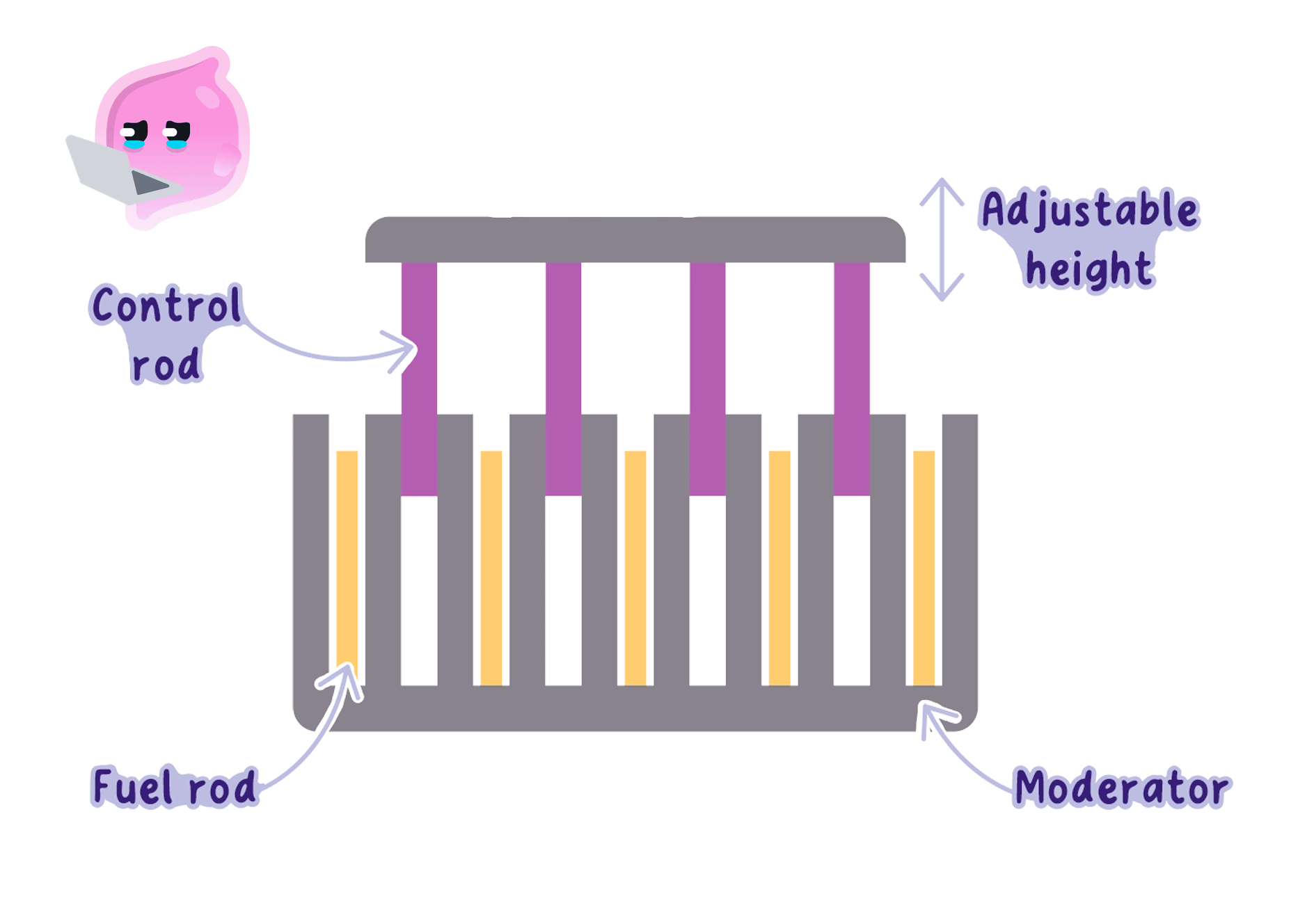
- The fuel rods are therefore surrounded by a moderator, usually blocks of graphite or a tank of water, filling the space between them.
- A neutron leaving a fuel rod collides many times with the nuclei of the moderator, and it transfers some of its kinetic energy at each collision.
- After enough collisions the neutron is travelling slowly, and a slow neutron spends far longer passing a nucleus, so it is much more likely to be absorbed.
- Slowed neutrons that wander back into a fuel rod are therefore absorbed by uranium-235 nuclei, and the chain reaction is sustained.
- The moderator slows neutrons down and does not absorb them, which is the single most important thing to keep straight in this topic.
The control rods
Control rod
A control rod is a movable rod in a reactor core that absorbs neutrons so that the rate of fission can be regulated.
- Control rods are made from a material that absorbs neutrons strongly without splitting, such as boron or cadmium.
- They hang between the fuel rods and can be raised and lowered by motors while the reactor is running.
- Every neutron a rod absorbs is one that can no longer reach a uranium-235 nucleus, so the rods set how many neutrons are left to keep the reaction going.
- Lowering the rods further in absorbs more neutrons, so fewer fissions happen each second and the rate of energy release falls.
- Raising the rods further out absorbs fewer neutrons, so more fissions happen each second and the rate of energy release rises.
- Detectors in the core measure the neutron level continuously and the rod position is adjusted automatically, which holds the average at one neutron per fission causing the next.
- In an emergency the rods are dropped fully into the core, absorbing so many neutrons that almost none reach a fuel nucleus and the chain reaction stops.
Why rod position matters so much
- In a reactor each fission of uranium-235 releases on average 2.52.52.5 neutrons.
- For a steady output, exactly 111 of those must go on to cause another fission.
- So on average 2.5−1=1.52.5-1=1.52.5−1=1.5 neutrons from each fission have to be removed, by absorption in the control rods, by absorption in other material, or by escaping from the core.
- Suppose the rods are raised slightly, so that 1.11.11.1 neutrons per fission now cause a further fission instead of 111.
- After 202020 generations the number of fissions per second has been multiplied by 1.120=6.71.1^{20}=6.71.120=6.7.
- A change of one tenth of a neutron per fission therefore raises the power output almost sevenfold, which is why the rod position is monitored and corrected automatically all the time.
From fission to electricity
Coolant
A coolant is the fluid pumped through a reactor core that transfers thermal energy away from the fuel.
- The energy released by the controlled chain reaction raises the thermal energy of the fuel rods, so the core becomes extremely hot.
- A coolant, usually water under high pressure or carbon dioxide gas, is pumped through the core and heated as it passes the fuel rods.
- The hot coolant flows to a heat exchanger, where it transfers thermal energy to water in a completely separate circuit before returning to the core.
- Keeping the two circuits separate matters, because the coolant has been through the reactor and must not be allowed to carry radioactive material out to the rest of the station.
- The water in the second circuit boils, producing high-pressure steam.
- The steam is directed onto the blades of a turbine and makes it spin.
- The turbine shaft turns a generator, which transfers energy electrically to the National Grid through transformers.
- The used steam is condensed back to water in a condenser cooled by river or sea water, and pumped round to be boiled again.
- The reactor is only the source of thermal energy, so from the heat exchanger onwards a nuclear station works in exactly the same way as a coal or gas station.
The products are radioactive
- The daughter nuclei left after a fission have too many neutrons for nuclei of their size, because they inherited a neutron-rich mixture from the much larger uranium nucleus.
- Those nuclei are unstable, so they undergo radioactive decay and emit ionising radiation, which is why the products of nuclear fission are radioactive.
- Used fuel taken out of the core is therefore intensely radioactive, and some of the isotopes in it stay active for a very long time.
- Parts of the reactor structure also become radioactive over the years, because their nuclei absorb neutrons and become unstable.
- Used fuel is therefore moved by remote handling behind thick shielding, and it is this radioactivity that creates the waste and decommissioning problems a nuclear station has to plan for.
Reactor questions worth full marks
- Name the component and give its action in the same sentence: the moderator slows the neutrons, the control rods absorb the neutrons.
- When you describe control, say which way the rods move, then what happens to the number of neutrons, then what happens to the rate of fission, then what happens to the energy output.
- For the electricity chain, name every stage in order and do not jump from the reactor to the generator; coolant, heat exchanger, steam, turbine and generator are separate marking points.
- Write thermal energy rather than heat energy, and say that the generator transfers energy electrically rather than that it makes electricity.
- If a question asks about the principle of a controlled chain reaction, the phrase the examiner wants is that on average one neutron from each fission goes on to cause another fission.
- Do not swap the two jobs over; the moderator slows neutrons and the control rods absorb them, and reversing this loses every mark in the question.
- Do not say the moderator slows the reaction down; it makes the chain reaction possible by making neutrons more likely to be absorbed.
- Do not say lowering the control rods speeds the reaction up; lowering them in absorbs more neutrons, so the reaction slows.
- Do not write that the reactor generates electricity directly; it heats a coolant, and a turbine and generator are still needed.
- Do not say the steam that turns the turbine has been through the core; it is boiled in a separate circuit at the heat exchanger.
- Do not describe the used fuel as safe once it has been removed from the reactor; the fission products are radioactive.
- Explain how the neutrons released by one fission can start a chain reaction.
- State the condition that makes a chain reaction controlled rather than growing or dying out.
- Explain why a moderator is needed and how it works.
- Describe what happens to the rate of fission when the control rods are lowered further into the core, and explain why.
- List, in order, the stages between fission in the core and electricity reaching the National Grid.
- Explain why the daughter nuclei produced by fission are radioactive.
6.7.4 Nuclear fusion
What happens in nuclear fusion
Nuclear fusion
Nuclear fusion is the joining of small nuclei to create a larger nucleus, with a loss of mass that is accompanied by a release of energy.
- In fusion, two small nuclei come together and merge into a single larger nucleus, so the number of particles bound into one nucleus goes up rather than down.
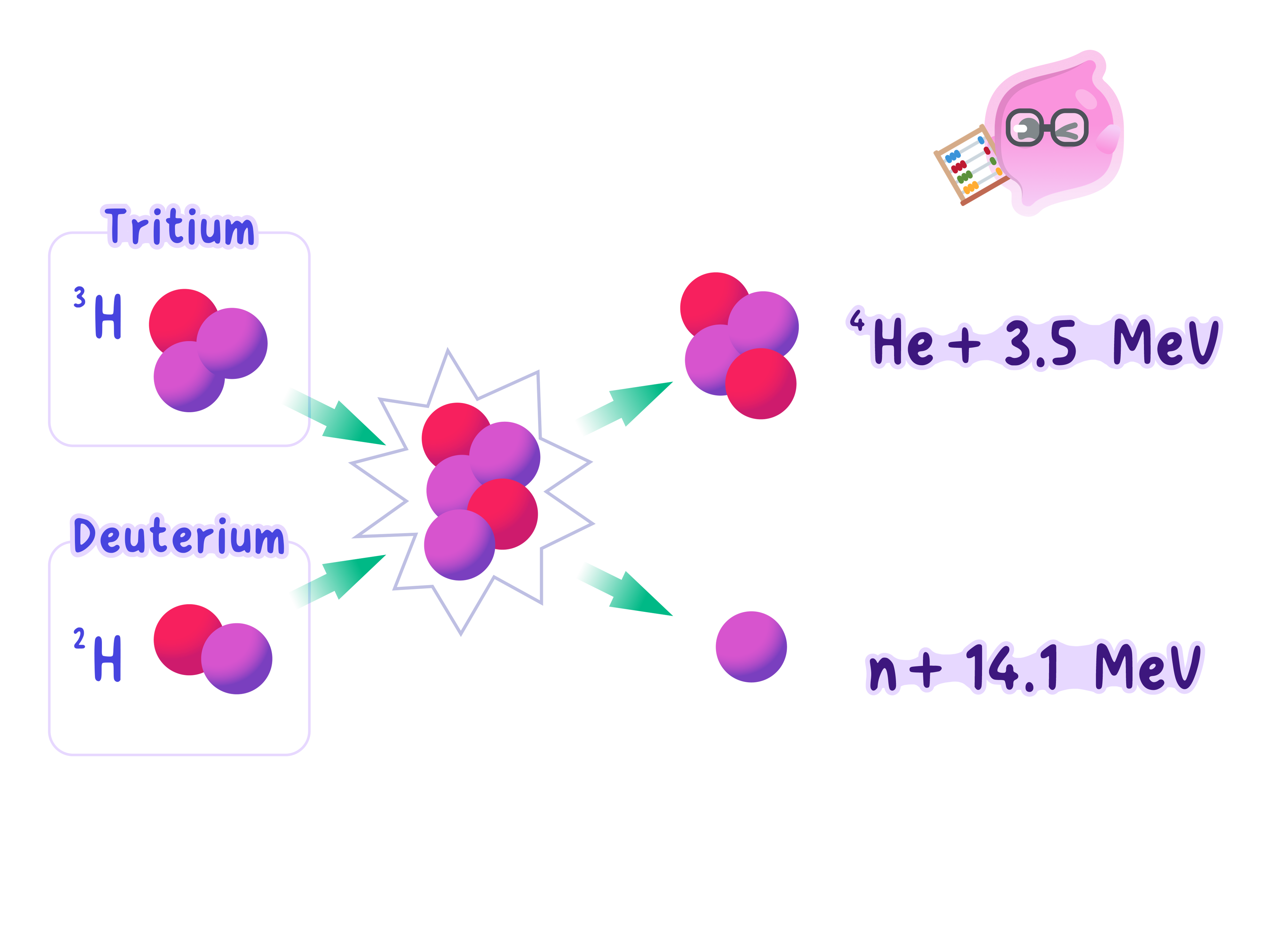
- The reaction most often used as an example joins two isotopes of hydrogen: deuterium, 12H^{2}_{1}\text{H}12H, which has one proton and one neutron, and tritium, 13H^{3}_{1}\text{H}13H, which has one proton and two neutrons.
- Written as a nuclear equation this is 12H+13H→24He+01n^{2}_{1}\text{H}+^{3}_{1}\text{H}\rightarrow{}^{4}_{2}\text{He}+^{1}_{0}\text{n}12H+13H→24He+01n.
- Both sides balance, because the mass numbers give 2+3=4+12+3=4+12+3=4+1 and the atomic numbers give 1+1=2+01+1=2+01+1=2+0.
- The larger nucleus created here is helium-4, and a spare neutron is left over that carries away most of the energy released.
- Fusion of small nuclei releases energy, and this holds for nuclei up to about the size of iron; joining nuclei larger than that would take energy in rather than give it out.
The loss of mass
- Weigh everything before the reaction and everything after it, and the total mass afterwards is very slightly smaller.
- No particles have gone missing, since the number of protons and the number of neutrons are both unchanged; it is the mass itself that has decreased.
- That loss of mass is where the released energy comes from, so mass and energy are two forms of the same thing rather than two separate quantities.
- The fraction of mass lost is extremely small, but the energy that appears is very large, which is why fusion releases more energy per kilogram of fuel than any chemical reaction and more even than fission.
- A full description of fusion therefore needs three linked statements: small nuclei join, a larger nucleus is created, and a loss of mass is accompanied by a release of energy.
- Fusion creates a larger nucleus from smaller ones.
- The products together are slightly lighter than the nuclei that went in, and that loss of mass is accompanied by the release of energy.
Balancing a fusion equation
- Two deuterium nuclei fuse to form a helium-3 nucleus and one other particle, which has to be identified: 12H+12H→23He+ZAX^{2}_{1}\text{H}+^{2}_{1}\text{H}\rightarrow{}^{3}_{2}\text{He}+^{A}_{Z}\text{X}12H+12H→23He+ZAX.
- Balancing the mass numbers gives 2+2=3+A2+2=3+A2+2=3+A, so A=1A=1A=1.
- Balancing the atomic numbers gives 1+1=2+Z1+1=2+Z1+1=2+Z, so Z=0Z=0Z=0.
- A particle with mass number 111 and no charge is a neutron, so the equation is 12H+12H→23He+01n^{2}_{1}\text{H}+^{2}_{1}\text{H}\rightarrow{}^{3}_{2}\text{He}+^{1}_{0}\text{n}12H+12H→23He+01n.
- Adding the masses before the reaction gives 2×2.0141=4.02822\times2.0141=4.02822×2.0141=4.0282 atomic mass units.
- Adding the masses afterwards gives 3.0160+1.0087=4.02473.0160+1.0087=4.02473.0160+1.0087=4.0247 atomic mass units.
- The loss of mass is 4.0282−4.0247=0.00354.0282-4.0247=0.00354.0282−4.0247=0.0035 atomic mass units, and it is this missing mass that is released as energy.
Fusion in stars
- A star is a vast ball of gas that is mostly hydrogen, and in its core hydrogen nuclei fuse to form helium.
- Every one of those reactions involves a small loss of mass, so every one releases energy, and an enormous number of them happen every second.
- The energy released keeps the core extremely hot and eventually works its way out to the surface, from where the star radiates it away as light, infrared and other electromagnetic radiation.
- Fusion is therefore the energy source for stars, including the Sun, and all the energy arriving at the Earth as sunlight was released by fusion in the Sun's core.
- Because mass is lost in each reaction, the Sun is very slowly getting lighter as it shines, even though it is losing only a tiny fraction of its mass over its whole lifetime.
- Fusion in stars also builds the heavier elements, so the carbon, oxygen and nitrogen in your body were made inside stars that existed before the Sun.
Fusion compared with fission
Nuclear fission
Nuclear fission is the splitting of a large unstable nucleus into two smaller daughter nuclei, with the emission of two or more neutrons and a release of energy.
- Fusion and fission are both nuclear reactions, so both change the nuclei of atoms rather than rearranging their electrons.
- Both release energy, and in both cases the energy comes from a small loss of mass between the particles going in and the particles coming out.
- The difference that defines them is the direction of the change: fusion joins small nuclei into a larger one, whereas fission splits one large nucleus into smaller ones.
- The fuels are at opposite ends of the periodic table: fusion uses the lightest nuclei, such as isotopes of hydrogen, while fission uses the heaviest, such as uranium.
- Fission has to be started by a neutron being absorbed, whereas fusion happens only where nuclei are already being driven together under extreme conditions.
- The products differ too: the daughter nuclei from fission are radioactive, while the helium produced by fusion is a stable, harmless gas.
- Where each one is found also differs: fission is what runs nuclear power stations on the Earth today, and fusion is what powers every star.
Describing and comparing fusion
- For a description of fusion, give all three points: small nuclei join, a larger nucleus is created, and the loss of mass is accompanied by a release of energy.
- Use the word nuclei, not atoms, because it is the nuclei that join and the electrons play no part.
- For a compare question, write one clear similarity and then the key difference in the same sentence structure, for example that both release energy but fusion joins nuclei while fission splits one.
- If the context is a star, say explicitly that fusion is the energy source for stars, since that statement is often a mark on its own.
- In an equation question, balance the mass numbers and the atomic numbers separately, and remember that a neutron is written 01n^{1}_{0}\text{n}01n.
- Do not confuse the two words; fusion joins small nuclei and fission splits a large nucleus.
- Do not say that energy is created from nothing; a small amount of mass is lost and that loss is accompanied by the release of energy.
- Do not say particles disappear during fusion; the protons and neutrons are all still there in the products.
- Do not write that the Sun burns hydrogen; burning is a chemical reaction and could not supply anything like the energy a star radiates.
- Do not say fusion needs a neutron to start it; that is fission, and the two are triggered in completely different ways.
- Describe nuclear fusion in three linked statements.
- Write the balanced equation for the fusion of deuterium and tritium.
- Explain where the energy released by a fusion reaction comes from.
- Explain why fusion is described as the energy source for stars.
- Give one similarity and three differences between nuclear fusion and nuclear fission.
- State which kinds of nuclei are used as fuel in fusion and which in fission.
6.7.5 Conditions for fusion
Why nuclei resist joining
Electrostatic repulsion
Electrostatic repulsion is the force that pushes apart two objects carrying the same type of electric charge.
- Every nucleus contains protons, and protons carry positive charge, so every nucleus is positively charged.
- Two objects with the same type of charge repel each other, so two nuclei approaching one another push each other apart.
- That repulsive force gets rapidly stronger as the separation gets smaller, so the closer the nuclei get, the harder they are pushed back.
- The attractive force that would hold the two nuclei together once they merge acts only over an extremely short range, roughly the width of a nucleus itself.
- So the two nuclei have to be forced right up against each other before that attraction can take over, and the electrostatic repulsion is fighting them the whole way in.
- Getting that close means the nuclei must arrive with a great deal of kinetic energy, because that energy is used up doing work against the repulsion as they approach.
- This is why fusion needs extreme conditions and does not simply happen in a container of hydrogen gas on a laboratory bench.
Why the temperature must be high
- Temperature is a measure of the average kinetic energy of the particles in a substance.
- Raising the temperature therefore makes the nuclei move faster, and a faster nucleus arrives at a collision with more kinetic energy to spend.
- At a very high temperature, enough nuclei have enough kinetic energy to overcome the electrostatic repulsion and get close enough to fuse.
- At a low temperature the nuclei move slowly, so they run out of kinetic energy while they are still far apart and the repulsion pushes them back before they can touch.
- The temperatures involved run to tens of millions of degrees, far hotter than anything a flame or a furnace can reach.
- At those temperatures the atoms have long since lost their electrons, so the fuel is a plasma of bare nuclei and free electrons rather than a gas of atoms.
Why the pressure must be high
- High pressure squeezes the fuel into a smaller volume, so there are far more nuclei packed into each cubic metre.
- Nuclei that are packed closely together travel a much shorter distance before meeting another one, so collisions happen far more often.
- This matters because even in a very hot plasma only a small fraction of collisions actually result in fusion, so a large number of collisions per second is needed to give a useful rate of energy release.
- At low pressure the nuclei are spread thinly, so collisions are rare and almost no fusion happens even if the nuclei are moving fast enough.
- The two conditions do different jobs and neither replaces the other: temperature decides whether a collision can lead to fusion, and pressure decides how many collisions there are.
- In the core of the Sun both conditions are supplied free by gravity, because the weight of the layers above squeezes the core to an enormous pressure and keeps it enormously hot.
- High temperature gives the nuclei enough kinetic energy to overcome the electrostatic repulsion between their positive charges.
- High pressure packs the nuclei closer together so that collisions happen often enough for a useful amount of fusion.
Building a fusion power station
- A power station on Earth cannot reach anything like the pressure at the centre of the Sun, so it has to make up for that with an even higher temperature, above a hundred million degrees.
- Reaching that temperature takes a very large energy input before any fusion happens at all.
- No solid container can hold the plasma, because any material touching it would melt or vaporise, and the contact would also cool the plasma below the temperature fusion needs.
- The plasma is therefore held away from the walls by powerful magnetic fields inside a ring-shaped vessel, which works because a plasma is made of charged particles.
- The magnets, the heating equipment and the vacuum vessel are all complex and expensive, and running the magnets uses a great deal of electricity of its own.
- A plasma at these conditions is also difficult to hold steady, because small disturbances grow quickly and can end the reaction in a fraction of a second.
- A power station must keep the conditions going continuously, not for a few seconds at a time, because the electricity supply has to be constant.
- The fast neutrons produced by the reaction damage the inner walls over time and make them radioactive, so parts must be replaced and eventually disposed of.
- The economic test is strict: the station must generate enough electricity to pay back the energy used to heat and confine the plasma, and to cover the cost of building, running and repairing it, and still have electricity left to sell.
- Individual fusion reactions releasing energy is not enough, and no fusion reactor has yet supplied electricity to a grid, which is why fusion is still an area of research rather than a working power source.
Testing the energy balance
- In one pulse of an experimental reactor, 50 MJ50\ \text{MJ}50 MJ of energy is supplied to heat and confine the plasma, and the fusion reactions release 60 MJ60\ \text{MJ}60 MJ.
- More energy comes out than goes in, since 6050=1.2\dfrac{60}{50}=1.25060=1.2, so at first sight the reactor appears to be a net source of energy.
- That energy still has to be turned into electricity through a coolant, a turbine and a generator, and only about 40%40\%40% of it survives that chain.
- The useful electrical output is therefore 0.40×60=24 MJ0.40\times60=24\ \text{MJ}0.40×60=24 MJ.
- That is less than the 50 MJ50\ \text{MJ}50 MJ that was put in, so the reactor uses more electricity than it delivers.
- To break even, the fusion energy needed is 500.40=125 MJ\dfrac{50}{0.40}=125\ \text{MJ}0.4050=125 MJ, which is more than twice the current output, and a station also has to cover its construction and repair costs on top of that.
Explaining the conditions for fusion
- Start from the charge: nuclei contain protons, protons are positive, so two nuclei repel each other electrostatically.
- Then attach each condition to its own consequence: high temperature gives greater kinetic energy to overcome the repulsion, high pressure gives more frequent collisions.
- Where a question asks why fusion does not happen at low temperature and pressure, answer both halves, because there is normally a mark for each.
- For the power station question, link the conditions to a practical problem and then to money, for example that containing the plasma needs powerful magnets, which are expensive to build and to run.
- Use the word because at every step, since the marks are for the causal links rather than for naming the conditions.
- Do not say that high pressure gives the nuclei the energy to overcome the repulsion; that is what high temperature does.
- Do not say that nuclei repel because they are heavy or because of gravity; the repulsion is electrostatic and comes from their positive charge.
- Do not say that electrons repel the nuclei; at these temperatures the electrons have already been stripped away.
- Do not claim fusion is impossible; it happens in stars and in experimental reactors, and the difficulty is making it produce more useful energy than it consumes.
- Do not answer the economic question by saying only that fusion is expensive; say what makes it expensive and why the output has to exceed the input.
- Explain why two nuclei repel each other as they approach.
- Explain why fusion does not happen at a low temperature.
- Explain why fusion does not happen at a low pressure, even if the nuclei are hot.
- State how the conditions needed for fusion are produced in the core of the Sun.
- Explain why the plasma in a fusion reactor cannot be held in an ordinary container.
- Give two reasons why a fusion power station is difficult to make economic.
