1.2.2a Efficiency of an energy transfer
Efficiency of an energy transfer
Definition
Efficiency
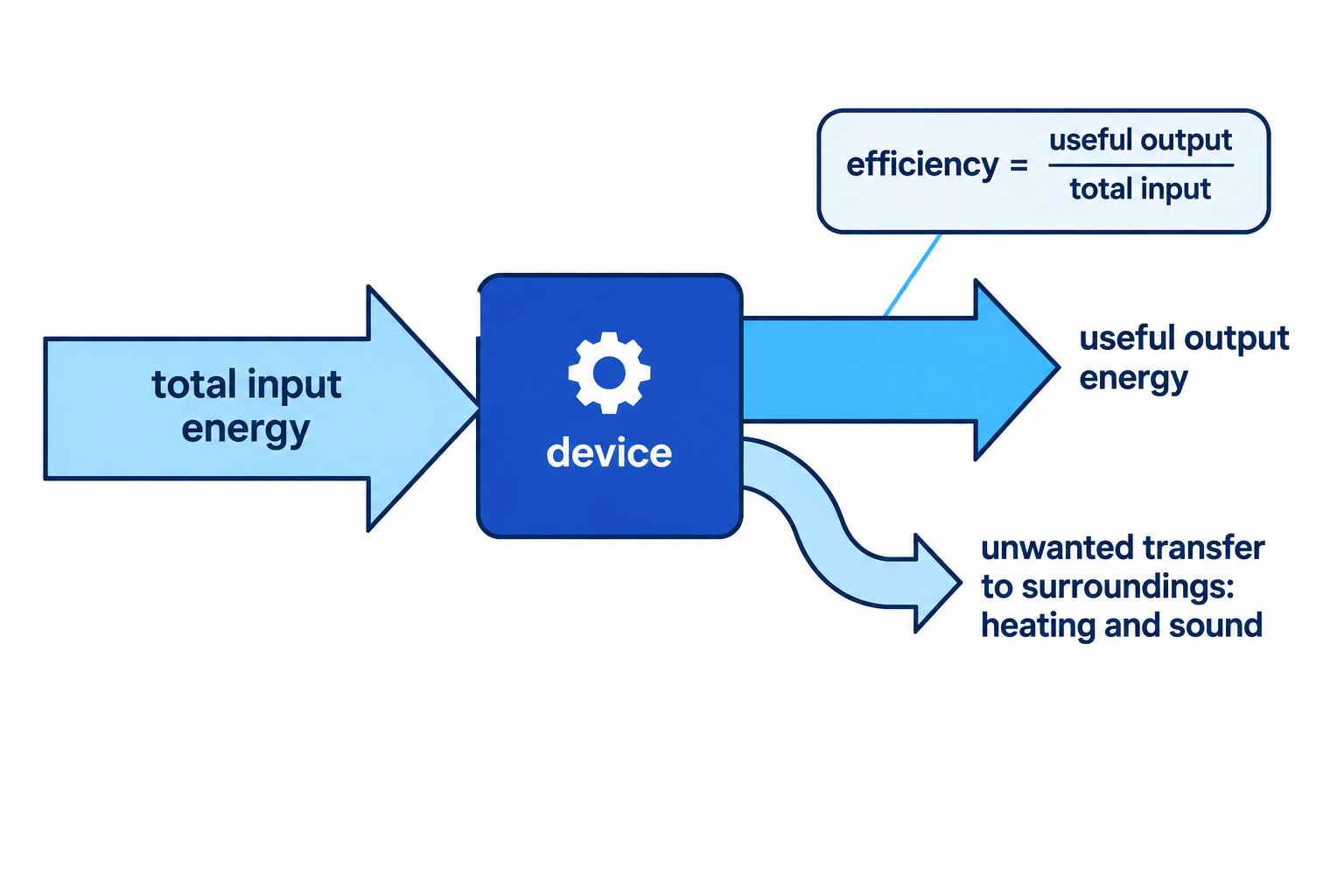
Efficiency is the proportion of the total input energy transfer that is usefully transferred.
- In any device, some input energy is transferred usefully and some in less useful ways, and the efficiency tells you how good it is at the intended transfer.
- Calculate it with efficiency=useful output energy transfertotal input energy transfer\text{efficiency} = \frac{\text{useful output energy transfer}}{\text{total input energy transfer}}efficiency=total input energy transferuseful output energy transfer.
- Both energy values must be in the same unit, usually joules, J\text{J}J.
- For example, a useful output of 60 J60\ \text{J}60 J from a total input of 100 J100\ \text{J}100 J gives 60100=0.60\frac{60}{100} = 0.6010060=0.60, or 60%60\%60%.
Example
- A motor draws 500 J500\ \text{J}500 J from the supply and usefully transfers 125 J125\ \text{J}125 J to lift a load; find its efficiency.
- Write the equation: efficiency=useful outputtotal input\text{efficiency} = \frac{\text{useful output}}{\text{total input}}efficiency=total inputuseful output.
- Substitute the values: efficiency=125500\text{efficiency} = \frac{125}{500}efficiency=500125.
- Calculate: efficiency=0.25\text{efficiency} = 0.25efficiency=0.25, which is 0.25×100=25%0.25 \times 100 = 25\%0.25×100=25%.
Efficiency using power
- You can also calculate efficiency from power, since power is the rate of energy transfer.
- Use efficiency=useful power outputtotal power input\text{efficiency} = \frac{\text{useful power output}}{\text{total power input}}efficiency=total power inputuseful power output.
- Both powers must be in the same unit, watts, W\text{W}W.
- This version is handy when a question gives the electrical power supplied to a device and the useful power output from it.
Example
- A lamp has a total power input of 40 W40\ \text{W}40 W and a useful power output as light of 8 W8\ \text{W}8 W; find its efficiency as a percentage.
- Write the equation: efficiency=useful power outputtotal power input\text{efficiency} = \frac{\text{useful power output}}{\text{total power input}}efficiency=total power inputuseful power output.
- Substitute the values: efficiency=840\text{efficiency} = \frac{8}{40}efficiency=408.
- Calculate: efficiency=0.20\text{efficiency} = 0.20efficiency=0.20, which is 0.20×100=20%0.20 \times 100 = 20\%0.20×100=20%.
Decimal and percentage efficiencies
- Efficiency can be written as a decimal or as a percentage.
- Convert a decimal to a percentage by multiplying by 100100100, so 0.72×100=72%0.72 \times 100 = 72\%0.72×100=72%.
- Convert a percentage to a decimal by dividing by 100100100, so 85%=85100=0.8585\% = \frac{85}{100} = 0.8585%=10085=0.85.
- A decimal efficiency is normally between 000 and 111, and a percentage efficiency between 0%0\%0% and 100%100\%100%.
Common Mistake
- Do not swap the useful output and total input: the useful output goes on top, the total input on the bottom.
- Do not treat 0.60.60.6 and 0.6%0.6\%0.6% as the same: 0.60.60.6 as a decimal is 60%60\%60%, whereas 0.6%0.6\%0.6% is only 0.0060.0060.006.
Exam technique
- Show the correct efficiency equation and substitute the useful output and total input correctly.
- Give the answer as a decimal or a percentage, whichever the question asks for; efficiency itself has no unit.
- If a percentage is asked for, multiply the decimal by 100100100 and add the %\%% symbol.
Self review
- What does the efficiency of a device tell you?
- Write the efficiency equation using energy.
- Write the efficiency equation using power, and give the unit of each power.
- How do you convert a decimal efficiency to a percentage?
- Which quantity goes on the top of the efficiency fraction?
1.2.2b Increasing the efficiency of an energy transfer
Increasing the efficiency of an intended energy transfer
Definition
Efficiency
Efficiency is a measure of how much of the input energy is transferred usefully.
- A transfer is more efficient when a greater proportion of the input energy goes to the intended, useful output.
- No device is perfectly efficient, because some energy is always transferred to unwanted stores, often heating the surroundings.
- In a car engine, the useful transfer fills the kinetic store of the car, while some energy also goes to the surroundings by heating and sound.
Key Idea
To increase efficiency, reduce unwanted energy transfers so that more of the input energy is transferred usefully.
Reducing energy wasted by friction
- One common way to raise efficiency is to reduce the friction between moving parts.
- Friction transfers energy by heating to the thermal stores of the parts and surroundings, where it spreads out and becomes less useful.
- Lubricating with oil or grease forms a slippery layer between the surfaces, so less work is done against friction and less energy is dissipated by heating.
- Everyday examples include oil in a car engine, grease on a bicycle chain, bearings in wheels, and smooth surfaces in moving mechanisms.
- A full answer links the steps: lubrication reduces friction, so less energy is transferred by heating to the surroundings, so a greater proportion of the input is transferred usefully, so the efficiency increases.
Reducing unwanted thermal transfers
- Another way to raise efficiency is to reduce unwanted thermal transfers to the surroundings.
- This helps when the intended transfer is heating something, such as water in a kettle or a house in winter, because less energy leaks away.
- Thermal insulation cuts this unwanted heating: insulated kettle sides, loft insulation in a house, and a jacket around a hot water tank all keep more energy where it is wanted.
- The idea is always the same: reducing unwanted thermal transfer leaves more energy available for the useful transfer.
Improving the design for the intended transfer
- The design of a device also affects its efficiency, because a better design directs more energy into the useful output.
- A streamlined vehicle loses less energy to air resistance, so more of the engine's energy maintains the vehicle's kinetic store.
- In an electrical device, reducing unnecessary resistance cuts the energy wasted heating the wires, so more reaches the useful output.
- You do not need engineering detail; focus on the physics reason that the design reduces unwanted energy transfers.
Common Mistake
- Do not say energy is "lost" as if it disappeared, because energy is conserved.
- In an inefficient transfer, energy is dissipated to the surroundings, usually by heating or sound, so it becomes less useful.
Exam technique
- Do not just name a method like "use oil" or "add insulation"; explain the chain of reasoning.
- Name the method, then the unwanted transfer it reduces, then where less energy is dissipated.
- Finish by saying the useful transfer is now a greater proportion of the input, which is what shows you understand efficiency.
Self review
- What does it mean for an energy transfer to be more efficient?
- Why can no device be perfectly efficient?
- How does lubrication increase efficiency?
- How does thermal insulation increase efficiency when the useful transfer is heating?
- In a "describe how to increase efficiency" answer, what final link shows you understand efficiency?