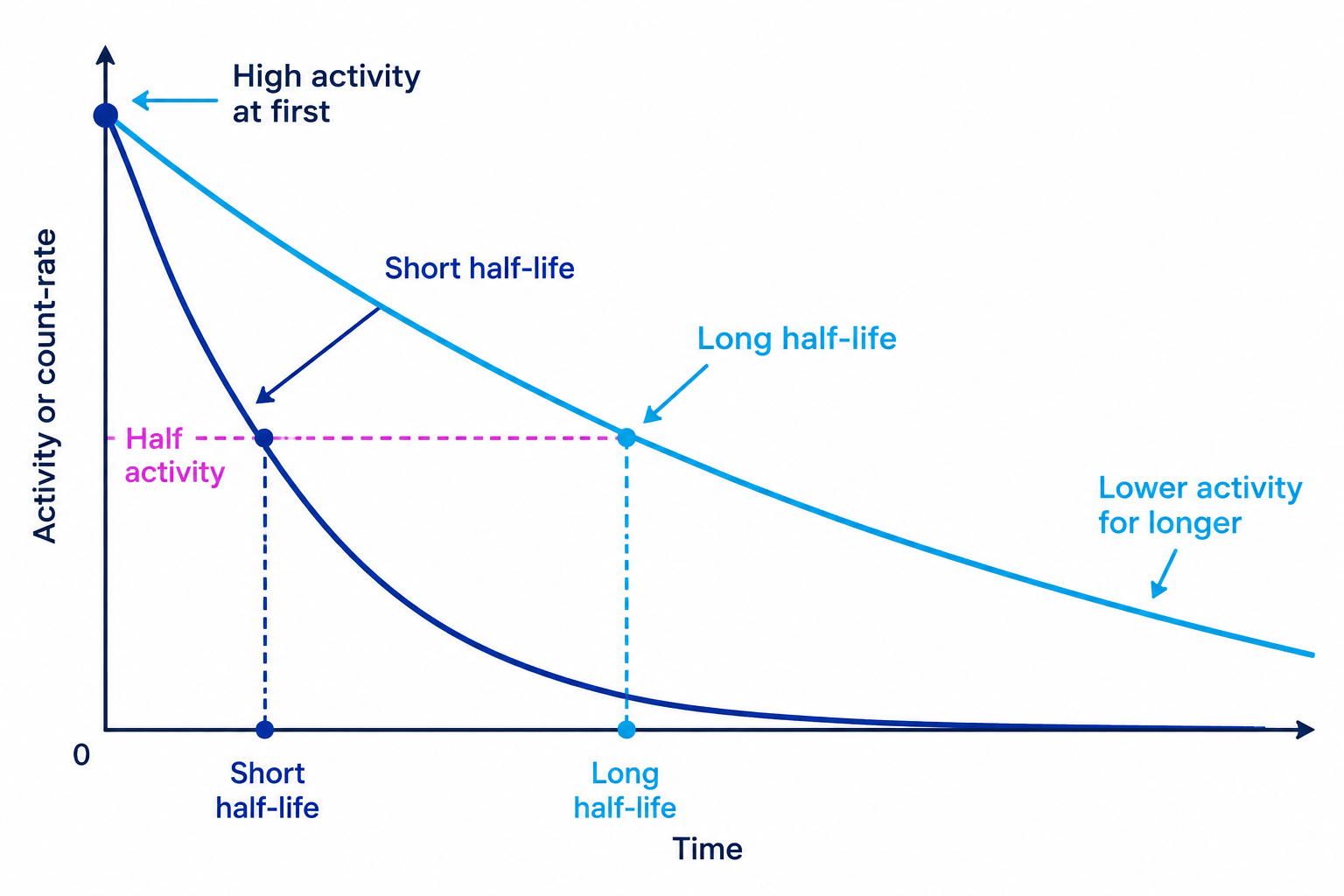
Half-lives vary enormously, and that changes the hazard
Definition
Half-life
The time taken for the count-rate (or activity) of a radioactive source to fall to half its starting value.
- Radioactive isotopes have half-lives that range from fractions of a second to billions of years.
- The half-life affects how active a source is and how long it stays a hazard.
A short half-life means high activity that does not last long
- An isotope with a short half-life decays quickly, so at first it gives out a lot of radiation and has a high activity.
- It becomes safe relatively quickly, because most of its unstable nuclei have soon decayed.
A long half-life means lower activity but a hazard that lasts
- An isotope with a long half-life decays slowly, so its activity at any moment is lower.
- It stays radioactive for a very long time, so it remains a hazard far into the future, which is why some radioactive waste is difficult to store.
Common Mistake
- A long half-life does not mean more dangerous right now: it means lower activity but a hazard that lasts much longer.
- A short half-life means intense radiation at first, but the danger passes relatively quickly.
Self review
- Roughly what range do the half-lives of radioactive isotopes cover?
- Why does an isotope with a short half-life have a high activity at first?
- Why does an isotope with a long half-life stay a hazard for a long time?
- Which type of isotope is harder to store safely as waste, and why?