Bounds
What you'll learn
- How to find lower and upper bounds from rounded measurements.
- How to choose the correct bounds for area, perimeter, circles and formulae.
- How to handle bounds with division, square roots and Pythagoras.
- How to decide a “suitable degree of accuracy” using bounds.
1. Why bounds exist
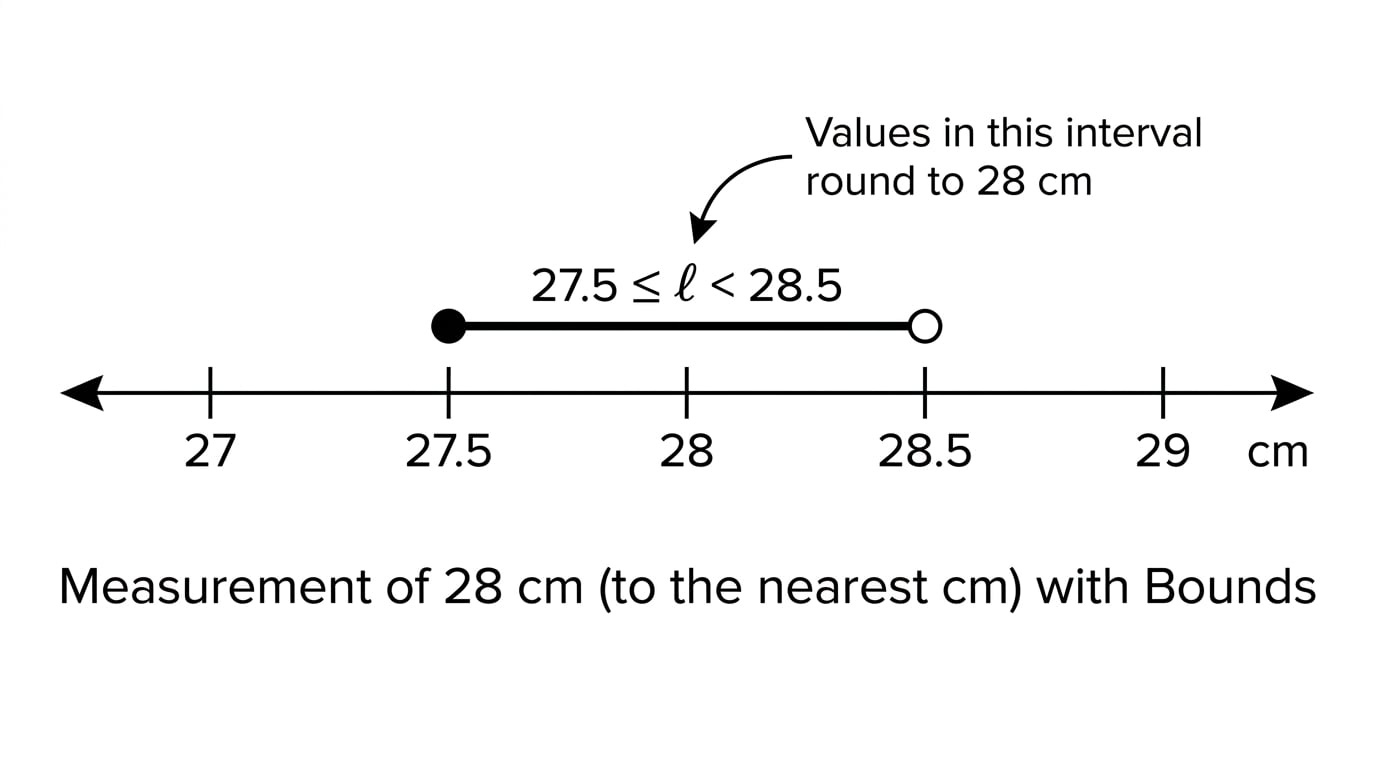
When a number has been rounded, it is not usually the exact value. For example, a length written as 28 cm to the nearest cm could actually be a little smaller or a little larger.
Bounds
- A lower bound is the smallest possible value before rounding.
- An upper bound is the largest boundary value before rounding.
- The real value is normally written as an interval, such as 27.5≤l<28.527.5 \le l < 28.527.5≤l<28.5.
The upper bound is written with < because the exact upper boundary would round up to the next value. In calculations, we still use that boundary value to find the upper bound of an answer.
Finding the half-gap
Look at the rounding amount, then halve it.
- Nearest cm means a gap of 1 cm, so the half-gap is 0.5 cm.
- Nearest 5 m means a gap of 5 m, so the half-gap is 2.5 m.
- Correct to 2 decimal places means a gap of 0.01, so the half-gap is 0.005.
- Nearest mm, when working in cm, means a gap of 0.1 cm, so the half-gap is 0.05 cm.
Finding bounds from rounding
A plank is 28 cm to the nearest cm. A strip is 7.6 cm to the nearest mm. Find the bounds for each measurement.

-
For 28 cm to the nearest cm, subtract and add 0.5 cm.
-
Write the interval for the length:
27.5≤l<28.527.5 \le l < 28.527.5≤l<28.5 -
For 7.6 cm to the nearest mm, remember that 1 mm is 0.1 cm, so the half-gap is 0.05 cm.
-
Write the interval for the width:
7.55≤w<7.657.55 \le w < 7.657.55≤w<7.65
Mixing up mm and cm
If a measurement is written in cm but rounded to the nearest mm, use 0.05 cm as the half-gap, not 0.5 cm.
2. Bounds in geometry
For positive lengths, areas and perimeters, the idea is usually straightforward:
Use small values for a lower answer and large values for an upper answer
For addition and multiplication with positive measurements, the lower bound comes from lower measurements, and the upper bound comes from upper measurements.
Rectangle: upper perimeter and lower area
A rectangle has length 19 cm to the nearest cm and width 6.4 cm to the nearest mm. Find the upper bound for its perimeter and the lower bound for its area.

-
Write the bounds for both measurements, all in cm:
18.5≤l<19.56.35≤w<6.45\begin{aligned} 18.5 &\le l < 19.5\\ 6.35 &\le w < 6.45 \end{aligned}18.56.35≤l<19.5≤w<6.45 -
For the upper bound of the perimeter, use the upper length and upper width:
Pupper=2(19.5+6.45)=51.9P_{\text{upper}} = 2(19.5+6.45)=51.9Pupper=2(19.5+6.45)=51.9 -
For the lower bound of the area, use the lower length and lower width:
Alower=18.5×6.35=117.475A_{\text{lower}} = 18.5 \times 6.35=117.475Alower=18.5×6.35=117.475 -
The answers are 51.9 cm for the upper perimeter and 117.475 cm² for the lower area.
Circles
For circles, the radius controls both circumference and area.
Use:
C=2πrC=2\pi rC=2πrand
A=πr2A=\pi r^2A=πr2Circle bounds
A circle has radius 7.2 cm correct to 1 decimal place. Find the lower bound for its circumference and the upper bound for its area, in terms of π\piπ.

-
Since 7.2 is correct to 1 decimal place, the half-gap is 0.05 cm.
-
Write the radius bounds:
7.15≤r<7.257.15 \le r < 7.257.15≤r<7.25 -
For the lower circumference, use the lower radius:
Clower=2π(7.15)=14.3πC_{\text{lower}}=2\pi(7.15)=14.3\piClower=2π(7.15)=14.3π -
For the upper area, use the upper radius:
Aupper=π(7.25)2=52.5625πA_{\text{upper}}=\pi(7.25)^2=52.5625\piAupper=π(7.25)2=52.5625π
Keep exact if asked
If the question says “in terms of π\piπ”, leave π\piπ in your answer. Do not multiply by 3.142 unless a decimal answer is requested.
3. Bounds in formulae
Many bounds questions use formulae such as v=stv=\frac{s}{t}v=ts or V=IRV=IRV=IR.
For positive values:
- To make a product bigger, use upper bound times upper bound.
- To make a product smaller, use lower bound times lower bound.
- To make a fraction bigger, use the upper numerator and the lower denominator.
- To make a fraction smaller, use the lower numerator and the upper denominator.
Division direction
For an upper bound of a fraction, do not use the upper bound of the denominator. A smaller denominator makes the fraction larger.
Upper bound for speed
A distance is 6.48 m correct to 2 decimal places. A time is 2.37 s correct to 2 decimal places. Given v=stv=\frac{s}{t}v=ts, find the upper bound for vvv to 3 decimal places.

-
Find the bounds:
6.475≤s<6.4852.365≤t<2.375\begin{aligned} 6.475 &\le s < 6.485\\ 2.365 &\le t < 2.375 \end{aligned}6.4752.365≤s<6.485≤t<2.375 -
To maximise vvv, use the largest distance and the smallest time.
-
Calculate the upper bound:
vupper=6.4852.365=2.742071…v_{\text{upper}}=\frac{6.485}{2.365}=2.742071\ldotsvupper=2.3656.485=2.742071… -
To 3 decimal places, the upper bound is 2.742.
4. Bounds with Pythagoras
Pythagoras' theorem
In a right-angled triangle, if ccc is the hypotenuse, then c2=a2+b2c^2=a^2+b^2c2=a2+b2. The hypotenuse is the longest side, opposite the right angle.

If you are finding the lower bound for the hypotenuse, use the lower bounds of the two shorter sides.
But if you are finding a shorter side, rearrange first:
b=c2−a2b=\sqrt{c^2-a^2}b=c2−a2Now subtraction matters. To make bbb as small as possible, use the lower bound of ccc and the upper bound of aaa.
Lower bound for a missing side
In a right-angled triangle, a=4.6a=4.6a=4.6 cm correct to the nearest mm and c=10c=10c=10 cm correct to the nearest cm. Find the lower bound for bbb to 1 decimal place, where ccc is the hypotenuse.

-
Write the relevant bounds:
4.55≤a<4.659.5≤c<10.5\begin{aligned} 4.55 &\le a < 4.65\\ 9.5 &\le c < 10.5 \end{aligned}4.559.5≤a<4.65≤c<10.5 -
Rearrange Pythagoras:
b=c2−a2b=\sqrt{c^2-a^2}b=c2−a2 -
For the lower bound of bbb, use c=9.5c=9.5c=9.5 and a=4.65a=4.65a=4.65.
-
Calculate:
blower=9.52−4.652=68.6275=8.284…b_{\text{lower}}=\sqrt{9.5^2-4.65^2}=\sqrt{68.6275}=8.284\ldotsblower=9.52−4.652=68.6275=8.284… -
To 1 decimal place, the lower bound is 8.3 cm.
5. Suitable degree of accuracy
Sometimes you are asked to find a value “to a suitable degree of accuracy”. This means you must calculate both the lower and upper bounds of the final answer, then see what rounding is guaranteed.
Suitable degree of accuracy
A suitable degree of accuracy is a rounding level where every possible value between the lower and upper bounds rounds to the same answer.
Choosing a suitable accuracy
Given p=FAp=\frac{F}{A}p=AF, where F=30.42F=30.42F=30.42 correct to 2 decimal places and A=5.67A=5.67A=5.67 correct to 3 significant figures, find ppp to a suitable degree of accuracy.

-
Write the bounds:
30.415≤F<30.4255.665≤A<5.675\begin{aligned} 30.415 &\le F < 30.425\\ 5.665 &\le A < 5.675 \end{aligned}30.4155.665≤F<30.425≤A<5.675 -
For the lower value of ppp, use lower FFF and upper AAA. For the upper value of ppp, use upper FFF and lower AAA.
-
Calculate both bounds:
plower=30.4155.675≈5.359pupper=30.4255.665≈5.371\begin{aligned} p_{\text{lower}}&=\frac{30.415}{5.675}\approx 5.359\\ p_{\text{upper}}&=\frac{30.425}{5.665}\approx 5.371 \end{aligned}plowerpupper=5.67530.415≈5.359=5.66530.425≈5.371 -
These do not both round to the same value to 2 decimal places, because they give 5.36 and 5.37.
-
They do both round to 5.4 to 2 significant figures, so a suitable answer is p=5.4p=5.4p=5.4 to 2 significant figures.
In the exam
-
Underline the rounding phrase first: nearest cm, nearest 5 m, 2 d.p., or 3 significant figures.
-
Write the bounds for each given value before substituting into a formula.
-
For fractions and subtractions, think carefully about which choice makes the final answer bigger or smaller.
Check yourself
- What are the bounds for 58.0 cm correct to the nearest millimetre?
- For Q=xyQ=\frac{x}{y}Q=yx, with positive xxx and yyy, which bounds give the upper value of QQQ?
- In b=c2−a2b=\sqrt{c^2-a^2}b=c2−a2, which bound of aaa would you use to find the lower bound of bbb?