What you'll learn
- When to use the Cosine Rule instead of Pythagoras or SOHCAHTOA.
- How to find a missing side when you know two sides and the included angle.
- How to find a missing angle when you know all three sides.
- How the Cosine Rule can appear in algebra and perimeter questions.
1. Naming the parts of a triangle
A vertex is a corner of a triangle. In triangle ABCABCABC, the vertices are AAA, BBB and CCC.
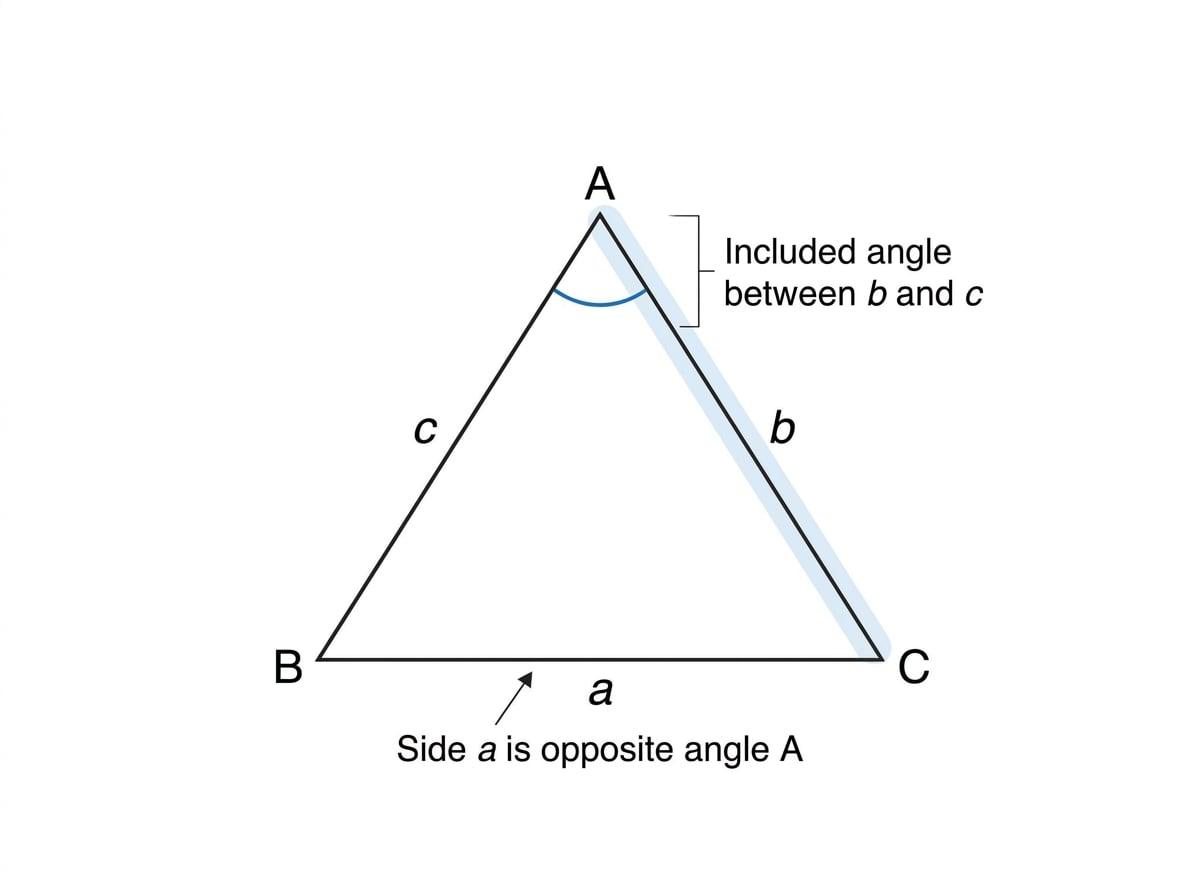
The side opposite an angle is the side across from it. For example, the side opposite angle AAA is BCBCBC.
Included angle
The included angle is the angle between two known sides. If you know sides ABABAB and ACACAC, the included angle is angle BACBACBAC, because both sides meet at AAA.

Spotting the opposite side
A triangle has AB=6AB = 6AB=6 m, AC=8AC = 8AC=8 m, and angle BAC=50∘BAC = 50^\circBAC=50∘. Which side is opposite the 50° angle?

-
The angle BACBACBAC is at vertex AAA.
-
The side opposite vertex AAA is the side joining the other two vertices.
-
So the opposite side is BCBCBC.
What to look for
The Cosine Rule connects an angle with the side directly opposite it. Always pair the angle with its opposite side before substituting numbers.
2. The Cosine Rule for finding a missing side
Use this when you know two sides and the included angle, and you want the third side.
The Cosine Rule
If side aaa is opposite angle AAA, then:

Here, bbb and ccc are the two sides that meet at angle AAA.
This looks a bit like Pythagoras, but the extra part involving cosA\cos AcosA adjusts for triangles that are not right-angled.
Finding a missing side
A triangle has two sides 12 cm and 9 cm with an included angle of 100°. Find the third side, giving your answer to 1 decimal place.

-
The unknown side is opposite the 100° angle, so call it xxx.
-
Substitute into the Cosine Rule using b=12b = 12b=12, c=9c = 9c=9 and A=100∘A = 100^\circA=100∘:
x2=122+92−2×12×9×cos100∘x2=144+81−216cos100∘x2=262.508…\begin{aligned} x^2 &= 12^2 + 9^2 - 2 \times 12 \times 9 \times \cos 100^\circ \\ x^2 &= 144 + 81 - 216\cos 100^\circ \\ x^2 &= 262.508\ldots \end{aligned}x2x2x2=122+92−2×12×9×cos100∘=144+81−216cos100∘=262.508… -
Square root the answer:
x=262.508…=16.202…x = \sqrt{262.508\ldots} = 16.202\ldotsx=262.508…=16.202… -
The third side is 16.2 cm to 1 decimal place.
Forgetting the square root
The formula gives x2x^2x2, not xxx. After using the Cosine Rule to find a side, you must square root before rounding.
Calculator mode
For GCSE triangle questions, your calculator should normally be in degrees mode. If your answer looks wildly wrong, check this first.
3. The Cosine Rule for finding a missing angle
Use this when you know all three sides and want an angle.
Rearrange the Cosine Rule:
cosA=b2+c2−a22bc\cos A = \frac{b^2 + c^2 - a^2}{2bc}cosA=2bcb2+c2−a2Then use inverse cosine, written cos−1\cos^{-1}cos−1, to get the angle.
Inverse cosine
cos−1\cos^{-1}cos−1 is the calculator function that finds the angle when you know its cosine value.
Finding a missing angle
A triangle has sides 14 cm, 15 cm and 22 cm. Find the angle between the 14 cm and 15 cm sides, giving your answer to 3 significant figures.

-
The angle we want is between the 14 cm and 15 cm sides, so the opposite side is 22 cm.
-
Use a=22a = 22a=22, b=14b = 14b=14 and c=15c = 15c=15:
cosA=142+152−2222×14×15\cos A = \frac{14^2 + 15^2 - 22^2}{2 \times 14 \times 15}cosA=2×14×15142+152−222 -
Simplify the fraction:
cosA=196+225−484420=−63420\cos A = \frac{196 + 225 - 484}{420} = \frac{-63}{420}cosA=420196+225−484=420−63 -
Use inverse cosine:
A=cos−1(−63420)=98.626…∘A = \cos^{-1}\left(\frac{-63}{420}\right) = 98.626\ldots^\circA=cos−1(420−63)=98.626…∘ -
The angle is 98.6° to 3 significant figures.
Using the wrong opposite side
When finding an angle, the side being subtracted in the numerator is the side opposite the angle. In b2+c2−a22bc\frac{b^2+c^2-a^2}{2bc}2bcb2+c2−a2, the a2a^2a2 side is opposite angle AAA.
4. Algebraic side lengths
Sometimes the side lengths contain expressions like x+1x+1x+1 or 2x+12x+12x+1. You still use the Cosine Rule, but you may need to expand brackets and solve a quadratic.
Finding from algebraic lengths
A triangle has sides x+1x+1x+1 and 2x+12x+12x+1 with an included angle of 60°. The opposite side is 91\sqrt{91}91. Find xxx.

-
Write the Cosine Rule. Since the opposite side is 91\sqrt{91}91:
(91)2=(x+1)2+(2x+1)2−2(x+1)(2x+1)cos60∘\left(\sqrt{91}\right)^2 = (x+1)^2 + (2x+1)^2 - 2(x+1)(2x+1)\cos 60^\circ(91)2=(x+1)2+(2x+1)2−2(x+1)(2x+1)cos60∘ -
Use (91)2=91\left(\sqrt{91}\right)^2 = 91(91)2=91 and cos60∘=12\cos 60^\circ = \frac{1}{2}cos60∘=21:
91=(x+1)2+(2x+1)2−(x+1)(2x+1)91 = (x+1)^2 + (2x+1)^2 - (x+1)(2x+1)91=(x+1)2+(2x+1)2−(x+1)(2x+1) -
Expand and simplify:
91=x2+2x+1+4x2+4x+1−(2x2+3x+1)91=3x2+3x+1\begin{aligned} 91 &= x^2 + 2x + 1 + 4x^2 + 4x + 1 - (2x^2 + 3x + 1) \\ 91 &= 3x^2 + 3x + 1 \end{aligned}9191=x2+2x+1+4x2+4x+1−(2x2+3x+1)=3x2+3x+1 -
Rearrange and solve:
3x2+3x−90=0x2+x−30=0(x+6)(x−5)=0\begin{aligned} 3x^2 + 3x - 90 &= 0 \\ x^2 + x - 30 &= 0 \\ (x+6)(x-5) &= 0 \end{aligned}3x2+3x−90x2+x−30(x+6)(x−5)=0=0=0 -
The possible values are x=−6x = -6x=−6 or x=5x = 5x=5.
-
Reject x=−6x = -6x=−6 because it would make side lengths negative. So x=5x = 5x=5.
5. Combining area and the Cosine Rule
A 5-mark question may ask for a perimeter but give you two sides and the area first.
Area using two sides and an included angle
For two sides aaa and bbb with included angle CCC:

Once you find the included angle, you can use the Cosine Rule to find the missing side. The perimeter is the total distance around the triangle.
Area first, then perimeter
A triangle has sides 15 m and 13 m meeting at an acute angle. Its area is 78 m². Find the perimeter to 3 significant figures.

-
Use the area formula to find the included angle CCC:
78=12×15×13×sinC78 = \frac{1}{2} \times 15 \times 13 \times \sin C78=21×15×13×sinC -
Simplify:
78=97.5sinC78 = 97.5\sin C78=97.5sinC -
Divide by 97.5:
sinC=0.8\sin C = 0.8sinC=0.8 -
Because the angle is acute:
C=sin−1(0.8)=53.130…∘C = \sin^{-1}(0.8) = 53.130\ldots^\circC=sin−1(0.8)=53.130…∘ -
Use the Cosine Rule to find the missing side xxx:
x2=152+132−2×15×13×cos53.130…∘x2=160\begin{aligned} x^2 &= 15^2 + 13^2 - 2 \times 15 \times 13 \times \cos 53.130\ldots^\circ \\ x^2 &= 160 \end{aligned}x2x2=152+132−2×15×13×cos53.130…∘=160 -
Square root:
x=160=12.649…x = \sqrt{160} = 12.649\ldotsx=160=12.649… -
Add the three sides:
15+13+12.649…=40.649…15 + 13 + 12.649\ldots = 40.649\ldots15+13+12.649…=40.649… -
The perimeter is 40.6 m to 3 significant figures.
Area can give two angles
If you use sin−1\sin^{-1}sin−1, there may be an acute and an obtuse angle with the same sine value. Use the diagram or wording carefully to decide which one is intended.
In the exam
-
Mark the angle and its opposite side before writing the formula.
-
If finding a side, calculate a2a^2a2 first, then square root.
-
If finding an angle, use cos−1\cos^{-1}cos−1 only after you have found the cosine value.
-
Keep full calculator values until the final line, then round to the accuracy asked for.
Check yourself
-
In a2=b2+c2−2bccosAa^2 = b^2 + c^2 - 2bc\cos Aa2=b2+c2−2bccosA, which side is opposite angle AAA?
-
When would you use the Cosine Rule instead of SOHCAHTOA?
-
Why might an area question lead to two possible included angles?