What you'll learn
- How to match an angle with the side opposite it.
- When to use the sine rule instead of right-angled trigonometry.
- How to find missing sides, missing angles, perimeters and areas.
- How to handle the “obtuse angle” twist in exam questions.
1. The key idea: opposite pairs
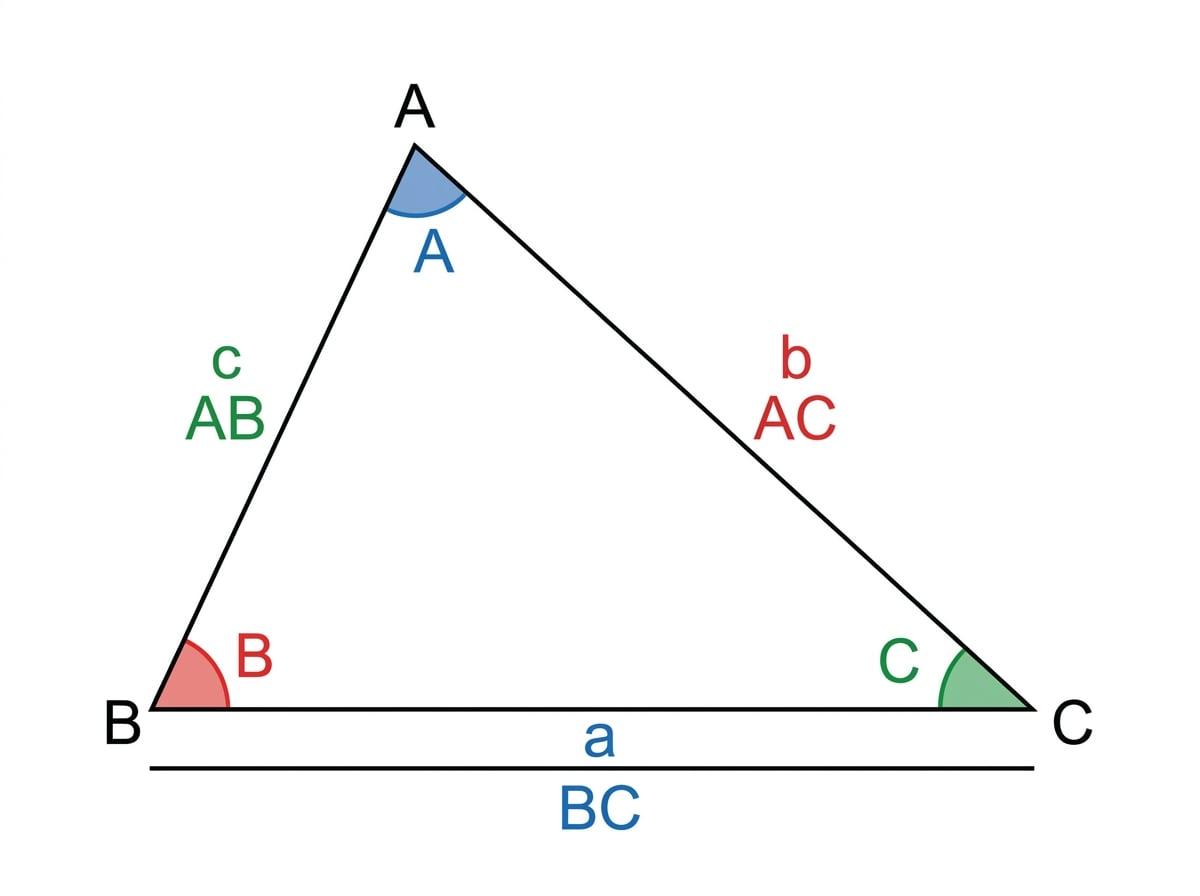
The sine rule connects angles to the sides directly opposite them.
In triangle ABC:

- Side AB is opposite angle C.
- Side AC is opposite angle B.
- Side BC is opposite angle A.
Opposite side
The opposite side to an angle is the side across the triangle from that angle, not one of the sides touching the angle.
You will often need the angle sum of a triangle first.
Angle sum
The angles in any triangle add to 180°.
Spotting the opposite pair
A triangle PQR has PQ = 9 cm, angle P = 47° and angle R = 68°. Find angle Q and name the complete opposite pair.

-
Use the angle sum:
Q=180∘−47∘−68∘=65∘Q = 180^\circ - 47^\circ - 68^\circ = 65^\circQ=180∘−47∘−68∘=65∘ -
Side PQ is opposite angle R.
-
So the complete opposite pair is 9 cm with angle 68°.
Degrees mode
Make sure your calculator is in degrees mode. At GCSE, triangle angles are measured in degrees unless stated otherwise.
2. The sine rule formula
Use the sine rule when you know one complete opposite pair and at least one more side or angle from another pair.
The sine rule
If sides aaa, bbb and ccc are opposite angles AAA, BBB and CCC, then:
-
To find a missing side, use:
asinA=bsinB=csinC\frac{a}{\sin A} = \frac{b}{\sin B} = \frac{c}{\sin C}sinAa=sinBb=sinCc -
To find a missing angle, use:
sinAa=sinBb=sinCc\frac{\sin A}{a} = \frac{\sin B}{b} = \frac{\sin C}{c}asinA=bsinB=csinC
Pairing the wrong side
The side must be opposite the angle, not next to it. Before substituting, draw or trace the line straight across from the angle to its opposite side.
3. Finding a missing side
When the unknown is a length, put the side lengths on top.
Finding a missing side
In triangle DEF, side DE = 14 cm. Angle F = 101° and angle E = 37°. Work out the length of DF to 1 decimal place.

-
Identify the complete opposite pair: DE = 14 cm is opposite angle F = 101°.
-
The side we want, DF, is opposite angle E = 37°. Let DF be xxx.
-
Use the side form of the sine rule:
xsin37∘=14sin101∘\frac{x}{\sin 37^\circ} = \frac{14}{\sin 101^\circ}sin37∘x=sin101∘14 -
Rearrange by multiplying by sin37∘\sin 37^\circsin37∘:
x=14sin37∘sin101∘x = \frac{14\sin 37^\circ}{\sin 101^\circ}x=sin101∘14sin37∘ -
Calculate and round: x≈8.6x \approx 8.6x≈8.6 cm to 1 decimal place.
4. Finding a missing angle
When the unknown is an angle, put the sines on top. You will then use inverse sine.
Inverse sine
The inverse sine, written sin−1\sin^{-1}sin−1, is the calculator function that finds an angle from its sine value.
Finding a missing angle
In triangle GHI, GH = 9.5 m, GI = 7.0 m and angle I = 72°. Work out angle H to 3 significant figures.

-
The complete opposite pair is GH = 9.5 m and angle I = 72°.
-
Side GI = 7.0 m is opposite angle H.
-
Use the angle form of the sine rule:
sinH7.0=sin72∘9.5\frac{\sin H}{7.0} = \frac{\sin 72^\circ}{9.5}7.0sinH=9.5sin72∘ -
Rearrange:
sinH=7.0sin72∘9.5\sin H = \frac{7.0\sin 72^\circ}{9.5}sinH=9.57.0sin72∘ -
Use inverse sine:
H=sin−1(7.0sin72∘9.5)≈44.5∘H = \sin^{-1}\left(\frac{7.0\sin 72^\circ}{9.5}\right) \approx 44.5^\circH=sin−1(9.57.0sin72∘)≈44.5∘ -
The angle is 44.5° to 3 significant figures.
Misreading inverse sine
sin−1\sin^{-1}sin−1 does not mean “divide by sine”. It means “find the angle whose sine is this number”.
5. Perimeter questions
A perimeter question usually means you must find the missing side lengths first, then add all the sides.
Using the sine rule to find a perimeter
Triangle ABC has AC = 10.4 m, angle B = 112° and angle C = 39°. Work out the perimeter to 3 significant figures.

-
Find the third angle:
A=180∘−112∘−39∘=29∘A = 180^\circ - 112^\circ - 39^\circ = 29^\circA=180∘−112∘−39∘=29∘ -
The known pair is AC = 10.4 m opposite angle B = 112°.
-
Find AB, which is opposite angle C:
AB=10.4sin39∘sin112∘≈7.06AB = \frac{10.4\sin 39^\circ}{\sin 112^\circ} \approx 7.06AB=sin112∘10.4sin39∘≈7.06 -
Find BC, which is opposite angle A:
BC=10.4sin29∘sin112∘≈5.44BC = \frac{10.4\sin 29^\circ}{\sin 112^\circ} \approx 5.44BC=sin112∘10.4sin29∘≈5.44 -
Add the three sides: P≈10.4+7.06+5.44=22.9P \approx 10.4 + 7.06 + 5.44 = 22.9P≈10.4+7.06+5.44=22.9 m.
Do not round too early
Keep full calculator values until the final answer. Rounding side lengths halfway through can change the final perimeter or area.
6. Area questions
For a non-right-angled triangle, the area formula is:
Area=12absinC\text{Area} = \frac{1}{2}ab\sin CArea=21absinCHere, aaa and bbb are two sides, and CCC is the included angle between them.

Included angle
The included angle is the angle between the two sides you are using.
Using the sine rule before finding area
Triangle LMN has LM = 12 m, angle L = 74° and angle N = 38°. Work out the area to 1 decimal place.

-
Find the third angle:
M=180∘−74∘−38∘=68∘M = 180^\circ - 74^\circ - 38^\circ = 68^\circM=180∘−74∘−38∘=68∘ -
The known pair is LM = 12 m opposite angle N = 38°.
-
Find LN, which is opposite angle M:
LN=12sin68∘sin38∘≈18.07LN = \frac{12\sin 68^\circ}{\sin 38^\circ} \approx 18.07LN=sin38∘12sin68∘≈18.07 -
Use LM and LN with the included angle L:
Area=12×12×18.07×sin74∘\text{Area} = \frac{1}{2} \times 12 \times 18.07 \times \sin 74^\circArea=21×12×18.07×sin74∘ -
The area is 104.2 m² to 1 decimal place.
7. The obtuse angle case
Sometimes inverse sine gives you the acute angle, but the triangle may need the obtuse angle instead.
The ambiguous case
For positive sine values, sinθ=sin(180∘−θ)\sin \theta = \sin(180^\circ - \theta)sinθ=sin(180∘−θ). If a question says an angle is obtuse, use the larger angle.
Choosing the obtuse angle
Triangle ABC has AC = 18 cm, AB = 12 cm and angle C = 32°. Angle B is obtuse. Work out angle B to 3 significant figures.

-
AC is opposite angle B, and AB is opposite angle C.
-
Use the sine rule:
sinB18=sin32∘12\frac{\sin B}{18} = \frac{\sin 32^\circ}{12}18sinB=12sin32∘ -
Rearrange and use inverse sine:
B=sin−1(18sin32∘12)≈52.6∘B = \sin^{-1}\left(\frac{18\sin 32^\circ}{12}\right) \approx 52.6^\circB=sin−1(1218sin32∘)≈52.6∘ -
This is the acute angle, but angle B is obtuse:
B=180∘−52.6∘=127.4∘B = 180^\circ - 52.6^\circ = 127.4^\circB=180∘−52.6∘=127.4∘ -
So angle B is 127° to 3 significant figures.
In the exam
-
Mark the side opposite each angle before writing the formula.
-
Check you have one complete opposite pair.
-
Use side-over-sine for missing sides, and sine-over-side for missing angles.
-
If using inverse sine, check whether an obtuse answer is possible or stated.
-
Round only at the end, to the accuracy asked for.
Check yourself
-
Can you explain why side AB is opposite angle C in triangle ABC?
-
If you know two angles and one side, what should you do before using the sine rule?
-
Why might an inverse sine calculation give an acute angle when the final answer is obtuse?