Cylinders
What you'll learn
- How radius, diameter and height describe a cylinder.
- How to calculate the volume of a cylinder.
- How to calculate the total surface area of a solid cylinder.
- How to handle half-cylinders, missing lengths, paint and filling questions.
1. The circle facts you need first
Cylinder and circle words
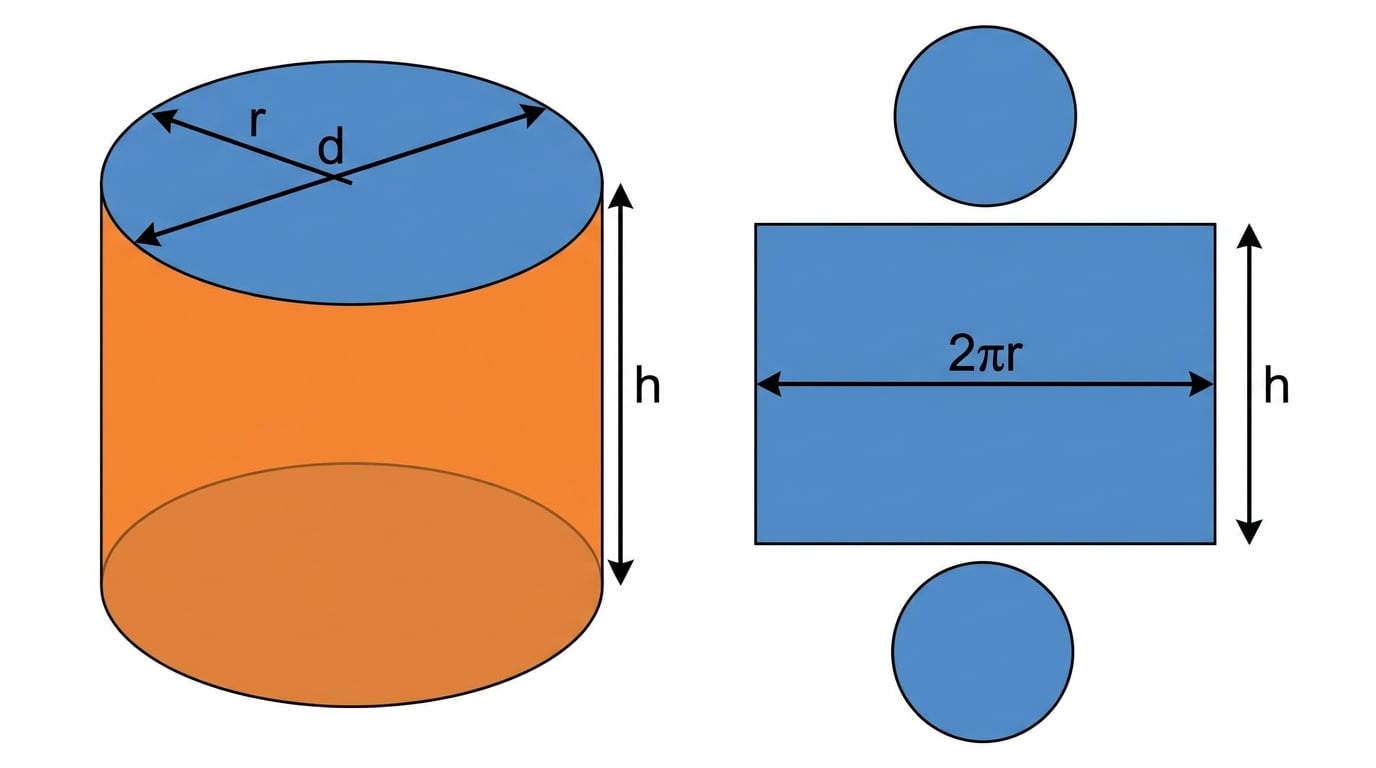
- A cylinder is a 3D solid with two equal, parallel circular faces joined by one curved surface.

- The radius is the distance from the centre of a circle to its edge.
- The diameter is the distance all the way across a circle through the centre, so d=2rd=2rd=2r.
- The height is the perpendicular distance between the two circular faces.
Two circle formulas appear again and again:
- Area of a circle: A=πr2A=\pi r^2A=πr2
- Circumference, which means distance around the circle: C=2πrC=2\pi rC=2πr
Choosing the radius
A cylinder has diameter 14 cm.

-
The diameter goes all the way across the circle.
-
The radius is half the diameter:
r=14÷2=7r=14\div 2=7r=14÷2=7 -
So in any cylinder formula, use 7 cm for the radius.
Diameter is not radius
If the question gives the diameter, halve it before using the formula. Squaring the diameter instead of the radius makes the answer much too large.
2. Volume of a cylinder
Volume means the amount of space inside a 3D shape. It is measured in cubic units such as cm³ or m³.
Volume formula
The volume of a cylinder is the area of the circular base multiplied by the height: V=πr2hV=\pi r^2hV=πr2h.

Think of it as stacking lots of identical circles on top of each other.
Volume from a diameter
A cylinder has diameter 8 cm and height 13 cm. Find its volume correct to 1 decimal place.

-
Find the radius by halving the diameter:
r=8÷2=4r=8\div 2=4r=8÷2=4 -
Substitute into V=πr2hV=\pi r^2hV=πr2h:
V=π×42×13=208πV=\pi \times 4^2 \times 13=208\piV=π×42×13=208π -
Use your calculator for the decimal value:
208π=653.451…208\pi=653.451\ldots208π=653.451… -
Rounded to 1 decimal place, the volume is 653.5 cm³.
In terms of pi
If the question says “give your answer in terms of π\piπ”, leave π\piπ in your final answer. For the example above, you would write 208π208\pi208π cm³.
3. Total surface area of a solid cylinder
Surface area means the total area on the outside of a 3D shape.
For a closed solid cylinder, there are three outside parts:
- the top circle
- the bottom circle
- the curved surface around the side
The curved surface unwraps into a rectangle. Its width is the circumference of the circle, and its height is the cylinder height.

So the total surface area formula is:
TSA=2πr2+2πrh\text{TSA}=2\pi r^2+2\pi rhTSA=2πr2+2πrhSurface area from a diameter
A solid cylinder has diameter 10 cm and height 14 cm. Find the total surface area correct to 3 significant figures.

-
Halve the diameter to get the radius:
r=10÷2=5r=10\div 2=5r=10÷2=5 -
Work out the two circular ends:
2πr2=2π×52=50π2\pi r^2=2\pi \times 5^2=50\pi2πr2=2π×52=50π -
Work out the curved surface:
2πrh=2π×5×14=140π2\pi rh=2\pi \times 5 \times 14=140\pi2πrh=2π×5×14=140π -
Add the parts together:
50π+140π=190π50\pi+140\pi=190\pi50π+140π=190π -
Convert to a decimal and round:
190π=596.902…190\pi=596.902\ldots190π=596.902… -
The total surface area is 597 cm² to 3 significant figures.
Forgetting the top and bottom
For total surface area, include both circular ends unless the question clearly says the cylinder is open.
4. Half-cylinders
A semi-cylinder is half a cylinder, cut lengthways.
For volume, halve the full cylinder volume. If the length is called LLL, then:
V=12πr2LV=\frac{1}{2}\pi r^2LV=21πr2LFor total surface area of a semi-cylinder, remember these parts:
- half the curved surface
- two semi-circular ends
- the flat rectangular face made by the cut
Volume and surface area of a semi-cylinder
A semi-cylinder has radius 6 cm and length 25 cm. Find the volume and total surface area correct to 3 significant figures.

-
Work out the volume using half the cylinder formula:
V=12π×62×25=450πV=\frac{1}{2}\pi \times 6^2 \times 25=450\piV=21π×62×25=450π -
Convert and round: 450π=1413.7…450\pi=1413.7\ldots450π=1413.7…, so the volume is 1410 cm³ to 3 significant figures.
-
The half-curved surface area is:
π×6×25=150π\pi \times 6 \times 25=150\piπ×6×25=150π -
The two semi-circular ends make one full circle:
π×62=36π\pi \times 6^2=36\piπ×62=36π -
The flat rectangle is 12 cm by 25 cm, so its area is 300 cm².
-
Add the surface areas:
150π+36π+300=186π+300=884.3…150\pi+36\pi+300=186\pi+300=884.3\ldots150π+36π+300=186π+300=884.3… -
The total surface area is 884 cm² to 3 significant figures.
Combined solids
For a shape made from a cuboid and a half-cylinder, find each volume separately and add them. For surface area, do not count hidden faces where the shapes touch.
5. Working backwards
Sometimes the volume or surface area is given, and you must find a missing radius or height.
Use the same formula, substitute what you know, then solve.
Finding a missing radius
A cylinder has height 10 m and volume 490π490\pi490π m³. Find the radius.
-
Start with the volume formula:
V=πr2hV=\pi r^2hV=πr2h -
Substitute the given volume and height:
490π=πr2×10490\pi=\pi r^2 \times 10490π=πr2×10 -
Divide by 10π10\pi10π:
r2=49r^2=49r2=49 -
Square root both sides:
r=7r=7r=7 -
The radius is 7 m.
Stopping at r squared
If you find r2r^2r2, you have not finished. Take the square root to find rrr.
6. Units, paint and filling questions
Real-life cylinder questions often involve tanks, paint or water.
- Painting questions usually need surface area.
- Filling questions usually need volume.
- Make sure all measurements are in the same units before calculating.
- 1 litre = 1000 cm³.
- 100 cm = 1 m, but 10,000 cm² = 1 m².
Paint needed for cylindrical tanks
Four closed cylindrical tanks are painted. Each tank has diameter 50 cm and height 1.5 m. One pot of paint covers 3 m². Find the number of pots needed.

-
Convert the diameter to metres: 50 cm = 0.5 m.
-
Find the radius:
r=0.5÷2=0.25r=0.5\div 2=0.25r=0.5÷2=0.25 -
Find the surface area of one closed tank:
TSA=2π(0.25)2+2π(0.25)(1.5)=0.875π\text{TSA}=2\pi(0.25)^2+2\pi(0.25)(1.5)=0.875\piTSA=2π(0.25)2+2π(0.25)(1.5)=0.875π -
Convert to a decimal:
0.875π=2.748…0.875\pi=2.748\ldots0.875π=2.748… -
For four tanks:
4×2.748…=10.995…4\times 2.748\ldots=10.995\ldots4×2.748…=10.995… -
Divide by the coverage of one pot:
10.995…÷3=3.665…10.995\ldots \div 3=3.665\ldots10.995…÷3=3.665… -
You must buy 4 pots, because 3 pots would not be enough.
Area unit conversions
Do not say 1500 cm² is 15 m². Since 1 m² is 10,000 cm², 1500 cm² is only 0.15 m².
In the exam
-
Check whether you have been given radius or diameter before using any formula.
-
Write the formula first, then substitute the numbers carefully.
-
Keep calculator values unrounded until the final line, then round exactly as requested.
Check yourself
-
If a cylinder has diameter 18 cm, what radius should you use in the formula?
-
Which formula would you use for volume: V=πr2hV=\pi r^2hV=πr2h or TSA=2πr2+2πrh\text{TSA}=2\pi r^2+2\pi rhTSA=2πr2+2πrh?
-
In a painting question, why might you need to round the number of pots up?