Volume of a Prism
What you'll learn
- How to spot the cross-section of a prism.
- How to use volume = area of cross-section × length.
- How to handle triangular, trapezium and L-shaped prisms.
- How to use unit conversions for litres, buckets, boxes and containers.
The basic idea
Before volume, you need to be confident with area. Area measures flat space in a 2D shape, using square units like cm².
Volume measures 3D space, using cubic units like cm³.
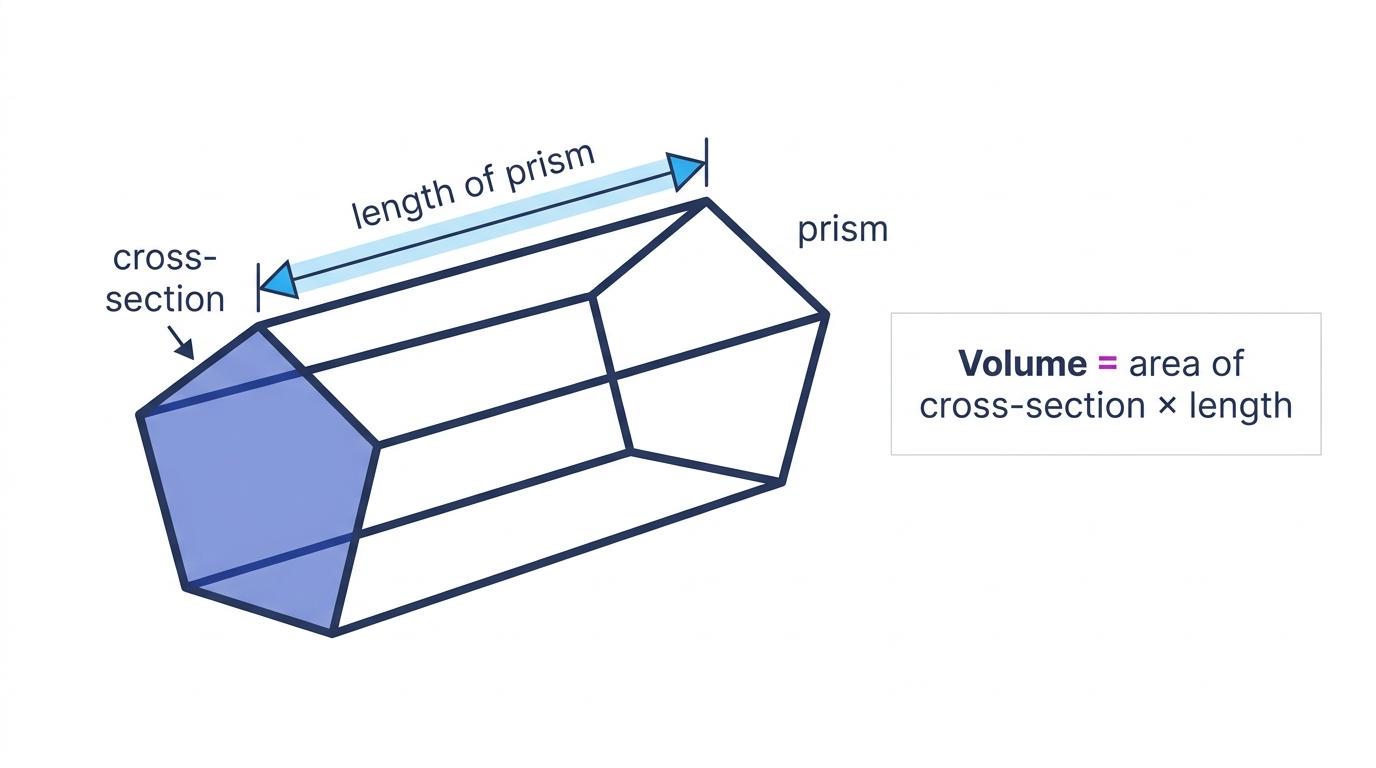
Volume, prism and cross-section
- Volume is the amount of space inside or taken up by a 3D solid.
- A prism is a 3D solid with the same 2D shape repeated all the way through.
- The cross-section is the repeated 2D shape you see if you slice straight through the prism.
The length or depth of the prism is how far the cross-section has been stretched.

Main formula
For any prism, use V=A×LV = A \times LV=A×L, where AAA is the area of the cross-section and LLL is the length of the prism.
A rectangular prism
A prism has a rectangular cross-section measuring 6 cm by 5 cm. The prism is 8 cm long. Find its volume.

-
Find the area of the rectangular cross-section.
A=6×5=30 cm2A = 6 \times 5 = 30\text{ cm}^2A=6×5=30 cm2 -
Multiply by the length of the prism.
V=30×8=240 cm3V = 30 \times 8 = 240\text{ cm}^3V=30×8=240 cm3 -
The volume is 240 cm³.
Composite cross-sections
A composite shape is made by joining simpler shapes together. For an L-shaped cross-section, split it into rectangles, find each area, then add them.
L-shaped prism
An L-shaped cross-section can be split into two non-overlapping rectangles: one is 5 cm by 2 cm, and the other is 3 cm by 4 cm. The prism is 10 cm deep. Work out the volume.

-
Find the area of the first rectangle.
A1=5×2=10 cm2A_1 = 5 \times 2 = 10\text{ cm}^2A1=5×2=10 cm2 -
Find the area of the second rectangle.
A2=3×4=12 cm2A_2 = 3 \times 4 = 12\text{ cm}^2A2=3×4=12 cm2 -
Add the areas to get the cross-section area.
A=10+12=22 cm2A = 10 + 12 = 22\text{ cm}^2A=10+12=22 cm2 -
Multiply by the depth of the prism.
V=22×10=220 cm3V = 22 \times 10 = 220\text{ cm}^3V=22×10=220 cm3 -
The volume is 220 cm³.
Adding the depth
Do not add the prism length to the cross-section area. Area is in cm² and length is in cm, so you multiply them to make cm³.
Triangular prisms
A triangular prism has a triangle as its cross-section. A right-angled triangle contains a 90° angle.
For a triangle:
A=12bhA = \frac{1}{2}bhA=21bhwhere bbb is the base and hhh is the perpendicular height.
Right-angled triangular prism
A triangular prism has a right-angled triangular cross-section with perpendicular sides 6 cm and 8 cm. The prism is 9 cm long. Find the volume.

-
Find the area of the triangular cross-section.
A=12×6×8=24 cm2A = \frac{1}{2} \times 6 \times 8 = 24\text{ cm}^2A=21×6×8=24 cm2 -
Multiply by the length of the prism.
V=24×9=216 cm3V = 24 \times 9 = 216\text{ cm}^3V=24×9=216 cm3 -
The volume is 216 cm³.
Using the hypotenuse
In a right-angled triangle, the hypotenuse is the longest side opposite the right angle. It is not needed for triangle area unless it is paired with a perpendicular height.

Trapezium prisms
A trapezium is a four-sided shape with one pair of parallel sides. Parallel sides are always the same distance apart and never meet.
For a trapezium:
A=12(a+b)hA = \frac{1}{2}(a+b)hA=21(a+b)hwhere aaa and bbb are the parallel sides, and hhh is the perpendicular height between them.
Trapezium cross-section
A prism has a trapezium cross-section. The parallel sides are 6 cm and 10 cm, and the perpendicular height is 5 cm. The prism is 11 cm long. Find the volume.

-
Find the area of the trapezium.
A=12(6+10)×5=40 cm2A = \frac{1}{2}(6+10)\times 5 = 40\text{ cm}^2A=21(6+10)×5=40 cm2 -
Multiply by the length of the prism.
V=40×11=440 cm3V = 40 \times 11 = 440\text{ cm}^3V=40×11=440 cm3 -
The volume is 440 cm³.
Working backwards
Sometimes the question gives you the volume and asks for a missing length, often called xxx.
Use the volume formula, then solve the equation.
Finding a missing height
A triangular prism has a right-angled triangular cross-section with base 7 cm and height xxx cm. The prism is 12 cm long. Its volume is 252 cm³. Find xxx.

-
Write the volume equation.
12×7×x×12=252\frac{1}{2}\times 7 \times x \times 12 = 25221×7×x×12=252 -
Simplify the numbers.
42x=25242x = 25242x=252 -
Divide both sides by 42.
x=25242=6x = \frac{252}{42} = 6x=42252=6 -
The missing height is 6 cm.
Keep the formula visible
When working backwards, write the full volume formula first. This helps you avoid forgetting the 12\frac{1}{2}21 in triangle questions.
Units, litres and containers
For containers, volume often connects to capacity.
- 1 ml = 1 cm³
- 1 litre = 1000 cm³
Filling a container with buckets
A rectangular container is 70 cm long, 50 cm wide and 40 cm high. Each bucket holds 12 litres. How many buckets are needed to fill the container?
-
Find the volume of the container.
V=70×50×40=140000 cm3V = 70 \times 50 \times 40 = 140000\text{ cm}^3V=70×50×40=140000 cm3 -
Convert cm³ to litres.
140000 cm3=140 litres140000\text{ cm}^3 = 140\text{ litres}140000 cm3=140 litres -
Divide by the amount in one bucket.
140÷12=11.666…140 \div 12 = 11.666\ldots140÷12=11.666… -
You need 12 buckets, because 11 buckets would not completely fill the container.
Rounding in capacity questions
If you are filling a container, round up. If you are finding how many cups can be completely filled, round down.
Boxes inside a larger cuboid
For packing boxes into a van or container, check how many fit along each direction.
Packing boxes
A van space is 2.4 m long, 1.5 m wide and 1.2 m high. Each box is 60 cm long, 30 cm wide and 40 cm high. How many boxes fit?

-
Convert the van dimensions to centimetres: 2.4 m is 240 cm, 1.5 m is 150 cm, and 1.2 m is 120 cm.
-
Find how many boxes fit along the length.
240÷60=4240 \div 60 = 4240÷60=4 -
Find how many fit along the width and height.
150÷30=5,120÷40=3150 \div 30 = 5,\qquad 120 \div 40 = 3150÷30=5,120÷40=3 -
Multiply the three amounts.
4×5×3=604 \times 5 \times 3 = 604×5×3=60 -
The van can fit 60 boxes.
Cubes and surface area
A cube is a cuboid where every edge has the same length. The surface area is the total area of all the outside faces.
A cube has 6 identical square faces.
Volume from surface area
The total surface area of a cube is 294 cm². Find its volume.
-
Divide by 6 to find the area of one square face.
294÷6=49 cm2294 \div 6 = 49\text{ cm}^2294÷6=49 cm2 -
Find the side length of the square face.
49=7\sqrt{49}=749=7 -
Cube the side length to find the volume.
V=73=343 cm3V = 7^3 = 343\text{ cm}^3V=73=343 cm3 -
The volume is 343 cm³.
In the exam
- Identify the cross-section first, then find its area.
- Multiply the cross-section area by the prism length or depth.
- Check units carefully, especially metres to centimetres and cm³ to litres.
- For missing lengths, set up an equation using the volume formula before solving.
Check yourself
- Can you point to the cross-section and the length of the prism in a diagram?
- Which area formula would you use for a triangle or trapezium cross-section?
- When should you round up, and when should you round down, in container questions?