What you'll learn
- How to read a pictogram using its key.
- How to work out values from full, half and quarter symbols.
- How to complete missing rows in a pictogram.
- How to spot common mistakes in tally charts and pictograms.
Before pictograms: counts and tally charts
A pictogram is a way of showing data, so first you need to be confident with simple counts.
Tally chart and frequency
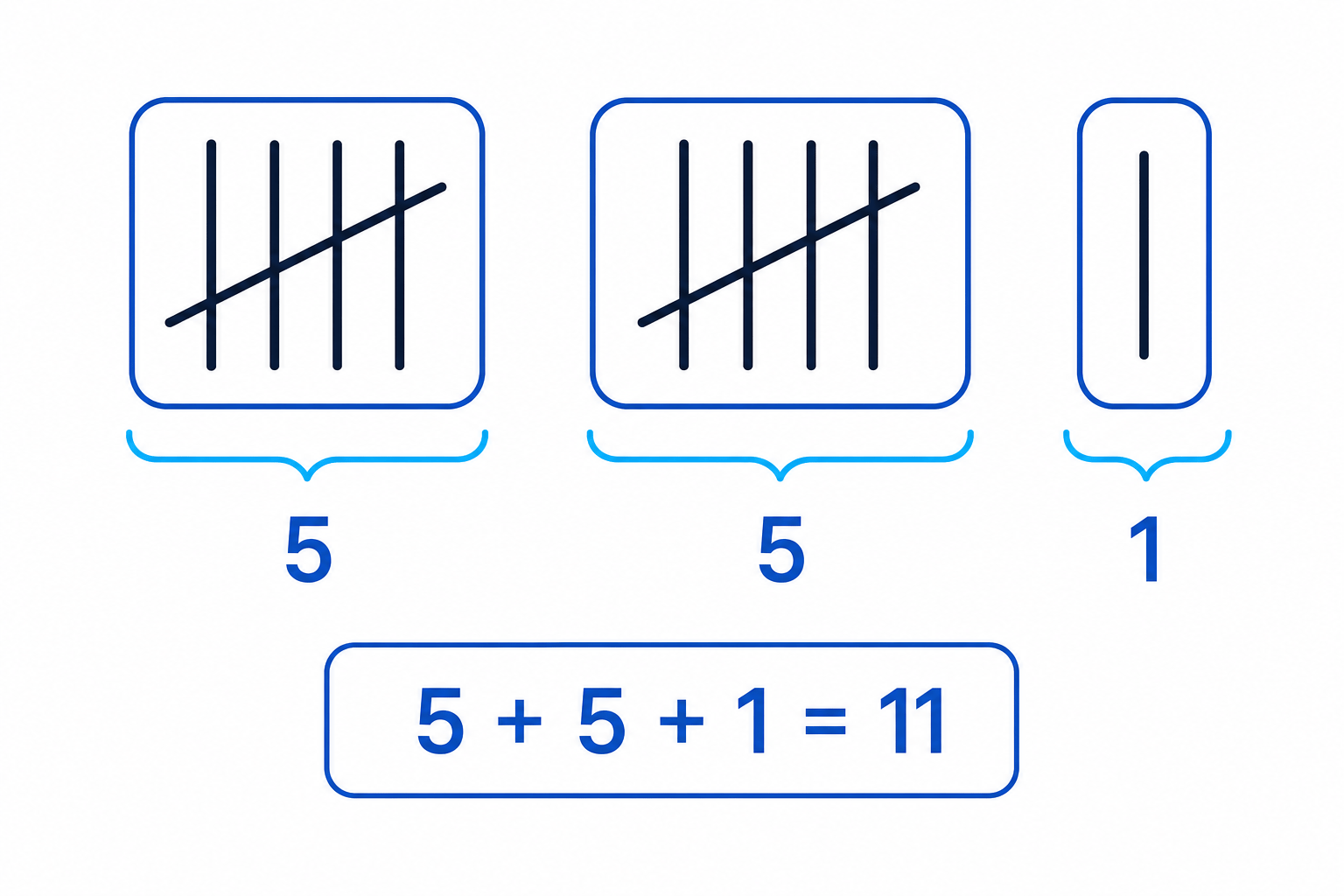
- A tally chart records counts using tally marks, usually grouped in fives.
- The frequency is the final number counted for each category.
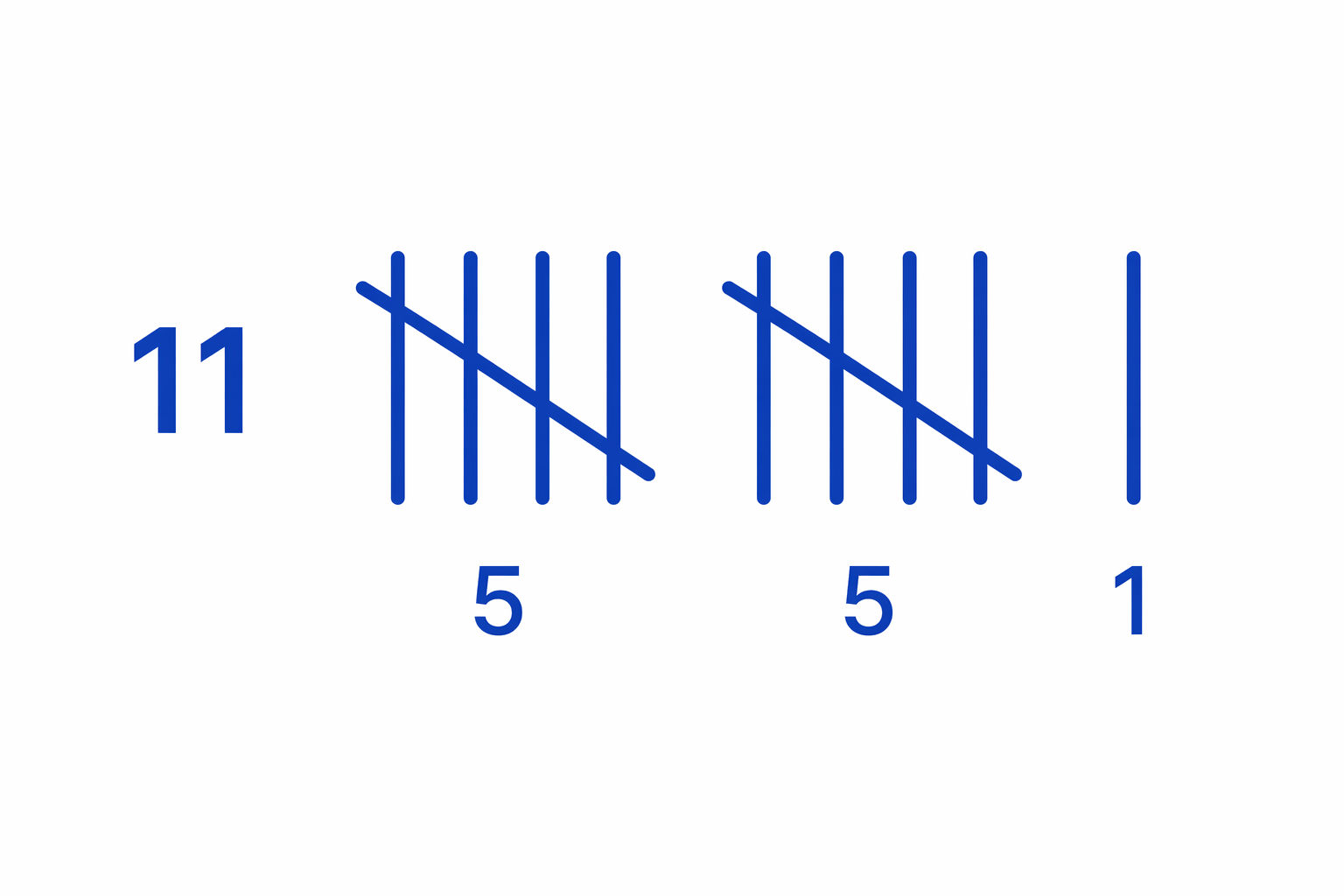
Tallies are helpful because you can count quickly. For example, 11 would be two groups of five and one extra mark.
Spotting a tally chart problem
-
Imagine a table is called a tally chart and it lists the number of drinks sold each day.
-
The frequency column has numbers such as 7, 10 and 12.
-
The tally column is completely empty.
-
One thing wrong is: it is not really a complete tally chart because the tally marks are missing.
Tally check
Tallies should match the frequency. If the frequency says 13, the tally marks must count to 13.
What is a pictogram?
Pictogram and key
- A pictogram is a chart that uses pictures or symbols to show amounts.
- The key tells you what each symbol represents.
The key is the most important part. One picture might mean 1 item, 2 items, 5 items, 8 items, or something else.
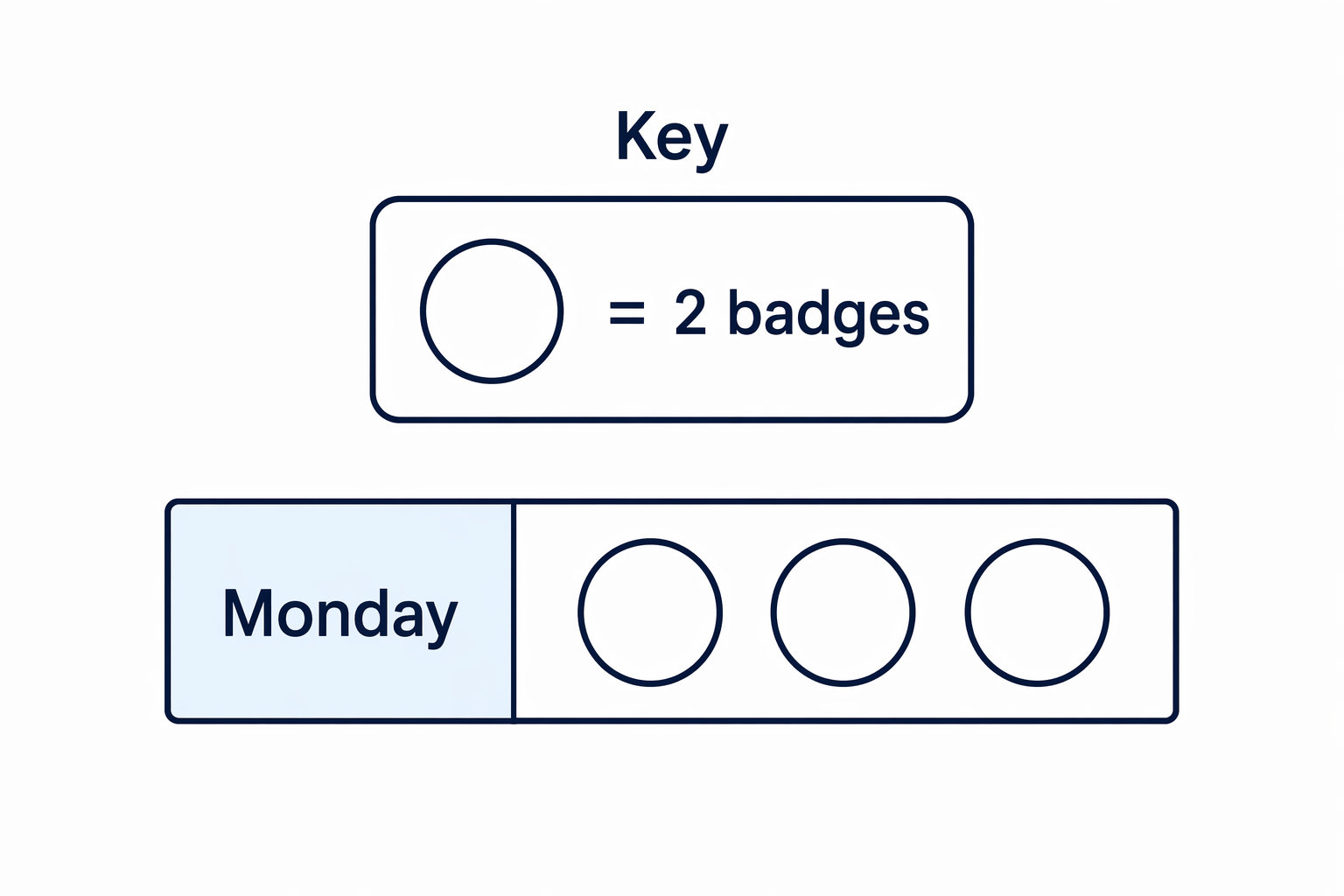
Read the key first
Never assume one picture means one item. Always check the key before counting.
Reading full symbols
-
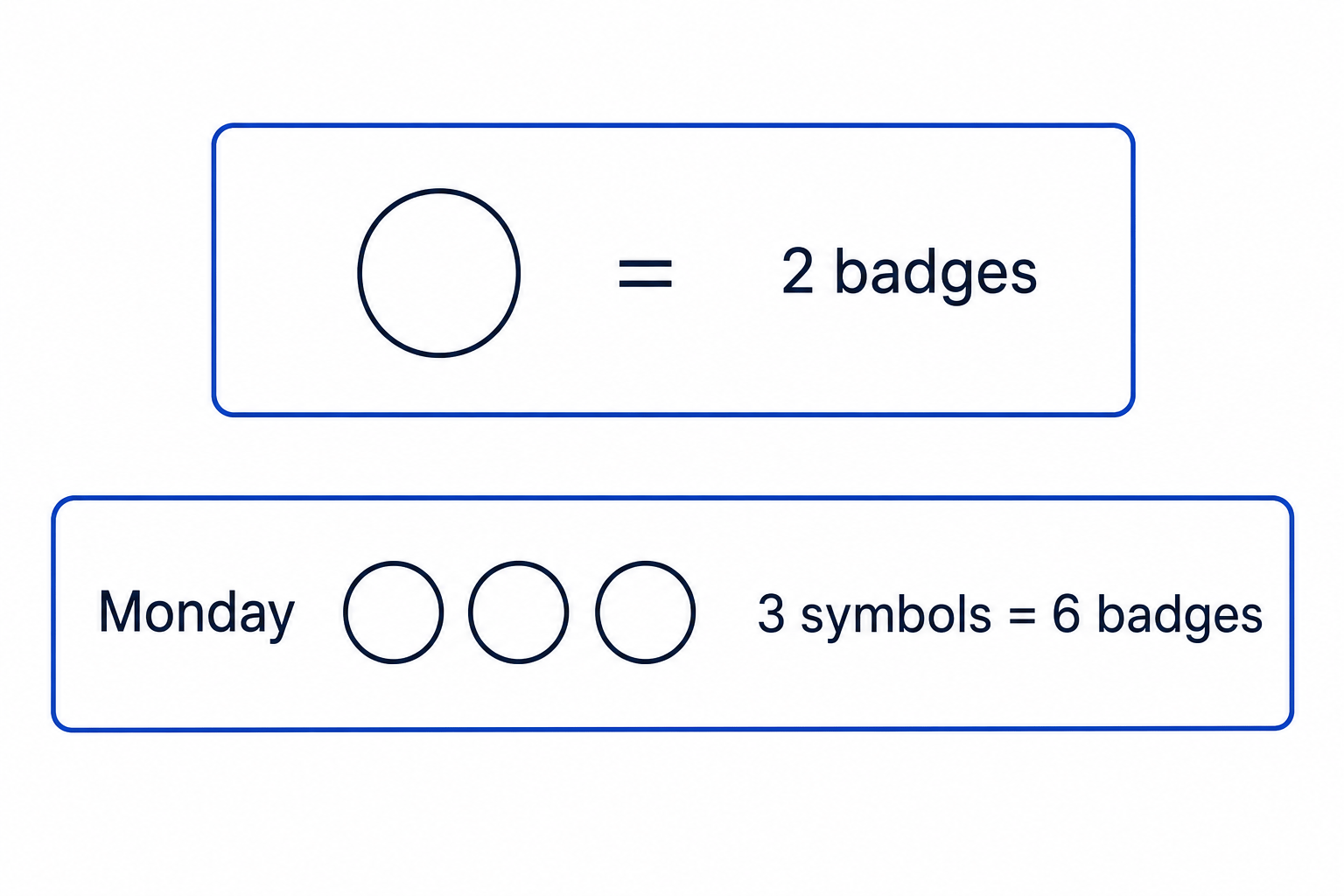
A pictogram shows badges sold in a shop.
-
The key says one circle represents 2 badges.
-
On Monday, the row has 3 full circles.
-
Work out the number of badges:
3×2=63 \times 2 = 63×2=6 -
So Monday represents 6 badges.
Reading half and quarter symbols
Sometimes a pictogram uses part of a symbol.
If one full symbol represents 8 items:
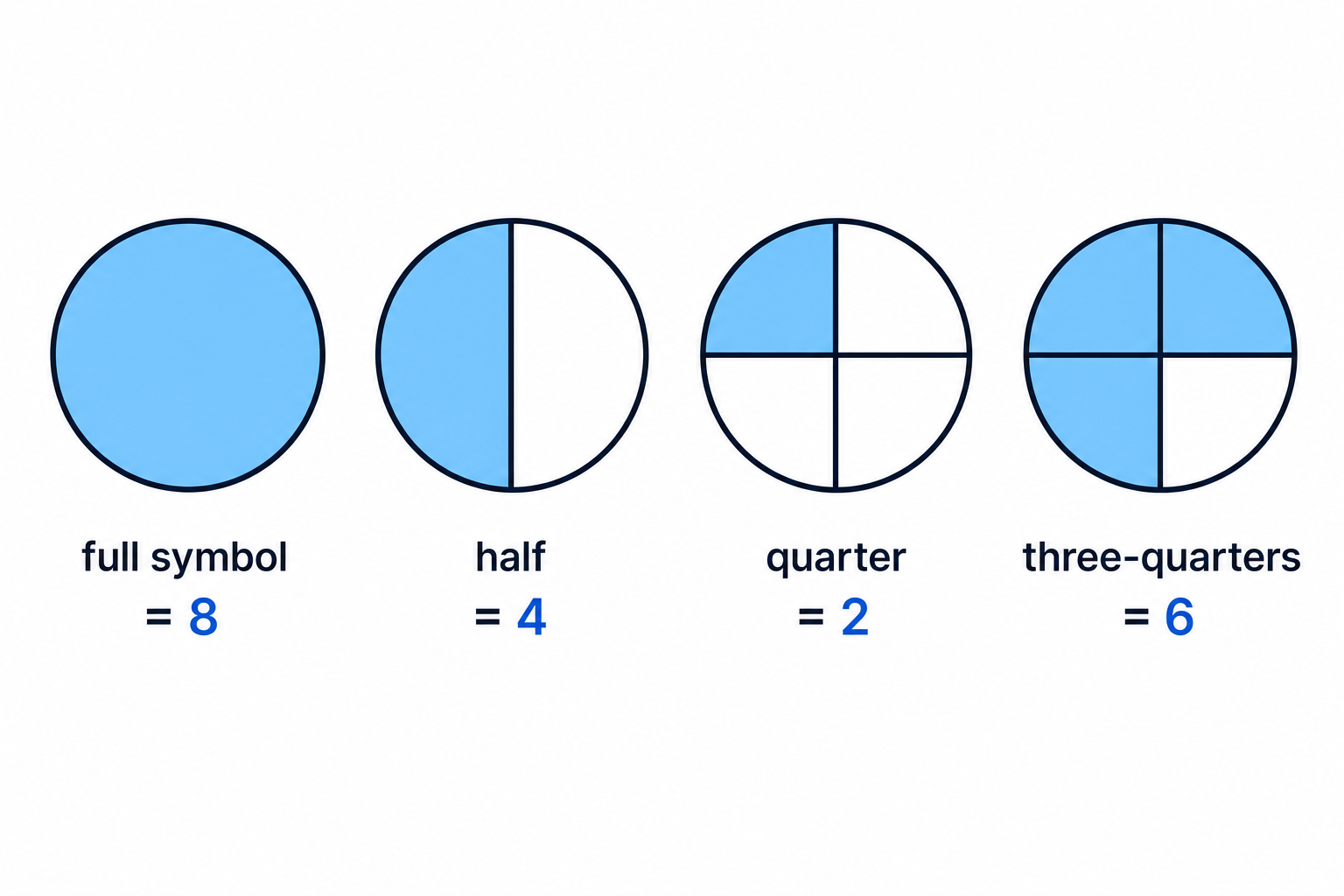
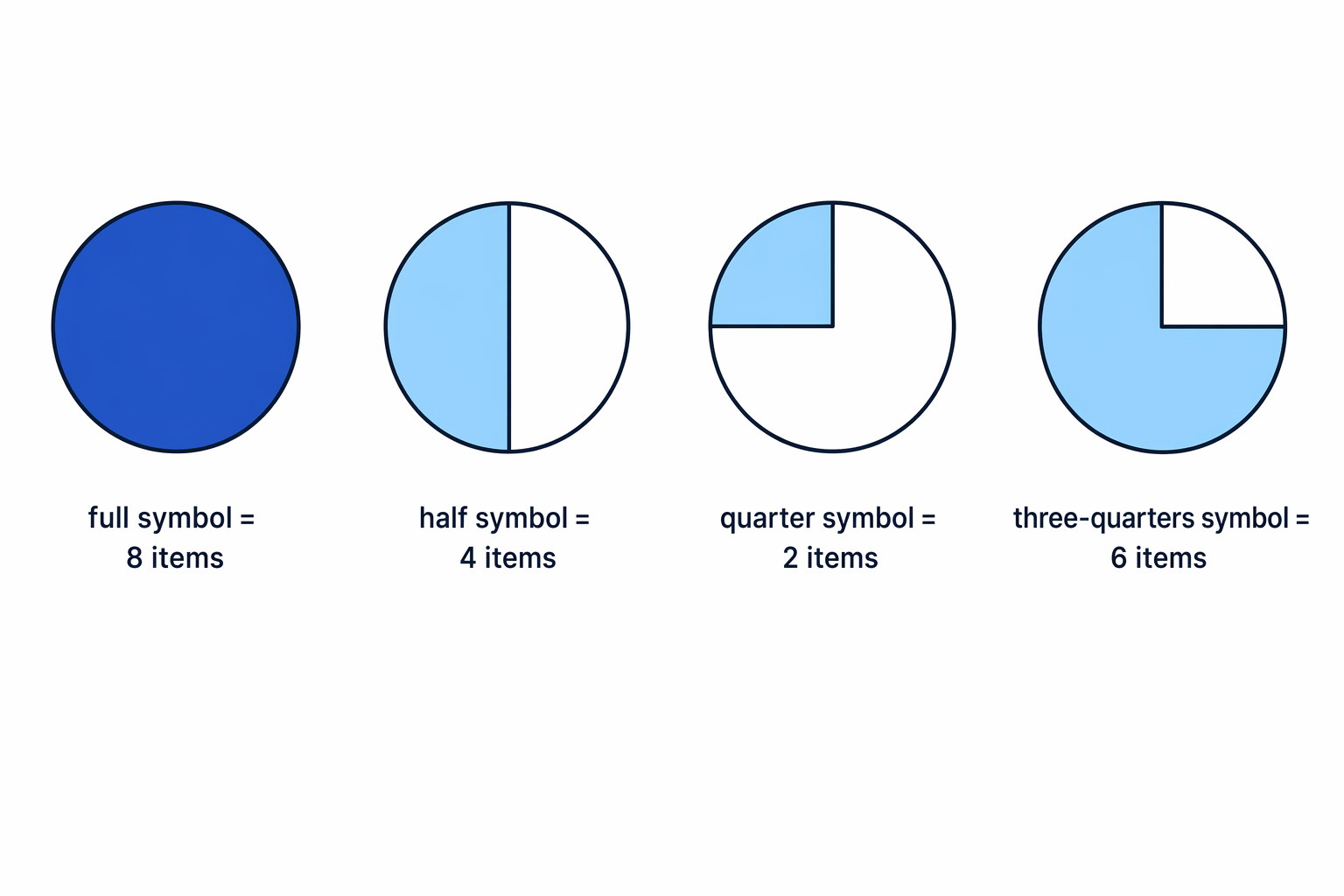
- half a symbol represents 4 items
- a quarter of a symbol represents 2 items
- three-quarters of a symbol represents 6 items
Reading half-symbols
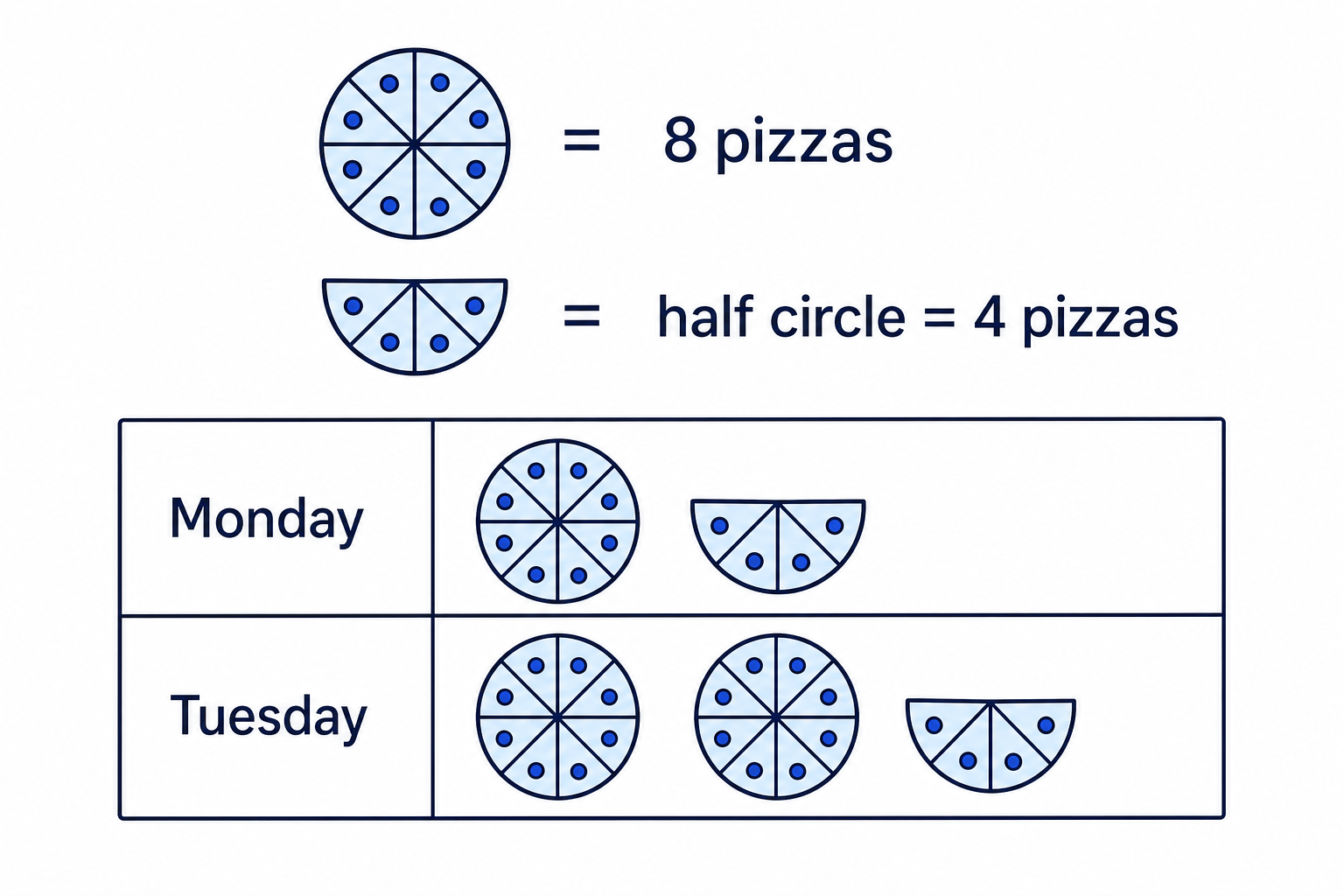
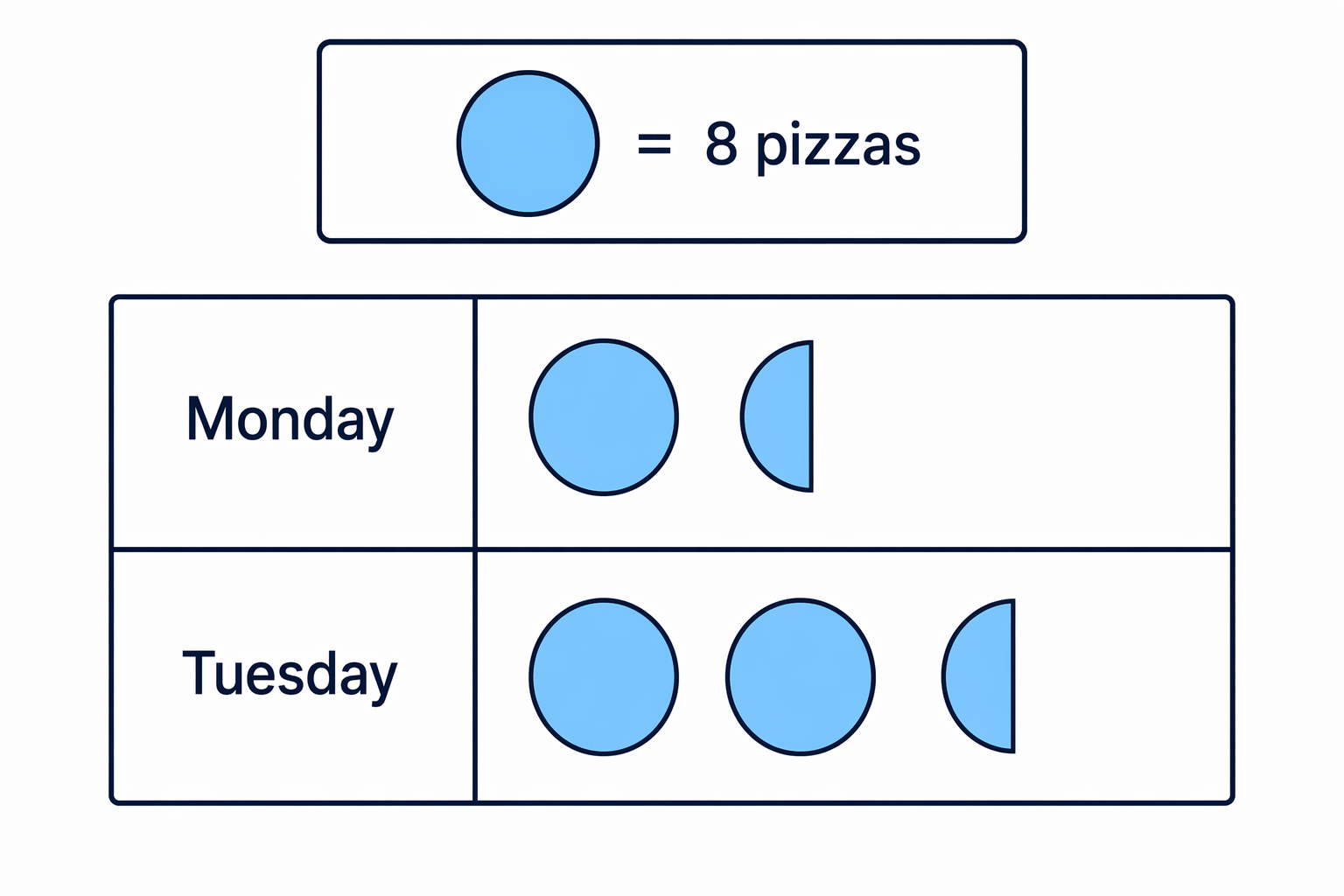
- A pizza pictogram has this key: one full circle represents 8 pizzas.
-
On Monday, the row shows 1 full circle and half a circle.
-
Half of 8 is 4.
-
Add the full circle and the half circle:
8+4=128 + 4 = 128+4=12 -
So Monday represents 12 pizzas.
-
On Tuesday, the row shows 2 full circles and half a circle.
-
Work out the total:
8+8+4=208 + 8 + 4 = 208+8+4=20 -
So Tuesday represents 20 pizzas.
Counting symbols instead of items
If you see 2 and a half symbols, that is not automatically 2 and a half items. You must multiply by the key.
Completing a pictogram from numbers
To complete a pictogram, turn each number into symbols.
Ask yourself:
- What does one full symbol represent?
- How many full symbols do I need?
- Do I need a half or quarter symbol for the leftover amount?
Completing rows with a key of 2
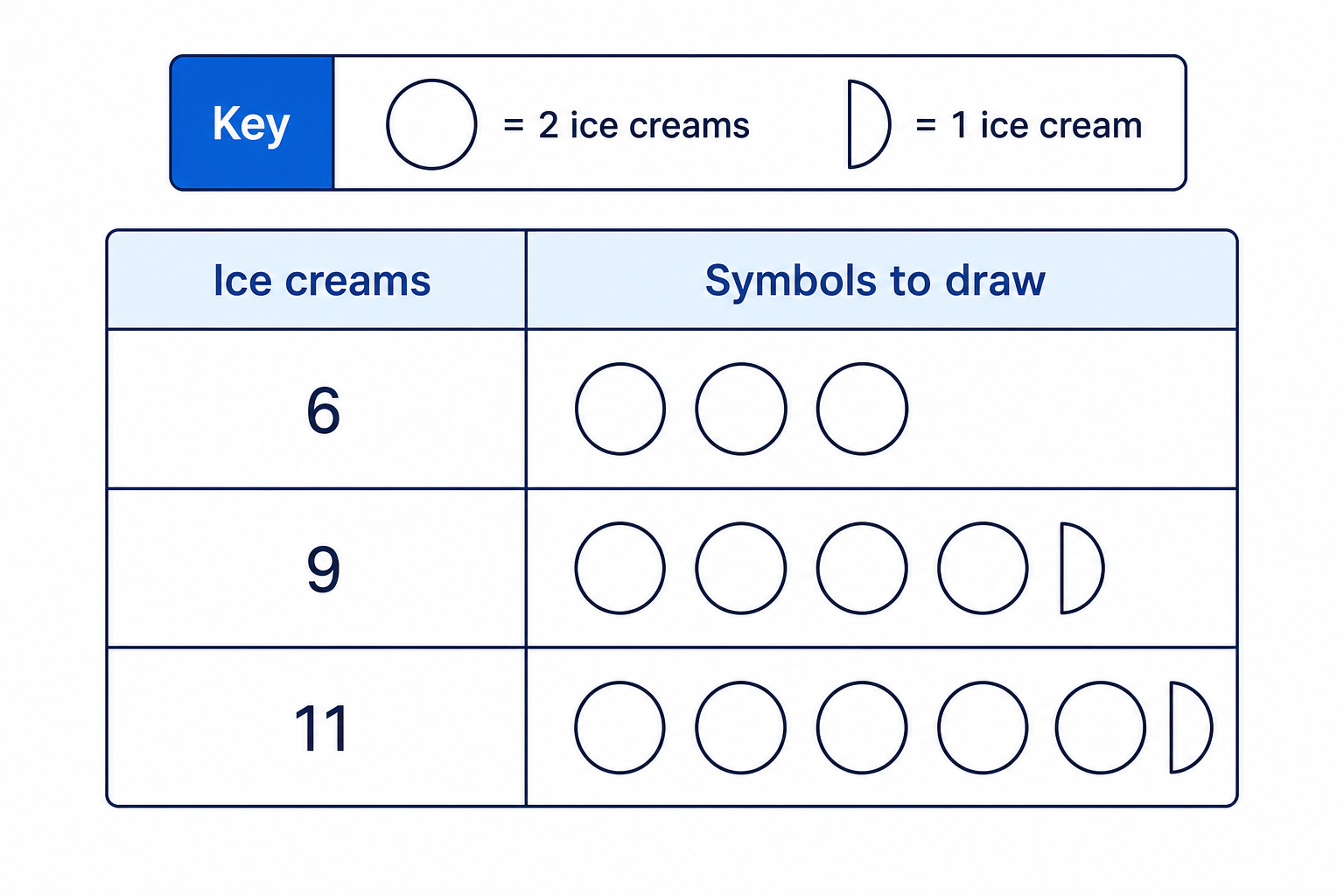
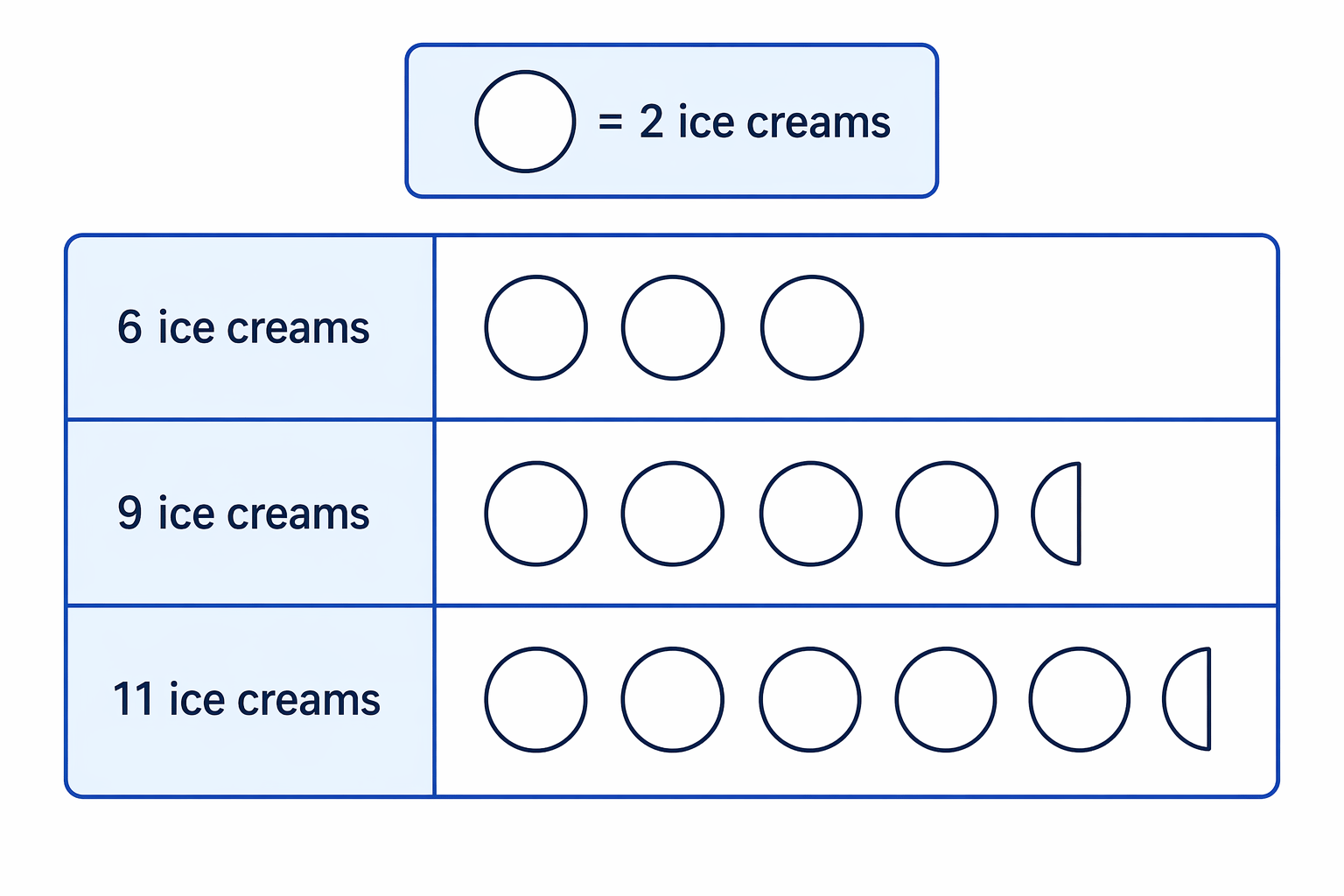
- A pictogram uses circles. The key says one full circle represents 2 ice creams.
-
For 6 ice creams, divide by the key:
6÷2=36 \div 2 = 36÷2=3 -
So you would draw 3 full circles.
-
For 9 ice creams, 4 full circles represent 8 ice creams.
-
There is 1 ice cream left, and half of 2 is 1.
-
So you would draw 4 full circles and half a circle.
-
For 11 ice creams, 5 full circles represent 10 ice creams.
-
There is 1 ice cream left, so you would draw 5 full circles and half a circle.
Odd numbers with a key of 2
When one symbol represents 2, odd numbers usually need a half-symbol.
Spotting mistakes in pictograms
A correct pictogram should be clear and consistent.
Check that:
- there is a key
- the symbols match the key
- the same size and style of symbol is used
- part-symbols are clear
Finding one thing wrong
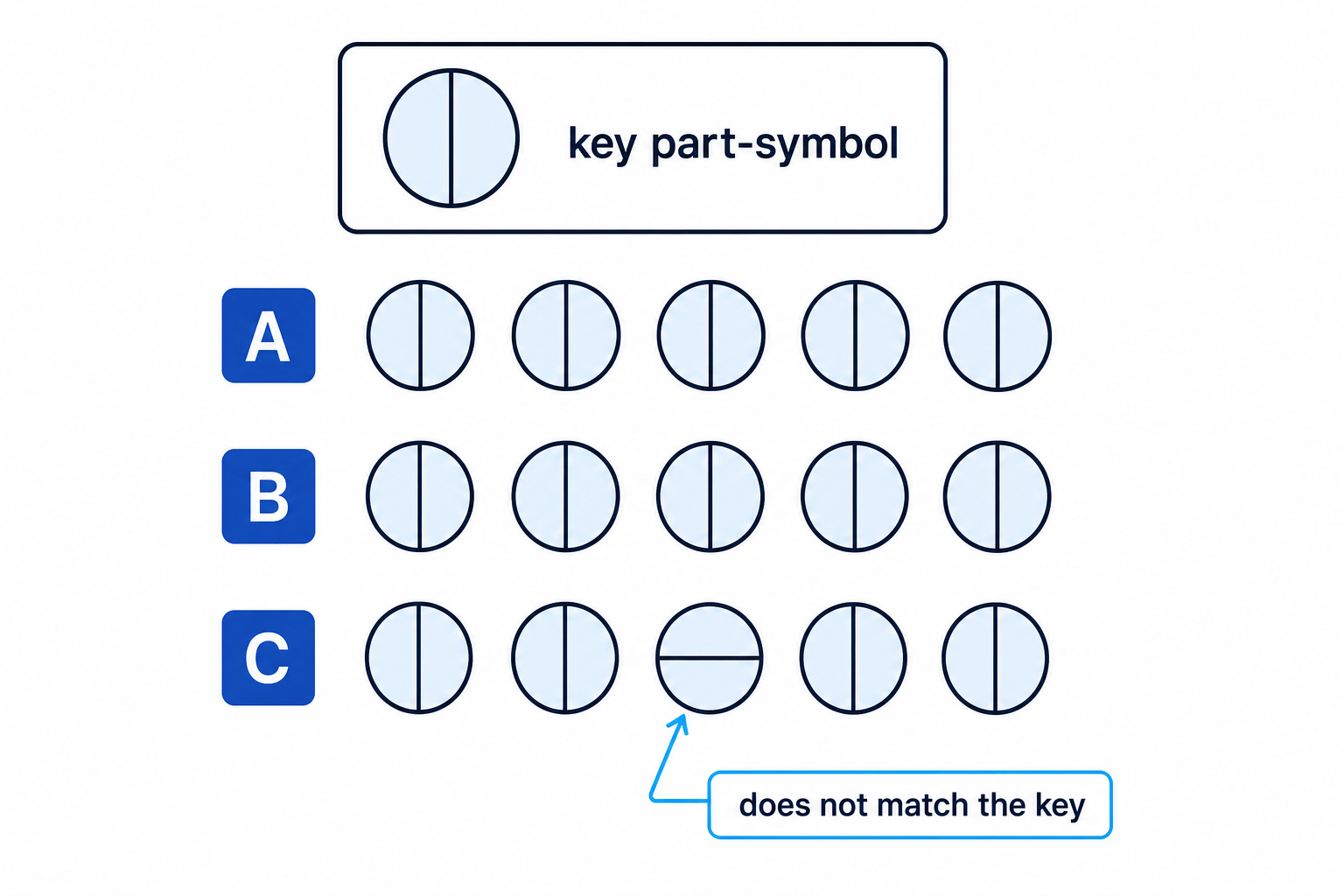
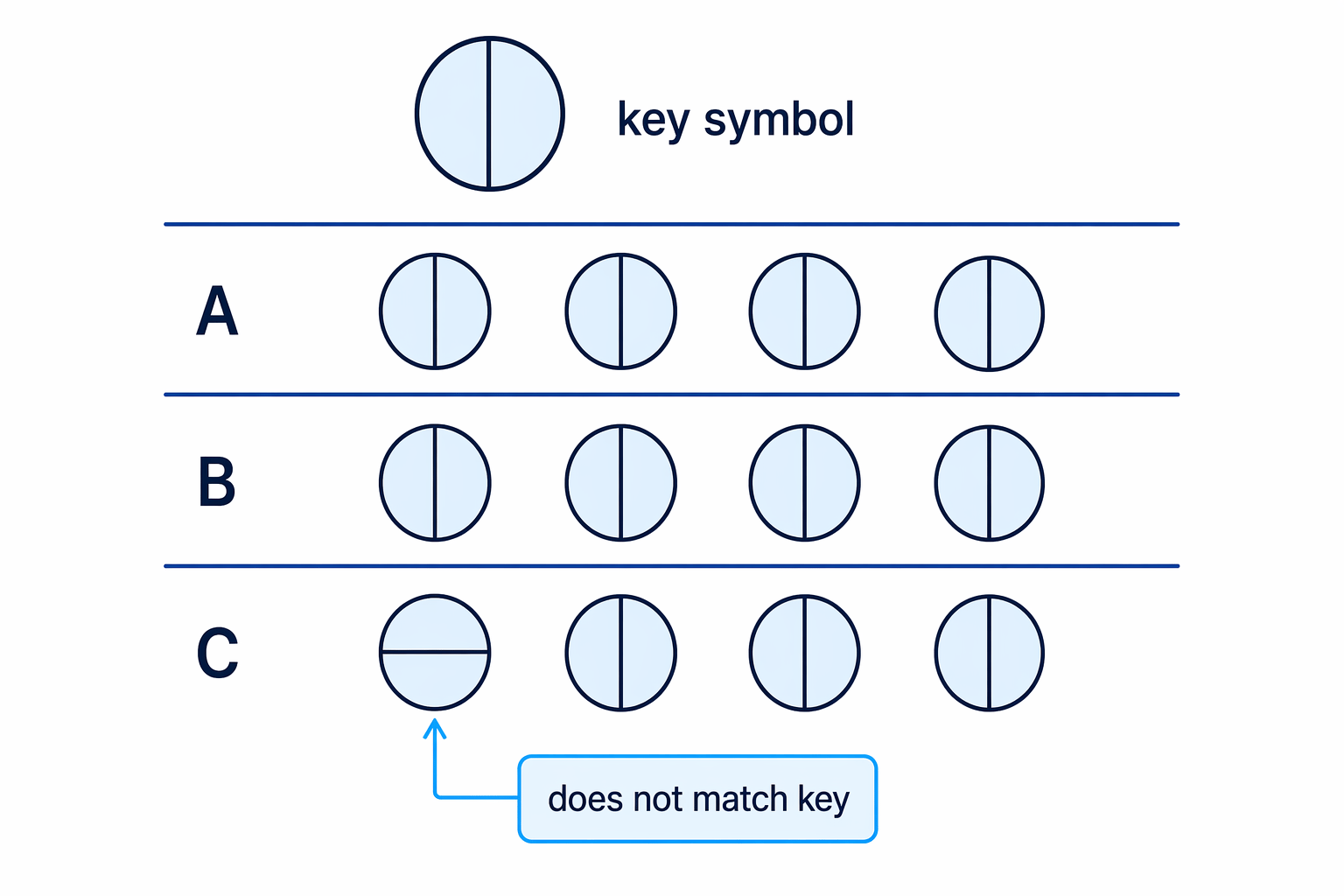
- A chocolate bar pictogram has a key showing a circle split vertically.
-
Most rows use that same vertically split circle.
-
One row uses a circle split horizontally instead.
-
That is a problem because the symbol does not match the key.
-
One thing wrong is: the pictogram uses an inconsistent symbol.
Changing the picture
Do not change the symbol halfway through a pictogram. In an exam, the marker needs to see that your symbols match the key.
Using a total to find the key
Sometimes the key is missing, but you are given the total for some rows. You can use the total to work out what one full symbol represents.
Working out the missing key
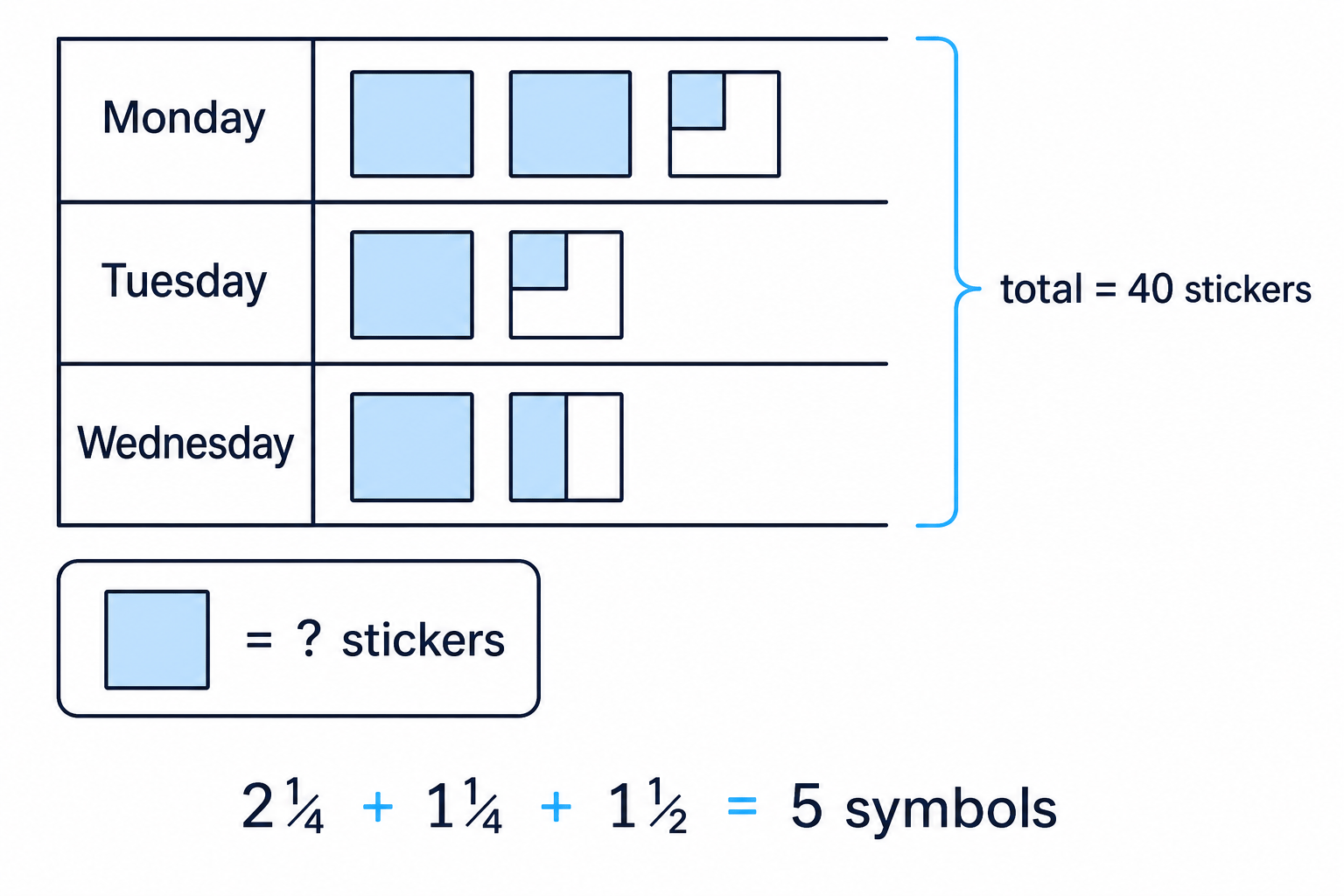
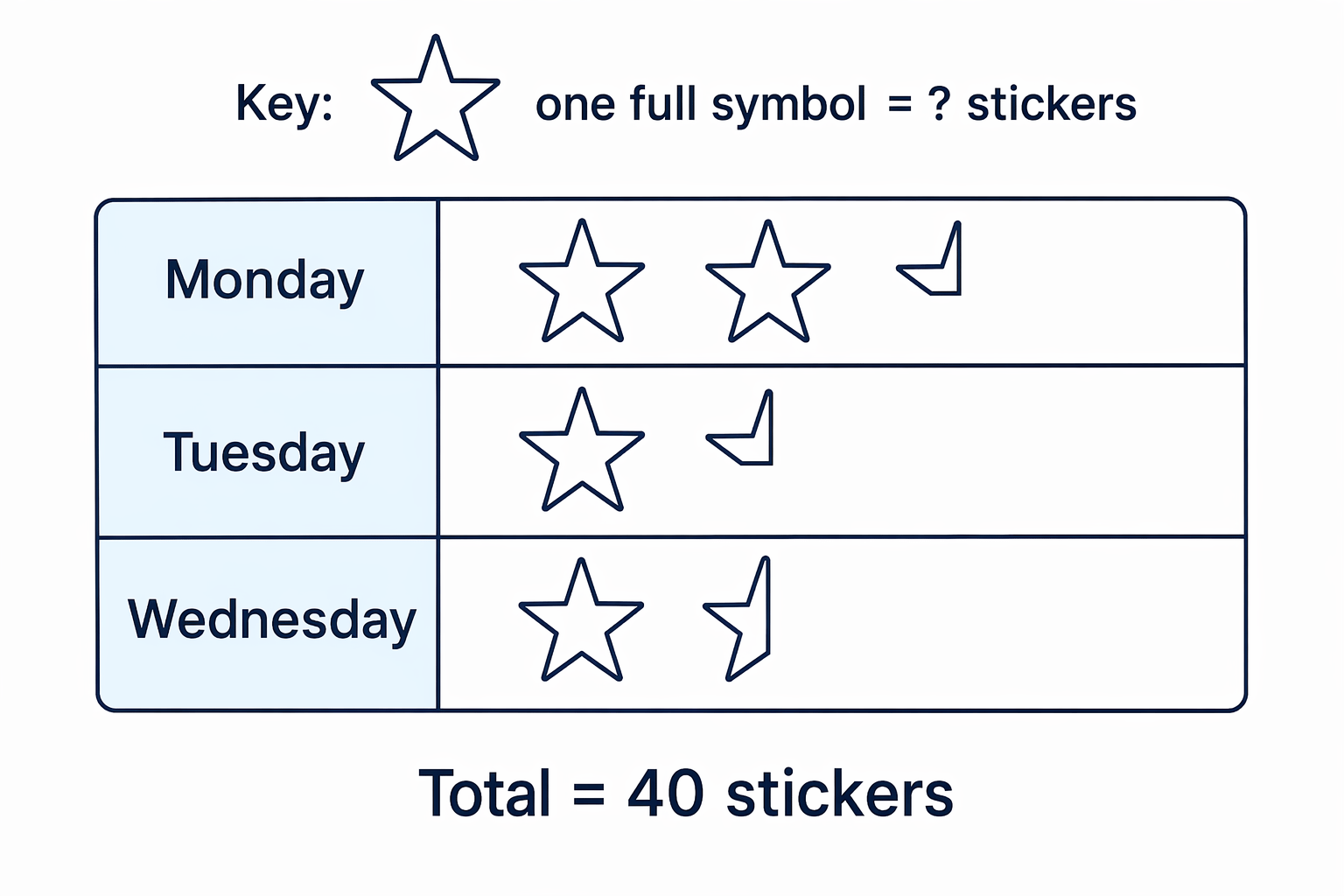
- A pictogram shows stickers sold on Monday, Tuesday and Wednesday.
-
Monday shows 2 full symbols and a quarter symbol.
-
Tuesday shows 1 full symbol and a quarter symbol.
-
Wednesday shows 1 full symbol and a half symbol.
-
Altogether, these three days represent 40 stickers.
-
First count the total number of symbols:
214+114+112=52\frac{1}{4} + 1\frac{1}{4} + 1\frac{1}{2} = 5241+141+121=5 -
Now divide the total number of stickers by the number of symbols:
40÷5=840 \div 5 = 840÷5=8 -
So one full symbol represents 8 stickers.
-
If another day has 18 stickers, draw 2 full symbols and a quarter symbol, because 2 full symbols represent 16 and a quarter represents 2.
Using “times as many” information
A pictogram question may give a total and a comparison, such as “Thursday was 3 times Wednesday”.
This means you can split the total into equal parts.
Completing rows from a total
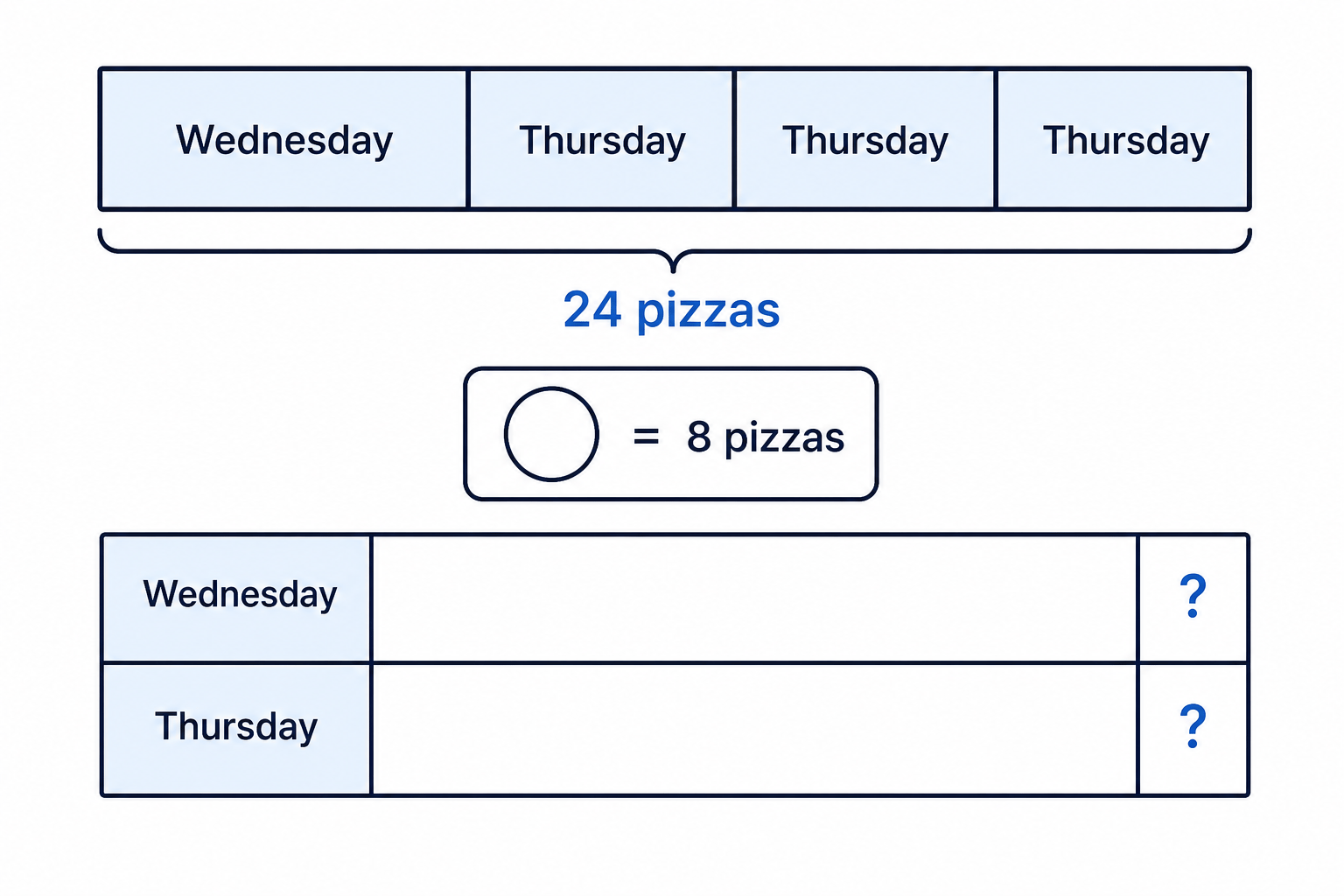
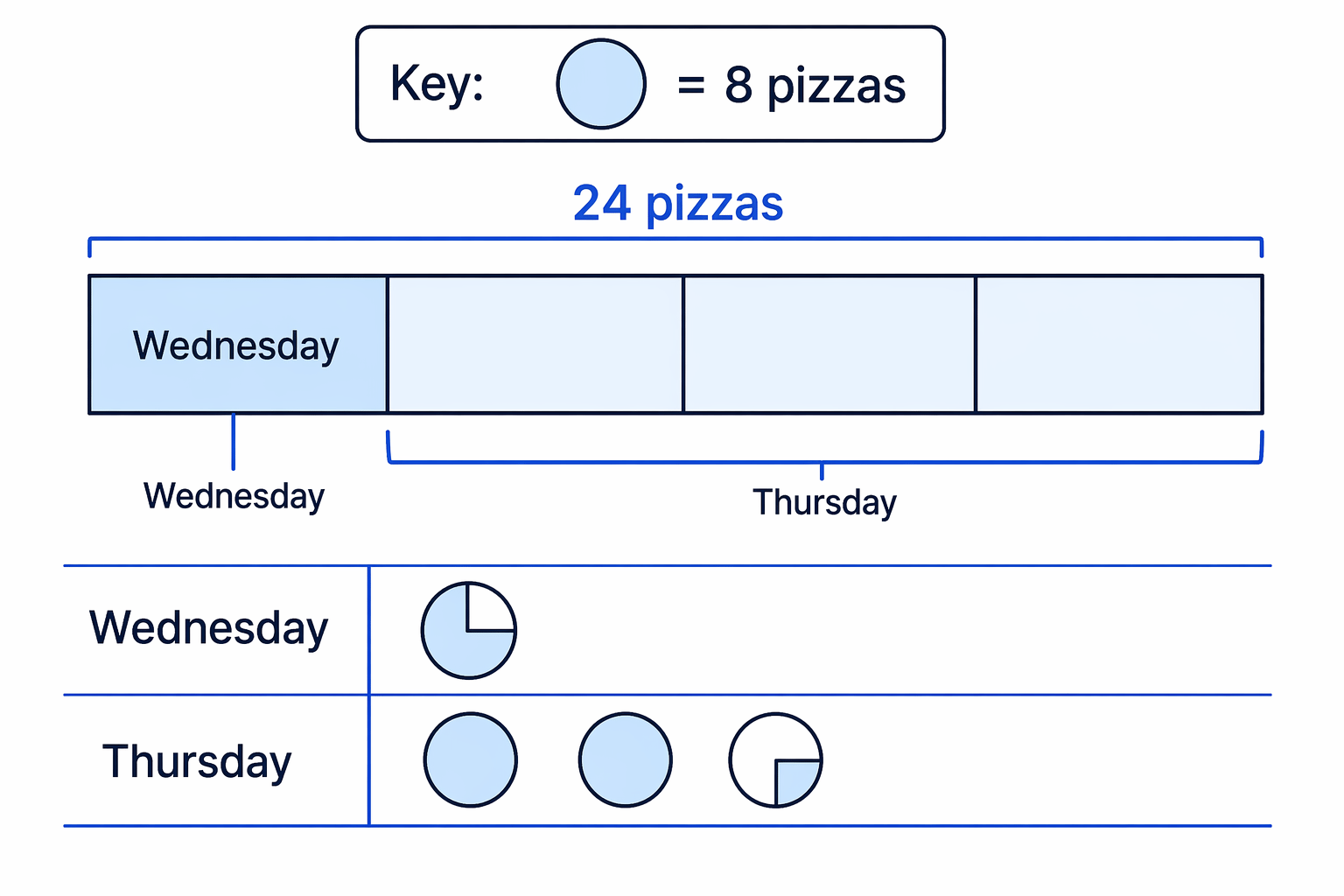
- A pictogram has the key: one full circle represents 8 pizzas.
-
Wednesday and Thursday together have 24 pizzas.
-
Thursday has 3 times as many pizzas as Wednesday.
-
Think of Wednesday as 1 part and Thursday as 3 parts, so there are 4 parts altogether.
-
Find one part:
24÷4=624 \div 4 = 624÷4=6 -
Wednesday has 6 pizzas.
-
Thursday has 3 parts:
3×6=183 \times 6 = 183×6=18 -
To draw Wednesday, use three-quarters of a circle because three-quarters of 8 is 6.
-
To draw Thursday, use 2 full circles and a quarter circle because 2 full circles represent 16 and a quarter represents 2.
In the exam
-
Read the key before doing any counting.
-
If there are half or quarter symbols, work out their values carefully.
-
When drawing symbols, keep them the same size and style as the key.
-
Check your final pictogram matches the numbers in the question.
Check yourself
- If one full symbol represents 8, what does half a symbol represent?
- If a row shows 3 full symbols and a half-symbol, how would you find the total?
- What is one thing that could be wrong with a pictogram?