Transforming Graphs y=f(x)
Teach Genie
Review Transforming Graphs y=f(x) by teaching Genie
Teach it back in your own words, spot gaps, and remember it better.

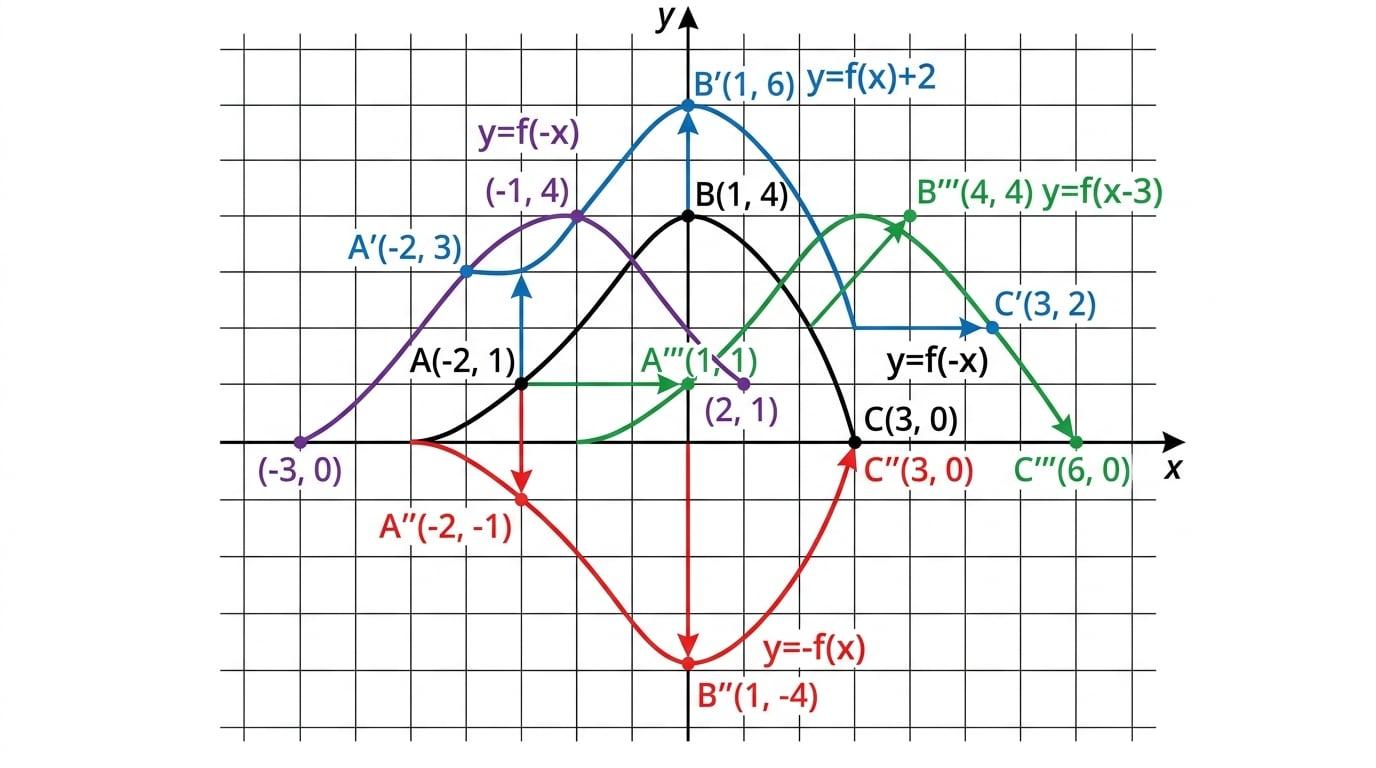
Treat y=f(x)y=f(x)y=f(x) as the original graph. If f(a)=bf(a)=bf(a)=b, then the graph passes through (a,b)(a,b)(a,b), so transformations can be tracked by moving old points to new positions.
Outside changes happen after the function gives an output, so they change yyy-coordinates. Inside changes happen to the input, so they change xxx-coordinates, and horizontal shifts work in the opposite direction.
Mark a few key points such as intercepts and turning points first. Move those points, then redraw the same overall shape.
Question 1
4 marksThe graph of y=f(x)y = f(x)y=f(x) is shown below.
The coordinates of the maximum point of this curve are (1,4)(1, 4)(1,4).
Write down the coordinates of the turning point of the curve with equation
If the function notation f(−2)=5f(-2)=5f(−2)=5 is given, what are the coordinates of the point on the original graph?
Transforming Graphs y=f(x) Revision Guide
Revision notes for OCR GCSE Maths Transforming Graphs y=f(x): explanations and worked examples.