Question 14
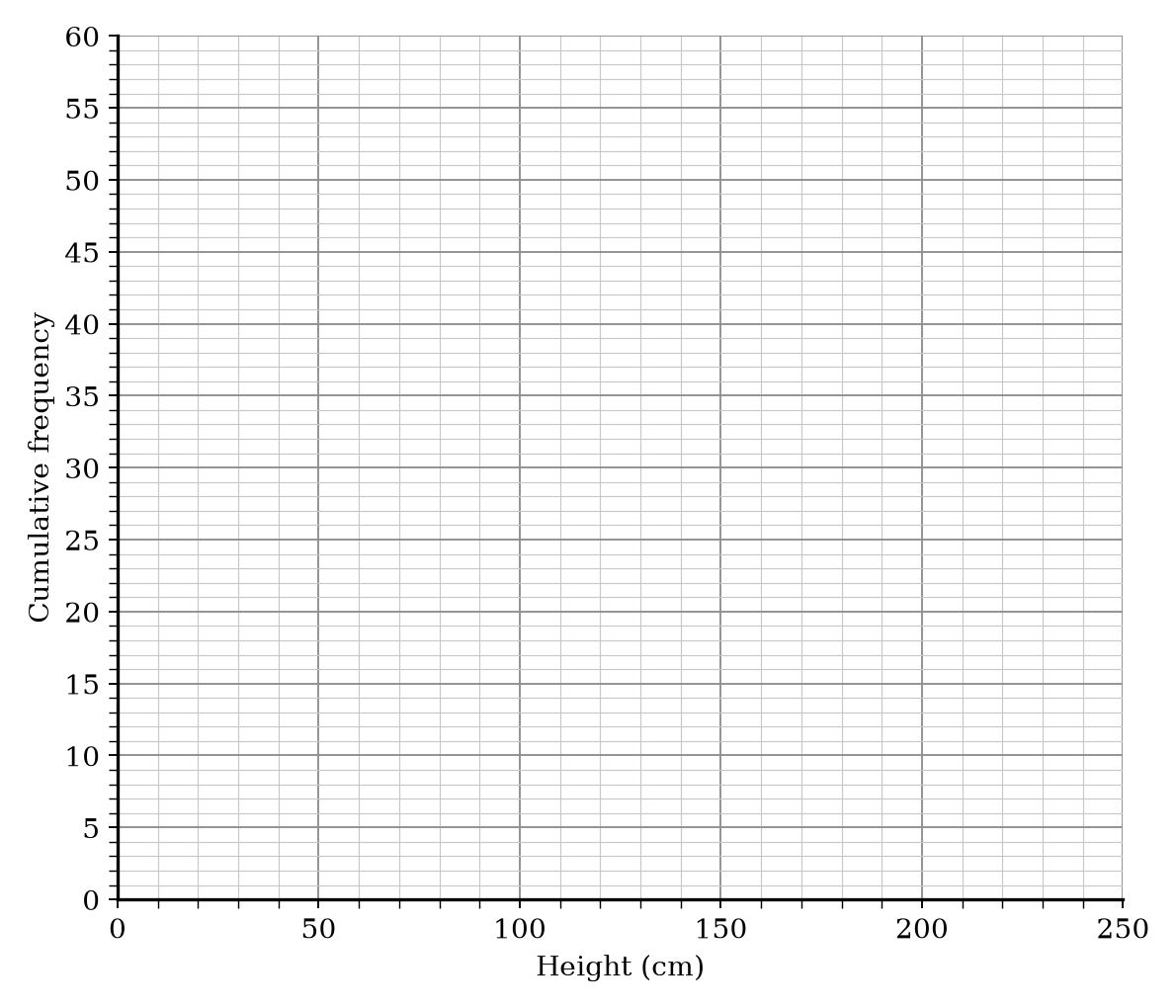
The frequency table shows the heights of 60 sunflower plants in a garden.
a.
[2]
On the grid, plot a cumulative frequency graph for this information.
| Height (h h\,h cm) | Frequency |
|---|---|
| 0<h≤500 < h \le 500<h≤50 | 5 |
| 50<h≤10050 < h \le 10050<h≤100 | 12 |
| 100<h≤150100 < h \le 150100<h≤150 | 22 |
| 150<h≤200150 < h \le 200150<h≤200 | 14 |
| 200<h≤250200 < h \le 250200<h≤250 | 7 |
b.[1]
Find an estimate for the number of sunflowers taller than 225 cm.
Cumulative Frequency Questions
21 exam-style questions on Eduqas GCSE Maths Cumulative Frequency. Each one has a worked solution and a mark scheme showing where the marks go.