Skip to content

Course home

Forming and Solving Equations

Forming and Solving Equations

MediumHard
123456789101112131415161718192021222324252627282930313233343536373839404142434445464748495051525354555657585960616263646566676869707172737475767778798081828384858687888990919293949596979899100101102103104105106107108109110111112113114115116117118119120121122123124125126127128
Question 94

The diagram shows a parallelogram ABCDABCDABCD. The top side AB AB\,AB has a length of 3x+53x + 53x+5. The bottom side DC DC\,DC has a length of 5x−95x - 95x−9.
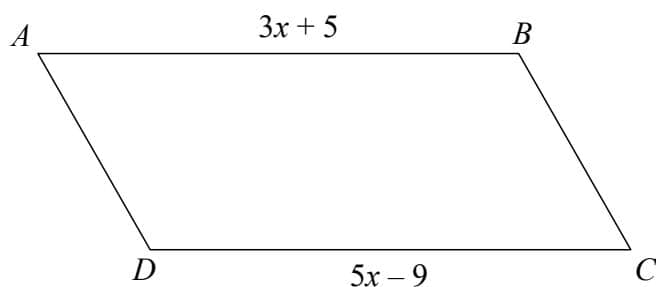
A parallelogram ABCD. The top side AB has a length of 3x + 5. The bottom side DC has a length of 5x - 9.

ABCD ABCD\,ABCD is a parallelogram. All measurements are in centimetres. The perpendicular height of the parallelogram is 5 cm.

Find the area of ABCDABCDABCD

[4]
Markscheme

Forming and Solving Equations Questions

  1. GCSE
  2. /Maths
  3. /Forming and Solving Equations

139 exam-style questions on Eduqas GCSE Maths Forming and Solving Equations. Each one has a worked solution and a mark scheme showing where the marks go.

Question bank