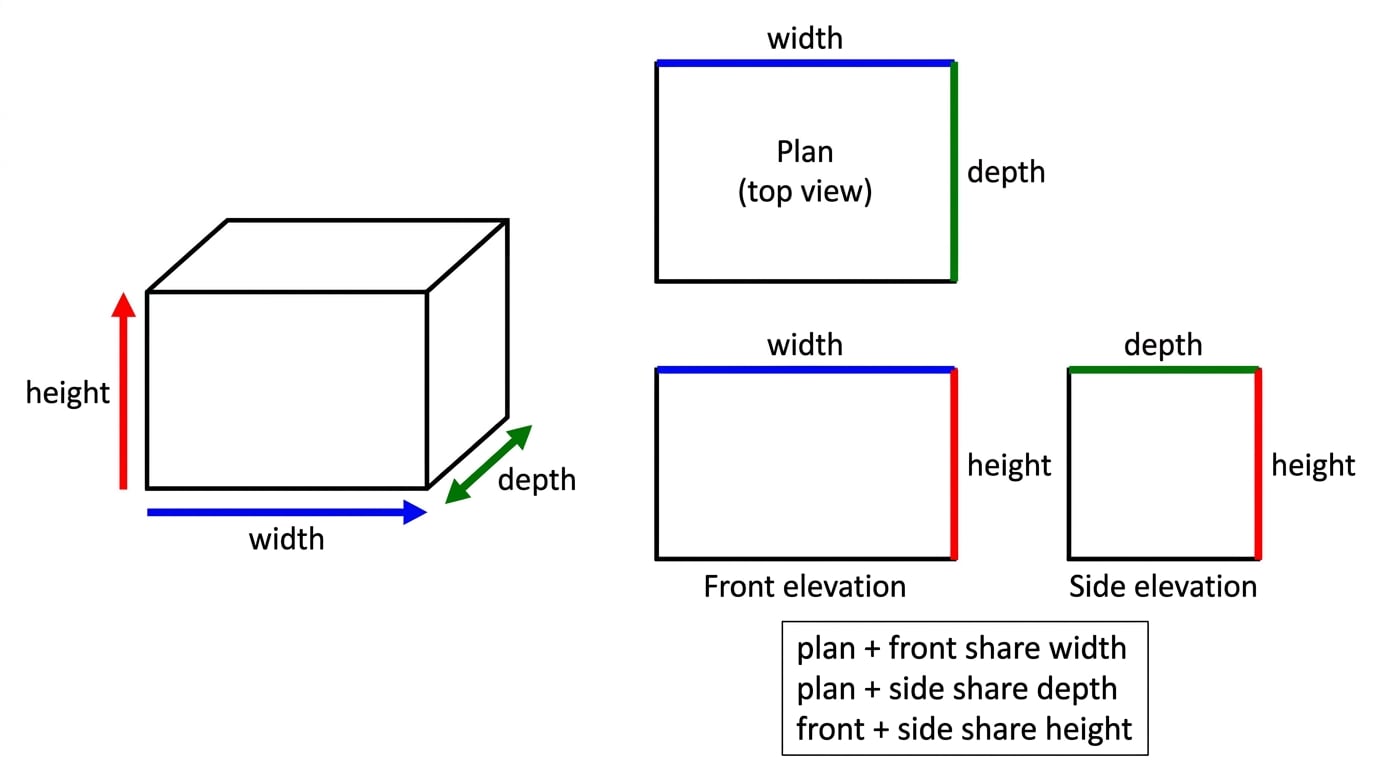
- How to recognise a plan, front elevation and side elevation.
- How to match width, depth and height between different views.
- How to draw views of cube solids, cones and pyramids on a grid.
- How to use a scale such as 2 cm to 1 m.
A three-dimensional, or 3D, shape has three directions: left-to-right, front-to-back, and bottom-to-top.

Plans and elevations are two-dimensional, or 2D, drawings of a 3D solid from different directions.
Orthographic views
-
An orthographic projection is a flat drawing of a 3D object from one direction, with no perspective.
-
A plan is the view from directly above.
-
An elevation is the view from the side of the object.
-
A front elevation is the view from the front.
-
A side elevation is the view from the side shown by the arrow or label.
Use these three words carefully:
- Width means left-to-right.
- Depth means front-to-back.
- Height means bottom-to-top.
The shared measurements
-
The plan and front elevation share the width.
-
The plan and side elevation share the depth.
-
The front elevation and side elevation share the height.

A prism is a solid with the same cross-section all the way through, like pushing a flat shape straight backwards.
Reading views to describe a solid
A solid has these views:
- Plan: a rectangle 5 cm wide and 2 cm deep.
- Front elevation: a trapezium with bottom width 5 cm, top width 3 cm and height 2 cm.
- Side elevation: a rectangle 2 cm deep and 2 cm high.
Describe the solid you would sketch.

-
Use the plan first. It tells you the solid covers a rectangular footprint 5 cm by 2 cm.
-
Use the front elevation next. The front face is a trapezium, 5 cm along the bottom, 3 cm along the top, and 2 cm high.
-
Use the side elevation to check the depth and height. It is 2 cm deep and 2 cm high.
-
So the solid is a trapezium-shaped prism with depth 2 cm. On your sketch, label the height 2 cm, depth 2 cm, bottom width 5 cm and top width 3 cm.
Mixing up depth and height
The side elevation shows depth across the page and height upwards. It does not show the full left-to-right width of the object.
For cube shapes, imagine each small cube sits on a square grid.
The footprint is the set of grid squares covered when you look from above. Stacked cubes do not make the footprint bigger; they only affect the height in an elevation.
Plan and side elevation of a cube solid
Five 1 cm cubes are arranged like this:
- The front row has 3 cubes from left to right.
- One cube is directly behind the left-hand cube.
- One cube is stacked on top of the right-hand front cube.
Draw the plan and the right side elevation.

-
For the plan, look from above. Mark every floor position that has at least one cube on it.
-
The plan has 3 squares in the front row, plus 1 square behind the left-hand square.
-
For the right side elevation, look from the right. The front depth position has maximum height 2 cubes because of the stack.
-
The back depth position has maximum height 1 cube.
-
Draw the side elevation as two depth columns: the front column 2 squares high, and the back column 1 square high.
Plan means top view
If a tower is 3 cubes high, its plan still shows only one square, because from above you only see its footprint.
For circles, the radius is the distance from the centre to the edge. The diameter is the full distance across the circle through the centre, so it is twice the radius.
For cones and pyramids, the apex is the pointed top. The perpendicular height is the straight vertical height from the base to the apex, at 90° to the base.
Recognising common views
-
A cylinder has a circular plan and rectangular elevations.
-
A cone has a circular plan and triangular elevations.
-
A square-based pyramid has a square plan and triangular elevations.
Plan and side elevation of a cone
A cone has radius 2 cm and perpendicular height 5 cm. Draw its plan and side elevation.

-
The plan is the view from above, so you see the circular base.
-
The radius is 2 cm, so the diameter is 4 cm. Draw a circle 4 cm across.
-
The side elevation of a cone is an isosceles triangle.
-
The base of the triangle is the diameter, 4 cm, and the vertical height is 5 cm.
-
Put the apex above the midpoint of the base, then join the apex to both ends of the base.
Perpendicular height vs slant height
For a cone or pyramid, the height of the elevation is normally the perpendicular height, not the sloping edge, unless the question specifically tells you otherwise.

A scale tells you how a length on the drawing matches a real length. For example, a scale of 2 cm to 1 m means every real metre is drawn as 2 cm on the grid.
Always convert the real measurements before drawing.
Scaled plan and elevation of a square-based pyramid
A square-based pyramid has base side 250 cm and perpendicular height 350 cm. Draw the plan and front elevation using a scale of 2 cm to 1 m.

-
The scale uses metres, so first convert the real measurements into metres. Remember that 100 cm is 1 m.
-
Apply the scale 2 cm to 1 m:
250 cm=2.5 m→5 cm on the drawing350 cm=3.5 m→7 cm on the drawing\begin{aligned}
250\text{ cm} &= 2.5\text{ m} \to 5\text{ cm on the drawing} \\
350\text{ cm} &= 3.5\text{ m} \to 7\text{ cm on the drawing}
\end{aligned}250 cm350 cm=2.5 m→5 cm on the drawing=3.5 m→7 cm on the drawing
-
The plan of a square-based pyramid is a square, so draw a 5 cm by 5 cm square.
-
To show the pyramid shape in the plan, mark the centre of the square and join it to the corners.
-
The front elevation is a triangle with base 5 cm and vertical height 7 cm.
-
Put the apex directly above the midpoint of the base, then join it to both ends of the base.
Forgetting the scale
If the scale is 2 cm to 1 m, a real length of 3 m is drawn as 6 cm, not 3 cm.
In the exam
-
First identify the viewing directions: plan, front elevation and side elevation.
-
Match dimensions carefully: width with width, depth with depth, height with height.
-
If a scale is given, convert every length before you start drawing.
-
Use the grid squares neatly and label important dimensions on your sketch.
Check yourself
-
From which direction is a plan drawn?
-
Which two views show the height of a solid?
-
A cone has radius 3 cm and height 7 cm. What shape is its plan, and what shape is its side elevation?