Revision notes for Edexcel GCSE Maths Two Way Tables. Open the guide for explanations and worked examples. Written against the Edexcel GCSE Maths (1MA1) specification, so the content matches what's examinable rather than general Maths background.
Two Way Tables
What you'll learn
- How to read a two-way table using rows and columns.
- How to fill in missing numbers using totals.
- How to answer simple probability questions from a completed table.
- How to build a table from worded information and percentages.
1. Reading a two-way table
A two-way table organises information in two different ways. For example, it might sort students by gender and by how they travel to school.
Definition
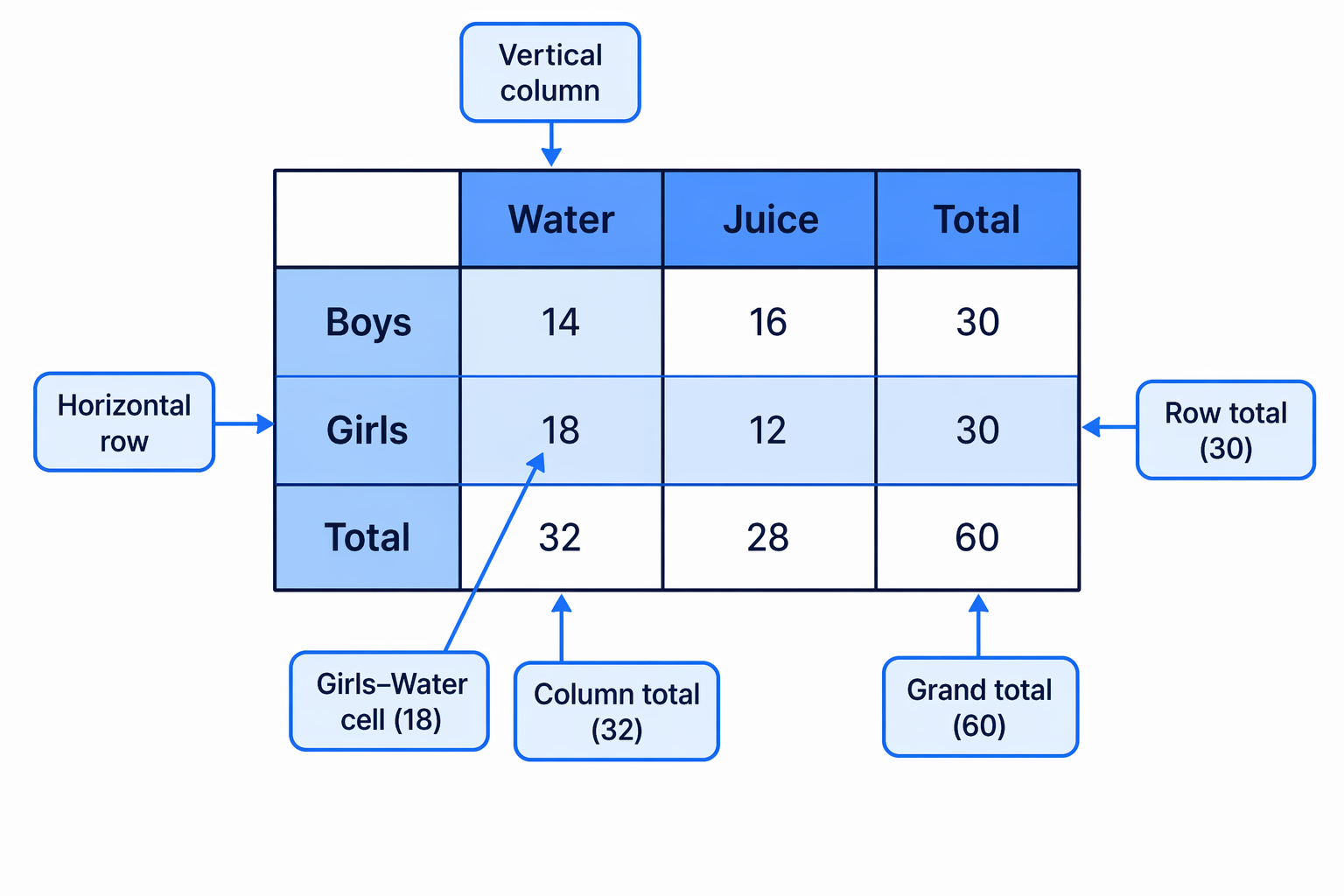
Rows, columns and cells
-
A row goes across the table.
-
A column goes down the table.
-
A cell is one box inside the table.
-
A row total adds across a row. A column total adds down a column.
-
The grand total is the total for the whole table, usually in the bottom-right corner.
Example
Reading one box in a table
The table shows 60 students’ favourite drink.
| Water | Juice | Total | |
|---|---|---|---|
| Boys | 14 | 16 | 30 |
| Girls | 18 | 12 | 30 |
| Total | 32 | 28 | 60 |
-
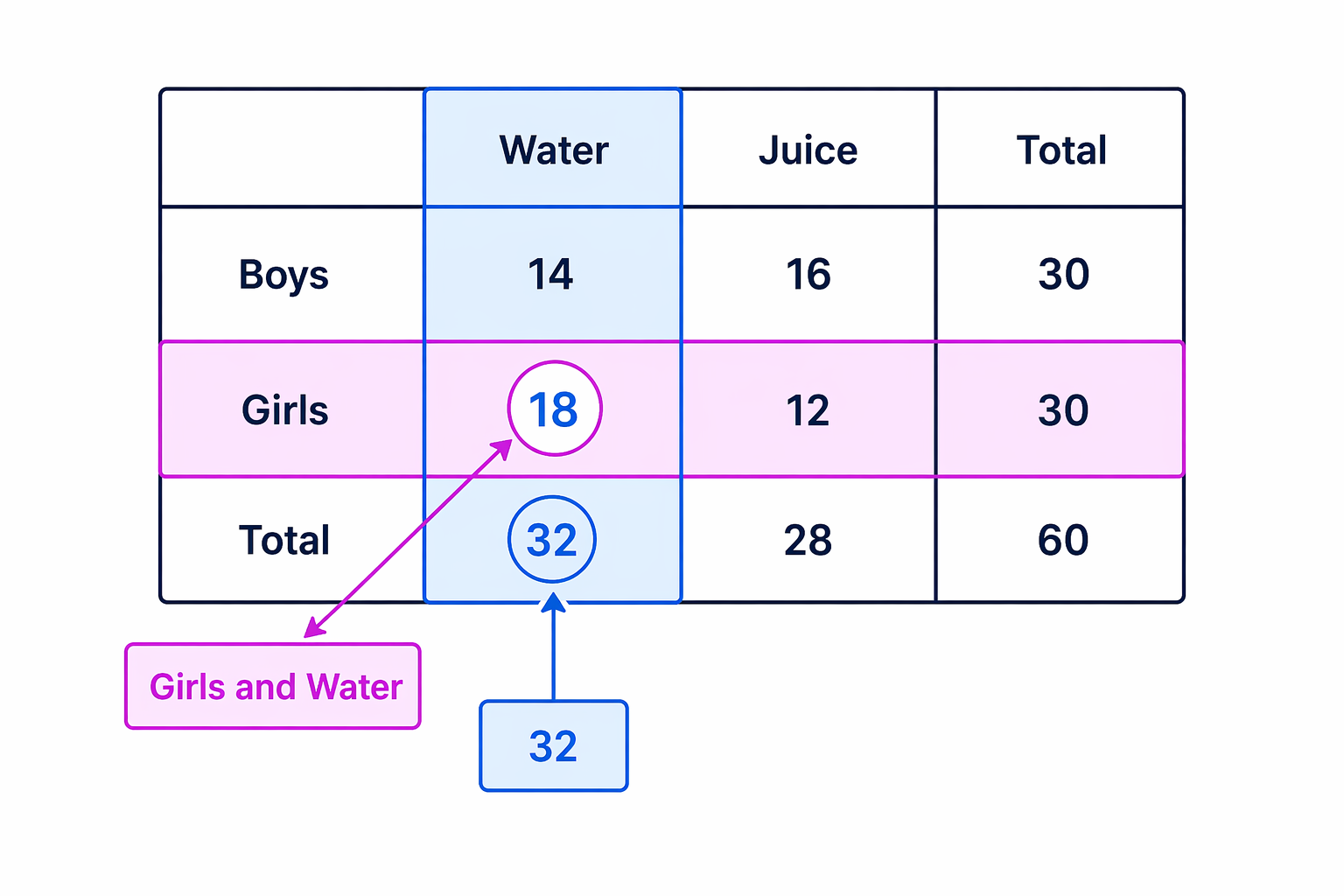
To find how many girls chose water, look along the Girls row.
-
Look down the Water column.
-
The row and column meet at 18, so 18 girls chose water.
-
The Water column total is 32, so 32 students chose water altogether.
2. Completing missing values
Most two-way table questions are about filling in blanks. A blank does not mean zero — it means the number is missing.
Key Idea
Totals must match
Every row must add across to its row total, and every column must add down to its column total. Use subtraction to work backwards from totals.
Example
Completing a travel table
100 students were asked how they travel to school.
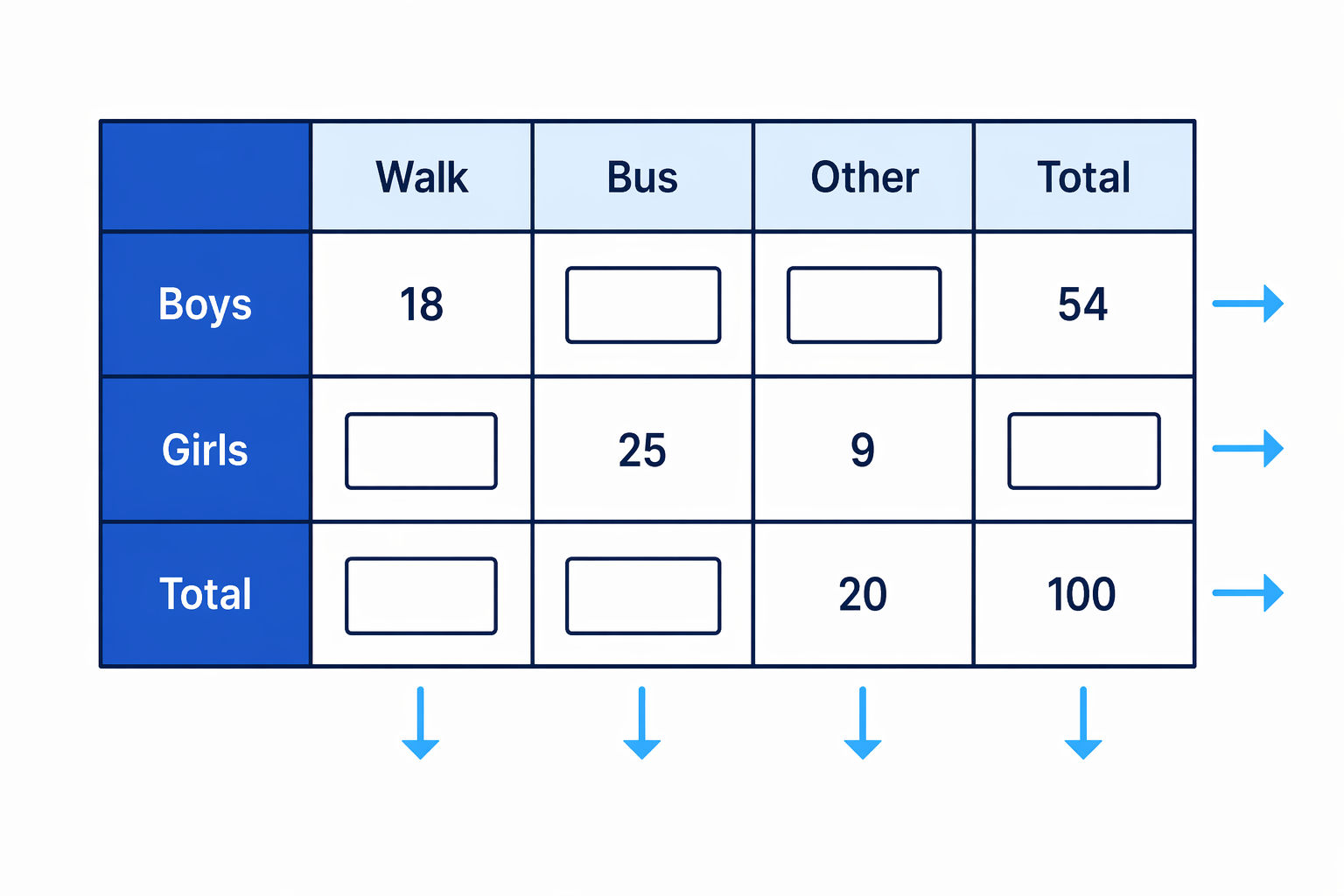
| Walk | Bus | Other | Total | |
|---|---|---|---|---|
| Boys | 18 | 54 | ||
| Girls | 25 | 9 | ||
| Total | 20 | 100 |
-
The grand total is 100 and there are 54 boys, so the girls’ total is 100 - 54 = 46.
-
In the Girls row, the missing Walk number is 46 - 25 - 9 = 12.
-
In the Other column, the missing Boys number is 20 - 9 = 11.
-
In the Boys row, the missing Bus number is 54 - 18 - 11 = 25.
-
Now add down the columns: Walk is 18 + 12 = 30, and Bus is 25 + 25 = 50.
The completed table is:
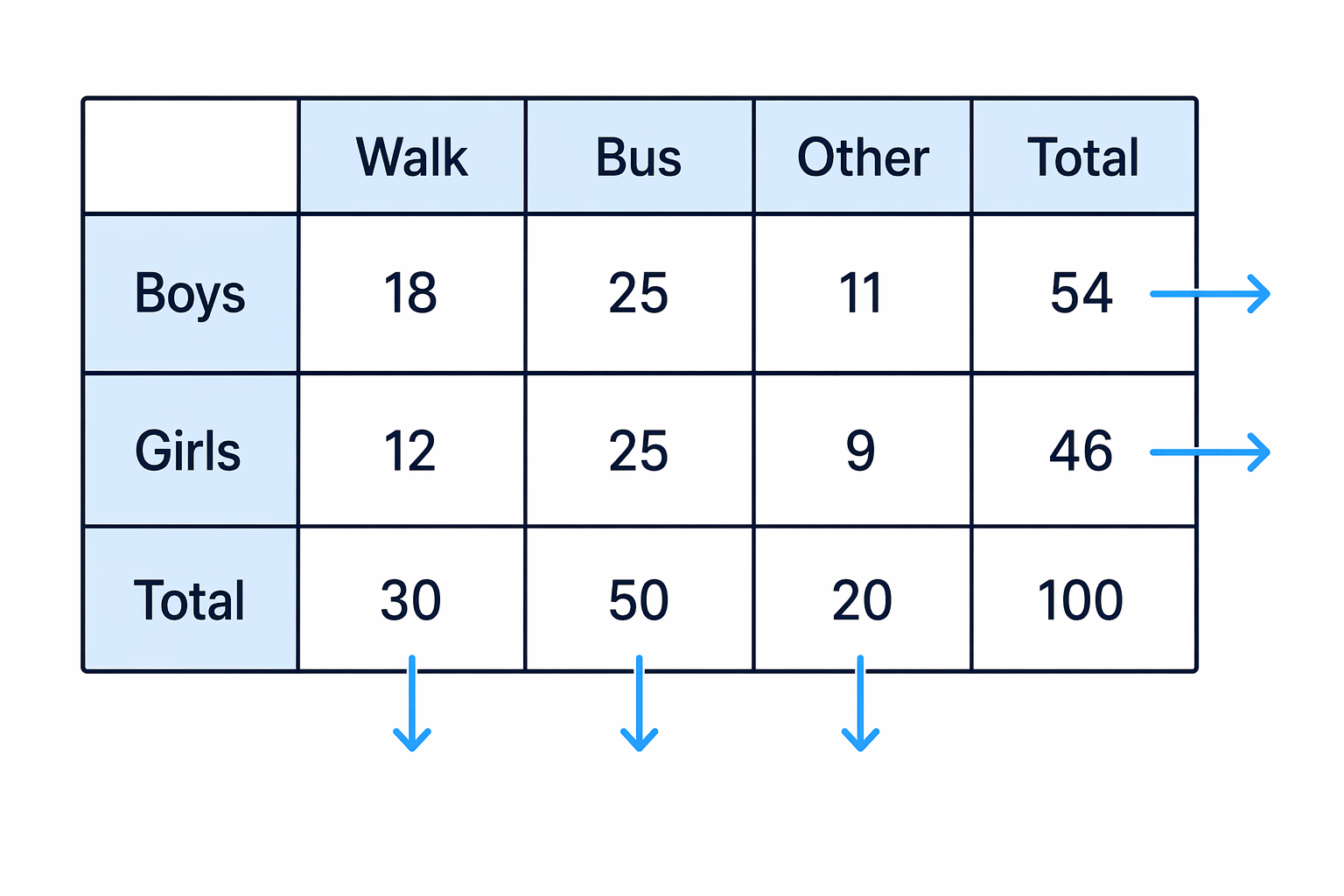
| Walk | Bus | Other | Total | |
|---|---|---|---|---|
| Boys | 18 | 25 | 11 | 54 |
| Girls | 12 | 25 | 9 | 46 |
| Total | 30 | 50 | 20 | 100 |
Tip
Quick check
When you finish, check both ways: rows across and columns down. If one total does not work, one of your entries is wrong.
3. Probability from a two-way table
A probability is a measure of chance. If one person is chosen at random, every person is equally likely to be picked.
For GCSE, you often use:
Probability = favourable outcomes divided by total outcomes.
The favourable outcomes are the ones the question asks for.
Example
Finding a probability from the table
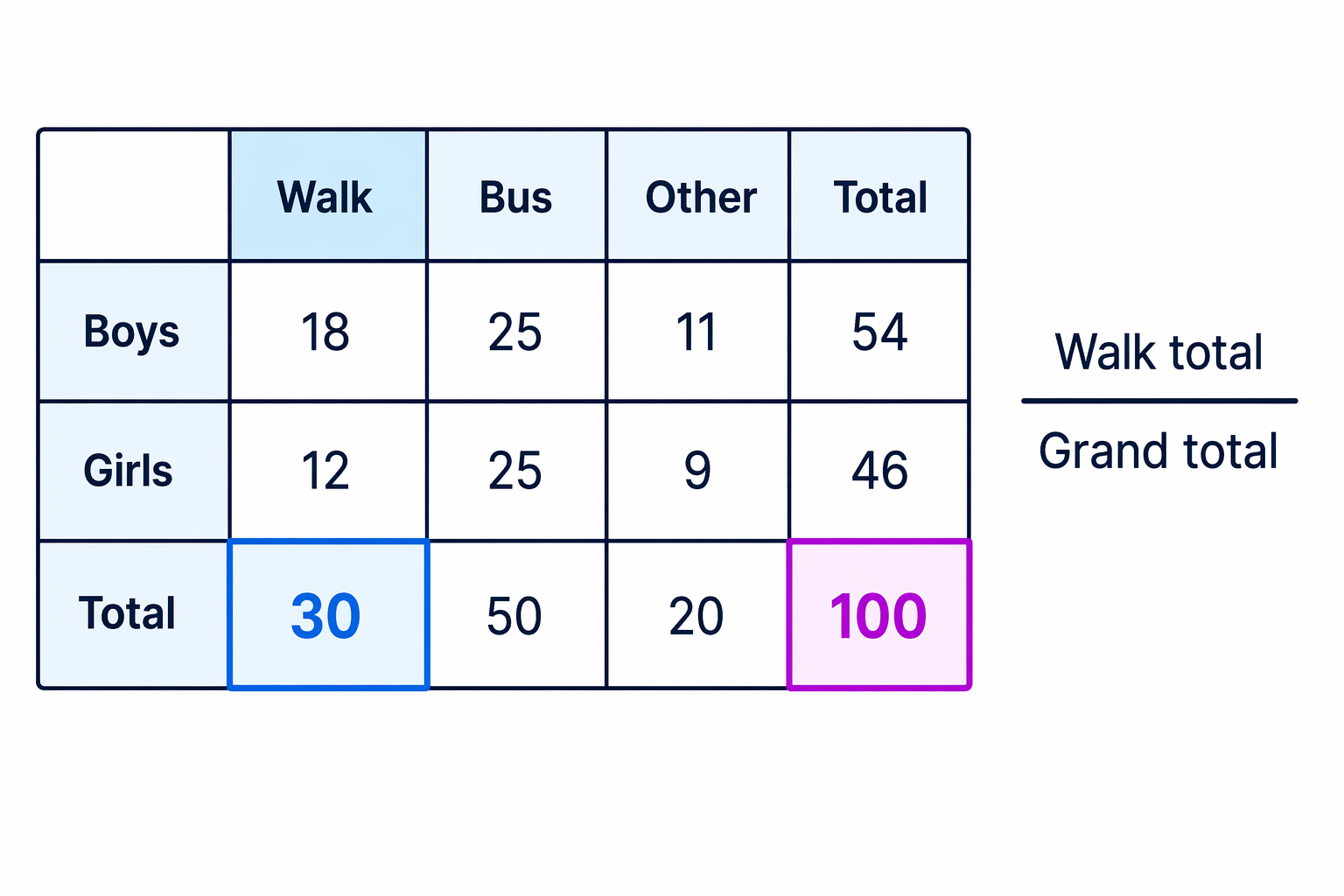
Use the completed travel table above. One student is chosen at random. Find the probability that the student walks to school.
-
The question says one student is chosen from the whole group, so use the grand total: 100.
-
The number who walk is the Walk column total: 30.
-
Write the probability as a fraction: 30100\frac{30}{100}10030.
-
Simplify the fraction by dividing top and bottom by 10, so the probability is 310\frac{3}{10}103.
Common Mistake
Using the wrong total
If the question says one student from the whole table, use the grand total. Only use a row total if the question says something like “one of the boys is chosen”.
4. Making a table from words
Sometimes the table is empty and the information is written in sentences. Start by putting in the totals you know, then fill the inside cells.
Example
Building a table from a worded question
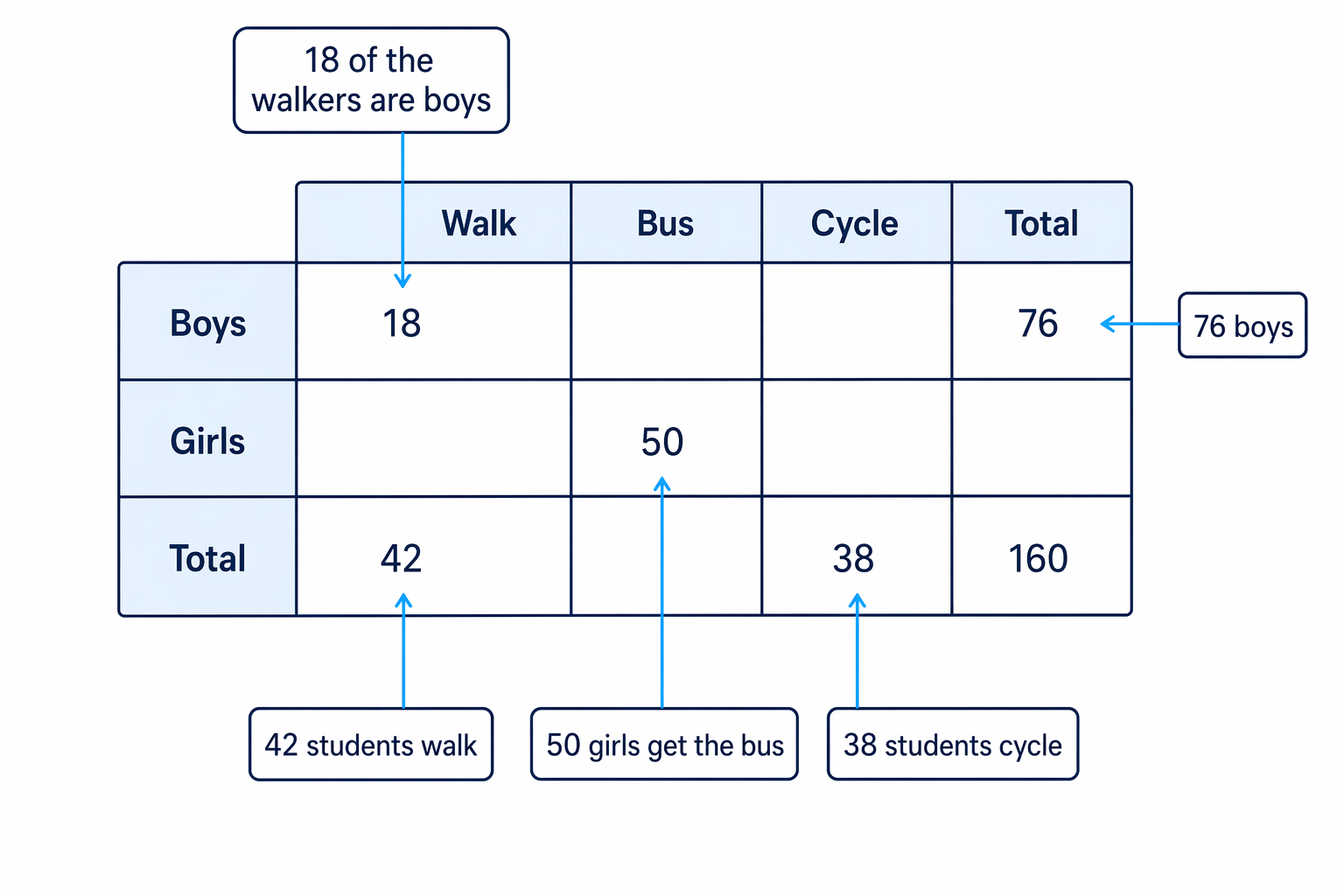
160 Year 8 students either walk, get the bus, or cycle. There are 76 boys. 42 students walk. 18 of the walkers are boys. 50 girls get the bus. 38 students cycle.
-
Put in the grand total 160 and the boys’ total 76.
-
Find the girls’ total: 160 - 76 = 84.
-
Put in the Walk total 42 and Cycle total 38, so the Bus total is 160 - 42 - 38 = 80.
-
“18 of the walkers are boys” means Boys Walk is 18, so Girls Walk is 42 - 18 = 24.
-
Girls Bus is 50, so Girls Cycle is 84 - 24 - 50 = 10.
-
Boys Bus is 80 - 50 = 30, and Boys Cycle is 38 - 10 = 28.
| Walk | Bus | Cycle | Total | |
|---|---|---|---|---|
| Boys | 18 | 30 | 28 | 76 |
| Girls | 24 | 50 | 10 | 84 |
| Total | 42 | 80 | 38 | 160 |
5. Percentages in two-way tables
A percentage means “out of 100”. If the question gives a total number, change the percentages into numbers first.
Common Mistake
Percent of all or percent of a group?
A phrase like “18% are boys who get the bus” usually means 18% of everyone, not 18% of the boys, unless the question clearly says “of the boys”.
Example
Using percentages with a known total
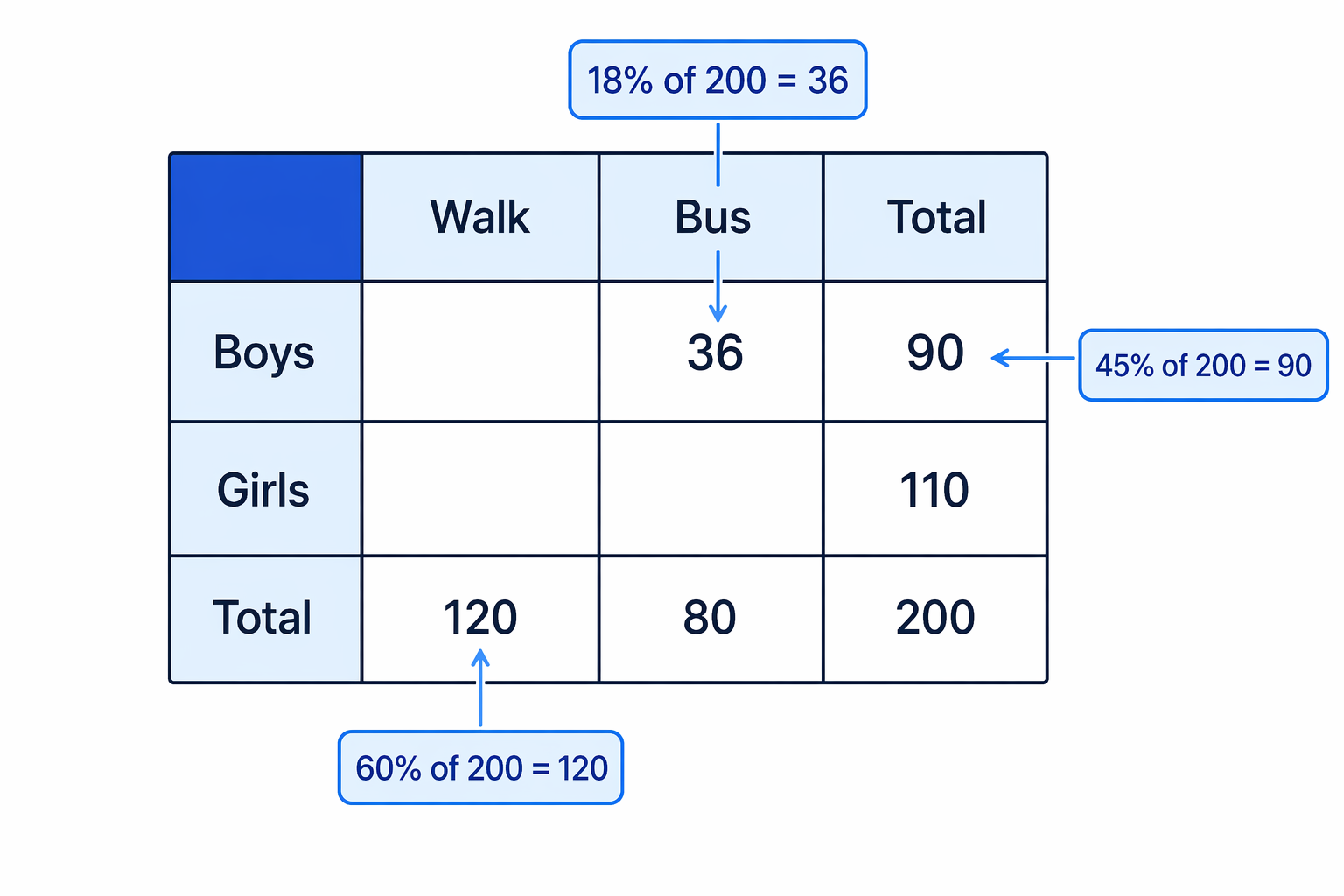
200 students either walk or get the bus. 60% walk. 45% are boys. 18% are boys who get the bus. Work out how many girls walk.
-
60% of 200 is 120, so 120 students walk.
-
The other students get the bus, so 200 - 120 = 80 get the bus.
-
45% of 200 is 90, so there are 90 boys and 110 girls.
-
18% of 200 is 36, so 36 boys get the bus.
-
Boys who walk is 90 - 36 = 54.
-
Girls who walk is 120 - 54 = 66.
If no total number is given, you can pretend the total is 100, because percentages are already out of 100.
Example
Using percentages when no total is given
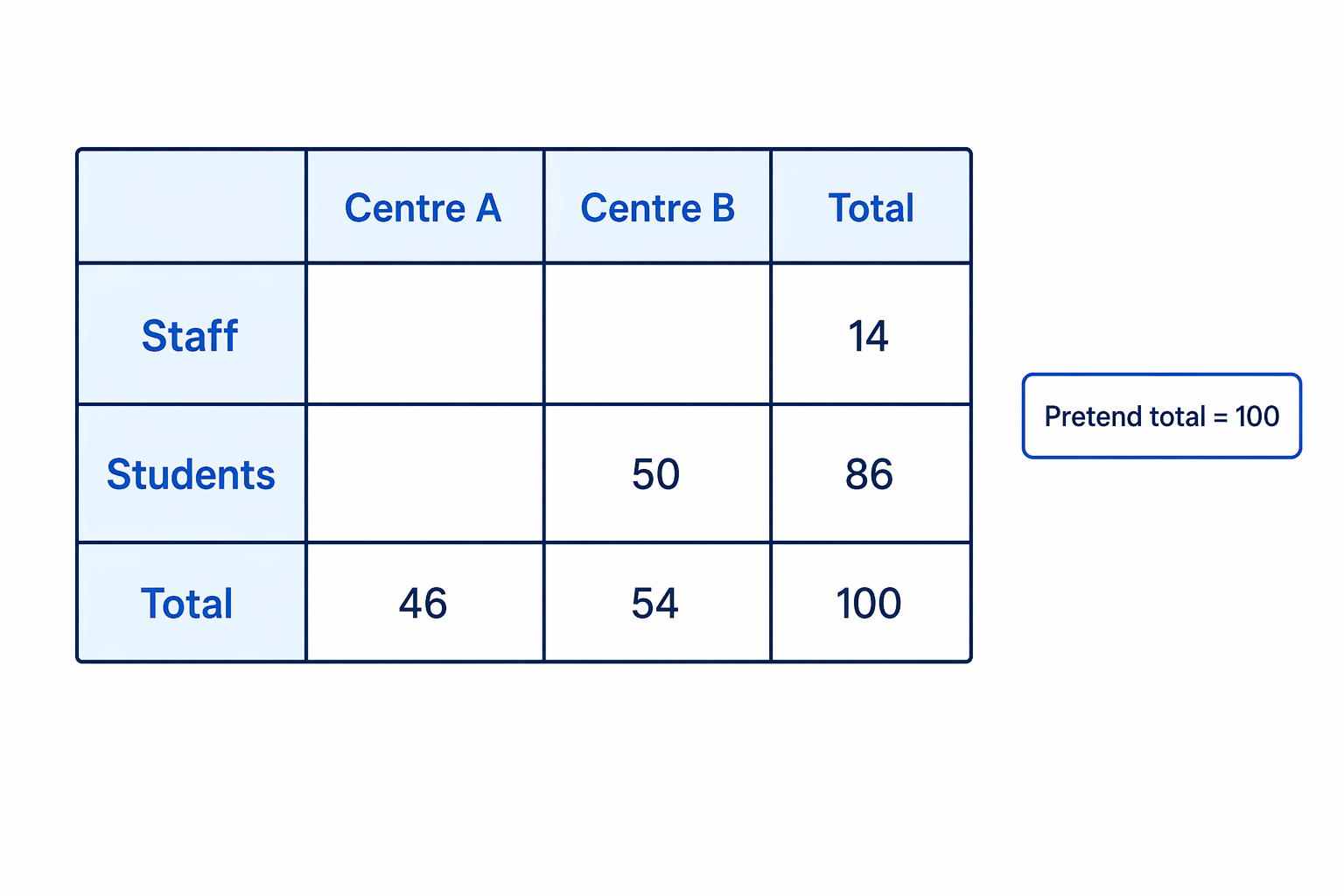
At a conference, 14% of people are staff and the rest are students. 46% are from Centre A. 50% are students from Centre B. Find the probability that a person chosen at random is staff from Centre A.
-
Pretend there are 100 people.
-
There are 14 staff and 86 students.
-
Centre A has 46 people, so Centre B has 54 people.
-
Centre B has 50 students, so Centre B has 54 - 50 = 4 staff.
-
There are 14 staff in total, so Centre A staff is 14 - 4 = 10.
-
The probability is 10100\frac{10}{100}10010, which simplifies to 110\frac{1}{10}101.
Exam technique
In the exam
-
Copy the table neatly and include the Total row and Total column.
-
Fill in the numbers you are directly given before doing calculations.
-
Use subtraction from totals to find missing boxes, then check rows and columns.
-
For probability, use the correct denominator: whole table, row total, or column total.
Self review
Check yourself
-
Can you explain the difference between a row total and a column total?
-
If 24 out of 120 students walk to school, what fraction would represent that probability?
-
In a percentage question with no total, why is it useful to pretend there are 100 people?

Recap questions
Test yourself with 5 quick questions on this guide. Answer them all correctly to complete it.
You've reached the end
Test yourself on this topic, or move on to the next guide.
How was this guide?