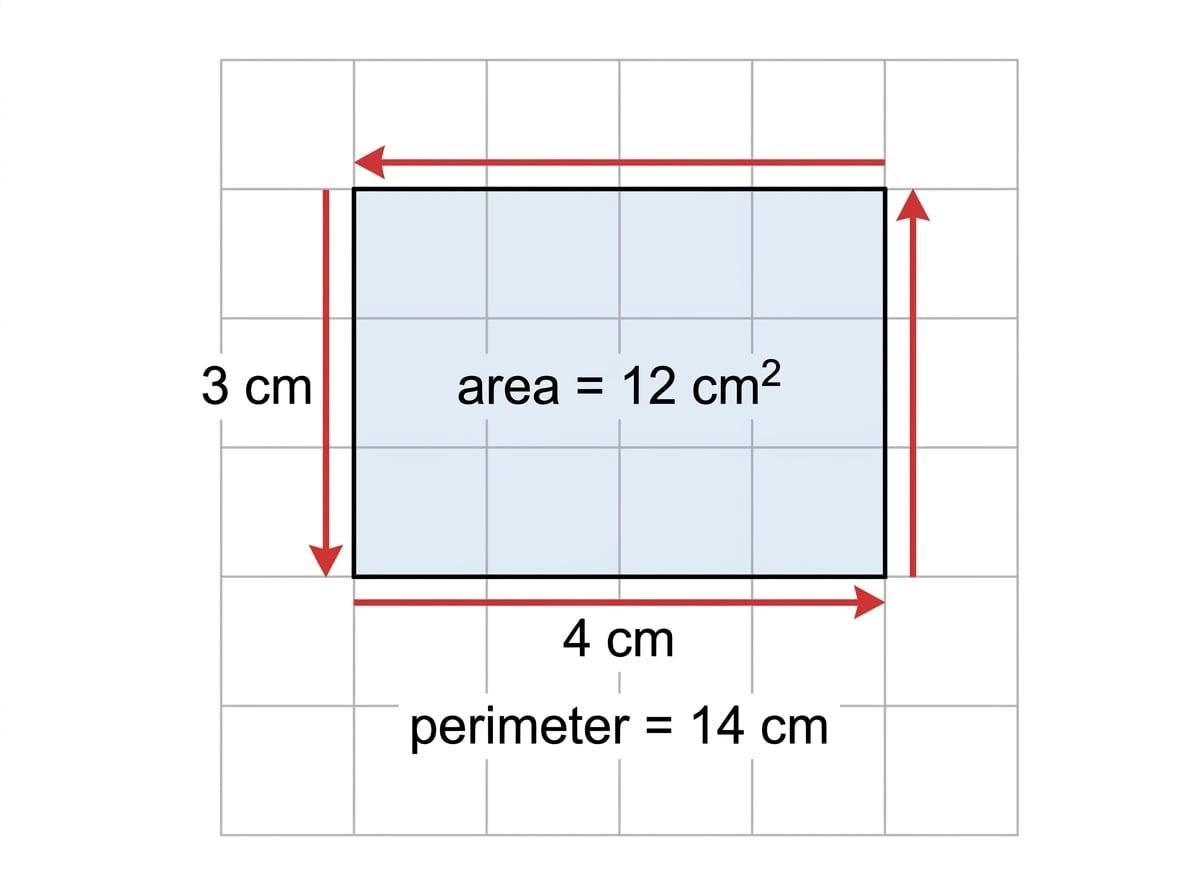
The area of a shape is the space inside the shape. Area is measured in squares.
Finding the area of a rectangle
Here is a rectangle drawn on a centimetre grid.
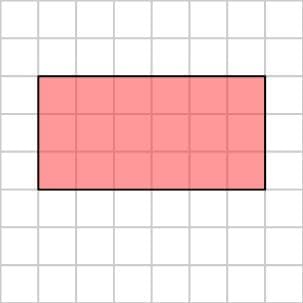
To find the area of a rectangle multiply the length by the width.
(We could also count the squares but this will not work from more complex questions)
In this example we have a length of 6cm and a width of 3cm.
Area = length × width
Area = 6 × 3
Area = 18 cm2
The units are cm2: one cm2 is a square that measures 1cm by 1 cm.
Example 1: A rectangle is drawn on a centimetre grid
Calculate the area of the rectangle
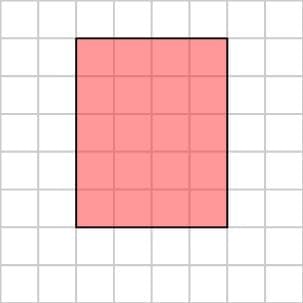
Area = length × width
Area = 5 × 4
Area = 20cm2
Try this:
Finding the area of a triangle
We can think of a triangle as half of a rectangle
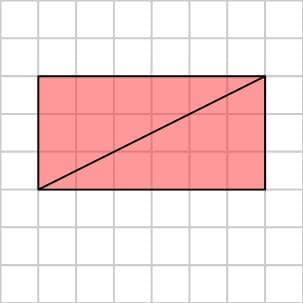
To calculate the area of a triangle we can half the area of a triangle
The area of a triangle = 1⁄2 × base × height
Example 2: Here is a triangle drawn on a centimetre grid.
Calculate the area of the triangle.
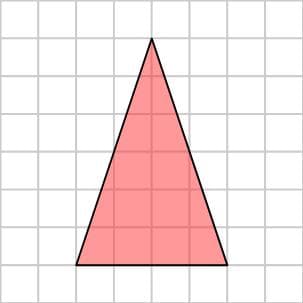
Area = 1⁄2 × base × height
Area = 1⁄2 × 4 × 6
Area = 2 × 6
Area = 12cm2
Example 3: Calculate the area of the triangle.
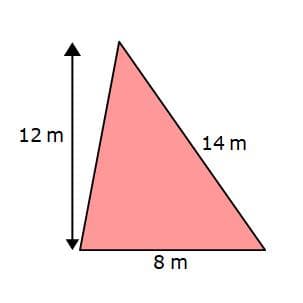
For the area calculation we use the perpendicular height (it must be straight up, not diagonal).
The height of this triangle is 12 metres.
Area = 1⁄2 × base × height
Area = 1⁄2 × 8 × 12
Area = 4 × 12
Area = 48m2
Try these:
Finding the area of a parallelogram
A parallelogram is a quadrilateral with two sets of parallel sides.
A parallelogram can be made into a rectangle by cutting off and moving a triangle:
The area of a parallelogram = base × height
Example 4: Here is a parallelogram drawn on a centimetre grid.
Calculate the area of the parallelogram.
Area = base × height
Area = 4 × 3
Area = 12cm2
Example 5: Calculate the area of the parallelogram.
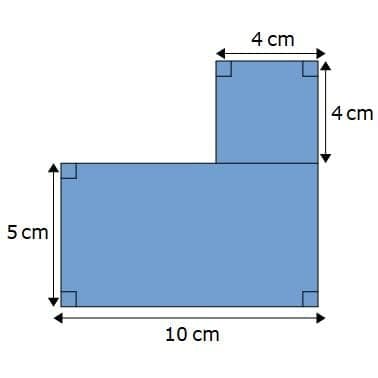
For the area calculation we use the perpendicular height (it must be straight up, not diagonal).
The height of this parallelogram is 11 metres.
Area = base × height
Area = 8 × 11
Area = 88m2
Try these:
Finding the area of a trapezium
The image below shows a trapezium, a trapezium (trapezoid in American English) is a quadrilateral with two parallel sides.
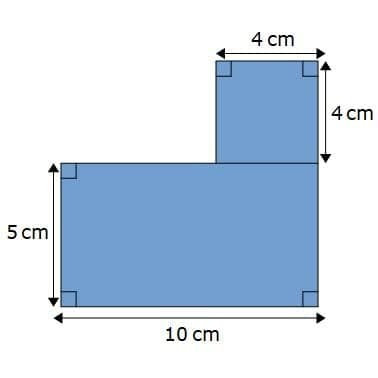
The area of a trapezium = 1⁄2(a + b) × height
Where a and b are the lengths of the two parallel sides
This formula can be made by splitting the trapezium into a rectangle and a triangle (you don't have to know where the formula comes from, you just have to know the formula).
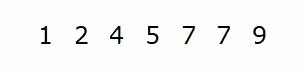
Example 6: Find the area of the trapezium
For the trapezium above:
Area = 1⁄2(6 + 10) × 7
Area = 1⁄2(16) × 7
Area = 8 × 7
Area = 56 cm2
Try these:
The perimeter of a shape is the distance around the edge of the shape
Here is a rectangle drawn on a centimetre grid.
To find the perimeter of a shape we add up the lengths of all of the sides
This rectangle has two sides with a length of 6cm and two sides with a length of 3cm
Perimeter = 6 + 6 + 3 + 3
Perimeter = 18 cm
Example 1: A rectangle is drawn on a centimetre grid
Calculate the perimeter of the rectangle
Perimeter = 5 + 5 + 4 + 4
Perimeter = 18cm
Example 2: Calculate the perimeter of the triangle
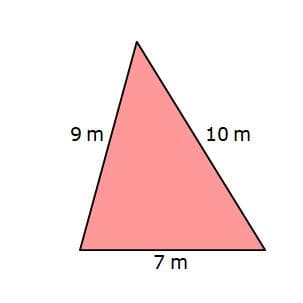
Perimeter = 10 + 9 + 7
Perimeter = 26m
Try these: