Angles
x

Revision notes for Edexcel GCSE Maths Angles. Open the guide for explanations and worked examples. Written against the Edexcel GCSE Maths (1MA1) specification, so the content matches what's examinable rather than general Maths background.

Angles

What you'll learn

  • How to name, measure and draw angles.
  • The key angle facts: straight lines, right angles and angles around a point.
  • How to find missing angles in triangles.
  • How to use facts about isosceles triangles, squares and equilateral triangles.

What is an angle?

An angle measures the amount of turn between two straight lines that meet.

Definition

Key angle words

  • The vertex is the point where the two lines meet.
  • An angle is measured in degrees, written with the symbol °.
  • A right angle is exactly 90°.
  • A straight line angle is 180°.
  • A full turn is 360°.

Types of angle

  • An acute angle is less than 90°.
  • A right angle is exactly 90°.
  • An obtuse angle is more than 90° but less than 180°.
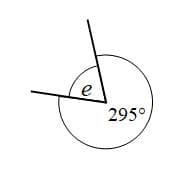
  • A reflex angle is more than 180° but less than 360°.
Example

Naming angles

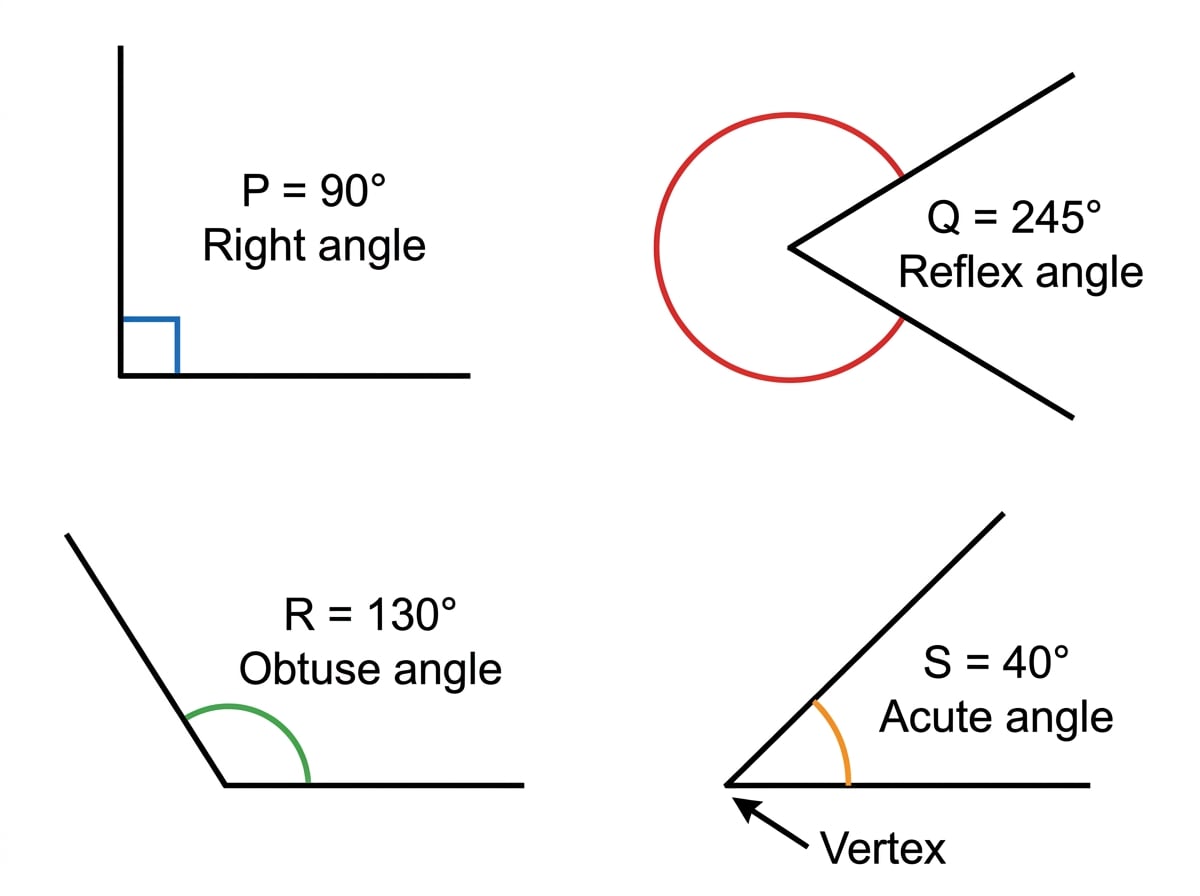
Four angles are shown: P is 90°, Q is 245°, R is 130°, and S is 40°. Match each one to its angle type.

The four labelled angles show a right angle, reflex angle, obtuse angle and acute angle.

  1. P is exactly 90°, so P is a right angle.

  2. Q is bigger than 180° but less than 360°, so Q is a reflex angle.

  3. R is bigger than 90° but less than 180°, so R is an obtuse angle.

  4. S is less than 90°, so S is an acute angle.

Tip

Quick check

Think: acute is “a-cute little angle”, so it is small — less than 90°.

Measuring and drawing angles

A protractor is the tool used to measure or draw angles.

To measure an angle:

  1. Put the centre of the protractor on the vertex.
  2. Line up one arm of the angle with 0°.
  3. Read the correct scale from 0° towards the other arm.
Common Mistake

Reading the wrong scale

Most protractors have two scales. Always start from the 0° line that lies on the arm of your angle.

Example

Measuring an obtuse angle

An angle has one arm pointing to the right. The other arm crosses the protractor at 118° on the scale starting from the right.

The protractor is aligned with the right-pointing arm, so the obtuse angle is read as 118° from the correct scale.

  1. Place the centre of the protractor on the vertex.

  2. Line up the right-pointing arm with 0°.

  3. Read around to the other arm.

  4. The angle is 118°, so it is obtuse.

Drawing an angle

To draw an angle, you start with one straight line, then use the protractor to mark the correct degree.

Example

Drawing an angle of 110°

Draw an angle labelled B with size 110°.

Angle B is drawn by starting from a baseline and measuring 110° anticlockwise from the vertex.

  1. Draw a straight line from a point. This point will be the vertex.

  2. Put the centre of the protractor on the vertex.

  3. Line up the base line with 0°.

  4. Find 110° on the correct scale and make a small mark.

  5. Draw a second straight line from the vertex through the mark.

  6. Label the angle B.

Angles on a straight line

Key Idea

Straight line fact

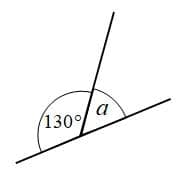
Angles on a straight line add up to 180°.

This is one of the most common GCSE angle facts. If you see a straight line split into two angles, subtract the known angle from 180°.

Example

Missing angle on a straight line

A straight line is split into two angles. One angle is 127° and the other is marked xxx.

The two adjacent angles lie on one straight line, so together they make 180°.

  1. Angles on a straight line add to 180°.

  2. Subtract the known angle:

    x=180−127=53x = 180 - 127 = 53x=180−127=53
  3. The missing angle is 53°.

Common Mistake

Do not trust the picture

Unless a diagram says it is accurately drawn, use the angle facts, not what the angle “looks like”.

Right angles and perpendicular lines

Definition

Perpendicular lines

Two lines are perpendicular if they meet at a right angle, which is 90°.

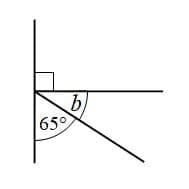
If a right angle is split into two smaller angles, the two smaller angles add to 90°.

Example

Angle inside a right angle

Two perpendicular lines form a right angle. A ray splits it into 34° and xxx.

A ray divides the 90° right angle into a 34° angle and the missing angle x.

  1. A right angle is 90°.

  2. Subtract the known angle:

    x=90−34=56x = 90 - 34 = 56x=90−34=56
  3. The missing angle is 56°.

Sometimes you need to combine facts.

Example

Straight line with a right angle

At a point, a vertical line and a horizontal line make a right angle. Another ray makes a 146° angle with the horizontal line. The angle between the ray and the vertical line is xxx.

  1. A straight line angle is 180°.

  2. The right angle is 90°.

  3. The 146° angle includes the right angle and xxx.

  4. Subtract 90° from 146°:

    x=146−90=56x = 146 - 90 = 56x=146−90=56
  5. So xxx is 56°.

Angles around a point

Key Idea

Full turn fact

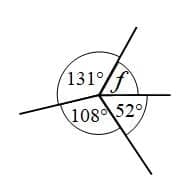
Angles around a point add up to 360°.

A “point” means all the angles meet at the same vertex and go all the way around once.

Example

Angles around one point

Four angles meet at a point. Three of them are 90°, 105° and 118°. The fourth angle is xxx.

All four angles surround the same point and together make a full turn of 360°.

  1. Angles around a point add to 360°.

  2. Add the known angles first:

    90+105+118=31390 + 105 + 118 = 31390+105+118=313
  3. Subtract from 360°:

    x=360−313=47x = 360 - 313 = 47x=360−313=47
  4. The missing angle is 47°.

Angles in triangles

Key Idea

Triangle fact

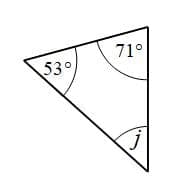
The three angles inside any triangle add up to 180°.

Example

Finding the third angle in a triangle

A triangle has angles 66° and 41°. The third angle is marked xxx.

  1. Angles in a triangle add to 180°.

  2. Add the two known angles:

    66+41=10766 + 41 = 10766+41=107
  3. Subtract from 180°:

    x=180−107=73x = 180 - 107 = 73x=180−107=73
  4. The third angle is 73°.

Isosceles triangles

Definition

Isosceles triangle

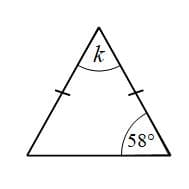
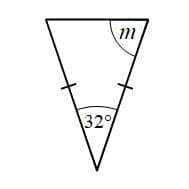
An isosceles triangle has two equal sides. The two angles at the base are also equal.

Equal sides are often shown using matching tick marks.

Example

Isosceles triangle angle

In an isosceles triangle, two equal sides meet at the top. One base angle is 68°. The top angle is xxx.

The matching tick marks show the equal sides, so the two base angles are equal in the isosceles triangle.

  1. The base angles in an isosceles triangle are equal.

  2. So the other base angle is also 68°.

  3. Use the triangle angle sum:

    x=180−68−68=44x = 180 - 68 - 68 = 44x=180−68−68=44
  4. The top angle is 44°.

Squares and equilateral triangles

A square has four equal sides and four right angles. Each corner is 90°.

An equilateral triangle has three equal sides and three equal angles. Each angle is 60°.

Example

Square joined to an equilateral triangle

A square and an equilateral triangle share one side. Find the angle made by one corner of the square and one corner of the triangle at the shared point.

At the shared point, the square contributes 90° and the equilateral triangle contributes 60° to the combined angle.

  1. The corner angle in a square is 90°.

  2. The angle in an equilateral triangle is 60°.

  3. Add the two angles:

    90+60=15090 + 60 = 15090+60=150
  4. The combined angle is 150°.

Exam technique

In the exam

  1. Write down the angle fact you are using, such as “angles on a straight line add to 180°”.

  2. Mark equal angles on the diagram when you spot an isosceles triangle.

  3. If asked to give a reason, use clear words like “angles in a triangle add to 180°” or “angles around a point add to 360°”.

Self review

Check yourself

  • What type of angle is bigger than 90° but smaller than 180°?
  • If two angles on a straight line are 132° and xxx, how would you find xxx?
  • What is special about the base angles in an isosceles triangle?

Recap questions

Test yourself with 5 quick questions on this guide. Answer them all correctly to complete it.

You've reached the end

Test yourself on this topic, or move on to the next guide.

Practice questionsTake a quick quiz on this topicFlashcardsSelf-test with active recall
Area and PerimeterUp next

How was this guide?

Angles Revision Guide

  1. GCSE
  2. /Maths
  3. /Angles