Algebraic Fractions
Teach Genie
Review Algebraic Fractions by teaching Genie
Teach it back in your own words, spot gaps, and remember it better.

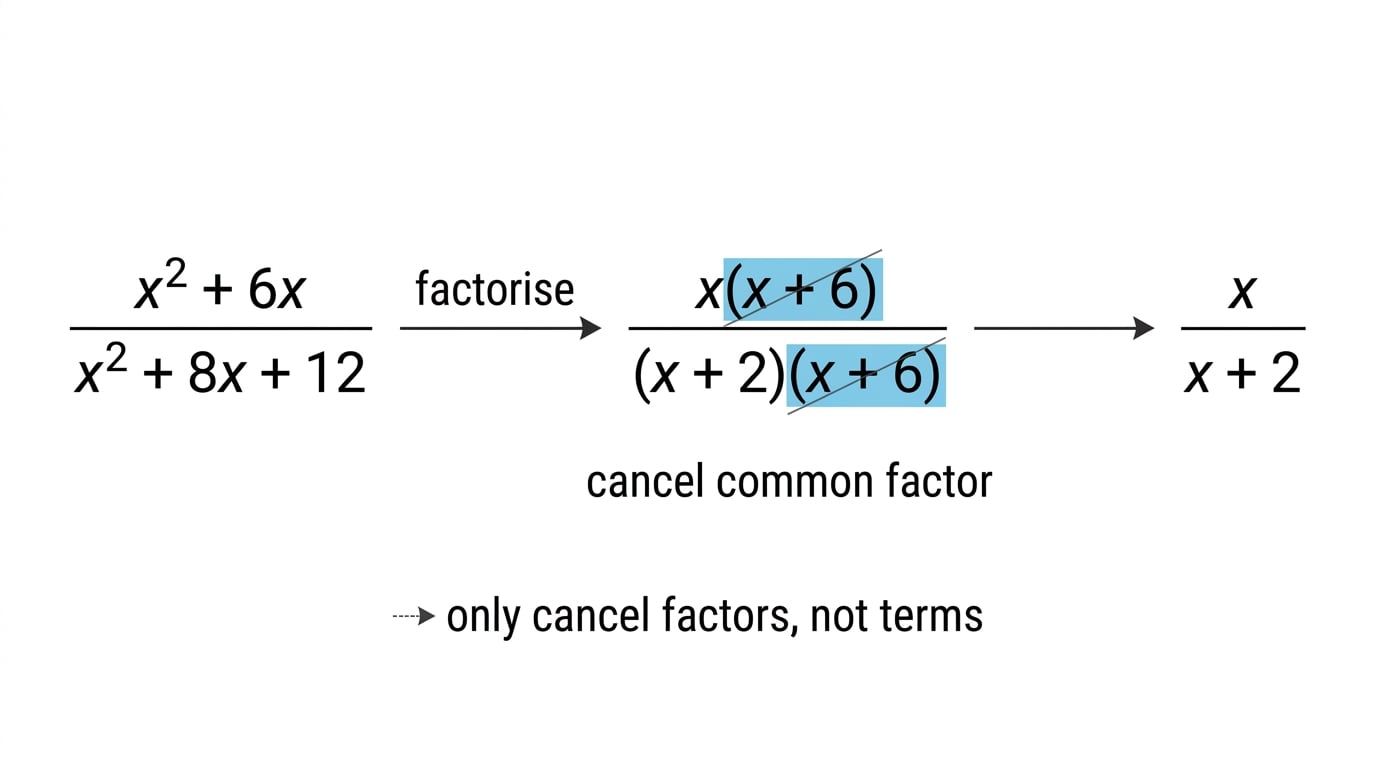
An algebraic fraction is a fraction whose numerator, denominator, or both contain algebra. The top is called the numerator and the bottom is called the denominator.
They follow the same rules as ordinary fractions, but you can only cancel common factors. You must not cancel part of a sum such as the xxx in x+4x+4x+4.
That is why factorising comes first. Useful patterns are:
3x2+9x=3x(x+3) 3x^2+9x = 3x(x+3) 3x2+9x=3x(x+3) x2+7x+10=(x+5)(x+2) x^2+7x+10 = (x+5)(x+2) x2+7x+10=(x+5)(x+2) x2−25=(x−5)(x+5) x^2-25 = (x-5)(x+5) x2−25=(x−5)(x+5)Question 1
2 marksSimplify fully x2+5xx2+7x+10\displaystyle \frac{x^2 + 5x}{x^2 + 7x + 10}x2+7x+10x2+5x
What specific part of an algebraic fraction is the only part allowed to be cancelled?
Algebraic Fractions Revision Guide
Revision notes for CCEA GCSE Maths Algebraic Fractions: explanations and worked examples.