The Product Rule for Counting
Teach Genie
Review The Product Rule for Counting by teaching Genie
Teach it back in your own words, spot gaps, and remember it better.

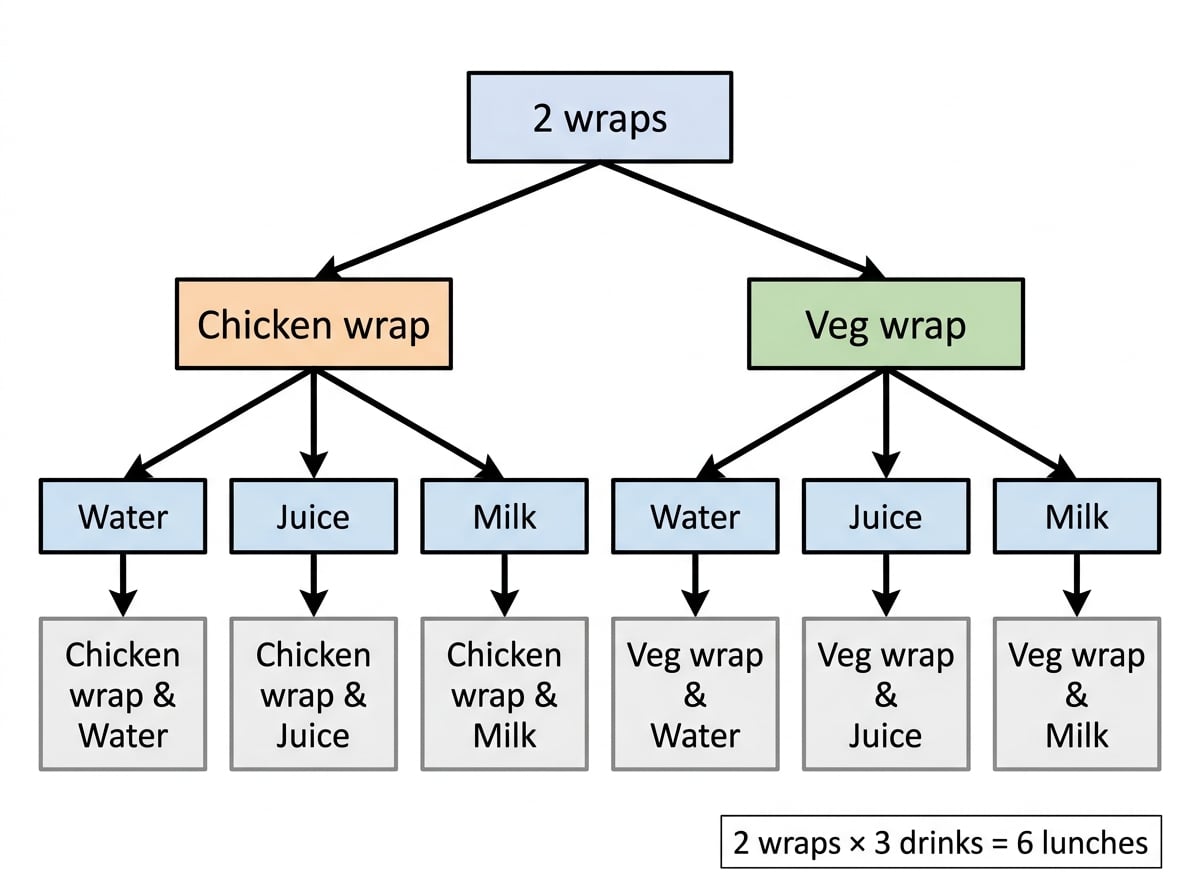
Counting problems often happen in stages. In the tree diagram, choosing a wrap is one stage and choosing a drink is another.
An option is one possible choice at a single stage, and an outcome is one complete result after all stages are chosen. Each full path on the tree is one lunch outcome.
If every first-stage option can go with every second-stage option, use the product rule. For two stages with aaa options and bbb options, total outcomes are a×ba \times ba×b, so here 2×3=62 \times 3 = 62×3=6.
Question 1
2 marksThere are 12 boys and 15 girls in a class. One boy and one girl will be selected to represent the class on the student council. Work out the total number of ways of choosing a boy and a girl.
A task has aaa options at stage one and bbb options at stage two. How is the total number of outcomes calculated?
The Product Rule for Counting Revision Guide
Revision notes for AQA GCSE Maths The Product Rule for Counting: explanations and worked examples.