Fractional and Negative Indices
Teach Genie
Review Fractional and Negative Indices by teaching Genie
Teach it back in your own words, spot gaps, and remember it better.

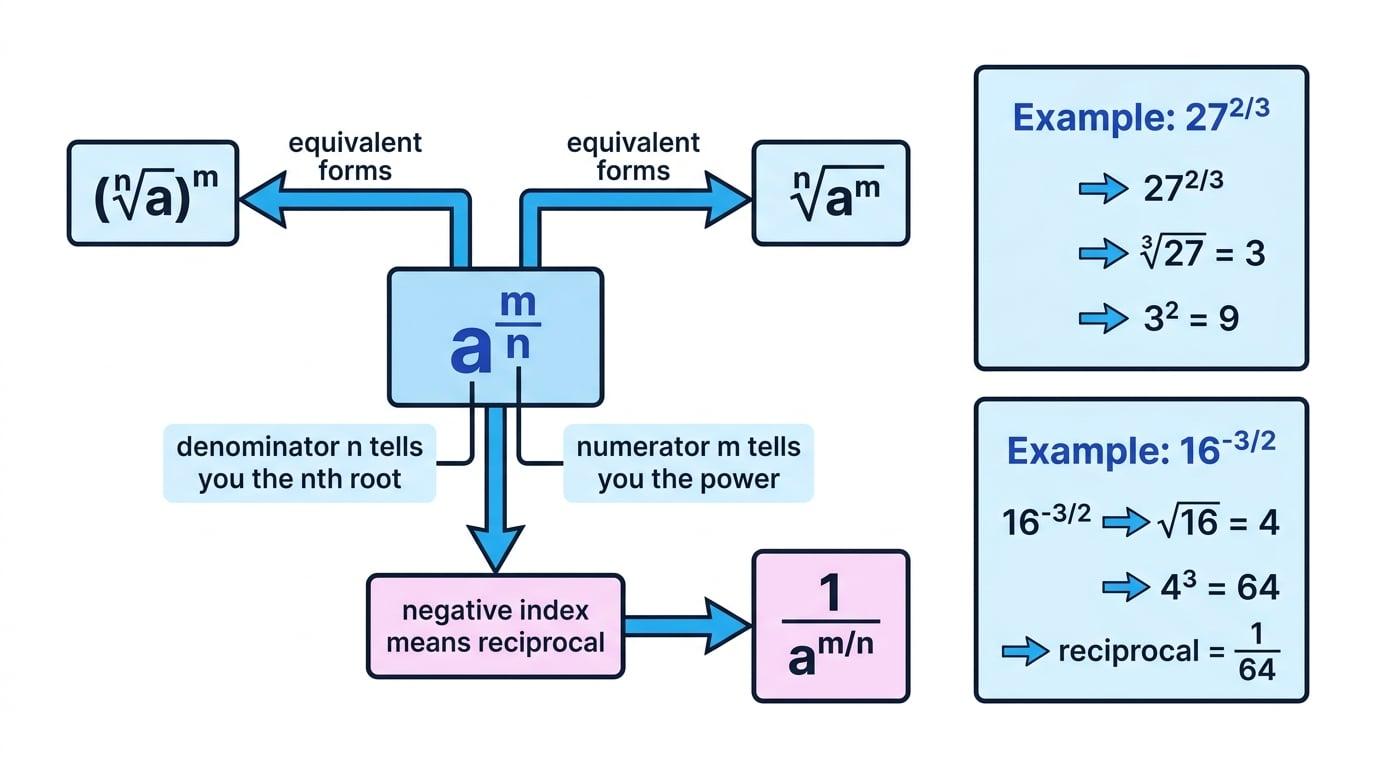 In ana^nan, aaa is the base and nnn is the index. The diagram shows how a fractional index splits into a root and a power, while a negative index tells you to take a reciprocal.
The key laws are below.
am⋅an=am+n,aman=am−n,(am)n=amn. a^m \cdot a^n = a^{m+n}, \qquad \frac{a^m}{a^n} = a^{m-n}, \qquad \left(a^m\right)^n = a^{mn}. am⋅an=am+n,anam=am−n,(am)n=amn.These work when the base is the same. These are not separate topics: they are all part of the same pattern of powers. A quick memory aid is denominator = root, numerator = power.
Question 1
1 markFind the value of 3−13^{-1}3−1
In the term ana^nan, what are the names for aaa and nnn?
Fractional and Negative Indices Revision Guide
Revision notes for AQA GCSE Maths Fractional and Negative Indices: explanations and worked examples.