Capture Recapture
x

Revision notes for AQA GCSE Maths Capture Recapture. Open the guide for explanations and worked examples. Written against the AQA GCSE Maths (8300) specification, so the content matches what's examinable rather than general Maths background.

Capture Recapture

What you'll learn

  • How capture recapture is used to estimate a large population.
  • How to set up the proportion using marked items or animals.
  • How to use the capture recapture formula.
  • What assumptions you must write for full marks.

The basic idea: estimating a hidden total

Sometimes you cannot count every animal or object directly. For example, there may be too many insects in a colony, fish in a lake, or beads in a large bag.

Instead, you take a sample, mark the items in it, return them, mix them back in, then take a second sample.

Definition

Population and sample

  • The population is the whole group you want to estimate.
  • A sample is a smaller group taken from the population.

The key question is:

What fraction of the second sample is marked?

That fraction helps you estimate what fraction of the whole population was marked.

Example

Identifying the important numbers

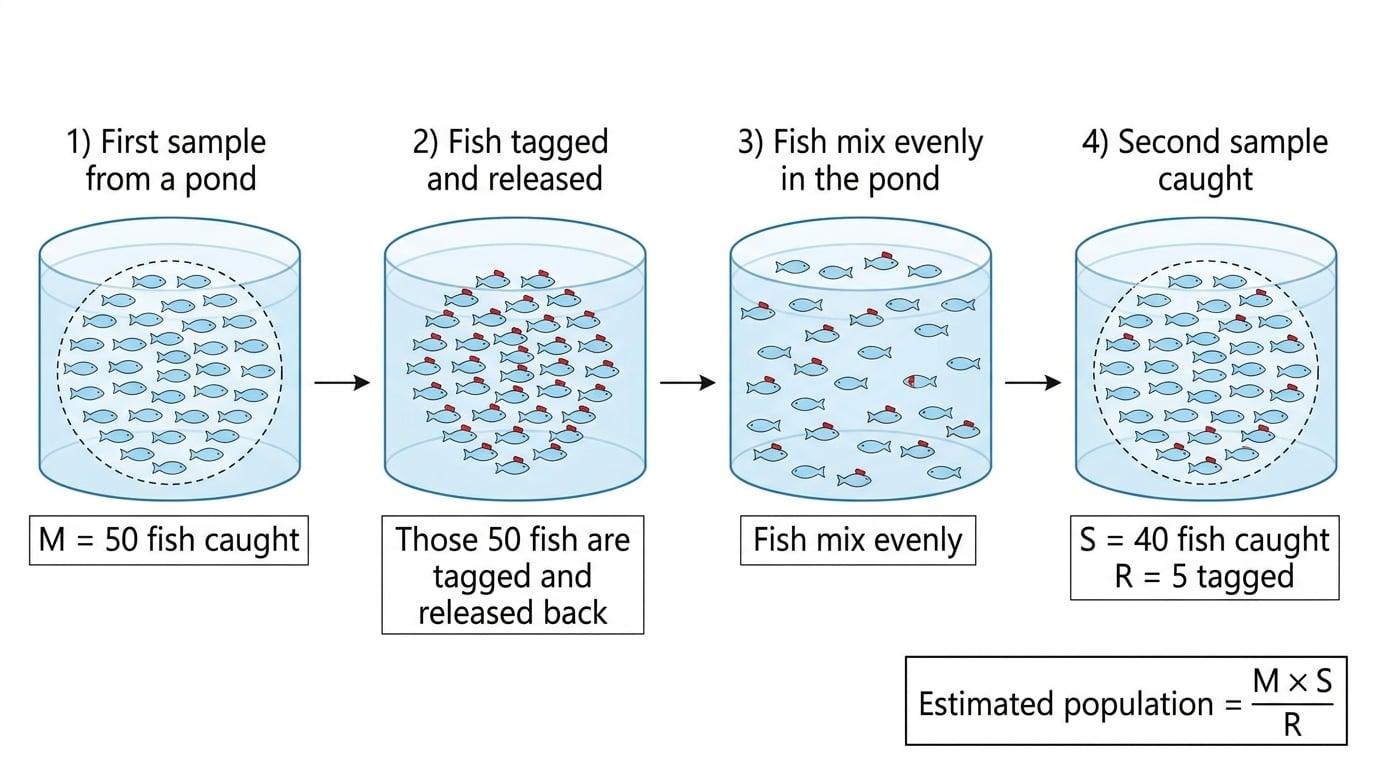
A wildlife volunteer catches 50 fish from a pond, tags them, and releases them. Later, she catches 40 fish. Of these, 5 are tagged.

The three key numbers are the first marked sample, the second sample, and the marked fish found again.

  1. The first sample is the number originally marked: 50 fish.

  2. The second sample is the number caught later: 40 fish.

  3. The number marked in the second sample is 5 fish.

  4. These are the three numbers needed for a capture recapture estimate.

Why proportions are used

Once the marked animals have mixed back into the population, the proportion marked in the second sample should be roughly the same as the proportion marked in the whole population.

Key Idea

Main capture recapture idea

The fraction marked in the second sample is used as an estimate for the fraction marked in the whole population.

For example, if 12 out of 60 animals in the second sample are marked, that is one fifth. So we estimate that the originally marked group is about one fifth of the whole population.

Example

Using a fraction to estimate the population

A scientist catches 60 beetles, marks them, and releases them. Later, she catches another 60 beetles. In the second sample, 12 are marked. Estimate the number of beetles.

If 12 out of 60 beetles in the second sample are marked, the marked fraction is one fifth.

  1. Work out the fraction of the second sample that is marked:

    1260=15\frac{12}{60} = \frac{1}{5}6012​=51​
  2. This suggests the 60 marked beetles are about one fifth of the whole population.

  3. If 60 is one fifth, multiply by 5 to estimate the whole population:

    60×5=30060 \times 5 = 30060×5=300
  4. The estimate is 300 beetles.

Tip

Sanity check

If only a small number in the second sample are marked, the total population estimate should be large. If lots are marked, the estimate should be smaller.

The capture recapture formula

You can use a formula to make the method quicker.

Let:

  • MMM be the number marked in the first sample.
  • SSS be the size of the second sample.
  • RRR be the number of marked individuals found in the second sample.

Then:

estimated population=M×SR\text{estimated population} = \frac{M \times S}{R}estimated population=RM×S​
Definition

Capture recapture estimate

A capture recapture estimate is an estimate of a population size found by marking a first sample, releasing it, then checking how many marked individuals appear in a second sample.

Example

Using the formula

A ranger tags 70 birds in a nature reserve and releases them. The next day, she catches 50 birds. Of these, 10 are tagged. Estimate the number of birds in the reserve.

The formula uses M = 70, S = 50, and R = 10, with the recaptured tagged birds as the denominator.

  1. Identify the three values:

    M=70,S=50,R=10M = 70,\quad S = 50,\quad R = 10M=70,S=50,R=10
  2. Substitute into the formula:

    estimated population=70×5010\text{estimated population} = \frac{70 \times 50}{10}estimated population=1070×50​
  3. Calculate:

    350010=350\frac{3500}{10} = 350103500​=350
  4. The estimate is 350 birds.

Common Mistake

Adding the two samples

Do not add the first sample and second sample together. The same animal could appear in both samples, so capture recapture uses a proportion, not addition.

When the two sample sizes are different

The first sample and second sample do not have to be the same size. The formula still works as long as you use the correct numbers.

Remember:

  • First sample marked = MMM
  • Second sample size = SSS
  • Marked in second sample = RRR
Example

Different sample sizes

A conservationist tags 45 squirrels in a woodland and releases them. A week later, she catches 30 squirrels. Of these, 6 are tagged. Estimate the number of squirrels in the woodland.

Capture recapture still works when the first and second sample sizes are different.

  1. Identify the values:

    M=45,S=30,R=6M = 45,\quad S = 30,\quad R = 6M=45,S=30,R=6
  2. Substitute into the formula:

    estimated population=45×306\text{estimated population} = \frac{45 \times 30}{6}estimated population=645×30​
  3. Calculate:

    13506=225\frac{1350}{6} = 22561350​=225
  4. The estimate is 225 squirrels.

Tip

Order of the numbers

The number marked in the second sample always goes on the bottom of the fraction. It is the “recaptured marked” amount.

Assumptions you need to state

Most GCSE capture recapture questions ask you to “write down an assumption”. This is often worth a mark.

You need to say something that makes the method fair and reliable.

Good assumptions include:

  • The marked animals/items mix evenly back into the population.
  • The marks or tags do not fall off.
  • The marks do not affect the chance of being caught again.
  • The population size does not change much between samples.
  • The second sample is random.
Example

Estimate and give an assumption

A researcher catches 40 rabbits, marks them, and releases them. The following week, she catches 40 rabbits. Of these, 4 are marked. Estimate the number of rabbits and give one assumption.

A fair estimate relies on the marked rabbits mixing evenly before the second sample is taken.

  1. Identify the values:

    M=40,S=40,R=4M = 40,\quad S = 40,\quad R = 4M=40,S=40,R=4
  2. Substitute into the formula:

    estimated population=40×404\text{estimated population} = \frac{40 \times 40}{4}estimated population=440×40​
  3. Calculate:

    16004=400\frac{1600}{4} = 40041600​=400
  4. The estimate is 400 rabbits.

  5. One assumption is that the marked rabbits have mixed evenly back into the population before the second sample is taken.

Common Mistake

If none are recaptured

If R=0R = 0R=0, the formula cannot be used because you would be dividing by zero. In real life, you would need a larger second sample or a repeat trial.

Rounding your answer

Capture recapture gives an estimate, so your answer should make sense for the context.

Usually, if the calculation gives a decimal, round to a whole number because you cannot have part of an animal or object.

Example

Rounding an estimate

A biologist marks 35 lizards. Later, she catches 25 lizards and finds 4 are marked. Estimate the total number of lizards.

The estimate may be a decimal from the formula, but the final population should be rounded to a whole lizard.

  1. Substitute into the formula:

    estimated population=35×254\text{estimated population} = \frac{35 \times 25}{4}estimated population=435×25​
  2. Calculate:

    8754=218.75\frac{875}{4} = 218.754875​=218.75
  3. Round to a sensible whole number: about 219 lizards.

Exam technique

In the exam

  1. Underline the three key numbers: first marked sample, second sample size, and marked in the second sample.

  2. Use the formula M×SR\frac{M \times S}{R}RM×S​, with the recaptured marked number on the bottom.

  3. Always write one clear assumption if the question asks for it.

Self review

Check yourself

  • Can you explain why the marked fraction in the second sample is useful?
  • Do you know which number goes on the bottom of the formula?
  • Can you write one sensible assumption for a capture recapture estimate?

Recap questions

Test yourself with 5 quick questions on this guide. Answer them all correctly to complete it.

You've reached the end

Test yourself on this topic, or move on to the next guide.

FlashcardsSelf-test with active recall
SurdsUp next

How was this guide?

Capture Recapture Revision Guide

  1. GCSE
  2. /Maths
  3. /Capture Recapture