Revision notes for AQA GCSE Maths Exact trig values. Open the guide for explanations and worked examples. Written against the AQA GCSE Maths (8300) specification, so the content matches what's examinable rather than general Maths background.
In this topic, you are not estimating with a calculator. You are giving the precise value.
Exact value
An exact value is an answer written without rounding. It might be a whole number, a fraction, or a surd, which is a square root that does not simplify to a whole number, such as 2\sqrt{2}2.
For example, 0.707 is only an approximation. The exact value of sin(45∘)\sin(45^\circ)sin(45∘) is 22\frac{\sqrt{2}}{2}22.
Exact, not rounded
Suppose you are asked for sin(45∘)\sin(45^\circ)sin(45∘).
A calculator gives a decimal starting 0.7071..., but this is rounded.
The exact GCSE answer is:
sin(45∘)=22\sin(45^\circ)=\frac{\sqrt{2}}{2}sin(45∘)=22Using decimals too early
If the question asks for an exact value, do not write a rounded decimal like 0.866. Use the fraction or surd form instead.
Exact trig values come from special right-angled triangles.
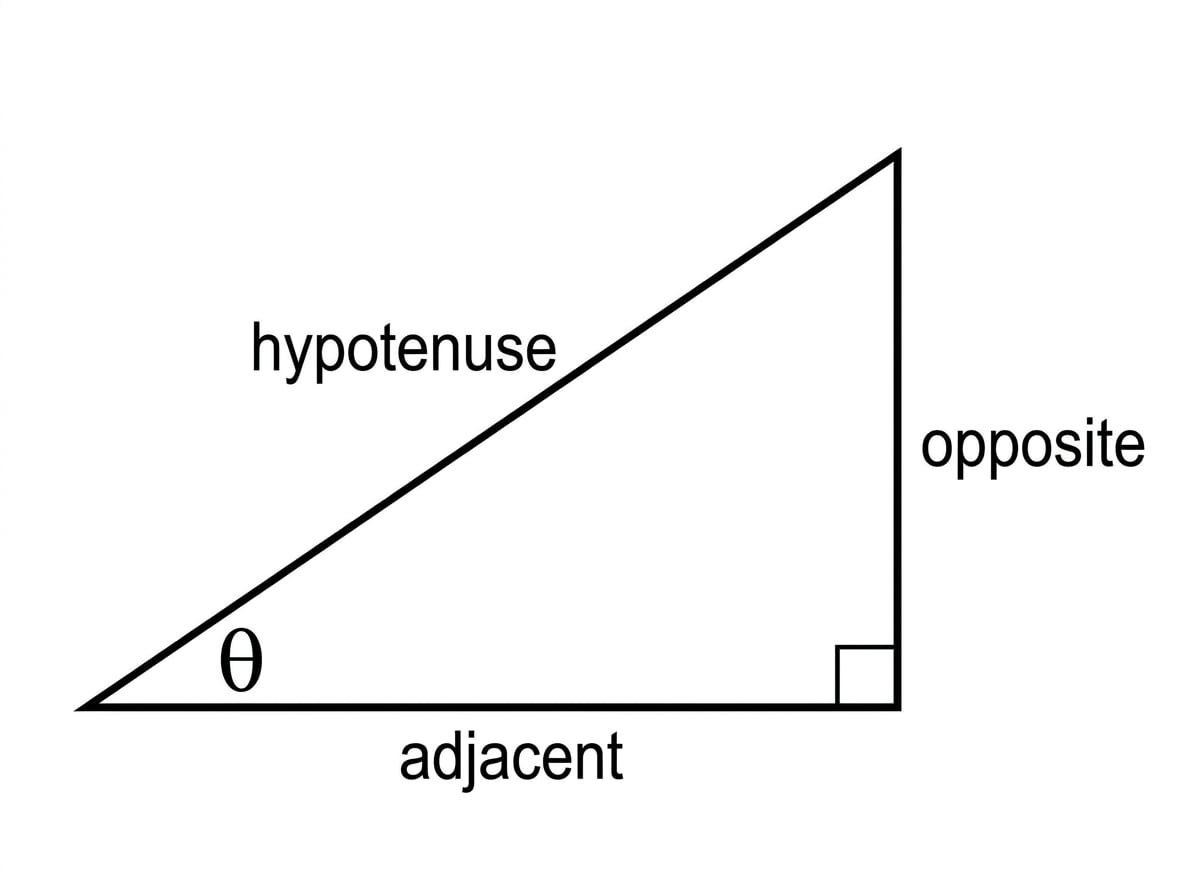
The three side names
The hypotenuse is the longest side of a right-angled triangle. It is opposite the right angle.
The opposite side is opposite the angle you are using.
The adjacent side is next to the angle you are using, but it is not the hypotenuse.

We often call the angle we are using θ\thetaθ, pronounced “theta”.
SOHCAHTOA
SOHCAHTOA reminds you that sinθ=oppositehypotenuse\sin\theta=\frac{\text{opposite}}{\text{hypotenuse}}sinθ=hypotenuseopposite, cosθ=adjacenthypotenuse\cos\theta=\frac{\text{adjacent}}{\text{hypotenuse}}cosθ=hypotenuseadjacent and tanθ=oppositeadjacent\tan\theta=\frac{\text{opposite}}{\text{adjacent}}tanθ=adjacentopposite.
Choosing the correct trig ratio

Opposite and hypotenuse means use sine:
sinθ=oppositehypotenuse\sin\theta=\frac{\text{opposite}}{\text{hypotenuse}}sinθ=hypotenuseoppositeSubstitute the side lengths:
sinθ=612\sin\theta=\frac{6}{12}sinθ=126Simplify:
sinθ=12\sin\theta=\frac{1}{2}sinθ=21An isosceles triangle has two equal sides. If you make an isosceles right-angled triangle, the two smaller angles are both 45°.
The useful side lengths are:

So for a 45° angle, the opposite and adjacent sides are the same.
Finding an exact value at 45°

For sin(45∘)\sin(45^\circ)sin(45∘), use opposite over hypotenuse:
sin(45∘)=12\sin(45^\circ)=\frac{1}{\sqrt{2}}sin(45∘)=21Remove the square root from the denominator:
12=22\frac{1}{\sqrt{2}}=\frac{\sqrt{2}}{2}21=22Therefore:
sin(45∘)=22\sin(45^\circ)=\frac{\sqrt{2}}{2}sin(45∘)=2245° shortcut
For 45°, sine and cosine are equal: sin(45∘)=cos(45∘)=22\sin(45^\circ)=\cos(45^\circ)=\frac{\sqrt{2}}{2}sin(45∘)=cos(45∘)=22.
An equilateral triangle has all three sides equal and all three angles 60°. If you cut one in half, you get a 30-60-90 right-angled triangle.

The useful side lengths are:
For the 30° angle, the opposite side is the shortest side.
For the 60° angle, the opposite side is the 3\sqrt{3}3 side.

Finding an exact value at 60°
Use the 30-60-90 triangle with side lengths 1, 3\sqrt{3}3 and 2.
For a 60° angle, the opposite side is 3\sqrt{3}3 and the adjacent side is 1.
Tangent uses opposite over adjacent:
tan(60∘)=31\tan(60^\circ)=\frac{\sqrt{3}}{1}tan(60∘)=13So tan(60∘)=3\tan(60^\circ)=\sqrt{3}tan(60∘)=3.
Swapping 30° and 60°
For sine, 30° has the smaller value 12\frac{1}{2}21 and 60° has the larger value 32\frac{\sqrt{3}}{2}23. Cosine is the other way round.
Memorise these values
0°: sin(0∘)=0\sin(0^\circ)=0sin(0∘)=0, cos(0∘)=1\cos(0^\circ)=1cos(0∘)=1, tan(0∘)=0\tan(0^\circ)=0tan(0∘)=0
30°: sin(30∘)=12\sin(30^\circ)=\frac{1}{2}sin(30∘)=21, cos(30∘)=32\cos(30^\circ)=\frac{\sqrt{3}}{2}cos(30∘)=23, tan(30∘)=33\tan(30^\circ)=\frac{\sqrt{3}}{3}tan(30∘)=33
45°: sin(45∘)=22\sin(45^\circ)=\frac{\sqrt{2}}{2}sin(45∘)=22, cos(45∘)=22\cos(45^\circ)=\frac{\sqrt{2}}{2}cos(45∘)=22, tan(45∘)=1\tan(45^\circ)=1tan(45∘)=1
60°: sin(60∘)=32\sin(60^\circ)=\frac{\sqrt{3}}{2}sin(60∘)=23, cos(60∘)=12\cos(60^\circ)=\frac{1}{2}cos(60∘)=21, tan(60∘)=3\tan(60^\circ)=\sqrt{3}tan(60∘)=3
90°: sin(90∘)=1\sin(90^\circ)=1sin(90∘)=1, cos(90∘)=0\cos(90^\circ)=0cos(90∘)=0
Why tan 90° is missing
tan(90∘)\tan(90^\circ)tan(90∘) is not defined because tangent involves dividing by the adjacent side, and at 90° this would mean dividing by zero.
Writing down exact values
For cos(90∘)\cos(90^\circ)cos(90∘), look at the 90° values: cos(90∘)=0\cos(90^\circ)=0cos(90∘)=0.
For tan(30∘)\tan(30^\circ)tan(30∘), look at the 30° values: tan(30∘)=33\tan(30^\circ)=\frac{\sqrt{3}}{3}tan(30∘)=33.
For sin(60∘)\sin(60^\circ)sin(60∘), look at the 60° values: sin(60∘)=32\sin(60^\circ)=\frac{\sqrt{3}}{2}sin(60∘)=23.
Sine pattern
The sine values from 0° to 90° go up as 02\frac{\sqrt{0}}{2}20, 12\frac{\sqrt{1}}{2}21, 22\frac{\sqrt{2}}{2}22, 32\frac{\sqrt{3}}{2}23, 42\frac{\sqrt{4}}{2}24. Cosine uses the same pattern backwards.
You may also be given a right-angled triangle and asked to calculate a missing side. The method is the same as normal trigonometry, but you substitute an exact value instead of a calculator decimal.
Finding a hypotenuse using 30°

Opposite and hypotenuse means use sine:
sin(30∘)=18h\sin(30^\circ)=\frac{18}{h}sin(30∘)=h18Substitute the exact value sin(30∘)=12\sin(30^\circ)=\frac{1}{2}sin(30∘)=21:
12=18h\frac{1}{2}=\frac{18}{h}21=h18Solve for hhh:
h=36h=36h=36The hypotenuse is 36 cm.
Finding an adjacent side using 60°

Opposite and adjacent means use tangent:
tan(60∘)=18a\tan(60^\circ)=\frac{18}{a}tan(60∘)=a18Substitute the exact value tan(60∘)=3\tan(60^\circ)=\sqrt{3}tan(60∘)=3:
3=18a\sqrt{3}=\frac{18}{a}3=a18Rearrange and simplify:
a=183=1833=63a=\frac{18}{\sqrt{3}}=\frac{18\sqrt{3}}{3}=6\sqrt{3}a=318=3183=63The adjacent side is 636\sqrt{3}63 cm.
In the exam
First identify the angle: is it 0°, 30°, 45°, 60° or 90°?
If it is a “write down” question, use the memorised exact value directly.
If it is a triangle question, label opposite, adjacent and hypotenuse before choosing sine, cosine or tangent.
Check yourself
Can you write down sin(30∘)\sin(30^\circ)sin(30∘), cos(60∘)\cos(60^\circ)cos(60∘) and tan(45∘)\tan(45^\circ)tan(45∘) without a calculator?
Which exact trig values involve 2\sqrt{2}2?
In a right-angled triangle, how do you decide which side is opposite?
Test yourself with 5 quick questions on this guide. Answer them all correctly to complete it.
Test yourself on this topic, or move on to the next guide.
How was this guide?