What you'll learn
- What negative numbers mean on a number line.
- How to add and subtract with negative numbers.
- How to multiply and divide with negative signs.
- How to use negative numbers in sequences and temperature questions.
Numbers below zero
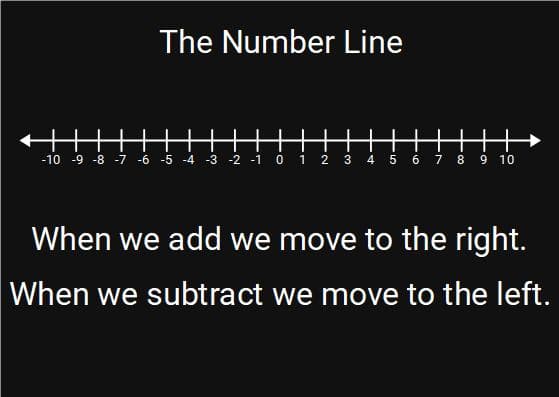
A number line is a straight line with numbers in order. Numbers get bigger as you move right and smaller as you move left.
Negative number
A negative number is less than zero. It has a minus sign in front, like -3. A positive number is greater than zero, like 3.

Left means smaller
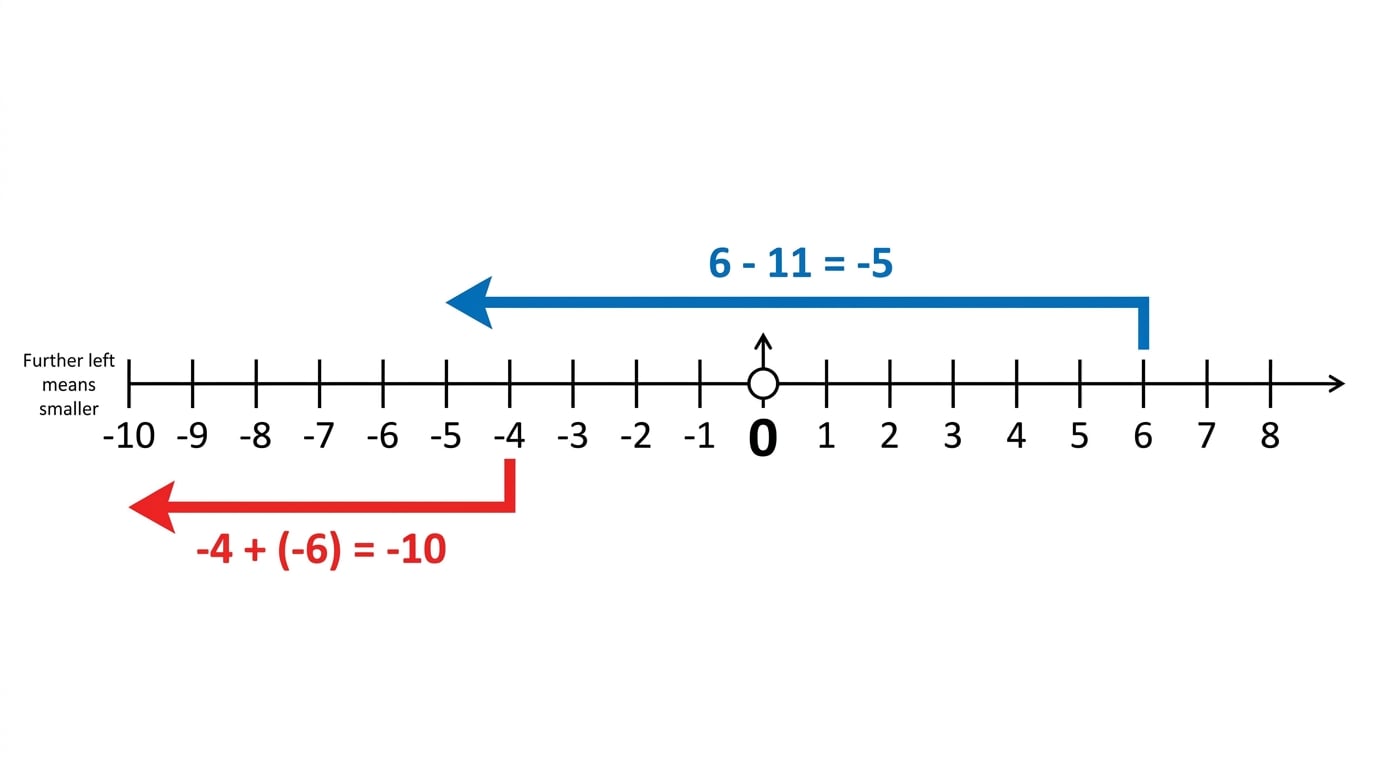
On a number line, the further left a number is, the smaller it is. So -6 is smaller than -2 because -6 is further left.

Finding the lowest temperature
Four towns have temperatures of 4°C, -2°C, -7°C and 1°C. Which temperature is lowest?

-
Lowest means the smallest number, or the coldest temperature.
-
Negative temperatures are lower than positive temperatures.
-
Compare the negative temperatures: -7 is further left than -2, so -7°C is the lowest temperature.
Adding and subtracting negative numbers
For Grade 1 questions, it helps to think about moving on a number line.
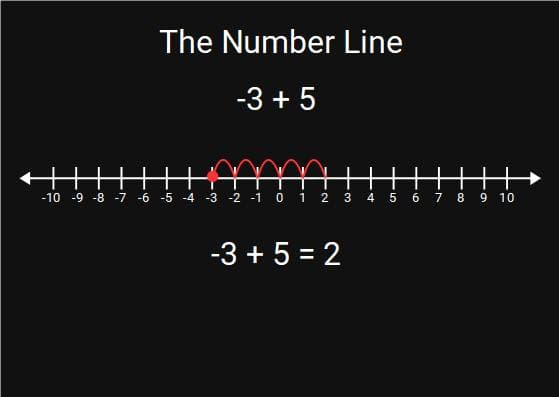
- Adding a positive number moves you right.
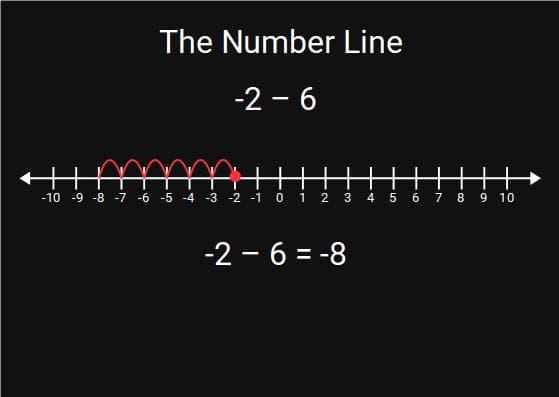
- Subtracting a positive number moves you left.
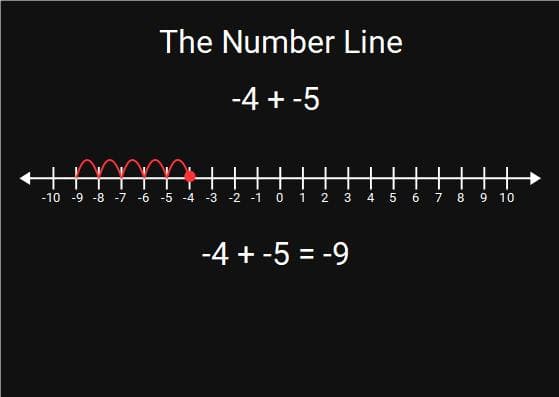
- Adding a negative number also moves you left.
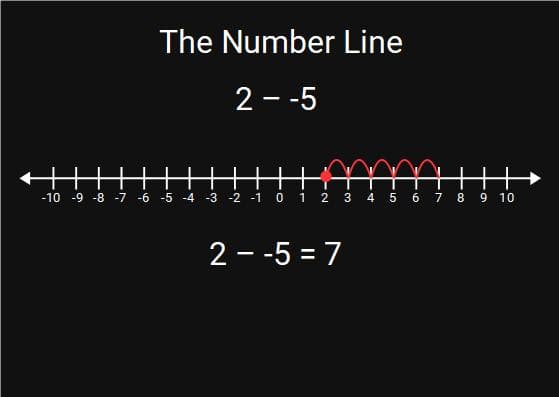
- Subtracting a negative number moves you right.
Subtracting past zero
Work out 6 subtract 11.

-
Start at 6 on the number line.
-
Subtract 11, so move 11 places left. Moving 6 places reaches zero, then 5 more reaches -5.
-
Write the calculation:
6−11=−56 - 11 = -56−11=−5
Adding a negative number
Work out negative 4 plus negative 6.

-
Start at -4.
-
Adding -6 means move 6 places left, because you are adding a negative number.
-
The calculation is:
−4+(−6)=−10-4 + (-6) = -10−4+(−6)=−10
Subtracting a negative
This is the bit that often catches people out. Subtracting a negative is the same as adding the positive version.
Subtracting a negative number
Work out 9 subtract negative 4.

-
Notice the two signs: you are subtracting a negative number.
-
Change “subtract negative 4” into “add 4”.
-
Calculate:
9−(−4)=9+4=13\begin{aligned} 9 - (-4) &= 9 + 4 \\ &= 13 \end{aligned}9−(−4)=9+4=13
Dropping the second minus
In a calculation like 9 - -4, the second minus belongs to the negative 4. Do not just ignore it. Subtracting a negative changes to addition.
Filling in missing boxes
Sometimes you are given a few numbers and need to choose which ones make a correct calculation. Try to think about the sign of the answer first.
Choosing numbers for an addition
Choose from -8, -3, 3 and 8 to make an addition with answer -11.
-
The answer is negative, so try adding two negative numbers.
-
Choose -8 and -3.
-
Check the calculation:
−8+(−3)=−11-8 + (-3) = -11−8+(−3)=−11
Quick sign check
If two numbers add to a negative answer, the negative number or numbers must have the bigger effect.
Multiplying and dividing negative numbers
For multiplying and dividing, work out the size of the answer first, then decide whether it should be positive or negative.
Sign rules for multiplying and dividing
- Same signs give a positive answer.

- Different signs give a negative answer.
Multiplying with one negative sign
Work out negative 7 times 5.
-
Ignore the sign first: 7 times 5 is 35.
-
There is one negative sign, so the answer is negative.
-
Write the answer:
−7×5=−35-7 \times 5 = -35−7×5=−35
Dividing with two negative signs
Work out negative 42 divided by negative 6.
-
Ignore the signs first: 42 divided by 6 is 7.
-
Both numbers are negative, so the signs are the same.
-
Same signs give a positive answer:
−42÷(−6)=7-42 \div (-6) = 7−42÷(−6)=7
Adding rules are not multiplying rules
Two negatives multiplied or divided give a positive answer. But two negatives added together stay negative.
Missing numbers in multiplication and division
An inverse operation is an operation that undoes another operation. Division undoes multiplication, and multiplication undoes division.
Finding a missing multiplier
A number is multiplied by 6 to give -18. Find the missing number.
-
Use the inverse operation: divide -18 by 6.
-
Work out the sign. Negative divided by positive gives negative.
-
Calculate:
−18÷6=−3-18 \div 6 = -3−18÷6=−3 -
Check:
6×(−3)=−186 \times (-3) = -186×(−3)=−18
Finding a missing number before division
A missing number divided by -4 gives 5. Find the missing number.
-
Undo the division by multiplying 5 by -4.
-
Positive times negative gives negative.
-
Calculate:
5×(−4)=−205 \times (-4) = -205×(−4)=−20
Number sequences with negatives
A sequence is a list of numbers in order. Each number in the sequence is called a term.
To continue a simple sequence, find the change from one term to the next.
Continuing a decreasing sequence
Continue this sequence: 13, 8, 3, …
-
Find the change: 13 to 8 is subtract 5, and 8 to 3 is subtract 5.
-
Keep subtracting 5.
-
The next two terms are found by:
3−5=−2,−2−5=−73 - 5 = -2,\quad -2 - 5 = -73−5=−2,−2−5=−7
Crossing zero
When a sequence goes below zero, keep counting through zero carefully: 3, 2, 1, 0, -1, -2.
Temperatures and differences
Temperature questions often use negative numbers because temperatures can go below 0°C.
- “Risen” or “increased” means add.
- “Lower” or “fallen” means subtract.
- “Difference” means the distance between two values.
Difference
The difference between two numbers is the distance between them. In temperature questions, a difference is written as a positive number of degrees.
Temperature change and difference
At midnight, a temperature is -5°C. By morning, it has risen by 8°C. Another city is 6°C. Find the new temperature and the difference between -5°C and 6°C.

-
Risen by 8°C means add 8.
-
Calculate the new temperature:
−5+8=3-5 + 8 = 3−5+8=3 -
To find the difference between -5°C and 6°C, count from -5 to 0, then from 0 to 6.
-
Add the two parts:
5+6=115 + 6 = 115+6=11
In the exam
-
Look carefully at each sign before you start, especially when you see two signs next to each other.
-
For multiplying or dividing, decide the sign first: same signs positive, different signs negative.
-
In temperature questions, underline words like “risen”, “lower” and “difference”.
Check yourself
- If you start at -3 and subtract 5, where do you land?
- What is the sign of a negative number multiplied by a negative number?
- What does “difference” mean in a temperature question?