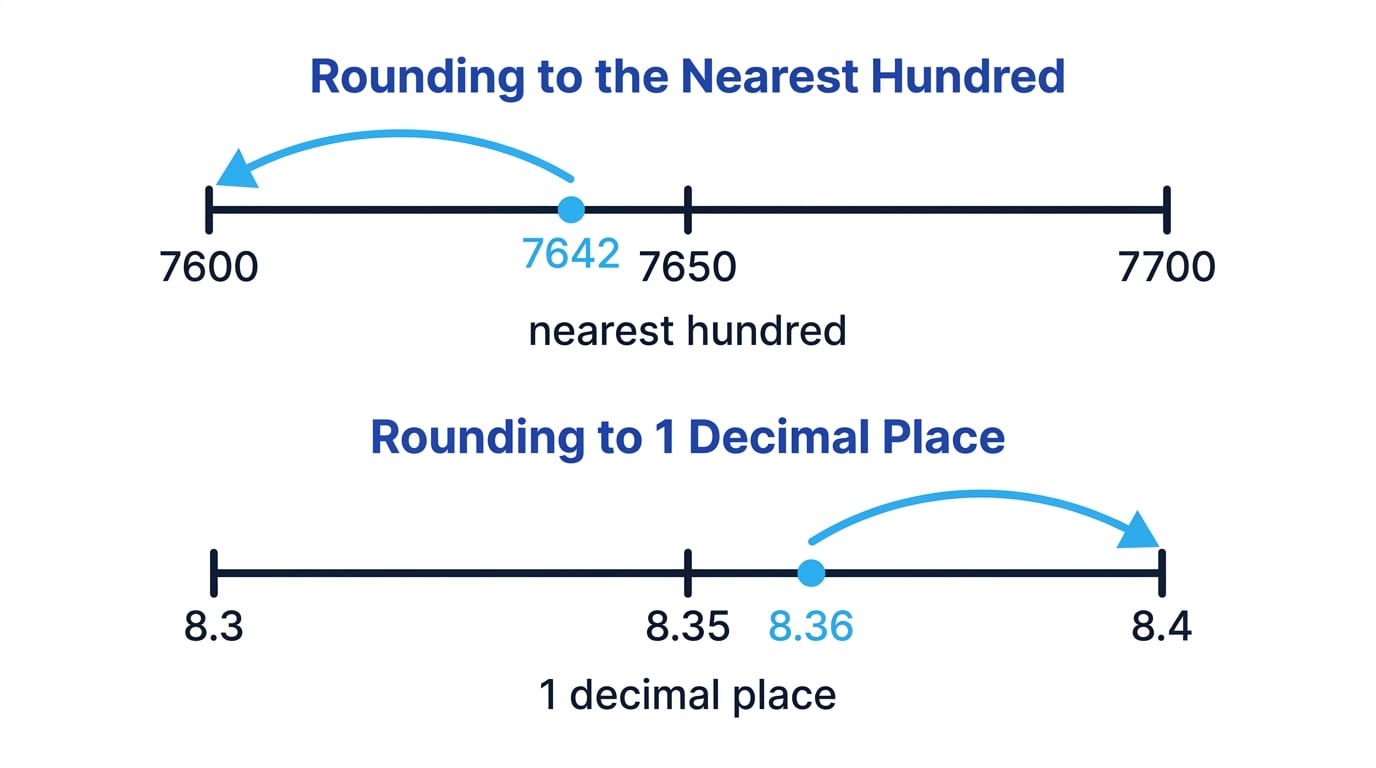
Example 1:
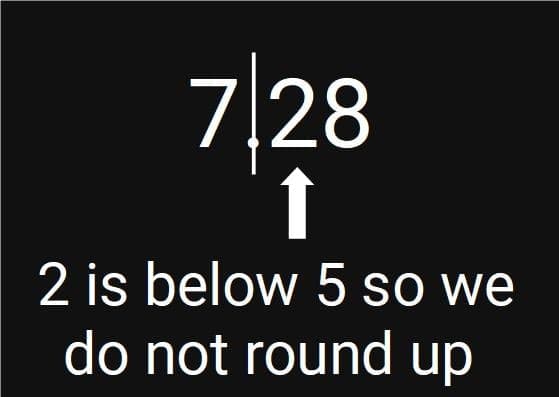
Round 7.28 to the nearest whole number.
Rounding to the nearest whole number is the same as rounding to the nearest one.
7.28 is in between 7 and 8. We need to work out if it is closer to 7 or 8.
We can draw a line after the ones and look at the next digit, the tenths. If the digit is 5 or above we will round up (to 8), if it is 4 or below we will not (it will stay as 7).
We have a 2 in the tenths, so we will not round up. The answer is 7.
Example 2:
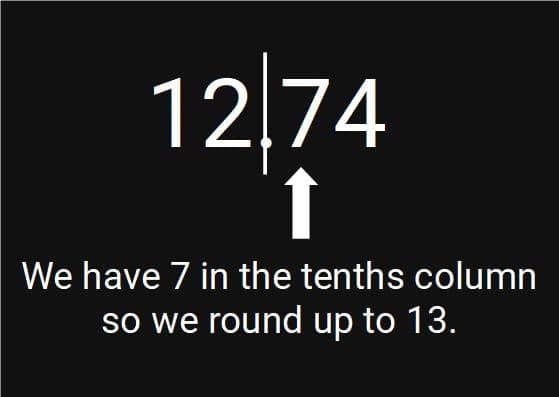
Round 12.74 to the nearest whole number.
12.74 is in between 12 and 13. We need to work out if it is closer to 12 or 13.
We can draw a line after the ones and look at the next digit, the tenths. If the digit is 5 or above we will round up (to 13), if it is 4 or below we will not (it will stay as 12).
We have a 7 in the tenths, so we will round up. The answer is 13.
Example 3:
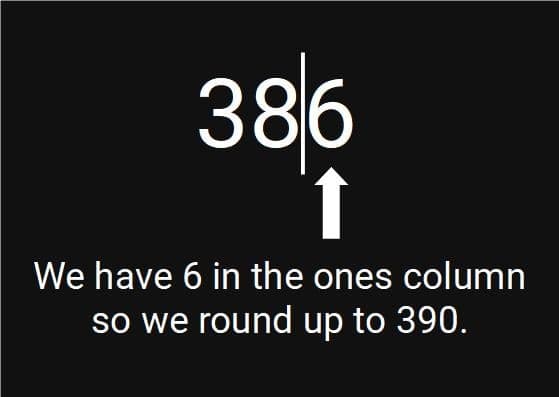
Round 386 to the nearest ten.
386 is in between 380 and 390. We need to work out if it is closer to 380 or 390.
We can draw a line after the tens and look at the next digit, the ones. If the digit is 5 or above we will round up (to 390), if it is 4 or below we will not (it will stay as 380).
We have a 6 in the ones, so we will round up. The answer is 390.
Example 4:
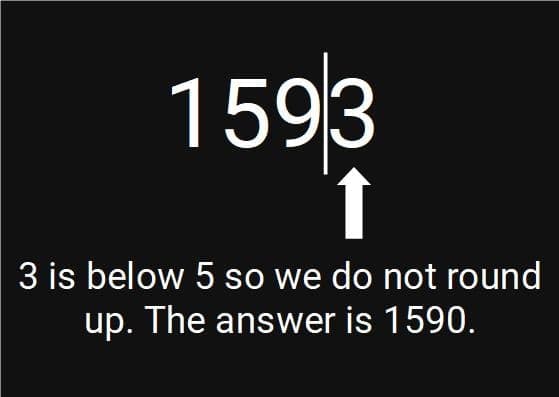
Round 1593 to the nearest ten.
1593 is in between 1590 and 1600. We need to work out if it is closer to 1590 or 1600.
We can draw a line after the tens and look at the next digit, the ones. If the digit is 5 or above we will round up (to 1600), if it is 4 or below we will not (it will stay as 1590).
We have a 3 in the ones, so we will not round up. The answer is 1590.
Example 5:
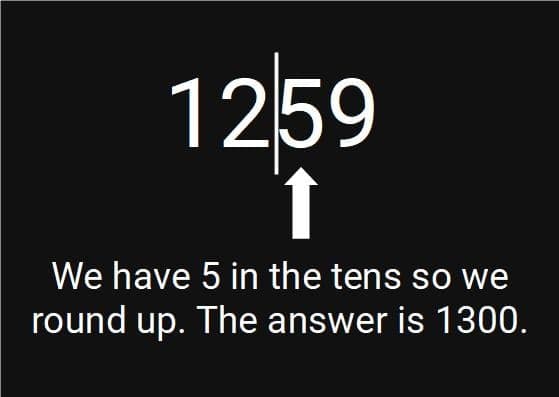
Round 1259 to the nearest hundred.
1259 is in between 1200 and 1300. We need to work out if it is closer to 1200 or 1300.
We can draw a line after the hundreds and look at the next digit, the tens. If the digit is 5 or above we will round up (to 1300), if it is 4 or below we will not (it will stay as 1200).
We have a 5 in the tens, so we will round up. The answer is 1300.
Example 6:
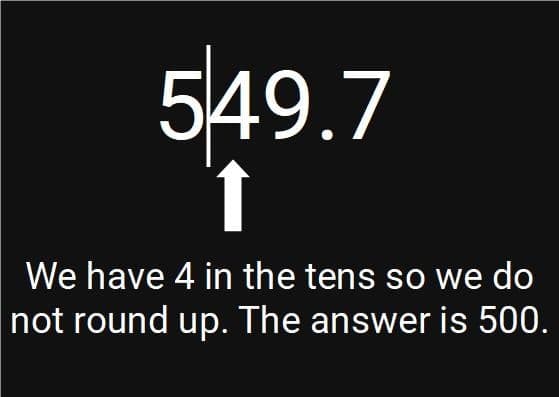
Round 549.7 to the nearest hundred.
549.7 is in between 500 and 600. We need to work out if it is closer to 500 or 600.
We can draw a line after the hundreds and look at the next digit, the tens. If the digit is 5 or above we will round up (to 600), if it is 4 or below we will not (it will stay as 500).
We have a 4 in the tens, so we will not round up. The answer is 500.
Try these:
Example 7:
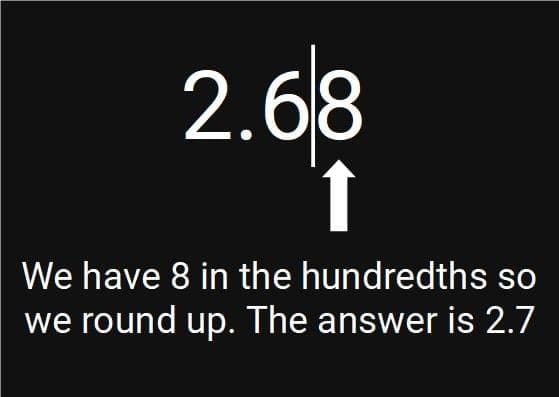
Round 2.68 to one decimal place.
When we round to one decimal place, we want just one digit after the decimal point.
2.68 is between 2.6 and 2.7. We need to work out if it closer to 2.6 or 2.7
We can draw a line after one decimal place and look at the next digit, the hundredths. If the digit is 5 or above we will round up (to 2.7), if it is 4 or below we will not (it will stay as 2.6).
We have a 8 in the hundredths, so we will round up. The answer is 2.7
Example 8:
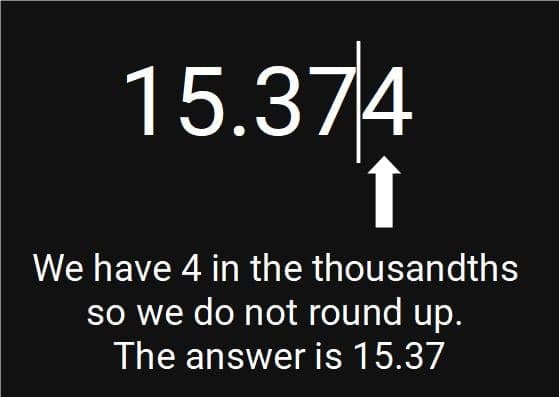
Round 15.374 to two decimal places.
When we round to two decimal places, we want two digits after the decimal point.
15.374 is between 15.37 and 15.38. We need to work out if it closer to 15.37 and 15.38
We can draw a line after two decimal places and look at the next digit, the thousandths. If the digit is 5 or above we will round up (to 15.38), if it is 4 or below we will not (it will stay as 15.37).
We have a 4 in the thousandths, so we will not round up. The answer is 15.37
Example 9:
Round 0.269 to two significant figures.
When we count significant figures we start counting from the first non zero digit.
The first non zero digit is the 2 (the first significant figure), the second significant figure is the 6.
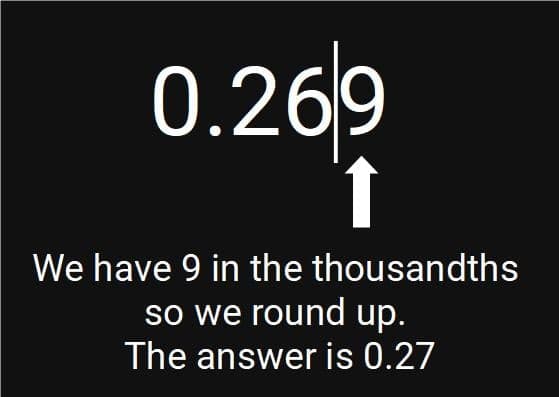
0.269 is between 0.26 and 0.27. We need to work out if it is closer to 0.26 or 0.27.
We can draw a line after two significant figures places and look at the next digit, the thousandths. If the digit is 5 or above we will round up (to 0.27), if it is 4 or below we will not (it will stay as 0.26).
We have a 9 in the thousandths, so we round up. The answer is 0.27
Example 10:
Round 17.045 to three significant figures.
When we count significant figures we start counting from the first non zero digit.
The first significant figure is the 1 (tens), the second significant figure is the 7 (ones) and the third significant figure is the 0 (tenths).
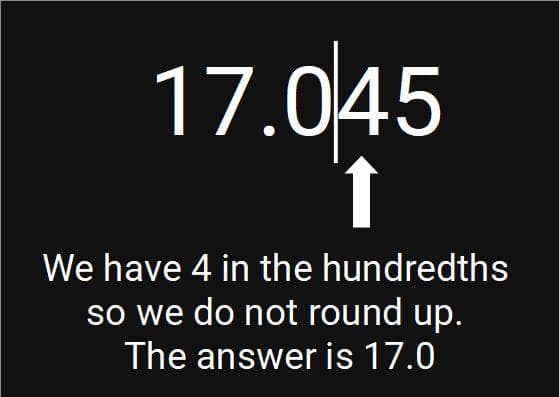
We can draw a line after three significant figures places and look at the next digit, the hundredths. If the digit is 5 or above we will round up (to 17.1), if it is 4 or below we will not (it will stay as 17.0).
We have a 4 in the hundredths, so we do not round up. The answer is 17.0
Example 11:
Round 54671 to two significant figures.
When we count significant figures we start counting from the first non zero digit.
The first significant figure is the 5 (ten thousands), the second significant figure is the 4 (thousands).
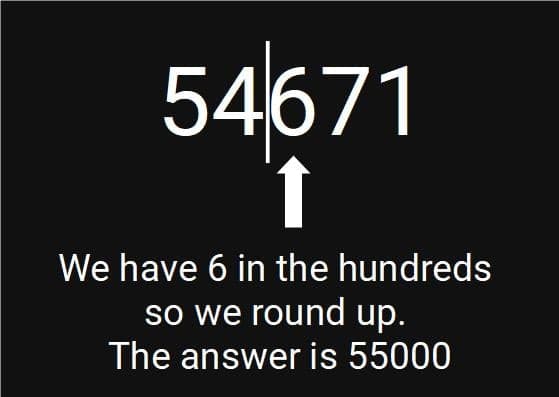
We can draw a line after two significant figures places and look at the next digit, the hundreds. If the digit is 5 or above we will round up (to 55000), if it is 4 or below we will not (it will stay as 54000).
We use zeros to keep the place value of the ten thousands and thousands (our two significant figures).
We have a 6 in the hundreds, so we round up. The answer is 55000.
Try these: