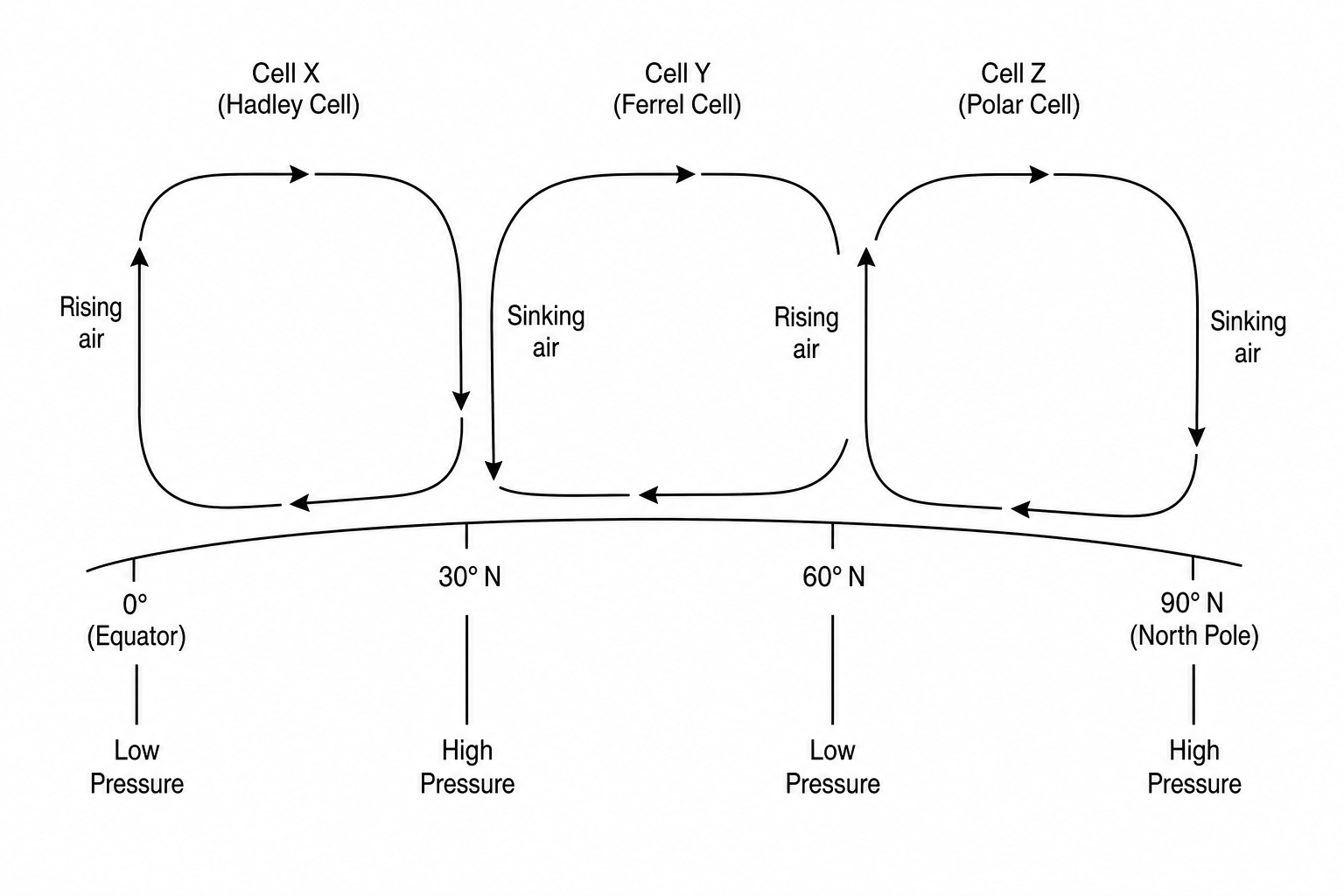
The diagram below shows a simplified model of the global atmospheric circulation system in the Northern Hemisphere, showing cells XXX, YYY, and ZZZ, along with their respective latitudes and pressure belts.
Based on this model and your knowledge of global atmospheric circulation, which of the following statements is correct?
At 30∘N30^\circ\text{N}30∘N, sinking air creates a persistent zone of high pressure, leading to dry, arid conditions where many of the world's hot deserts are located, while surface winds (westerlies) blow from here towards the equator.
Cell XXX is a thermally direct cell driven by intense solar heating at the Equator (0∘0^\circ0∘). Warm, moist air rises, cooling adiabatically to form dense cloud cover and heavy convective precipitation in the Intertropical Convergence Zone (ITCZ).
Cell YYY is a thermally direct cell driven by sinking air at 30∘N30^\circ\text{N}30∘N and rising air at 60∘N60^\circ\text{N}60∘N, creating the prevailing polar easterly winds that dominate mid-latitude climates.
At 60∘N60^\circ\text{N}60∘N, the sinking of cold air from Cell ZZZ creates a stable high-pressure zone known as the polar front, leading to dry, cold desert climates across subpolar regions.

