What you'll learn
- Why literacy matters in GCSE Geography, not just in English.
- How to match your writing to the people reading it and the reason you are writing.
- How to use place detail, data and specialist terms accurately.
- How to structure clear exam answers, reports, captions and recommendations.
What “literacy” means in Geography
Most of your geography knowledge is communicated through writing: short answers, extended responses, fieldwork conclusions, annotations, captions and sometimes report-style tasks. Good literacy helps the examiner, teacher, councillor or public reader understand exactly what you mean.
Literacy in GCSE Geography
Literacy means using reading and writing to communicate geographical ideas clearly. It includes spelling and grammar, but also selecting evidence — information used to support a point — using specialist vocabulary — precise geography words such as erosion, urbanisation or sustainability — and organising ideas logically.
This section is about your communication skills. It is not mainly about memorising facts. It is about showing what you know in a way that fits the task.
Confusing two meanings of literacy
In this skills section, literacy means your ability to communicate geography. It is different from literacy rate, a development indicator measuring the percentage of people who can read and write.
Start with the reader and the purpose
Before you write, ask two questions: Who is this for? and What is my writing trying to do?
Target audience and purpose
A target audience is the person or group your writing is for. Purpose means the job your writing needs to do, such as inform, explain, persuade, justify a decision or give advice.
For example, an examiner needs concise, accurate geography. A local council officer may need clear recommendations based on fieldwork. Local residents may need simple language, key risks and practical advice.
The same geographical information can be communicated in different ways depending on audience and purpose.
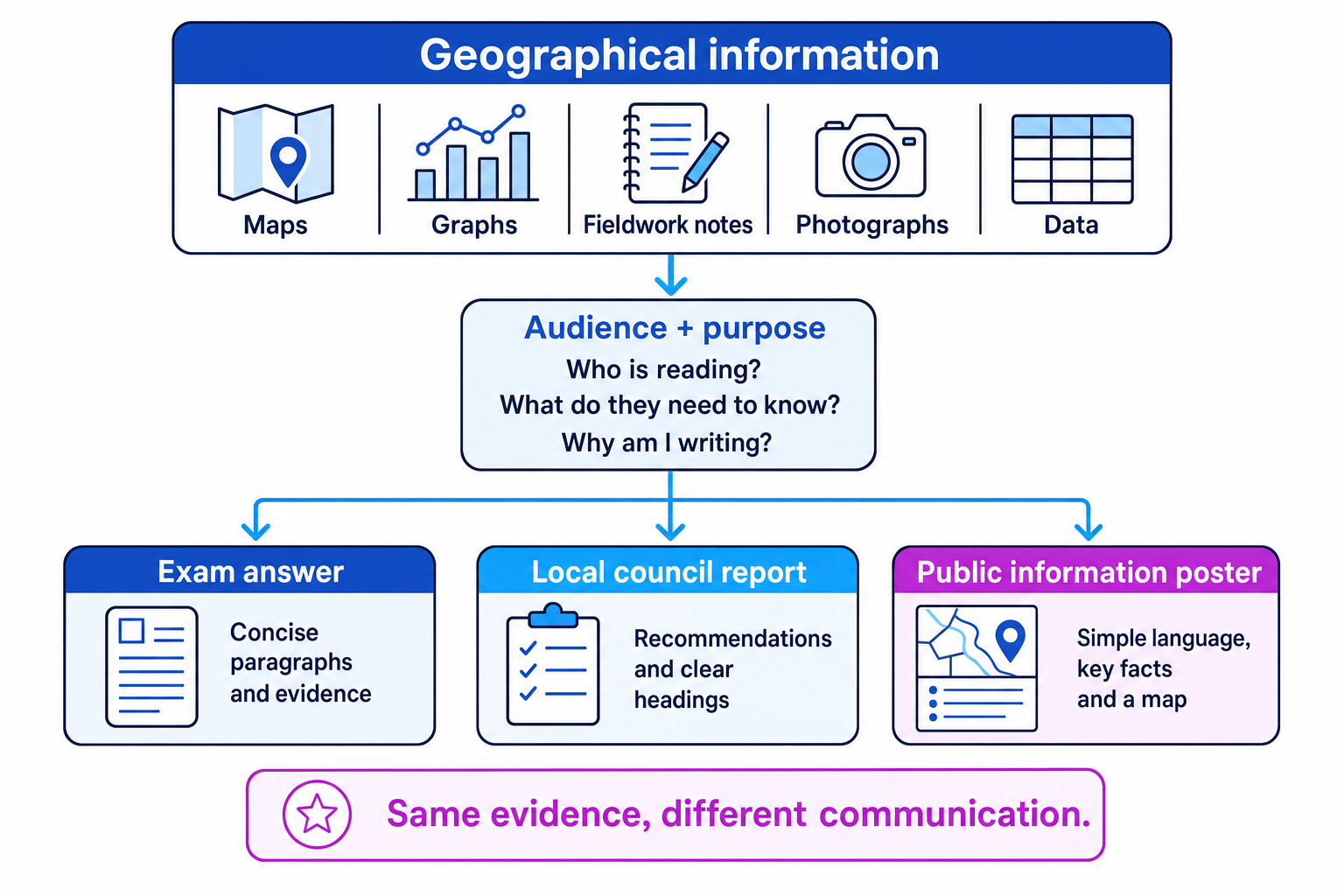
Same evidence, different communication
Good geography writing is not one-size-fits-all. You choose the detail, vocabulary, tone and format that best fit the reader and the task.
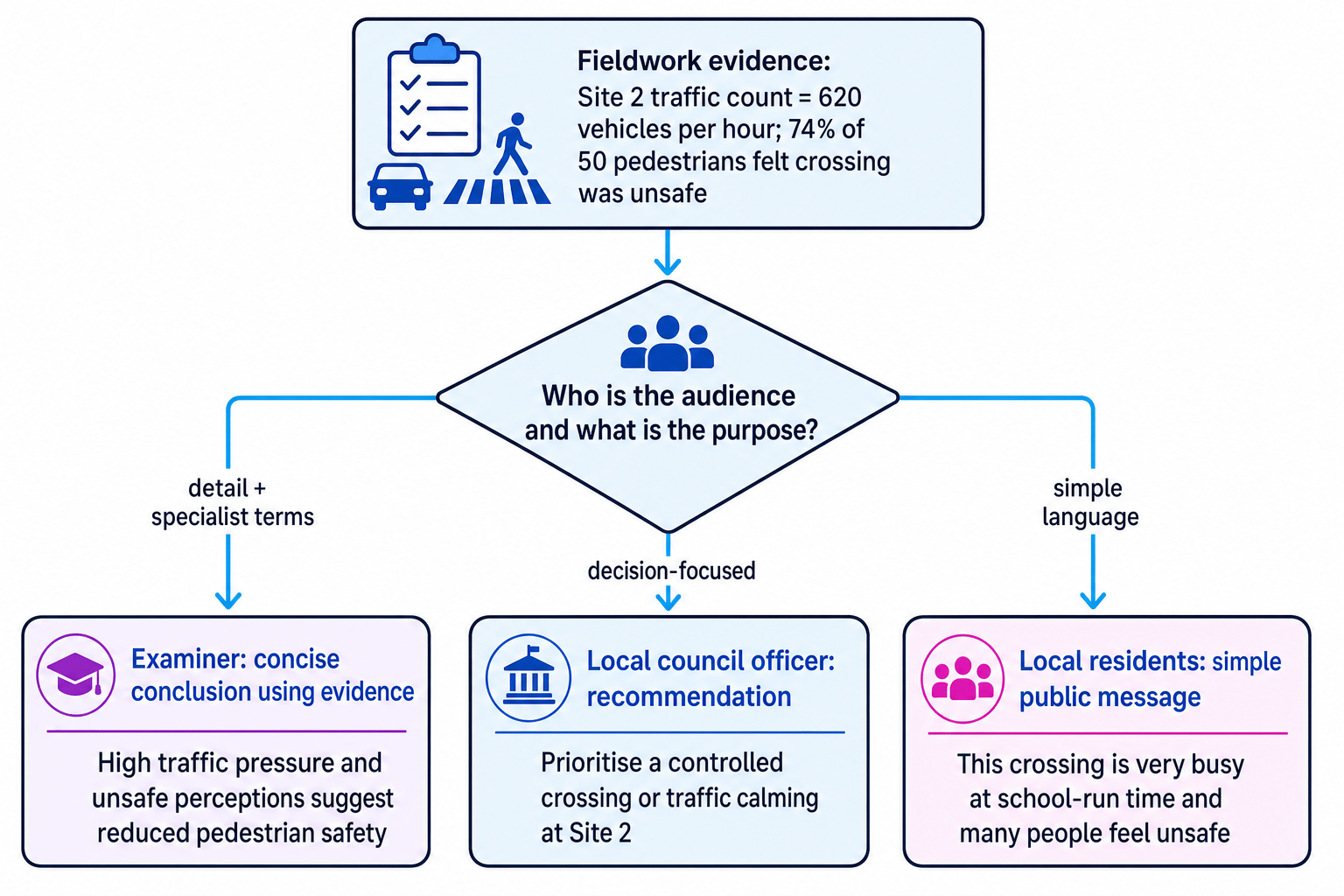
Adapting the same fieldwork finding
A fieldwork note says: “At Site 2 on the high street, the traffic count was 620 vehicles per hour between 8:00 and 9:00; 74% of 50 surveyed pedestrians said crossing felt unsafe.”
- For an examiner, use the data as evidence for a conclusion: “Site 2 had high traffic pressure, with 620 vehicles per hour and 74% of surveyed pedestrians reporting unsafe crossings, suggesting traffic reduces perceived safety.”
- For a local council officer, turn the evidence into a decision-focused recommendation: “Prioritise Site 2 for a controlled crossing or traffic-calming measure because both observed traffic and survey responses indicate risk.”
- For a public information poster, simplify the message and remove unnecessary method detail: “This crossing is very busy at school-run time; nearly three-quarters of surveyed pedestrians said they felt unsafe.”
Know what type of writing is needed
Format and tone
Format means the form your communication takes, such as a paragraph, report, annotation, caption, poster or letter. Tone means the level of formality and the attitude your writing creates.
Different tasks need different writing choices.
| Audience or task | What they need | Good literacy choices |
|---|---|---|
| GCSE examiner | Relevant geography that answers the question | Concise paragraphs, specialist terms, named places, data |
| Local council | Evidence-based advice | Headings, recommendations, practical language |
| Local residents | Clear information about risks or changes | Simple wording, key facts, maps or captions |
| Younger pupils | Basic explanation | Short sentences, defined terms, examples |
| Fieldwork write-up | Method, results and conclusion | Accurate data, limitations, clear links to enquiry question |
A limitation is a weakness or boundary in your evidence. For example, a questionnaire completed by only 20 people may not represent a whole town.
Match detail to the reader
An examiner usually wants developed geographical explanation. A public audience usually wants the main message quickly, with any technical words explained.
Writing clearly for an examiner
Exam answers are a major part of GCSE Geography literacy. You need to read the command word carefully.
Command word
A command word tells you what kind of answer is needed. For example, describe means give the pattern or features; explain means give reasons; assess or evaluate means weigh up evidence and reach a judgement.
A pattern means a trend in data or the way features are spread across space. For example, a map might show higher population density near the coast, or a graph might show rainfall increasing from May to August.
| Command word | What your writing should do |
|---|---|
| Describe | Say what is shown; use data, direction, place or pattern |
| Explain | Give reasons using cause and effect |
| Compare | Identify similarities and differences |
| Assess / Evaluate | Consider strengths and weaknesses, then make a judgement |
| Justify | Give reasons for a choice or decision |
PEEL for longer answers
For 6- and 9-mark answers, a reliable paragraph shape is PEEL: Point — your main idea; Evidence — place detail or data; Explain — cause and effect; Link — back to the question or judgement. Use it flexibly, because shorter answers may only need one developed point.
Developing an explanation about coastal management
- Choose a specific method and location: a sea wall, which is a built structure used in hard engineering, at Mappleton on the Holderness Coast.
- Use the process, not just the label: the wall reduces the energy of destructive waves reaching the soft boulder clay cliffs, so hydraulic action — water and trapped air forcing cracks open — and abrasion — sediment scraping rock — attack the cliff base less often.
- Link the physical process to a human outcome: slower cliff erosion helps protect homes and the B1242 road from being lost to the sea.
- If the command word asks for judgement, add balance: hard engineering can be effective locally, but it may be costly and can increase erosion further along the coast if sediment movement is disrupted.
Name-dropping places
Writing “Lagos has problems” or “Holderness has erosion” is too vague. Add what happens, why it happens, who or what is affected, and at least one place-specific detail.
Be precise, not overloaded
Geography answers should be accurate and selective. You do not need to write everything you know. You need the most relevant detail.
Strong geographical writing often includes:
- Place: a named location, such as Bristol, Lagos, the Holderness Coast or the River Tees.
- Scale: the level you are discussing, such as local, regional, national or global.
- Data: measurements or recorded facts, such as percentages, rainfall in mm or population in millions.
- Process: how something happens, such as longshore drift, rural-to-urban migration or convection.
- Consequence: the effect on people, the economy or the environment.
- Qualification: a limiting phrase showing accuracy, such as “in the short term”, “for some residents” or “in this part of the city”.
Precision beats length
A shorter answer with place, process, evidence and consequence is usually stronger than a long paragraph full of vague claims.
Be careful with statistics. Use the figures your teacher has given for your case studies, or the data in the resource. Exact values can vary depending on the source and year, so avoid inventing precise numbers.
Writing judgements
Some questions ask you to decide how successful, important or sustainable something is. A judgement is a clear decision backed by evidence. A criterion is a standard used to make that decision, such as cost, environmental impact, effectiveness or fairness.
Making a justified judgement
Suppose you are judging whether regeneration — improving an area socially, economically and environmentally — has been successful in a UK city you have studied.
- Choose criteria that match the question: jobs, quality of life and environmental improvement would help judge success.
- Apply evidence from your case study: new employment, improved public spaces or better transport links could support a positive judgement.
- Weigh this against remaining problems: high housing costs, inequality or benefits not reaching all residents could limit success.
- Make a balanced decision: “Overall, regeneration was partly successful because it improved employment and the built environment, but success was uneven because some lower-income residents gained less.”
Spelling, punctuation and grammar still matter
SPaG means spelling, punctuation and grammar. In GCSE Geography, clear writing helps your geographical understanding come through. Some longer questions also reward accurate spelling, punctuation, grammar and specialist terminology.
This does not mean you need fancy writing. It means your sentences should be controlled and your key terms should be accurate.
Sentence control
If one sentence has too many ideas joined by “and”, “because” or “which”, split it. Then use a short linking sentence such as “This means…” or “As a result…” to explain the consequence.
Unclear pronouns
Avoid writing “it affects them” when the reader may not know what “it” or “them” refers to. Name the thing clearly: “Deforestation increases surface run-off, which raises flood risk for downstream communities.”
Using technical language with care
Technical vocabulary is powerful when the reader understands it. For an examiner, terms like deposition, interdependence, urbanisation and mitigation show geographical knowledge. For a public poster, you may need to define or replace technical words.
For example, instead of writing “Residents face fluvial flood risk due to impermeable surfaces,” a public information leaflet might say: “Heavy rain can make the river overflow, and concrete surfaces stop water soaking into the ground.”
Explain jargon when needed
Jargon means specialist language that may be hard for non-experts. Use it in exam answers, but define or simplify it for public audiences.
In the exam
- Read the command word and decide the purpose: describe a pattern, explain a process, compare options or make a judgement.
- Use named places, accurate units and specialist terms, then link ideas with “because”, “therefore” or “this leads to”.
- Adapt your style to the task: concise paragraphs for exam answers; clear headings and recommendations if asked for a report or advice.
- Leave a minute to check SPaG, especially key geographical spellings and unclear words such as “it”, “they” and “there”.
Check yourself
- If you were writing to local residents about flood risk, how would your language differ from an answer written for an examiner?
- What is the difference between describing a pattern and explaining a process?
- Choose one of your case studies: can you write one PEEL paragraph using a named place, evidence and a consequence?