What you'll learn
- Why global demand for energy is increasing and why supply is uneven.
- How energy insecurity can affect economies, environments, food production and conflict.
- The main renewable and non-renewable strategies for increasing energy supply.
- How places can move towards a more sustainable energy future.
Energy in GCSE Resource Management
In AQA Resource Management, you study the overview of resources and then one of Food, Water or Energy in more depth. If your class has chosen Energy, this is your optional in-depth topic.
Energy resource
An energy resource is a source of power that people use for electricity, heating, transport or industry. Examples include coal, oil, gas, uranium, sunlight, wind and moving water.
Energy is essential because it supports almost every part of modern life: homes, schools, hospitals, factories, farming, transport networks and digital technology.
Energy security, surplus and deficit
Energy security
Energy security means having a reliable and affordable supply of energy. A country has an energy surplus when it produces more energy than it uses, and an energy deficit when it uses more energy than it produces domestically.
A surplus country can often export energy, earning money and increasing political influence. A deficit country often imports energy, which can make it vulnerable to price rises, conflict or political pressure from suppliers.
However, deficit does not automatically mean disaster. Japan imports most of its energy but is wealthy enough to buy supplies from several countries. By contrast, a poorer country with weak infrastructure may be insecure even if it has some resources.
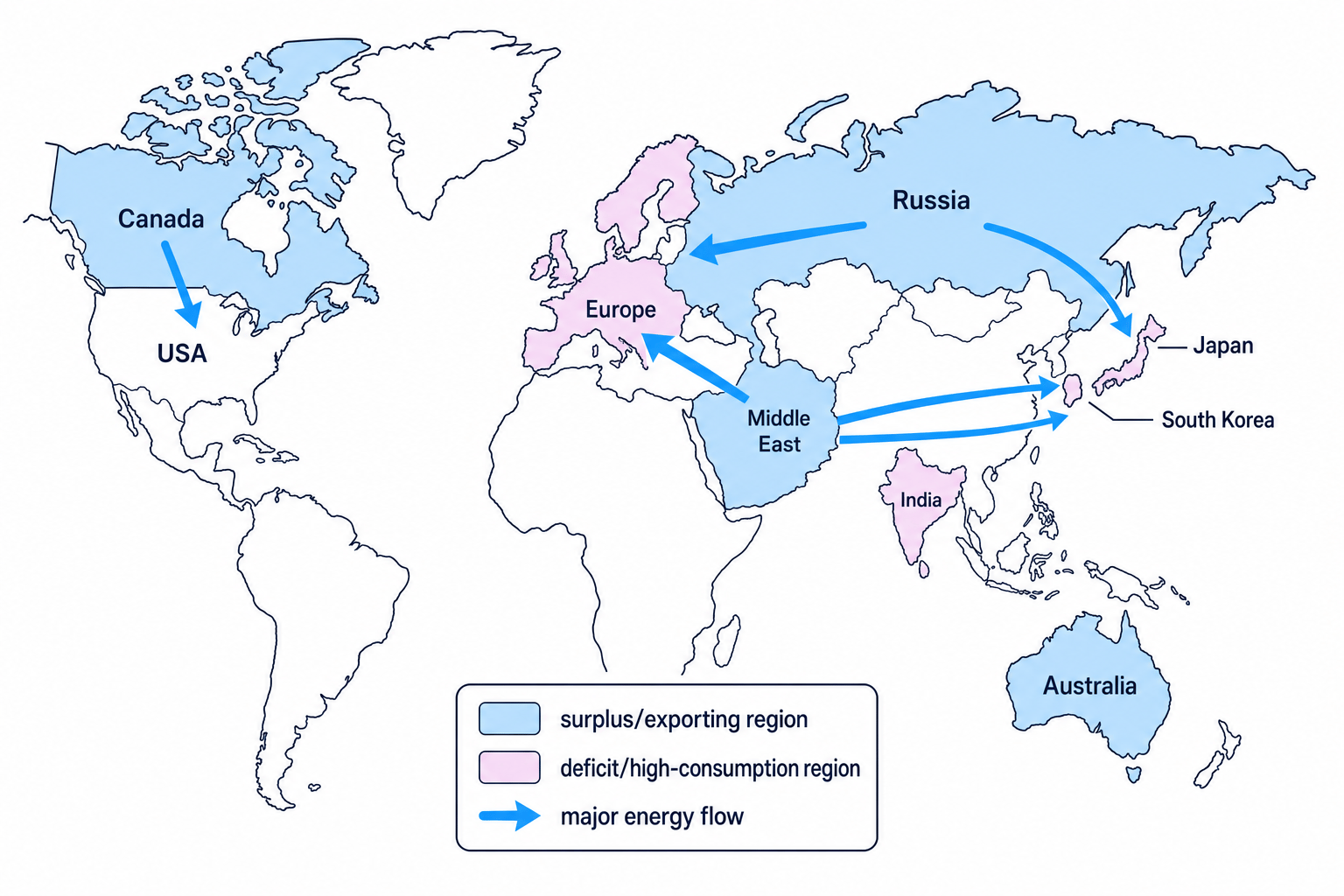
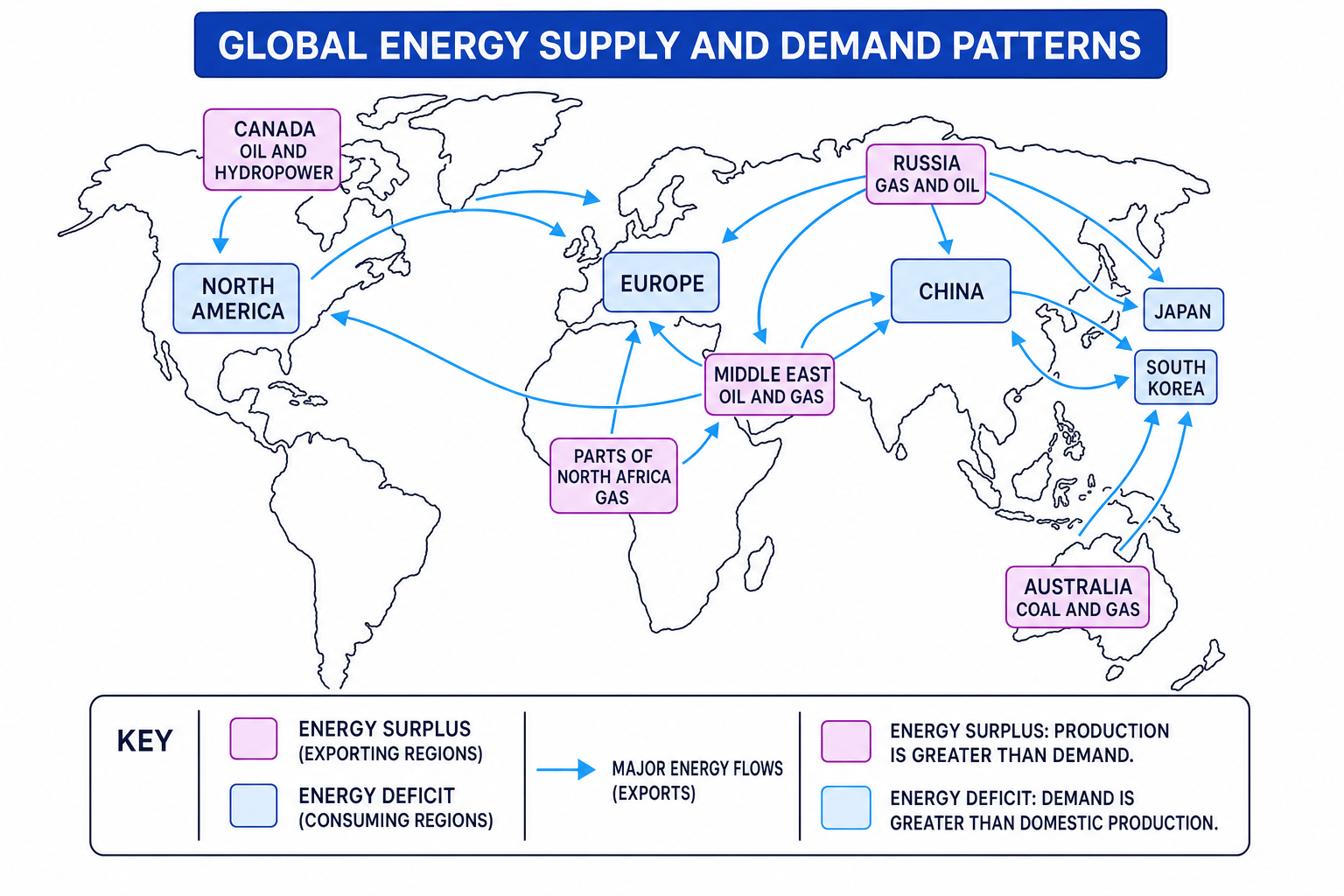
The simplified map below shows the broad global pattern: high consumption is concentrated in North America, Europe and industrialised parts of Asia, while major exporting regions include the Middle East, Russia, Canada and Australia.
Deciding whether a country has an energy deficit
- Compare energy production with energy consumption. If a country produces 80 units but consumes 120 units, demand is higher than domestic supply.
- Calculate the gap: 120−80=40120 - 80 = 40120−80=40. The country needs to import 40 units or reduce its demand.
- Decide what this means for security. If imports are cheap and reliable, the country may still be fairly secure; if imports come from one unstable supplier, it is more energy insecure.
Deficit does not always mean insecure
Do not write that every country with an energy deficit is automatically energy insecure. Security also depends on wealth, storage, technology, political stability and trade links.
Why global energy consumption is rising
Economic development
Economic development means improvement in wealth, jobs, services and living standards. As countries develop, they usually use more energy because they build factories, offices, roads, airports, ports, homes and schools.
Newly emerging economies such as China and India have seen rapid growth in manufacturing, urban populations and transport. This has increased total energy demand sharply, even though energy use per person may still be lower than in many HICs.
Rising population
A larger population means more homes need heating, cooling and lighting. It also means more food production, water pumping, transport, hospitals and schools. All of these require energy.
Population growth is especially important in parts of Africa and Asia, where future energy demand is expected to rise as both population and living standards increase.
Technology and lifestyles
Technology increases demand because people use more phones, computers, appliances, air conditioning, electric vehicles and data centres. Urban lifestyles can be energy-intensive, especially when people rely on private cars or live in homes that need heating or cooling.
Calculating percentage increase in energy use
A country’s energy use rises from 500 units to 750 units.
- Find the increase by subtracting the old value from the new value: 750−500=250750 - 500 = 250750−500=250 units.
- Divide the increase by the old value because percentage increase is measured against the starting point.
- Multiply by 100:
So energy use has increased by 50%.
Why energy supply is uneven
Energy supply depends on several linked factors.
Physical factors
Physical factors are natural conditions such as geology, climate, relief and water supply. Oil and gas form only in certain rock basins, coal forms in older sedimentary rocks, and geothermal energy is most useful near plate boundaries or volcanic areas.
Renewables are also physical. Solar power works best in sunny regions, hydroelectric power needs reliable river flow and steep relief, and wind power needs exposed windy locations.
Cost of exploitation and production
Exploitation means extracting and using a resource. Some resources are cheap to access, but others are deep underground, offshore, in the Arctic or in politically unstable areas. If the cost of extraction is higher than the price people will pay, companies may not develop the resource.
Technology
Technology can increase supply by making difficult resources usable. Examples include deep-water drilling, hydraulic fracturing for shale gas, liquefied natural gas terminals, better wind turbines, solar panels and battery storage.
Technology can also reduce demand by improving efficiency, which means getting the same output using less energy.
Political factors
Political decisions affect supply through taxes, subsidies, planning laws, environmental regulations, trade agreements and conflict. For example, Russia’s invasion of Ukraine in 2022 disrupted energy markets and pushed many European countries to reduce reliance on Russian gas.
Energy supply is about access, not just resources
A country may have energy resources but still lack secure supply if extraction is too expensive, technology is limited, infrastructure is poor or politics are unstable.
Impacts of energy insecurity
Energy insecurity can affect people, the economy and the environment.
- Exploration of difficult and sensitive areas: Countries may search for oil and gas in the Arctic, deep oceans, rainforests or tar sands. This can damage habitats and increase oil spill risks.
- Economic costs: Energy prices may rise, increasing household bills and business costs. Poorer households may suffer from fuel poverty.
- Environmental costs: Countries may return to cheaper but dirtier fuels such as coal or firewood, increasing air pollution and greenhouse gas emissions.
- Food production: Energy is needed for tractors, fertiliser production, irrigation, refrigeration and transport. Higher energy prices can increase food prices.
- Industrial output: Factories may reduce production if electricity is unreliable or too expensive.
- Potential for conflict: Tensions can grow over pipelines, shipping routes, dams, oil fields and gas supplies when demand exceeds secure supply.
Increasing energy supply: the energy mix
Energy mix
A country’s energy mix is the combination of energy sources it uses, such as coal, oil, gas, nuclear power, wind, solar and hydroelectric power.
Most countries use a mix because no single source is perfect. The aim is to balance cost, reliability, environmental impact and security.
| Energy source | Type | Main advantage | Main disadvantage |
|---|---|---|---|
| Coal, oil and gas | Non-renewable fossil fuels | Reliable and high energy output | Finite and produce greenhouse gases |
| Nuclear power | Non-renewable because uranium is finite | Low carbon emissions during operation | Expensive, radioactive waste and safety concerns |
| Biomass | Renewable if replanted | Can use local organic waste or crops | Can compete with food production or cause deforestation |
| Wind | Renewable | Low running emissions | Intermittent because wind varies |
| Hydroelectric power | Renewable | Reliable where river flow is strong | Dams can flood land and disrupt ecosystems |
| Tidal | Renewable | Predictable tides | Expensive and only suitable in some coastal areas |
| Geothermal | Renewable | Reliable in volcanic or tectonically active areas | Limited to suitable locations |
| Wave | Renewable | Useful for exposed coastlines | Technology is still developing and can be costly |
| Solar | Renewable | Useful from large solar farms to rooftop panels | Output falls at night and in cloudy conditions |
Renewable does not mean impact-free
Renewable energy is naturally replaced, but it can still have environmental and social impacts. For example, dams may flood valleys, and biomass may require land that could grow food.
Named example: fossil fuel extraction in Alberta, Canada
A useful example is oil sands extraction in Alberta, western Canada. Oil sands contain bitumen, a thick, sticky form of oil mixed with sand and clay. It can be extracted by surface mining or by injecting steam underground.
Advantages include jobs, export income, tax revenue and improved energy security for Canada and its trading partners. It also supports roads, pipelines and related industries.
Disadvantages include forest clearance, habitat loss, high water use, tailings ponds containing polluted waste, greenhouse gas emissions and impacts on some Indigenous communities. Exact figures vary by source and year, so focus on the clear overall pattern rather than memorising one precise statistic.
Balancing the Alberta oil sands
- Link the advantage to energy security: extracting oil sands increases domestic supply and creates exports, so Canada gains income and is less dependent on imported oil.
- Link the disadvantage to environmental cost: mining removes forest and uses water, while processing bitumen produces high greenhouse gas emissions.
- Make a judgement: the scheme brings major economic benefits, but it is difficult to call it sustainable because the resource is non-renewable and the environmental costs are high.
Moving towards a sustainable energy future
Sustainable energy future
A sustainable energy future means meeting today’s energy needs without damaging the ability of future generations to meet their own needs.
This involves both increasing cleaner supply and reducing wasteful demand.
Individual energy use and carbon footprints
Carbon footprint
A carbon footprint is the total amount of greenhouse gases produced by a person, activity, product or place, often expressed as carbon dioxide equivalent.
Your carbon footprint is affected by heating, electricity use, transport, diet, purchases and waste. Individuals can reduce it by insulating homes, using public transport, walking or cycling, reducing flights, buying efficient appliances and switching off unused devices.
Energy conservation and efficiency
Energy conservation means reducing unnecessary energy use. Energy efficiency means using less energy to provide the same service.
Homes and workplaces can be designed for sustainability using insulation, double or triple glazing, LED lighting, smart meters, efficient appliances, heat pumps and passive solar design. Transport can become more sustainable through better public transport, cycle routes, electric vehicles, car-sharing and compact urban planning.
Technology can also make fossil fuel use more efficient. Examples include combined-cycle gas power stations, combined heat and power systems, efficient engines and carbon capture and storage. These reduce waste or emissions, but they do not make fossil fuels renewable.
Named example: local renewable scheme in an NEE — micro-hydro in Chambamontera, Peru
Chambamontera in northern Peru is often used as a GCSE example of a local renewable scheme in an NEE. It uses small-scale micro-hydro systems, where fast-flowing mountain streams turn turbines to generate electricity for local homes and community buildings.
The scheme is more sustainable than diesel generators because it uses a renewable water flow and produces very low emissions during operation. It can improve quality of life by providing lighting for studying, power for phones, refrigeration and small businesses.
There are limits. Output is small, maintenance skills are needed, and water flow can vary seasonally. It is suitable for local community needs, not for powering heavy industry.
Judging whether micro-hydro is sustainable
- Assess the social impact: electricity improves lighting, education, communication and safety, so quality of life can improve.
- Assess the economic impact: low running costs and local maintenance can support small businesses and reduce spending on diesel.
- Assess the environmental impact: the scheme uses renewable water flow and has low emissions, although stream ecosystems still need protection.
- Reach a balanced judgement: micro-hydro is a strong local solution where relief and water flow are suitable, but it cannot solve energy insecurity everywhere.
In the exam
- For energy security questions, link supply, demand, cost and reliability rather than just saying “there is not enough energy”.
- For examples, name the place and keep your advantages and disadvantages balanced, especially for fossil fuel extraction.
- When evaluating sustainability, cover social, economic and environmental effects before making a clear judgement.
Check yourself
- Why might a country with an energy deficit still be energy secure?
- How can energy insecurity affect food production and industrial output?
- What makes the Chambamontera micro-hydro scheme more sustainable than using diesel generators?