Welcome to your study guide on the characters of Macbeth! To secure a Grade 9 in your GCSE English Literature exam, you must move beyond simply memorising what characters say and do. You need to understand why William Shakespeare created them, how they develop, and what ideas they represent to a Jacobean audience.
The Golden Rule of GCSE Character Analysis
Never treat characters like real, living people. They are dramatic constructs—tools carefully designed by Shakespeare to deliver a moral, political, or philosophical message to his audience.
What you'll learn
- How Shakespeare uses Macbeth and Lady Macbeth to explore the destructive nature of ambition.
- The role of minor characters as "foils" to highlight Macbeth’s moral descent.
- How to structure a high-scoring character analysis that weaves language, structure, and context together.
1. Macbeth: The Tragic Hero
At the start of the play, Macbeth is presented as a loyal, brave warrior. By the end, he is a "tyrant" and a "hell-hound". This dramatic shift makes him a classic tragic hero.
Tragic Hero & Hamartia
A tragic hero is a noble, high-status protagonist who makes a fatal error in judgment that leads to their own destruction. This fatal flaw is known as their hamartia.
Macbeth's Tragic Arc
Macbeth’s hamartia is his "vaulting ambition" (Act 1, Scene 7). This ambition is stimulated by the Witches' prophecies and nurtured by Lady Macbeth, but the choice to act on it is entirely his own.
As he climbs to power, his psychological state disintegrates:
- Act 1: Highly respected, but harbor's dark desires: "Let not light see my black and deep desires" (Act 1, Scene 4).
- Act 2: Overcome with guilt immediately after murdering King Duncan: "Will all great Neptune's ocean wash this blood / Clean from my hand?" (Act 2, Scene 2).
- Act 3: Desperate and paranoid, he orders the murder of Banquo. He states, "full of scorpions is my mind, dear wife" (Act 3, Scene 2), illustrating his mental torment.
- Act 4 & 5: Completely numb, cynical, and isolated. Upon hearing of his wife's death, he laments that life is "a tale / Told by an idiot, full of sound and fury, / Signifying nothing" (Act 5, Scene 5).
Blaming it all on the Witches
Do not write that Macbeth is a helpless victim of the Witches' magic. The Witches only offer predictions; they never force Macbeth to do anything. Macbeth's downfall is caused by his own internal choices and ambition.
2. Lady Macbeth: The Catalyst
Lady Macbeth is one of Shakespeare’s most complex and famous creations. In the patriarchal (male-dominated) society of Jacobean England, women were expected to be submissive, gentle, and nurturing. Lady Macbeth completely subverts these expectations.
Subverting Gender Expectations
To help her husband commit regicide (the murder of a king), she famously asks spirits to "unsex me here" (Act 1, Scene 5).
By asking to be "unsexed," she wants to strip away her feminine capacity for pity, maternal warmth, and guilt, replacing them with cold, masculine ruthlessness. She even claims she would have "dashed the brains out" of her own nursing child if she had sworn to do so (Act 1, Scene 7)—a shocking image designed to horrify the Jacobean audience.
The Intersecting Trajectories
One of the most fascinating aspects of the play is how the power dynamic between Macbeth and Lady Macbeth shifts. Their mental and political paths cross dramatically as the play progresses.
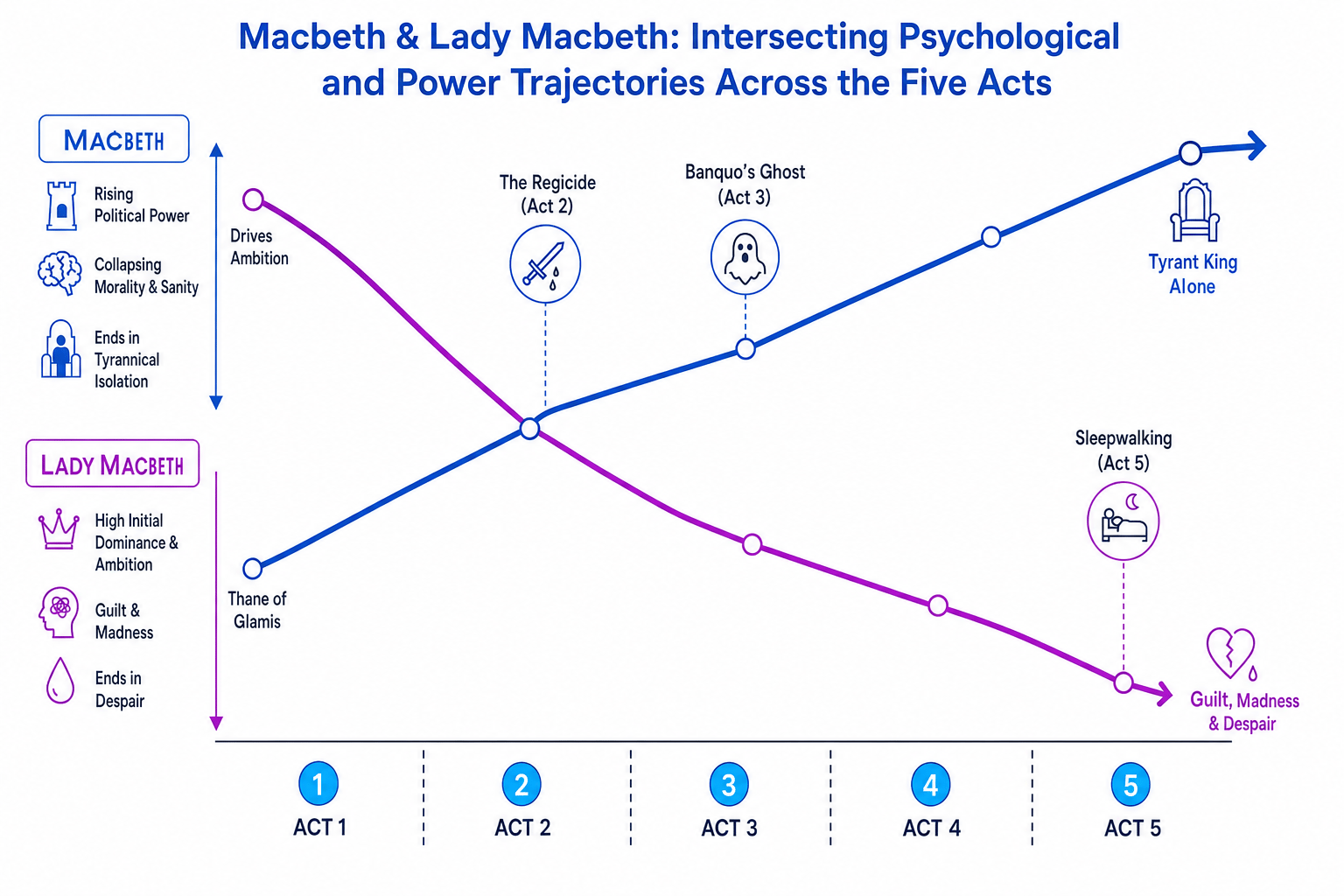
As the diagram shows:
- At the start: Lady Macbeth is dominant, driving the ambition, while Macbeth is hesitant.
- The turning point: Following the regicide and the banquet scene (where Macbeth sees Banquo's ghost), Macbeth becomes increasingly independent and bloodthirsty, shutting his wife out of his plans ("Be innocent of the knowledge, dearest chuck").
- At the end: While Macbeth grows colder and more tyrannical, Lady Macbeth is crushed by her repressed guilt, descending into madness and sleepwalking, eventually taking her own life.
3. Analysing Character Evolution
To secure top marks in your exam (AO2), you must show the examiner how a character changes and explain why Shakespeare structures their journey this way.
Let’s look at how to walk through a comparative character analysis.
Deconstructing Lady Macbeth's mental deterioration
Analyze how Shakespeare uses language and form to show Lady Macbeth's descent from absolute control to complete madness.
-
Contrast her initial control of language with her final breakdown: In Act 1, Scene 5, Lady Macbeth speaks in authoritative, structured blank verse (unrhymed iambic pentameter) and uses forceful, imperative verbs: "Come, you spirits", "Take my milk for gall". However, by Act 5, Scene 1 (the sleepwalking scene), her structured verse has collapsed into fragmented prose and repetitive, frantic questions: "Will these hands ne'er be clean?" This formal shift mirror the complete disintegration of her mental stability.
-
Track the shifting symbolism of blood and water: In Act 2, Scene 2, immediately after the murder, she casually dismisses Macbeth's terror by asserting, "A little water clears us of this deed". By Act 5, Scene 1, this illusion of easy purification is shattered. She obsessively washes her hands in her sleep, crying, "Out, damned spot! out, I say!" and lamenting, "All the perfumes of Arabia will not sweeten this little hand". The hyperbole contrasts sharply with her earlier dismissive attitude, demonstrating that physical water cannot wash away moral guilt.
-
Link her psychological collapse to Jacobean context: By showing Lady Macbeth's agonizing psychological collapse and eventual suicide, Shakespeare satisfies the moral expectations of his Jacobean audience and his patron, King James I. Her madness is a direct punishment for violating the Divine Right of Kings and the Great Chain of Being. Shakespeare warns the audience that attempting to usurp the throne will inevitably lead to mental self-destruction.
4. The Foils: Banquo and Macduff
To understand Macbeth’s character fully, we must look at how he interacts with the characters around him. Shakespeare uses foils to highlight Macbeth’s flaws.
Character Foil
A foil is a character who contrasts sharply with the protagonist, highlighting specific personality traits, moral choices, or flaws in that protagonist.
Banquo: The Moral Foil
Banquo is Macbeth's co-commander in the Scottish army. He is present when the Witches deliver their prophecies. However, Banquo reacts very differently:
- He is skeptical, calling the Witches "instruments of darkness" who win us over with "honest trifles, to betray's in deepest consequence" (Act 1, Scene 3).
- While Macbeth yields to temptation, Banquo prays to keep his thoughts pure: "Restrain in me the cursed thoughts that nature / Gives way to in repose" (Act 2, Scene 1).
Why did Shakespeare write him this way? Historically, King James I claimed ancestry from the real, historical Banquo. Therefore, Shakespeare had to portray Banquo as completely noble, innocent of the conspiracy, and fiercely loyal to the true line of kings.
Macduff: The Avenging Foil
Macduff is the Thane of Fife. He represents the ideal patriotic subject:
- He is the first to suspect Macbeth of Duncan's murder.
- Unlike Macbeth, who acts out of selfish ambition, Macduff acts out of love for his country: "O Scotland, Scotland!" (Act 4, Scene 3).
- When his family is brutally murdered on Macbeth’s orders, Macduff expresses deep, emotional grief. He insists he must "feel it as a man" (Act 4, Scene 3), offering a healthy model of masculinity that contrasts with Lady Macbeth's cold, violent definition of manhood.
5. The Witches: The Catalysts
The Witches (also called the Weird Sisters) represent temptation and the supernatural forces that threaten humanity.
The Paradoxical Language of the Witches
The Witches speak in trochaic tetrameter (four beats per line, stressing the first syllable: DUM-da, DUM-da) rather than iambic pentameter. This, combined with their use of rhyming couplets, makes their speech sound like supernatural, unnatural spells: "Double, double, toil and trouble..."
They also speak in paradoxes (contradictory statements) and half-truths, known as equivocation:
- "Fair is foul, and foul is fair" (Act 1, Scene 1).
- They trick Macbeth into false confidence in Act 4 by telling him that "none of woman born / Shall harm Macbeth" and he will never be defeated until "Great Birnam Wood to high Dunsinane Hill / Shall come against him."
These predictions are designed to appeal to Macbeth’s hubris (excessive pride), leading him to believe he is invincible when, in reality, he is marching to his doom.
In the exam
When writing about characters under timed exam conditions, keep these strategies in mind:
- Structure your essay chronologically: Trace the character's journey from the start of the play, through the turning points, to the end. This naturally shows the examiner that you understand character development and structural craft.
- Embed short, high-impact quotations: Instead of writing out a massive block of text, weave small fragments of quotes directly into your sentences (e.g., Macbeth's mind is "full of scorpions" as he realizes his crown is "fruitless").
- Always link to context (AO3): Every time you analyze a character's actions or mental state, explain how a Jacobean audience would view it. Think about the Gunpowder Plot, the Divine Right of Kings, and contemporary beliefs about witchcraft and gender.
Check yourself
- Why does Shakespeare use prose instead of blank verse for Lady Macbeth's sleepwalking scene in Act 5, Scene 1?
- In what ways does Banquo act as a moral foil to Macbeth?
- What does Macbeth's transition from a "valiant cousin" in Act 1 to a "dead butcher" in Act 5 tell us about the play's main themes?
