When J.B. Priestley wrote An Inspector Calls in 1945, he was not just trying to write an entertaining detective story. He was writing a political play designed to challenge the social inequalities of post-WWII Britain. To do this, he set his play in 1912—an era of deep division between the wealthy upper classes and the struggling working classes.
In this guide, you will learn how to analyze the characters in An Inspector Calls not just as "real people," but as deliberate tools used by Priestley to convey his political and social messages.
What you'll learn:
- How to analyze characters as literary constructs designed to represent specific ideologies.
- The stark contrast between the "Older Generation" and the "Younger Generation," and why this divide is central to Priestley's message.
- How to use the Inspector and Eva Smith to analyze the clash between Capitalism and Socialism.
- How to structure a high-scoring character analysis essay that integrates language analysis and historical context.
Understanding Characters as "Constructs"
To achieve the highest marks in your GCSE essay, you must move away from talking about the characters as if they are real people who lived in Brumley. Instead, you need to view them through the lens of the writer’s craft.
Construct
A construct is a character created by an author to represent a specific social class, political viewpoint, or set of values. They are symbols designed to deliver a message, rather than just three-dimensional individuals.
If you write "Mr. Birling is a greedy man who doesn't care about his staff," you are treating him like a real person. If you write "Priestley constructs Mr. Birling as a caricature of Edwardian capitalist greed to expose the moral failures of the ruling class," you are analyzing the writer's craft (meeting the requirements of AO2 and AO3).
Mouthpiece
A mouthpiece is a character whose primary purpose is to speak directly for the author, expressing the author’s own beliefs, ideals, or political convictions.
Throughout the play, characters are defined by how they react to the Inspector's revelations. Priestley uses these reactions to map out a clear social hierarchy and expose the moral corruption of the wealthy.
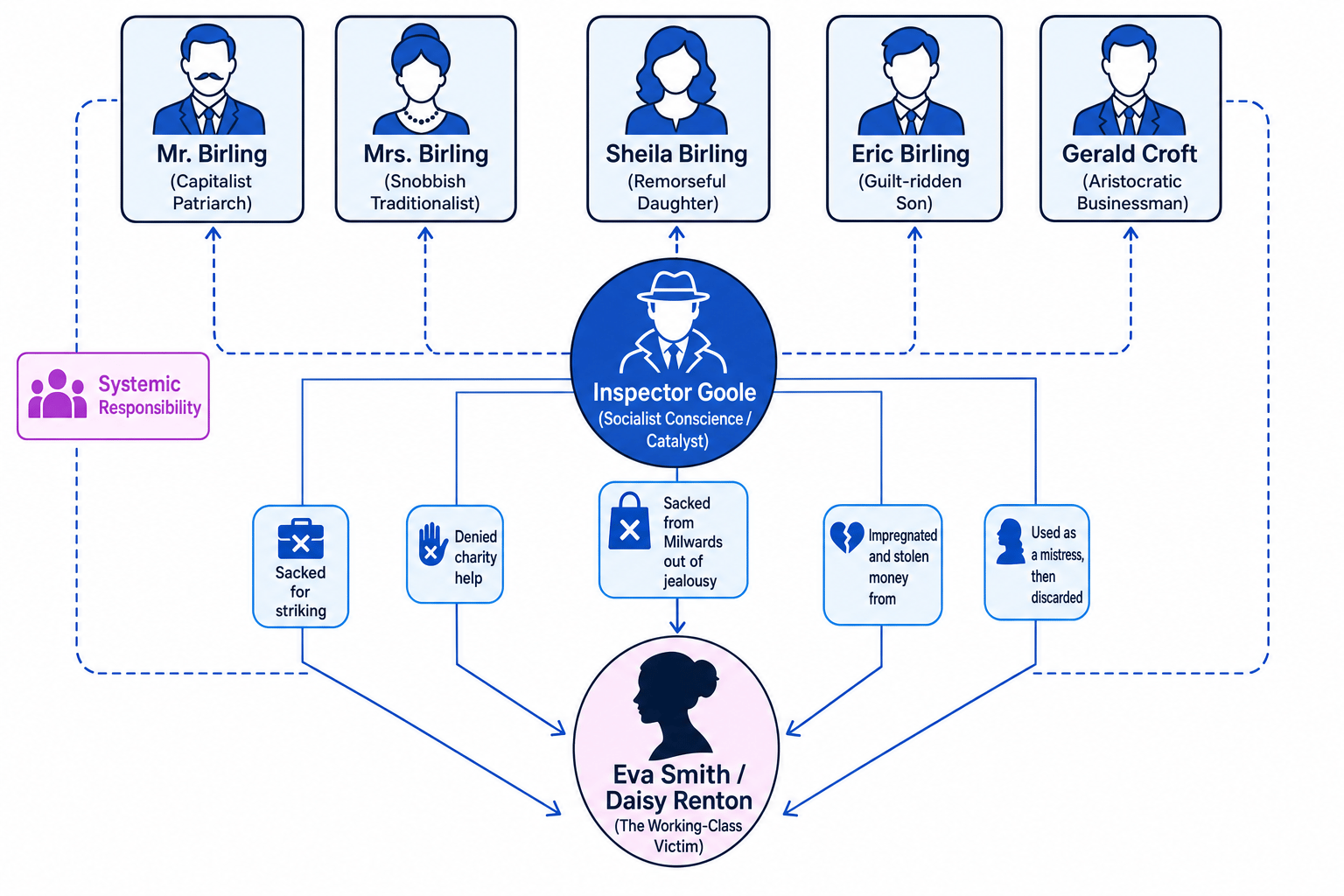
The Older Generation: Bastions of Capitalism
The older generation in the play is represented by Mr. Arthur Birling and Mrs. Sybil Birling. They represent the rigid, uncaring attitudes of Edwardian high society.
Mr. Arthur Birling
Mr. Birling is a wealthy factory owner and patriarch of the Birling family. He is a self-made man who prioritizes profit over people. Priestley uses his dramatic speeches in Act One to immediately discredit him in the eyes of the audience.
- Key Concept: Mr. Birling is the ultimate symbol of Capitalism—the economic system where trade and industry are controlled by private owners for profit, rather than by the state.
- Key Quote: He describes himself as a "hard-headed, practical man of business" and asserts that "a man has to make his own way—has to look after himself."
- The Writer's Technique (Dramatic Irony): In Act One, Mr. Birling declares that the Titanic is "unsinkable, absolutely unsinkable" and dismisses the possibility of war as "silly little war scares." Because the audience in 1945 had lived through the sinking of the Titanic and two devastating World Wars, they immediately recognize Mr. Birling as foolish and untrustworthy. By discrediting his predictions, Priestley discredits his capitalist ideology.
Mrs. Sybil Birling
Mrs. Birling is a prominent member of the Brumley Women's Charity Organization, but she is described as "a cold woman and her husband's social superior."
- Key Concept: She represents the hypocrisy of the ruling-class elite. She cares about social etiquette and reputation, not genuine morality.
- Key Quote: When confronted with her cruelty toward Eva Smith, she insists, "I did my duty" and claims she had "done no more than my duty."
- The Writer's Technique (Hypocrisy): Mrs. Birling is willing to condemn the "drunken young idler" who got Eva pregnant, completely unaware that she is publicly prosecuting her own son, Eric. Her lack of empathy blinds her, exposing how the wealthy class's pride leads to their own moral ruin.
Confusing the setting and the writing dates
Do not confuse the year the play is set (1912) with the year it was written and first performed (1945). Priestley wrote the play after World War II because he wanted Britain to build a fairer, socialist society. He set it in 1912 to show his audience how selfish, capitalist attitudes led directly to the disasters of the early 20th century.
The Younger Generation: Agents of Change
In stark contrast to their parents, Sheila and Eric Birling represent hope for the future. They are impressionable, and through the course of the play, they undergo a profound transformation.
Sheila Birling
Sheila begins the play as a naive, materialistic young woman, but she emerges as the most perceptive character, adopting the Inspector’s role once he departs.
- Key Concept: Sheila represents the transition from capitalist complacency to socialist responsibility.
- Key Quote: Early on, she refers to her mother as "Mummy," but by Act Three, she uses the more mature "Mother." When discussing the factory workers, she famously argues, "But these girls aren't cheap labour—they're people."
- The Writer's Technique (Symbolic Shift): Sheila's willingness to give back her engagement ring to Gerald represents her rejection of the capitalist transaction of marriage, choosing moral truth over financial security.
Eric Birling
Eric is described as "half-shy, half-assertive." He is deeply troubled, struggling with an alcohol addiction and the heavy expectations of his father.
- Key Concept: Eric represents the damaging consequences of a capitalist upbringing. He has been starved of parental affection, leading to his abusive, exploitative behavior toward Eva.
- Key Quote: When confronting his mother, he cries, "You killed her... and the child she’d have had too—my child—your own grandchild—you killed them both!"
- The Writer's Technique (Generational Divide): By the end of the play, Eric accepts his guilt, saying, "the girl's dead and we all helped to kill her—and that's what matters." He stands alongside Sheila against his parents, highlighting that the young are capable of learning and evolving.
The Generational Divide
The older generation (Mr. and Mrs. Birling) represents rigid capitalism and a refusal to change. The younger generation (Sheila and Eric) represents the future of society—they are capable of learning, feeling guilt, and adopting socialist principles of collective responsibility.
The Complicated Middle Ground: Gerald Croft
Gerald Croft is the son of Lord and Lady Croft, making him socially superior to the Birlings. He is engaged to Sheila, a marriage that Mr. Birling views as an excellent business alliance.
- Key Concept: Gerald represents the trap of aristocracy. Although he is young, he aligns politically and socially with the older generation. He represents the class of wealthy young men who exploit working-class women like Eva/Daisy under the guise of chivalry.
- Key Quote: After the Inspector leaves, Gerald is the first to seek a loophole, eagerly stating, "Everything’s all right now, Sheila. What about this ring?"
- The Writer's Technique (The Unchanging Elite): Priestley uses Gerald to show that age alone does not guarantee progress. Gerald is a warning to the 1945 audience: if the wealthy young men of Britain do not actively reject the capitalist views of their fathers, society will remain corrupt and unequal.
The Catalyst: Inspector Goole
Inspector Goole is the driving force of the play. He does not behave like a standard Edwardian police officer; instead, he acts as a moral judge.
- Key Concept: The Inspector is Priestley’s mouthpiece. He represents Socialism—the political belief that society should be organized collectively for the benefit of everyone, not just wealthy individuals.
- Key Quote: His final speech contains the play's central manifesto: "We don't live alone. We are members of one body. We are responsible for each other."
- The Writer's Technique (Omniscience & Prophecy): The name "Goole" sounds like "ghoul" (a ghost or spirit), suggesting his supernatural nature. He seems to know everything before the characters speak. His final warning that if humanity does not learn this lesson, they will be taught it in "fire and blood and anguish" acts as a direct, prophetic allusion to the World Wars.
The Inspector as a Mirror
Think of Inspector Goole as a physical mirror brought into the Birling home. He doesn't actually force any of the characters to commit bad acts; he simply shines a harsh, unrelenting light on their actions, forcing them to look at their own moral ugliness.
The Silent Catalyst: Eva Smith / Daisy Renton
Eva Smith never appears on stage, yet she is the most important character in the play.
- Key Concept: Eva is a universal symbol for the exploited working class. Her name "Eva" recalls the biblical "Eve" (mother of all humanity), while "Smith" is the most common English surname.
- Key Quote: The Inspector makes her universal nature explicit in his final speech: "One Eva Smith has gone—but there are millions and millions and millions of Eva Smiths and John Smiths still left with us."
- The Writer's Technique (Anonymity and Absence): By keeping Eva off-stage, Priestley prevents the audience from viewing her as an individual case of bad luck. Instead, she becomes a blank canvas representing the systemic abuse of the entire working class by the wealthy elite.
Character Analysis in Practice
When writing a character essay, you must link your points to Priestley's wider social message and analyze the specific dramatic methods he uses. Let's walk through an example of how to build a high-scoring analytical paragraph.
Analyzing Sheila's development from naive capitalist to social advocate
How does Priestley present the character of Sheila in An Inspector Calls?
- Formulate a thesis statement (Point): Priestley constructs Sheila's character to demonstrate how the younger generation can reject capitalist self-interest in favor of social responsibility.
- Introduce precise textual evidence (Evidence): At the start of the play, Sheila is presented as childish and obsessed with material goods, but her perspective shifts when she learns of Eva’s death, asserting that "these girls aren't cheap labour—they're people."
- Analyze the writer's methods (Method): Priestley utilizes a contrast in Sheila's dialogue. The noun phrase "cheap labour" reflects the cold, dehumanizing language of her father's capitalist business model, where human beings are reduced to financial expenses. By contrasting this with the plural noun "people," Priestley uses Sheila to re-inject humanity and moral worth back into the working class.
- Link to context and Priestley's purpose (Effect/Context): This shift would have resonated deeply with Priestley's 1945 audience, who were actively trying to rebuild a fairer post-war Britain. Through Sheila’s awakening, Priestley demonstrates that the younger generation has the moral capacity to break free from the class prejudices of their parents and champion a socialist future.
In the exam
- Never write about characters as real people. Always use the writer's name (e.g., "Priestley constructs Mr. Birling to show..." or "Priestley uses Sheila as a symbol of...").
- Group characters by their function. If you get a question on Eric, always compare his reaction to his parents' reactions to show the generational divide.
- Focus on the ending. How a character finishes the play is crucial. Do they change (Sheila, Eric) or do they try to cover things up (Mr. Birling, Mrs. Birling, Gerald)? This is where Priestley's moral lesson is delivered.
- Integrate context naturally. Do not just drop in random historical facts. Tie the context (1912 class system vs. 1945 socialist post-war hopes) directly to how a character behaves and what they represent.
Check yourself
- Why did Priestley set the play in 1912 but write it in 1945, and how does this affect our view of Mr. Birling's character?
- What are the major differences between how Sheila and Gerald react to the news that the Inspector might be a fraud?
- How does the name "Eva Smith" reinforce her role as a universal construct for the working class?
