In short
- Four extracts in two pairs: Romeo's love in Act 1 (Scenes 1 and 5), then Juliet left alone by the Nurse (Act 3, Scene 5) and by the Friar (Act 5, Scene 3).
- AQA has printed none of these passages (to June 2025), but each comes from a scene it has printed or a moment its reports name.
- For each: place it in the play's four days (Sunday morning to Thursday's dawn), follow one image or phrase out, and know three links.
Extract 1: Act 1, Scene 1: Romeo tells Benvolio what love feels like
At this point in the play, Benvolio has asked Romeo why he is sad, and Romeo has told him he loves a woman who does not love him. It is Sunday morning.
ROMEO.
Where shall we dine?—O me! What fray was here?
Yet tell me not, for I have heard it all.
Here's much to do with hate, but more with love.
Why then, O brawling love, O loving hate,
O anything of nothing first create!
O heavy lightness, serious vanity,
Misshapen chaos of well-seeming forms,
Feather of lead, bright smoke, cold fire, sick health,
Still-waking sleep that is not what it is!
This love feel I, that feel no love in this.
Dost thou not laugh?BENVOLIO.
No, coz, I rather weep.ROMEO.
Good heart, at what?BENVOLIO.
At thy good heart's oppression.ROMEO.
Why, such is love's transgression.
Griefs of mine own lie heavy in my breast,
Which thou wilt propagate to have it pressed
With more of thine. This love that thou hast shown
Doth add more grief to too much of mine own.
Love is a smoke made with the fume of sighs;
Being purged, a fire sparkling in lovers' eyes;
Being vexed, a sea nourished with loving tears.
What is it else? A madness most discreet,
A choking gall, and a preserving sweet.
Farewell, my coz.BENVOLIO.
Soft, I will go along.
An if you leave me so, you do me wrong.ROMEO.
Tut, I have lost myself. I am not here.
This is not Romeo. He's some other where.
Line by line
- "Where shall we dine?": bathos, a comic fall from sighs to lunch. M. M. Mahood reads it as the giveaway that Romeo is "posing at posing": playing the lover rather than being one.
- "Here's much to do with hate, but more with love.": he turns a fight he missed into his own story. Then come the oxymorons (two opposites forced together), "O brawling love, O loving hate": in Verona even love speaks the feud's language.
- "Feather of lead, bright smoke, cold fire, sick health,": stock contradictions in the fashion 1590s poets took from Petrarch, whose lover pines for a cold lady: love as a sickness, and unreturned.
- "Why, such is love's transgression.": his love poetry is a game with a friend, not words to the woman: he caps Benvolio's "oppression" with a rhyme. At the feast he will share a sonnet with Juliet herself (Act 1, Scene 5).
- "A choking gall, and a preserving sweet.": love as poison and cure at once ("gall" is bitter poison). The play makes it literal: the Friar's flower holds "Poison" and "medicine power" (Act 2, Scene 3).
- "This is not Romeo. He's some other where.": the third person makes him a stranger to himself. The pose may hide a real need: Coleridge called Rosaline "a mere name for the yearning of his youthful imagination". At the feast that yearning finds Juliet.
Link it to the whole text
- The Friar says Rosaline saw through this love: "Thy love did read by rote, that could not spell" (Act 2, Scene 3). The oxymorons are words learned by heart, not understood.
- Juliet asks him to "Deny thy father and refuse thy name", and he offers: "Henceforth I never will be Romeo." (Act 2, Scene 2). "This is not Romeo" becomes a real offer.
- Juliet's "Beautiful tyrant, fiend angelical!" (Act 3, Scene 2) borrows his oxymoron once he has killed Tybalt: the paradox he played with is now her real situation.
Questions it could come up with
- Starting with this conversation, explore how far Shakespeare presents Romeo's love as sincere. Write about: how Shakespeare presents Romeo's love in this conversation; how far Shakespeare presents Romeo's love as sincere in the play as a whole.
- Starting with this conversation, explore how Shakespeare presents ideas about love and hate in Romeo and Juliet. Write about: how Shakespeare presents ideas about love and hate in this conversation; how Shakespeare presents ideas about love and hate in the play as a whole.
Extract 2: Act 1, Scene 5: Romeo sees Juliet, and Tybalt knows his voice
At this point in the play, Romeo has come masked and uninvited to the Capulets' feast, where he sees Juliet for the first time. It is Sunday night, hours after Extract 1.
ROMEO.
What lady's that which doth enrich the hand
Of yonder knight?SERVINGMAN.
I know not, sir.ROMEO.
O, she doth teach the torches to burn bright!
It seems she hangs upon the cheek of night
As a rich jewel in an Ethiop's ear—
Beauty too rich for use, for Earth too dear.
So shows a snowy dove trooping with crows
As yonder lady o'er her fellows shows.
The measure done, I'll watch her place of stand
And, touching hers, make blessèd my rude hand.
Did my heart love till now? Forswear it, sight,
For I ne'er saw true beauty till this night.TYBALT.
This, by his voice, should be a Montague.—
Fetch me my rapier, boy.Page exits.
What, dares the slave
Come hither covered with an antic face
To fleer and scorn at our solemnity?
Now, by the stock and honor of my kin,
To strike him dead I hold it not a sin.CAPULET.
Why, how now, kinsman? Wherefore storm you so?TYBALT.
Uncle, this is a Montague, our foe,
A villain that is hither come in spite
To scorn at our solemnity this night.CAPULET.
Young Romeo is it?TYBALT.
'Tis he, that villain Romeo.CAPULET.
Content thee, gentle coz. Let him alone.
He bears him like a portly gentleman,
And, to say truth, Verona brags of him
To be a virtuous and well-governed youth.
Line by line
- "What lady's that": his first words about her are a question. He does not know who she is, and learns her family only after the kisses, so this love cannot yet be defiance of the feud.
- "O, she doth teach the torches to burn bright!": hyperbole makes Juliet the torches' teacher, the first of the play's images of the lovers as light in the dark.
- "Beauty too rich for use, for Earth too dear.": M. M. Mahood hears "dear" as precious and costly. The praise half-wishes her out of the world: a warning only the audience can hear.
- "Did my heart love till now? Forswear it, sight,": a rhetorical question wipes out Rosaline, and "Forswear" tells his eyes to take back their oath. Fickle eyes, or eyes opened at last? AQA's 2019 report welcomed "healthy scepticism".
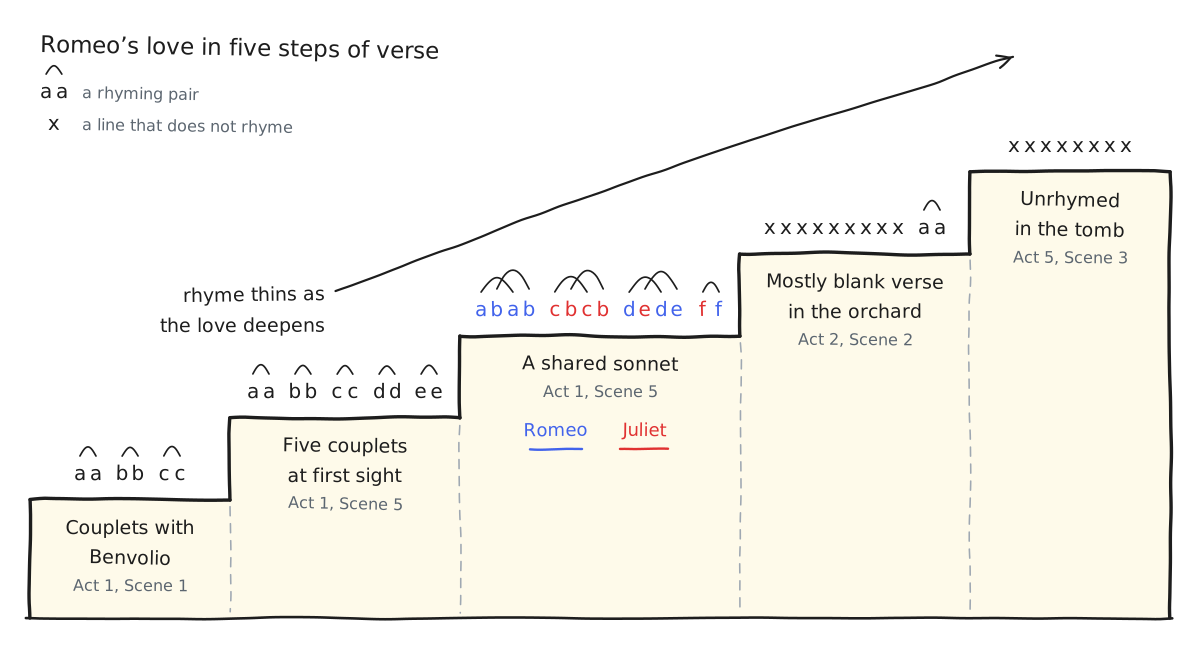
- "true beauty till this night.": this ends five couplets in a row, from the torches line on: the rhymes he used about Rosaline. Rhyme thins as the love deepens, and his tomb speech is unrhymed (Act 5, Scene 3). Harry Levin sees the lovers "expressly repudiating the artificial language".
- "To strike him dead I hold it not a sin.": eleven lines after the torches, Tybalt knows Romeo's voice through the mask and calls for his rapier, making killing a family duty. Minutes later, in the lovers' sonnet, "sin" means a kiss: one word, two codes.
- "Content thee, gentle coz. Let him alone.": calm imperatives ("coz" means kinsman) from a man used to obedience. Calling Romeo "portly" (dignified) and "well-governed" is dramatic irony: that youth has just fallen for Capulet's daughter.
Link it to the whole text
- Tybalt's grudge comes due: "Boy, this shall not excuse the injuries / That thou hast done me" (Act 3, Scene 1). In the same scene Mercutio, of neither house, dies in the quarrel cursing "A plague o' both your houses!" A slight at a feast becomes two deaths.
- Capulet's will shields Romeo, then turns on Juliet. To Tybalt, a few lines on: "Am I the master here or you? Go to." (Act 1, Scene 5). To his daughter: "An you be mine, I'll give you to my friend" (Act 3, Scene 5).
- The light runs from these torches to the tomb, which Juliet's beauty makes "a feasting presence full of light" (Act 5, Scene 3): a love begun at a feast ends in a vault lit like one.
Questions it could come up with
- Starting with this moment in the play, explore how far Shakespeare presents love as dangerous in Romeo and Juliet. Write about: how Shakespeare presents love at this moment in the play; how far Shakespeare presents love as dangerous in the play as a whole.
- Starting with this moment in the play, explore how Shakespeare presents Capulet as the head of his family. Write about: how Shakespeare presents Capulet at this moment in the play; how Shakespeare presents Capulet as the head of his family in the play as a whole.
Extract 3: Act 3, Scene 5: The Nurse tells Juliet to marry Paris
At this point in the play, Juliet's parents have left her after she refused to marry Paris, and she has begged the Nurse for comfort. It is Tuesday morning, and Romeo left for Mantua at dawn.
NURSE.
Romeo is banished, and all the world to nothing
That he dares ne'er come back to challenge you,
Or, if he do, it needs must be by stealth.
Then, since the case so stands as now it doth,
I think it best you married with the County.
O, he's a lovely gentleman!
Romeo's a dishclout to him. An eagle, madam,
Hath not so green, so quick, so fair an eye
As Paris hath. Beshrew my very heart,
I think you are happy in this second match,
For it excels your first, or, if it did not,
Your first is dead, or 'twere as good he were
As living here and you no use of him.JULIET.
Speak'st thou from thy heart?NURSE.
And from my soul too, else beshrew them both.JULIET.
Amen.NURSE.
What?JULIET.
Well, thou hast comforted me marvelous much.
Go in and tell my lady I am gone,
Having displeased my father, to Lawrence' cell
To make confession and to be absolved.NURSE.
Marry, I will; and this is wisely done.She exits.
JULIET.
Ancient damnation, O most wicked fiend!
Is it more sin to wish me thus forsworn
Or to dispraise my lord with that same tongue
Which she hath praised him with above compare
So many thousand times? Go, counselor.
Thou and my bosom henceforth shall be twain.
I'll to the Friar to know his remedy.
If all else fail, myself have power to die.
Line by line
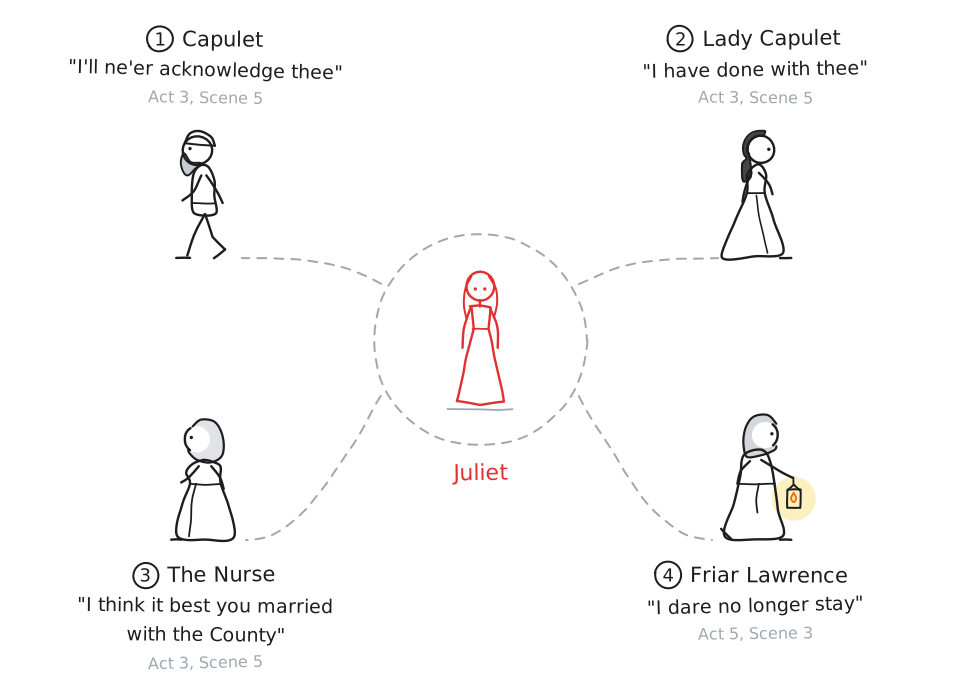
- "I think it best you married with the County." (Count Paris): the mild "I think it best" makes bigamy (marrying again while the first husband lives) sound like common sense. To Juliet it breaks a vow made before God.
- "Romeo's a dishclout to him.": a kitchen word (a dishcloth) beside the hyperbole of Paris's eagle "eye". She judges husbands by looks, as she once praised Romeo's "face" and "leg" (Act 2, Scene 5).
- "Your first is dead, or 'twere as good he were": brutal, or practical? Minutes earlier she alone defended Juliet ("You are to blame, my lord, to rate her so") and was told to "Hold your tongue". With Romeo banished, a servant who cannot cross her master offers the only safe road.
- "Amen." and "What?": two one-word lines break the verse. Juliet's "Amen" turns the Nurse's oath into a curse she cannot hear; "comforted me marvelous much" is irony, her first lie to the Nurse.
- "Ancient damnation, O most wicked fiend!": with the Nurse sent off ("Go in and tell my lady I am gone"), Juliet says what she means: a damned old woman, a devil. The Nurse's sin is disloyalty, to "dispraise my lord" with the tongue that praised him.
- "myself have power to die.": the bond cut ("Thou and my bosom henceforth shall be twain": split in two), Juliet ends the scene on her own couplet. Alone, she keeps one power in reserve, and uses it in the tomb (Act 5, Scene 3).
Link it to the whole text
- The Nurse's love was real: "Thou wast the prettiest babe that e'er I nursed" (Act 1, Scene 3). Samuel Johnson called her "trusty and dishonest", and here she is both: a mother who fails Juliet while trying to keep her safe.
- The woman who urges a second husband sent Juliet to the first: "There stays a husband to make you a wife" (Act 2, Scene 5). The comedy's go-between cannot follow her into tragedy.
- Juliet keeps the break. With the vial ready she starts to call the Nurse back, then stops: "My dismal scene I needs must act alone" (Act 4, Scene 3).
Questions it could come up with
- Starting with this conversation, explore how Shakespeare presents the relationship between Juliet and the Nurse. Write about: how Shakespeare presents their relationship in this conversation; how Shakespeare presents the relationship between Juliet and the Nurse in the play as a whole.
- Starting with this moment in the play, explore how Shakespeare presents ideas about loyalty in Romeo and Juliet. Write about: how Shakespeare presents ideas about loyalty at this moment in the play; how Shakespeare presents ideas about loyalty in the play as a whole.
Extract 4: Act 5, Scene 3: Juliet wakes in the tomb
At this point in the play, Romeo, believing Juliet dead, has killed Paris and poisoned himself beside her. Friar Lawrence has come to the tomb to be there when she wakes. It is Wednesday night.
FRIAR LAWRENCE.
Romeo! O, pale! Who else? What, Paris too?
And steeped in blood? Ah, what an unkind hour
Is guilty of this lamentable chance!
The lady stirs.JULIET.
O comfortable friar, where is my lord?
I do remember well where I should be,
And there I am. Where is my Romeo?FRIAR LAWRENCE.
I hear some noise.—Lady, come from that nest
Of death, contagion, and unnatural sleep.
A greater power than we can contradict
Hath thwarted our intents. Come, come away.
Thy husband in thy bosom there lies dead,
And Paris, too. Come, I'll dispose of thee
Among a sisterhood of holy nuns.
Stay not to question, for the watch is coming.
Come, go, good Juliet. I dare no longer stay.JULIET.
Go, get thee hence, for I will not away.He exits.
What's here? A cup closed in my true love's hand?
Poison, I see, hath been his timeless end.—
O churl, drunk all, and left no friendly drop
To help me after! I will kiss thy lips.
Haply some poison yet doth hang on them,
To make me die with a restorative.She kisses him.
Thy lips are warm!
Enter Paris's Page and Watch.
FIRST WATCH.
Lead, boy. Which way?JULIET.
Yea, noise? Then I'll be brief. O, happy dagger,
This is thy sheath. There rust, and let me die.She takes Romeo's dagger, stabs herself, and dies.
Line by line
- "Ah, what an unkind hour / Is guilty of this lamentable chance!": personification puts the clock on trial: the first explanation for the deaths is chance.
- "O comfortable friar, where is my lord?": "comfortable" means comforting. She wakes trusting, asking for Romeo, who lies dead beside her: dramatic irony at its cruellest.
- "come from that nest / Of death, contagion, and unnatural sleep.": a nest should hold new life. "Contagion" recalls the plague quarantine that stopped the letter (Act 5, Scene 2); "unnatural sleep" is his own potion's work.
- "A greater power than we can contradict / Hath thwarted our intents.": the second explanation is providence (God's plan), from the man whose plan failed ("our intents"). Faith, or an excuse? His "dispose of thee" (place you) plans her life, as her father did.
- "I dare no longer stay.": Juliet caps his rhyme with a refusal: "Go, get thee hence, for I will not away." He once capped Romeo's "sudden haste" with "They stumble that run fast" (Act 2, Scene 3); now he runs. Cowardice, or the tragedy's need for her to die alone?
- "Thy lips are warm!": seeing his "timeless" (untimely) end, she teases him tenderly as a "churl" (miser) who "drunk all", then kisses him. The half-line, cut off as the Watch arrives, shows she missed him by minutes.
- "O, happy dagger, / This is thy sheath.": the third explanation is her own choice, made in two lines where Romeo's farewell took thirty-seven. "Happy" means lucky and welcome; her body is the "sheath", an image of the wedding night.
Link it to the whole text
- "A pair of star-crossed lovers take their life" (Prologue): "take their life" means born and self-killed. English law punished suicide with a shameful burial; the Prologue calls them "star-crossed", not sinful, and the play ends by promising them golden statues (Act 5, Scene 3).
- "My grave is like to be my wedding bed." (Act 1, Scene 5): said lightly at the feast, before she knows his name; the sheath makes it literal.
- Her fear before the potion, "I wake before the time that Romeo / Come to redeem me?" (Act 4, Scene 3), comes true in reverse: she wakes minutes too late. She drank anyway: courage in spite of fear.
Questions it could come up with
- Starting with this moment in the play, explore how Shakespeare presents ideas about death in Romeo and Juliet. Write about: how Shakespeare presents ideas about death at this moment in the play; how Shakespeare presents ideas about death in the play as a whole.
- Starting with this moment in the play, explore how far Shakespeare presents Juliet as a courageous character. Write about: how Shakespeare presents Juliet at this moment in the play; how far Shakespeare presents Juliet as a courageous character in the play as a whole.