Skip to content

Literary Hub

Macbeth
Sign up
  1. Literary Hub
  2. Summary

Summary

Act 1, Scene 1 · An open place. Thunder and lightning.

The Witches in the storm

Scenes · 1 of 28

When shall we three1 meet again? / In thunder, lightning, or in rain?2First Witch, Act 1, Scene 1, line 1
When the hurly-burly1's done,2 / When the battle's lost and won.3Second Witch, Act 1, Scene 1, line 3
That will be1 ere the set of sun.2Third Witch, Act 1, Scene 1, line 5
There to meet with Macbeth.1Third Witch, Act 1, Scene 1, line 8
I come, Graymalkin.1 / Paddock calls.2 / Anon.First, Second and Third Witch, Act 1, Scene 1, line 9
Fair is foul, and foul is fair;1 / Hover through the fog and filthy air.2The Witches, Act 1, Scene 1, line 12

Act 1, Scene 1 · An open place. Thunder and lightning.

The Witches in the storm

When shall we three1 meet again? / In thunder, lightning, or in rain?2First Witch, Act 1, Scene 1, line 1
When the hurly-burly1's done,2 / When the battle's lost and won.3Second Witch, Act 1, Scene 1, line 3
That will be1 ere the set of sun.2Third Witch, Act 1, Scene 1, line 5
There to meet with Macbeth.1Third Witch, Act 1, Scene 1, line 8
I come, Graymalkin.1 / Paddock calls.2 / Anon.First, Second and Third Witch, Act 1, Scene 1, line 9
Fair is foul, and foul is fair;1 / Hover through the fog and filthy air.2The Witches, Act 1, Scene 1, line 12

Act 1: Temptation

The Witches greet the victorious Macbeth as a future king, and within days he is weighing up murder. Duncan names Malcolm his heir, Lady Macbeth calls on dark spirits to make her cruel, and Macbeth argues himself out of killing his king, only for his wife to argue him back in. More AQA extracts have come from this act than from any other, so know it best.

Act 1, Scene 1: The Witches in the storm

In thunder and lightning the three Witches agree to meet Macbeth on the heath once the battle is over, then leave chanting 'Fair is foul, and foul is fair'.

The big question

Why does the play begin with the Witches, not with Macbeth?

Three voices in a storm

Thunder and lightning, and three Witches already making plans. The play's first line is a question: ‘When shall we three meet again? / In thunder, lightning, or in rain?’ The Second Witch answers with a riddle: ‘When the hurly-burly's done, / When the battle's lost and won.’ Offstage a rebellion rages, and to them it is just a 'hurly-burly'. It will be over ‘ere the set of sun’. Then the place, the heath, and the name: ‘There to meet with Macbeth.’ We hear of the hero first from them.

Called away

Something calls, and each Witch answers a voice the audience cannot hear: ‘I come, Graymalkin. / Paddock calls. / Anon.’ Graymalkin is a grey cat and Paddock a toad, spirits in animal shape, yet the Witches come the moment their animals call, so even these three seem to answer to someone. Then they chant together and vanish into the murk, leaving the line that sums up the play:

Important quote

Fair is foul, and foul is fair;⁠1 / Hover through the fog and filthy air.⁠2,3

  1. 1

    Method · Paradox and chiasmus · AO2

    Opposites are jammed together, then swapped round (fair, foul, foul, fair), so the line flips itself as you say it. From the first scene it warns that nothing here is what it seems, including the honours about to land on Macbeth.

  2. 2

    Method · Alliteration · AO2

    The soft, breathy fricative 'f' (fair, foul, fog, filthy) sounds like a curse spat under the breath, and 'fog' blurs sight just as the Witches blur truth. They leave the stage hidden in murk, and the play's moral vision stays murky after them.

  3. 3

    Form and structure · Trochaic tetrameter · AO2

    The Witches chant in rhyming trochaic tetrameter (DUM-da ×4). 'Fair is foul, and foul is fair' has seven syllables, dropping the final weak beat, so it starts and ends on a thump. Set against the humans' blank verse, it sounds like a spell and marks them as outside the natural order.

Grade 9 insight

Perhaps 'fair is foul' is less a spell than a job description for the Macbeths. Lady Macbeth's 'Look like th' innocent flower, / But be the serpent under 't' (1.5) and Macbeth's 'False face must hide what the false heart doth know' (1.7) put it into practice.

Pair it with

5 quotes

So foul1 and fair a day I have not seen.Macbeth, Act 1, Scene 3, line 39Look like th' innocent flower,1 / But be the serpent2 under 't.Lady Macbeth, Act 1, Scene 5, line 76Away, and mock the time1 with fairest2 show. / False face3 must hide what the false heart doth know.Macbeth, Act 1, Scene 7, line 94Double,1 double toil and trouble; / Fire burn, and cauldron bubble.2The Witches, Act 4, Scene 1, line 10This castle hath a pleasant1 seat.2 The air / Nimbly and sweetly recommends itself3 / Unto our gentle senses.Duncan, Act 1, Scene 6, line 1

Echo

Duncan ends 1.2 with 'What he hath lost, noble Macbeth hath won', and Macbeth's first line is 'So foul and fair a day I have not seen' (1.3). Both men speak the Witches' language without ever having heard it.

Grade 9 idea

Perhaps the form is the warning. Three voices finish each other's rhymes, one asking and two answering, as if they share a single mind. By 1.5 Macbeth and his wife finish each other's verse lines too.

Quotes from this scene

When shall we three⁠1 meet again? / In thunder, lightning, or in rain?⁠2,3

First Witch, Act 1, Scene 1, line 1

When the hurly-burly1's done,2 / When the battle's lost and won.3

Second Witch, Act 1, Scene 1, line 3

There to meet with Macbeth.⁠1,2,3

Third Witch, Act 1, Scene 1, line 8

Fair is foul, and foul is fair;⁠1 / Hover through the fog and filthy air.⁠2,3,4

The Witches, Act 1, Scene 1, line 12
More from this scene (2)

That will be1 ere the set of sun.2

Third Witch, Act 1, Scene 1, line 5

I come, Graymalkin.1 / Paddock calls.2 / Anon.

First, Second and Third Witch, Act 1, Scene 1, line 9

Act 1, Scene 2: Brave Macbeth

Before we ever see him, a bleeding Captain and then Ross tell King Duncan how Macbeth cut a rebel open and beat off Norway, so Duncan sentences the traitor Cawdor to death and gives his title to Macbeth.

AQA extract

June 2019

The big question

Before he meets the Witches, is Macbeth a hero, or already the butcher he will become?

What bloody man is that?

Trumpets sound: Scotland is at war. Duncan and his sons meet a wounded soldier, and the King's first words give the play its colour: ‘What bloody man is that?’ The Captain, who saved Malcolm from capture, reports a deadlock, the armies ‘As two spent swimmers that do cling together / And choke their art’. The rebels were led by ‘The merciless Macdonwald’, and at first ‘Fortune, on his damnèd quarrel smiling, / Showed like a rebel's whore’.

Analysis: Scotland faces rebellion, then invasion. Perhaps the order Macbeth destroys was never as secure as Duncan's court believes.

Courage's darling

It was not enough, the Captain says. Fortune smiled on the rebels, but one soldier made his own luck with his sword, and the Captain names him with an epithet the rest of the play will put on trial:

Important quote

For brave Macbeth⁠1 (well he deserves that name), / Disdaining Fortune,⁠2 with his brandished steel, / Which smoked with bloody execution,⁠3 / Like Valor's minion,⁠4 carved out his passage / Till he faced the slave

  1. 1

    Method · Epithet · AO2

    Macbeth's first label is 'brave', and the bracket '(well he deserves that name)' insists on it, as if the Captain expects no argument. The play then tests that name to destruction: by 5.8 Malcolm calls him 'this dead butcher'.

  2. 2

    Interpretation · Disdaining Fortune · AO1

    Fortune, the fickle goddess of luck, has just been 'smiling' on the rebels like a 'whore'. Macbeth scorns her and wins by his own sword. By 1.3 he hopes 'chance may crown me' without his 'stir', by 4.1 he stakes everything on the Witches' word, and in 5.8, the prophecies broken, he is back to his sword alone: 'Yet I will try the last'.

  3. 3

    Method · Word choice · AO2

    Here 'execution' means slaughter, but it also names a lawful sentence carried out for the crown, so the killing sounds like justice even as the sword 'smoked' and Macbeth 'carved' like a butcher. In 3.1 the word returns, now for carrying out a murder: 'Whose execution takes your enemy off'.

  4. 4

    Method · Word choice · AO2

    A 'minion' is a darling or favourite: Macbeth is courage's own pet. The word returns in 2.4, when Duncan's horses, 'the minions of their race', turn wild against their keepers, just as the King's favourite soldier has turned on him.

Pair it with

10 quotes

I'll fight till from my bones my flesh be hacked.1 / Give me my armor.2Macbeth, Act 5, Scene 3, line 38Of this dead butcher1 and his fiend-like queen2 / (Who, as 'tis thought, by self and violent hands,3 / Took off her life)Malcolm, Act 5, Scene 8, line 82This tyrant,1 whose sole name blisters our tongues,2 / Was once thought honest.3Malcolm, Act 4, Scene 3, line 14And Duncan's horses (a thing most strange and certain), / Beauteous and swift,1 the minions2 of their race, / Turned wild in nature, broke their stalls, flung out, / Contending 'gainst obedience,3 as they would / Make war with mankind.Ross, Act 2, Scene 4, line 17Thou wast born of woman. / But swords I smile at,1 weapons laugh to scorn,2 / Brandished3 by man that's of a woman born.Macbeth, Act 5, Scene 7, line 15Great Dunsinane he strongly fortifies. / Some say he's mad; others that lesser hate him / Do call it valiant fury.1 But for certain / He cannot buckle his distempered cause2 / Within the belt of rule.Caithness, Act 5, Scene 2, line 14Though Birnam Wood be come to Dunsinane / And thou opposed, being of no woman born, / Yet I will try the last.1 Before my body / I throw my warlike shield. Lay on, Macduff,2 / And damned be him that first cries “Hold! Enough!”3Macbeth, Act 5, Scene 8, line 35My name's1 Macbeth.2Macbeth, Act 5, Scene 7, line 9What man dare, I dare.1 / Approach thou like the rugged Russian bear,2 / The armed rhinoceros, or th' Hyrcan tiger; / Take any shape but that,3 and my firm nerves4 / Shall never tremble.Macbeth, Act 3, Scene 4, line 121There to meet with Macbeth.1Third Witch, Act 1, Scene 1, line 8

No handshake, no farewell

Macbeth is nowhere on stage: our first picture of the hero is a sword, described by someone else. It hacked a path through the rebel army to Macdonwald, and when it reached him there was no handshake and no farewell, only this:

Important quote

Till he unseamed⁠1 him from the nave to th' chops, / And fixed his head upon our battlements.⁠2,3

  1. 1

    Method · Word choice · AO2

    'Unseamed' treats a body like a garment being unpicked at the seam. The tailor's verb makes the killing sound expert and casual, as if one practised stroke opened him from navel to jaw, and it is unsettling how easily the violence comes to him.

  2. 2

    Form and structure · Circular structure · AO2

    Macbeth begins the play displaying a traitor's head and ends it as one. In 5.8 Macduff enters with 'Th' usurper's cursèd head', so the image that proves his loyalty here becomes the frame of his fall.

  3. 3

    Context · Traitors' heads · AO3

    Traitors' heads were set on spikes over the gate of London Bridge, which playgoers could pass on their way to the Globe. To that audience a head on the battlements was not horror but proof that the King's order had been restored.

Grade 9 insight

AQA's 2023 examiner report praised answers that set 'unseamed' against 5.3, where Macbeth vows to fight 'till from my bones my flesh be hacked'. The man who cut others open ends ready to be cut to pieces himself: the same violence, now for no cause but his own.

Pair it with

4 quotes

I'll fight till from my bones my flesh be hacked.1 / Give me my armor.2Macbeth, Act 5, Scene 3, line 38Hail, King!1 for so thou art. Behold where stands / Th' usurper's2 cursèd head. The time is free.3Macduff, Act 5, Scene 8, line 65I'll go no more.1 / I am afraid to think2 what I have done. / Look on 't again I dare not.3Macbeth, Act 2, Scene 2, line 65The raven1 himself is hoarse / That croaks the fatal2 entrance of Duncan / Under my battlements.3Lady Macbeth, Act 1, Scene 5, line 45

Valiant cousin

Duncan is thrilled: ‘O valiant cousin, worthy gentleman!’ But, the Captain warns, good news can turn at its source: ‘from that spring whence comfort seemed to come / Discomfort swells’. Just as the rebels flee, a fresh Norwegian army attacks. Were Macbeth and Banquo dismayed? ‘Yes, as sparrows eagles, or the hare the lion’: not remotely. Like overloaded cannons they redoubled their blows, and he cannot say why, ‘Except they meant to bathe in reeking wounds / Or memorize another Golgotha’. Then he grows faint, and Duncan praises his words and gashes alike, ‘They smack of honor both’, and sends for surgeons.

Another reading

Macbeth is praised here for the same 'bloody execution' the play later condemns. Perhaps the play defends not peace but legitimacy: violence is heroic when it serves the rightful king.

A traitor's title

Ross rushes in from Fife: Norway's king had invaded, ‘Assisted by that most disloyal traitor, / The Thane of Cawdor’, until ‘Bellona's bridegroom’, Macbeth in armour, met him blow for blow. Scotland has won. Duncan's verdict is swift: ‘No more that Thane of Cawdor shall deceive / Our bosom interest’. Cawdor is to die, his title goes to Macbeth, and the King sums up: ‘What he hath lost, noble Macbeth hath won.’

Dramatic irony

Duncan vows the traitor Cawdor will never deceive him again, then hands Cawdor's title to the man who will. We have just watched the Witches plan to meet Macbeth; Duncan has not.

Grade 9 idea

Perhaps the scene is about hearsay. Duncan sees neither the battle nor Macbeth, only reports, and judges the Captain 'by his plight'. A king who knows his kingdom by report rewards the man he is told about, and never meets the man inside.

Quotes from this scene

What bloody⁠2 man⁠1 is that? He can report, / As seemeth⁠3 by his plight, of the revolt / The newest state.⁠4

Duncan, Act 1, Scene 2, line 1

Doubtful1 it stood, / As two spent swimmers2 that do cling together3 / And choke their art.

Captain, Act 1, Scene 2, line 9

For brave Macbeth1 (well he deserves that name), / Disdaining Fortune,2 with his brandished steel, / Which smoked with bloody execution,3 / Like Valor's minion,4 carved out his passage / Till he faced the slave

Captain, Act 1, Scene 2, line 18

Till he unseamed⁠1 him from the nave to th' chops, / And fixed his head upon our battlements.⁠2,3,4

Captain, Act 1, Scene 2, line 24

O valiant⁠1 cousin,⁠2 worthy gentleman!⁠3,4

Duncan, Act 1, Scene 2, line 26

Yes, as sparrows eagles,⁠1 or the hare the lion.⁠2

Captain, Act 1, Scene 2, line 39

As cannons overcharged with double cracks, / So they doubly redoubled1 strokes upon the foe. / Except they meant to bathe in reeking wounds2 / Or memorize another Golgotha,3 / I cannot tell.

Captain, Act 1, Scene 2, line 41

So well thy words become thee as thy wounds:1 / They smack of honor2 both.

Duncan, Act 1, Scene 2, line 47

Assisted by that most disloyal traitor,1 / The Thane of Cawdor,2 began a dismal conflict

Ross, Act 1, Scene 2, line 60

Till that Bellona's bridegroom,1 lapped in proof,2 / Confronted him with self-comparisons, / Point against point, rebellious arm 'gainst arm,3 / Curbing his lavish spirit.

Ross, Act 1, Scene 2, line 62

No more that Thane of Cawdor shall deceive / Our bosom interest.⁠1 Go, pronounce his present death,⁠2 / And with his former title greet Macbeth.⁠3,4

Duncan, Act 1, Scene 2, line 73

What he hath lost, noble Macbeth⁠1 hath won.⁠2,3

Duncan, Act 1, Scene 2, line 78
More from this scene (3)

The merciless1 Macdonwald / (Worthy to be a rebel, for to that / The multiplying villainies of nature / Do swarm2 upon him)

Captain, Act 1, Scene 2, line 11

And Fortune,1 on his damnèd quarrel smiling, / Showed like a rebel's whore.2

Captain, Act 1, Scene 2, line 16

As whence the sun 'gins his reflection / Shipwracking storms and direful thunders break,1 / So from that spring whence comfort seemed to come / Discomfort swells.2

Captain, Act 1, Scene 2, line 27

Act 1, Scene 3: The Weird Sisters' prophecy

Three Witches hail Macbeth as Thane of Glamis, Thane of Cawdor and future king, promise Banquo a line of kings, and vanish; minutes later the King's messengers hail him Thane of Cawdor, and in a string of asides he finds himself imagining murder.

AQA extract

June 2018

The big question

Do the Witches plant the idea of murder, or wake one that was already there?

Spite on the heath

Thunder again, and the Witches swap news. The Second Witch has been killing pigs. The First has a grudge against a sailor's wife who ‘munched and munched and munched’ her chestnuts and told the Witch to be gone, so she will hound the husband at sea and curse him with sleeplessness: ‘Sleep shall neither night nor day / Hang upon his penthouse lid’. Then she admits a limit: ‘Though his bark cannot be lost, / Yet it shall be tempest-tossed’. They can torment this man, it seems, but not sink him, though she shows off a shipwrecked pilot's thumb as a trophy.

The charm is wound up

A drum: Macbeth is coming. The three join hands and circle nine times until the spell is sealed: ‘Peace, the charm's wound up’. On that word he walks on with Banquo, and his first words in the play borrow the Witches' own chant from 1.1:

Important quote

So foul⁠1 and fair a day I have not seen.⁠2,3

  1. 1

    Method · Word choice · AO2

    'Foul' means the storm, but it also means wicked, ugly and unfair, so the word carries the play's moral weather. Macbeth thinks he is describing the sky; the audience hears a description of the man.

  2. 2

    Form and structure · Echo · AO2

    Macbeth's first words repeat the Witches' 'Fair is foul' (1.1) before he has met them. Shakespeare introduces him through their language, as if his mind were already tuned to their wavelength, or as if the chant has got inside him.

  3. 3

    Interpretation · Two readings · AO1

    Read plainly, the day is foul in weather and fair in victory. Read darkly, it is Macbeth himself: the 'brave Macbeth' of 1.2 and the murderer he is minutes from imagining. A strong answer can hold both readings at once.

Grade 9 insight

Listen to the metre. The Witches chanted their paradox in trochees; Macbeth says it in ten monosyllables of perfectly regular iambic pentameter, the measured verse of the human world. Perhaps their spell has already been translated into his own voice, so smoothly that he does not hear it.

Pair it with

Fair is foul, and foul is fair;1 / Hover through the fog and filthy air.2The Witches, Act 1, Scene 1, line 12

Three titles

Banquo sees them first, ‘So withered, and so wild in their attire’, like nothing on this earth, and cannot settle what sex they are: ‘your beards forbid me to interpret / That you are so’. Macbeth orders them to speak. Each Witch answers with a title, climbing from the one he holds, to one he does not know he already has, to the one he has perhaps dreamed of.

Important quote

All hail,⁠1,2 Macbeth! Hail to thee, Thane of Glamis! / All hail, Macbeth! Hail to thee, Thane of Cawdor! / All hail, Macbeth, that shalt be king hereafter!⁠3,4

  1. 1

    Context · Judas's greeting · AO3

    Judas greets Christ with 'Hail' before betraying him, and Shakespeare's Richard II ties 'All hail' to Judas directly. The praise carries betrayal inside it, and the crown it promises can only be won by betraying a king.

  2. 2

    Form and structure · Circular structure · AO2

    The Witches' 'All hail' starts Macbeth's rise, and a hail ends it: Macduff, holding Macbeth's severed head, greets Malcolm with 'Hail, King of Scotland!' (5.8). Is the returning greeting order restored, or an ominous repeat, hinting that the cycle could begin again?

Grade 9 insight · ‘king hereafter’3

'Hereafter' promises a future. When Macbeth hears of his wife's death in 5.5 he says 'She should have died hereafter': the same word, now empty. Perhaps the play's whole arc sits in one word, travelling from promise to despair.

  1. 4

    Method · Tricolon and climax · AO2

    Three greetings rise in a pattern, each opening 'All hail', from Glamis (inherited, the past) to Cawdor (granted, the present) to king (the future). The structure makes the third title feel as certain as the first two.

Pair it with

12 quotes

Great Glamis,1 worthy Cawdor, / Greater than both by the all-hail hereafter!2Lady Macbeth, Act 1, Scene 5, line 62She should have died1 hereafter.2 / There would have been a time for such a word.3Macbeth, Act 5, Scene 5, line 20Hail, King of Scotland!Macduff, then all, Act 5, Scene 8, line 70There to meet with Macbeth.1Third Witch, Act 1, Scene 1, line 8My plenteous joys, / Wanton in fullness, seek to hide themselves / In drops of sorrow.1 … We will establish2 our estate upon / Our eldest, Malcolm, whom we name hereafter3 / The Prince of CumberlandDuncan, Act 1, Scene 4, line 39Glamis thou art, and Cawdor, and shalt be1 / What thou art promised.2Lady Macbeth, Act 1, Scene 5, line 15“Glamis1 hath murdered sleep, and therefore Cawdor / Shall sleep no more. Macbeth shall sleep no more.”2Macbeth, Act 2, Scene 2, line 55Thou hast it now: king, Cawdor, Glamis, all1 / As the Weïrd Women promised,2 and I fear / Thou played'st most foully3 for 't.Banquo, Act 3, Scene 1, line 1How now,1 you secret, black, and midnight hags?2,3 / What is 't you do?Macbeth, Act 4, Scene 1, line 48Macbeth! Macbeth! Macbeth!1 Beware Macduff! / Beware the Thane of Fife!2First Apparition (an Armed Head), Act 4, Scene 1, line 81My name's1 Macbeth.2Macbeth, Act 5, Scene 7, line 9Hail, King!1 for so thou art. Behold where stands / Th' usurper's2 cursèd head. The time is free.3Macduff, Act 5, Scene 8, line 65

Two men, two futures

Macbeth flinches, and Banquo notices: ‘why do you start and seem to fear / Things that do sound so fair?’ While his partner stands ‘rapt’, Banquo challenges the Witches to ‘look into the seeds of time’ for him too, though he claims to want nothing from them. He gets three riddles, one from each Witch, and the last is a promise that will haunt Macbeth far more than it troubles Banquo:

Important quote

Lesser than Macbeth and greater.⁠1 / Not so happy, yet much happier. / Thou shalt get⁠4 kings⁠3, though thou be none.⁠2

  1. 1

    Method · Paradox · AO2

    Each line is a paradox the play later solves: Banquo is lower in rank but greater in virtue, less lucky but happier in conscience. The riddles are equivocations, true in a way the listener cannot yet see.

  2. 2

    Form and structure · The prophecy behind Act 3 · AO2

    Macbeth hears this too, and it is the prophecy he cannot bear. It drives the murder of Banquo and the attempt on Fleance in 3.3; Fleance's escape keeps it alive, and in 4.1 Macbeth demands to know whether Banquo's issue will ever reign and is shown the line of eight kings that seems to 'stretch out to th' crack of doom'. A riddle tossed to the bystander shapes the play's second half.

  3. 3

    Context · James I's ancestor · AO3

    James I traced his line back to Banquo, so the prophecy flatters the new King, patron of Shakespeare's company. Shakespeare cleaned Banquo up: in his source, Holinshed's Chronicles, Banquo helps Macbeth kill Duncan. Banquo himself was probably invented by an earlier chronicler, Hector Boece.

  4. 4

    Method · Word choice · AO2

    'Get' means beget, to father children. This is the prophecy that will torment the childless Macbeth: in 3.1 he rages that he wears a 'fruitless crown' and holds a 'barren scepter' for Banquo's sons to inherit.

Pair it with

7 quotes

Upon my head they placed a fruitless crown1 / And put a barren scepter in my grip, / Thence to be wrenched2 with an unlineal hand, / No son of mine3 succeeding.Macbeth, Act 3, Scene 1, line 66Yet it was said / It should not stand in thy posterity,1 / But that myself should be the root and father2 / Of many kings.3Banquo, Act 3, Scene 1, line 3O treachery!1 Fly, good Fleance, fly, fly, fly!2 / Thou mayst revenge. O slave!3Banquo, Act 3, Scene 3, line 25Most royal sir,1 Fleance is 'scaped.2First Murderer, Act 3, Scene 4, line 22The time has been / That, when the brains were out,1 the man would die, / And there an end. But now they rise again / With twenty mortal murders on their crowns2 / And push us from our stools.3Macbeth, Act 3, Scene 4, line 94Yet my heart / Throbs1 to know one thing. Tell me, if your art / Can tell so much: shall Banquo's issue2 ever / Reign in this kingdom?Macbeth, Act 4, Scene 1, line 114What, will the line1 stretch out2 to th' crack of doom?3Macbeth, Act 4, Scene 1, line 132

Tell me more

As the Witches turn to go, Macbeth, silent since the prophecy, finds his voice: ‘Stay, you imperfect speakers. Tell me more.’ Glamis he understands, but Cawdor lives, and ‘to be king / Stands not within the prospect of belief’. The Witches vanish.

Analysis: Banquo asks; Macbeth commands. One encounter, two appetites.

Dramatic irony

We watched Duncan give Macbeth the traitor's title in 1.2, so his disbelief is dramatic irony. It also raises a sly question: are the Witches seeing the future, or just hearing the news first?

Would they had stayed

Banquo calls them bubbles thrown up by the earth. Macbeth watches them melt into the air, ‘As breath into the wind. Would they had stayed!’ Banquo looks for a rational cause: ‘have we eaten on the insane root / That takes the reason prisoner?’ Then, half joking, the two friends swap prophecies, and it is Macbeth who brings up Banquo's children first.

The Cawdor prophecy comes true

Ross and Angus arrive with the King's thanks, and Ross praises Macbeth for standing among the enemy dead, ‘Nothing afeard of what thyself didst make, / Strange images of death.’ Then the proof: ‘He bade me, from him, call thee Thane of Cawdor’. Banquo reacts at once, ‘What, can the devil speak true?’ Macbeth is puzzled, and his question starts one of the play's great chains of images:

Important quote

The Thane of Cawdor lives. Why do you dress me⁠1 / In borrowed robes?⁠2,3,4,5

Grade 9 insight · ‘dress me’1

Perhaps the grammar matters. In 'dress me' Macbeth is the object of the verb, clothed by others in an honour he earned but did not ask for. It is the last title he will receive rather than take.

  1. 2

    Method · Clothing metaphor · AO2

    A title is a garment, and this one belongs to someone else. The first of the play's clothing images, it quietly asks whether Macbeth's honours will ever fit him, or whether he will always look like a man in another's clothes.

  2. 3

    Method · Word choice · AO2

    Not clothes but 'robes': the ceremonial dress of an office, worn by thanes, judges and kings. The word looks ahead to the robes of the crown, and in 2.4 Macduff, staying away from the coronation, fears 'Lest our old robes sit easier than our new'.

  3. 4

    Form and structure · Motif · AO2

    The robes grow into a pattern. Banquo soon says new honours are 'Like our strange garments', and by Act 5 Macbeth's title hangs 'like a giant's robe / Upon a dwarfish thief' (5.2): stolen clothes, far too big for him.

  4. 5

    Interpretation · Critical view · AO1

    This begins one of the play's recurring images: a man in clothes that do not fit, his titles hanging on him like a garment that belongs to someone else. Banquo's 'strange garments' (1.3) and 'a giant's robe' (5.2) carry it on, a pattern to trace in an imagery-led answer.

Pair it with

11 quotes

Now does he feel his title / Hang loose1 about him, like a giant's robe2 / Upon a dwarfish3 thief.Angus, Act 5, Scene 2, line 23Was the hope drunk1 / Wherein you dressed yourself?2 Hath it slept since? / And wakes it now, to look so green and pale3 / At what it did so freely?Lady Macbeth, Act 1, Scene 7, line 39Assisted by that most disloyal traitor,1 / The Thane of Cawdor,2 began a dismal conflictRoss, Act 1, Scene 2, line 60No more that Thane of Cawdor shall deceive / Our bosom interest.1 Go, pronounce his present death,2 / And with his former title greet Macbeth.3Duncan, Act 1, Scene 2, line 73Nothing in his life / Became him like the leaving it.1 He died / As one that had been studied in his death2 / To throw away the dearest thing he owed3 / As 'twere a careless trifle.Malcolm, Act 1, Scene 4, line 8there the murderers, / Steeped1 in the colors of their trade, their daggers / Unmannerly breeched with gore.2Macbeth, Act 2, Scene 3, line 133Let's briefly1 put on manly readiness2 / And meet i' th' hall together.Macbeth, Act 2, Scene 3, line 157He is already1 named and gone to Scone2 / To be invested.3Macduff, Act 2, Scene 4, line 43Well, may you see things well done1 there. Adieu, / Lest our old robes2 sit easier3 than our new.Macduff, Act 2, Scene 4, line 52Come, put mine armor on.1 Give me my staff. … Pull 't off,2 I say.Macbeth, Act 5, Scene 3, line 59Now near enough. Your leafy screens1 throw down2 / And show like those you are.3Malcolm, Act 5, Scene 6, line 1

The greatest is behind

Angus explains: the old Thane lives, but he has confessed to treason and is condemned. Macbeth turns aside, speaking his private thoughts to us while the messengers stand a few feet away: ‘Glamis and Thane of Cawdor! / The greatest is behind.’

Banquo's warning

In a low voice Macbeth tests his friend: ‘Do you not hope your children shall be kings, / When those that gave the Thane of Cawdor to me / Promised no less to them?’ Banquo is wary. Believed completely, he warns, the prophecy ‘Might yet enkindle you unto the crown’: it could set Macbeth's ambition alight. Then, before turning back to Ross and Angus, he explains exactly how a trap like this is sprung:

Important quote

And oftentimes, to win us to our harm, / The instruments of darkness⁠1 tell us truths,⁠2 / Win us with honest trifles,⁠3 to betray 's / In deepest consequence.⁠4

  1. 1

    Method · Metaphor · AO2

    The Witches become tools, 'instruments', in the hand of darkness itself. Banquo sees them not as powers in their own right but as the devil's equipment, which makes Macbeth a man being played by them.

  2. 2

    Context · Equivocation · AO3

    Banquo is describing equivocation, misleading with words that are technically true: a scandal in 1606, after the Gunpowder Plot trials, and the trick the Porter's 'equivocator' names outright in 2.3. Every prophecy in the play will work this way, right up to Birnam Wood.

  3. 3

    Method · Contrast · AO2

    'Honest trifles' are small true things, Glamis and Cawdor, used as bait. Set against 'deepest consequence', the phrase maps the whole plot: two little truths win Macbeth's trust for one enormous lie.

  4. 4

    Interpretation · Two attitudes · AO1

    Banquo reads the prophecy as a trap, Macbeth as a promise: the contrast AQA asked about when it set this passage in June 2018. Perhaps that is why the scene still feels modern: every con, from a phishing email to a rigged bet, opens with honest trifles.

Grade 9 insight

Macbeth hears this warning and ignores it; only at the end does he begin 'To doubt th' equivocation of the fiend' (5.5). Perhaps the tragedy is less that he is deceived than that he was told, and chose not to listen.

Pair it with

8 quotes

I pull in resolution1 and begin / To doubt th' equivocation of the fiend,2 / That lies like truth.3Macbeth, Act 5, Scene 5, line 48And be these juggling1 fiends no more believed / That palter with us in a double sense,2 / That keep the word of promise to our ear3 / And break it to our hope.Macbeth, Act 5, Scene 8, line 23Thou marshal'st1 me the way that I was going,2 / And such an instrument3 I was to use.Macbeth, Act 2, Scene 1, line 54Faith, here's an equivocator1 that could swear in both the scales against either scale, who committed treason enough for God's sake2 yet could not equivocate to heaven.3Porter, Act 2, Scene 3, line 8Saucy and overbold, how did you dare / To trade and traffic1 with Macbeth / In riddles2 and affairs of deathHecate, Act 3, Scene 5, line 3Whate'er thou art, for thy good caution, thanks. / Thou hast harped1 my fear2 aright.Macbeth, Act 4, Scene 1, line 83To the succeeding royalty1 he leaves / The healing benediction. With this strange virtue, / He hath a heavenly gift of prophecy,2 / And sundry blessings hang about his throne / That speak him full of grace.3Malcolm, Act 4, Scene 3, line 177Macbeth / Is ripe for shaking,1 and the powers above2 / Put on their instruments.3Malcolm, Act 4, Scene 3, line 278

The word nobody said

Macbeth does not listen. Aside again: ‘Two truths are told / As happy prologues to the swelling act / Of the imperial theme.’ Then he argues with himself: ‘This supernatural soliciting / Cannot be ill, cannot be good’. If it is good, he asks, why does one picture ‘unfix my hair / And make my seated heart knock at my ribs’? The picture has a name, and he is the first in the play to say it:

Important quote

My thought, whose murder⁠1 yet is but fantastical, / Shakes so my single state of man⁠2 / That function is smothered in surmise, / And nothing is but what is not.⁠3

  1. 1

    Form and structure · First mention · AO2

    This is the first time anyone in the play says 'murder', and it is Macbeth. The Witches promised a crown, not a crime. The idea of killing Duncan is his own, which is the strongest single piece of evidence that he is not simply fated.

  2. 2

    Method · Metaphor · AO2

    A 'state' is also a kingdom. Macbeth pictures himself as a small country in revolt, as Scotland was in 1.2: the rebellion he has just crushed on the battlefield now breaks out inside him, a microcosm of the chaos to come.

  3. 3

    Method · Paradox · AO2

    The riddle could be the Witches' own. Only the future that does not yet exist feels real to him; the present, with Ross and Angus beside him, fades away. He is already living inside the murder.

Grade 9 insight

Macbeth's imagination is proleptic (it runs ahead of time): he sees himself past the crime before he has chosen it. Perhaps that is his tragedy. The murder is 'but fantastical', yet to him it already feels done.

Pair it with

3 quotes

Is this a dagger1 which I see before me, / The handle toward my hand?2 Come, let me clutch3 thee.Macbeth, Act 2, Scene 1, line 44Thy letters have transported me beyond / This ignorant present,1 and I feel now / The future in the instant.2Lady Macbeth, Act 1, Scene 5, line 64It is a tale / Told by an idiot,1 full of sound and fury,2 / Signifying nothing.3Macbeth, Act 5, Scene 5, line 29

Common mistake

Many answers claim the Witches tell Macbeth to kill Duncan. They only make promises. The word 'murder' first appears in the play in Macbeth's own aside. Treat them as a spark, not a set of orders.

Chance may crown me

Banquo notices his partner is rapt again: 'Look how our partner's rapt.' Macbeth pulls back from the picture he has just painted, and for now he hands the whole business to fate:

Important quote

If chance⁠1 will have me king, why, chance may crown me / Without my stir.⁠2,3

  1. 1

    Method · Repetition · AO2

    'Chance' twice: he tries to hand the whole business over to fate, and says it twice as if to convince himself. It is a position he abandons within a scene.

  2. 2

    Interpretation · Fate or free will · AO1

    The key line for the free will debate: the prophecy can come true without Macbeth doing anything. When he murders, he is choosing a route the Witches never required. 'Stir' is a small, domestic word for an enormous act.

  3. 3

    Form and structure · A resolution that lasts one scene · AO2

    In 1.4 Duncan names Malcolm Prince of Cumberland, and Macbeth sees 'a step / On which I must fall down or else o'erleap'. The heir closes the road that chance might have taken, and waiting turns into choosing.

Grade 9 insight

Perhaps the cruellest irony is that chance does what he asks. Within a day Duncan chooses to sleep under his roof, and in 1.7 Lady Macbeth says time and place 'have made themselves'. Chance brings the crown within reach; it still needs a hand to take it.

Pair it with

7 quotes

The Prince of Cumberland! That is a step1 / On which I must2 fall down or else o'erleap,3 / For in my way it lies.Macbeth, Act 1, Scene 4, line 55I have no spur1 / To prick the sides of my intent, but only2 / Vaulting3 ambition, which o'erleaps itself / And falls on th' otherMacbeth, Act 1, Scene 7, line 25And Fortune,1 on his damnèd quarrel smiling, / Showed like a rebel's whore.2Captain, Act 1, Scene 2, line 16Thou marshal'st1 me the way that I was going,2 / And such an instrument3 I was to use.Macbeth, Act 2, Scene 1, line 54'Gainst nature still! / Thriftless1 ambition, that will ravin up2 / Thine own lives' means. Then 'tis most like / The sovereignty will fall upon Macbeth.3Ross, Act 2, Scene 4, line 39Rather than so, come fate into the list,1 / And champion me to th' utterance.2Macbeth, Act 3, Scene 1, line 76Thoughts speculative their unsure hopes relate, / But certain issue1 strokes must arbitrate;2 / Towards which, advance the war.Siward, Act 5, Scene 4, line 25

Things forgotten

Banquo covers for him in front of the messengers: ‘New honors come upon him, / Like our strange garments’, they take wearing in. Macbeth settles on a proverb, ‘Come what come may, / Time and the hour runs through the roughest day.’ Then he tells his first lie: his mind, he says, was on things forgotten.

Analysis: The murder has been imagined, then shelved. But notice who imagined it.

Grade 9 idea

Perhaps the real horror is what the Witches leave out: they offer a future and let Macbeth's imagination write the crime. Some top answers call the meeting a Faustian pact, like Faustus in Marlowe's Doctor Faustus (c.1592), who sells his soul for power, but here the terms are Macbeth's own.

Quotes from this scene

A sailor's wife had chestnuts in her lap / And munched and munched and munched.1 “Give me,” quoth I. / “Aroint thee, witch,”2 the rump-fed runnion cries.

First Witch, Act 1, Scene 3, line 4

I'll drain him dry as hay. / Sleep shall neither night nor day1 / Hang upon his penthouse lid.2 / He shall live a man forbid.3

First Witch, Act 1, Scene 3, line 19

Weary sev'nnights, nine times nine,1 / Shall he dwindle, peak, and pine.2 / Though his bark cannot be lost,3 / Yet it shall be tempest-tossed.

First Witch, Act 1, Scene 3, line 23

The Weïrd⁠1 Sisters, hand in hand, / Posters⁠2 of the sea and land, / Thus do go about, about, / Thrice to thine and thrice to mine / And thrice again, to make up nine. / Peace, the charm's wound up.⁠3,4

The Witches, Act 1, Scene 3, line 33

So foul⁠1 and fair a day I have not seen.⁠2,3,4

Macbeth, Act 1, Scene 3, line 39

What are these, / So withered, and so wild1 in their attire,2 / That look not like th' inhabitants o' th' Earth / And yet are on 't?3

Banquo, Act 1, Scene 3, line 40

You should be women,⁠1,2 / And yet your beards⁠3 forbid me to interpret / That you are so.⁠4

Banquo, Act 1, Scene 3, line 47

All hail,⁠1,2 Macbeth! Hail to thee, Thane of Glamis! / All hail, Macbeth! Hail to thee, Thane of Cawdor! / All hail, Macbeth, that shalt be king hereafter!⁠3,4

First, Second and Third Witch, Act 1, Scene 3, line 51

Good sir, why do you start1 and seem to fear2 / Things that do sound so fair?3

Banquo, Act 1, Scene 3, line 54

Are you fantastical,1 or that indeed / Which outwardly you show? My noble partner / You greet with present grace and great prediction / Of noble having and of royal hope,2 / That he seems rapt3 withal.

Banquo, Act 1, Scene 3, line 56

If you can look into the seeds of time⁠1 / And say which grain will grow and which will not, / Speak, then, to me, who neither beg nor fear⁠2 / Your favors nor your hate.⁠3

Banquo, Act 1, Scene 3, line 61

Lesser than Macbeth and greater.1 / Not so happy, yet much happier. / Thou shalt get4 kings3, though thou be none.2

First, Second and Third Witch, Act 1, Scene 3, line 68

Stay,1 you imperfect2 speakers. Tell me more.3

Macbeth, Act 1, Scene 3, line 73

and to be king / Stands not within the prospect of belief,1 / No more than to be Cawdor.2

Macbeth, Act 1, Scene 3, line 76

Into the air, and what seemed corporal melted, / As breath into the wind.1 Would they had stayed!2

Macbeth, Act 1, Scene 3, line 84

Or have we eaten on the insane root1 / That takes the reason prisoner?2

Banquo, Act 1, Scene 3, line 87

Nothing afeard1 of what thyself didst make, / Strange2 images of death.

Ross, Act 1, Scene 3, line 100

And for an earnest of a greater honor,1 / He bade me, from him, call thee Thane of Cawdor, / In which addition, hail, most worthy thane,2 / For it is thine.

Ross, Act 1, Scene 3, line 109

What, can the devil1,2 speak true?3

Banquo, Act 1, Scene 3, line 113

The Thane of Cawdor lives. Why do you dress me⁠1 / In borrowed robes?⁠2,3,4,5

Macbeth, Act 1, Scene 3, line 114

Glamis and Thane of Cawdor!⁠1 / The greatest is behind.⁠2,3

Macbeth, Act 1, Scene 3, line 125

Do you not hope1 your children shall be kings,2 / When those that gave the Thane of Cawdor to me / Promised no less to them?

Macbeth, Act 1, Scene 3, line 128

That, trusted home,1 / Might yet enkindle2 you unto the crown, / Besides the Thane of Cawdor.

Banquo, Act 1, Scene 3, line 132

And oftentimes, to win us to our harm, / The instruments of darkness⁠1 tell us truths,⁠2 / Win us with honest trifles,⁠3 to betray 's / In deepest consequence.⁠4,5

Banquo, Act 1, Scene 3, line 135

Two truths1 are told / As happy prologues2 to the swelling act3 / Of the imperial theme.

Macbeth, Act 1, Scene 3, line 140

This supernatural soliciting⁠1 / Cannot be ill, cannot be good.⁠2 If ill, / Why hath it given me earnest of success⁠3 / Commencing in a truth? I am Thane of Cawdor.⁠4

Macbeth, Act 1, Scene 3, line 143

If good, why do I yield to that suggestion⁠1 / Whose horrid image doth unfix my hair / And make my seated heart knock at my ribs⁠2 / Against the use of nature?⁠3 Present fears / Are less than horrible imaginings.⁠4

Macbeth, Act 1, Scene 3, line 147

My thought, whose murder⁠1 yet is but fantastical, / Shakes so my single state of man⁠2 / That function is smothered in surmise, / And nothing is but what is not.⁠3,4

Macbeth, Act 1, Scene 3, line 152

If chance⁠1 will have me king, why, chance may crown me / Without my stir.⁠2,3,4

Macbeth, Act 1, Scene 3, line 157

New honors come upon him, / Like our strange garments, cleave⁠1 not to their mold / But with the aid of use.⁠2

Banquo, Act 1, Scene 3, line 160

Come what come may,1 / Time and the hour2 runs through the roughest day.

Macbeth, Act 1, Scene 3, line 163

Act 1, Scene 4: The Prince of Cumberland

Duncan hears that the traitor Cawdor died repenting and admits that no face shows the mind, just as the new Cawdor walks in; the King heaps thanks on Macbeth and names Malcolm his heir, and Macbeth, aside, asks the stars to hide his 'black and deep desires'.

The big question

Why does the moment Macbeth is most praised become the moment he turns to darkness?

A traitor dies well

King Duncan asks whether the traitor Cawdor has been executed. Malcolm reports that he confessed, repented and died well: ‘Nothing in his life / Became him like the leaving it’. The King draws a lesson from the man he never saw through:

Important quote

There's no art⁠1 / To find the mind's construction⁠2 in the face.⁠3,4

  1. 1

    Context · Reading faces · AO3

    Physiognomy, the supposed 'art' of reading character in the face, was much discussed in Shakespeare's day. Duncan dismisses it outright, and the play bears him out: the next face he trusts, Macbeth's, is already hiding murderous thoughts.

  2. 2

    Method · Double meaning · AO2

    'Construction' works two ways: how a mind is built, like a building hidden behind the face, and perhaps how it is construed, or read. Either way, the face gives nothing away.

  3. 3

    Form and structure · Echo forward · AO2

    Faces become a battleground. Lady Macbeth warns 'Your face, my thane, is as a book' (1.5), and Macbeth resolves 'False face must hide what the false heart doth know' (1.7). The Macbeths learn Duncan's lesson, and use it.

  4. 4

    Interpretation · A flaw in the good king? · AO1

    Duncan states the lesson and forgets it within seconds. Some readers see saintly innocence; others see a king too trusting to protect his country. Perhaps his goodness is exactly what makes him so easy to murder.

Pair it with

7 quotes

He was a gentleman1 on whom I built2 / An absolute trust.3Duncan, Act 1, Scene 4, line 15No more that Thane of Cawdor shall deceive / Our bosom interest.1 Go, pronounce his present death,2 / And with his former title greet Macbeth.3Duncan, Act 1, Scene 2, line 73This castle hath a pleasant1 seat.2 The air / Nimbly and sweetly recommends itself3 / Unto our gentle senses.Duncan, Act 1, Scene 6, line 1Your face,1 my thane, is as a book2 where men / May read strange matters.Lady Macbeth, Act 1, Scene 5, line 73Away, and mock the time1 with fairest2 show. / False face3 must hide what the false heart doth know.Macbeth, Act 1, Scene 7, line 94Where we are, / There's daggers in men's smiles.1 The near in blood, / The nearer bloody.2Donalbain, Act 2, Scene 3, line 164Angels are bright still, though the brightest fell.1 / Though all things foul would wear the brows of grace,2,3 / Yet grace must still look so.4Malcolm, Act 4, Scene 3, line 27

An absolute trust

Duncan had built ‘an absolute trust’ on that gentleman, he admits, and on those very words the new Thane of Cawdor walks in, with Banquo, Ross and Angus behind him.

Dramatic irony

Duncan has just said that faces hide minds, and the audience knows what this one hides: in 1.3 we heard Macbeth's 'horrible imaginings' of murder.

Thanks, and more than thanks

Duncan greets his 'worthiest cousin' almost with an apology: ‘The sin of my ingratitude even now / Was heavy on me’. Macbeth replies with a polished speech of duty, ‘The service and the loyalty I owe / In doing it pays itself’. The King answers like a gardener, promising that his reward will go on growing:

Important quote

I have begun to plant thee⁠1 and will labor / To make thee full of growing.⁠2,3

  1. 1

    Method · Extended metaphor · AO2

    Duncan speaks as a gardener-king: he plants, tends and waits for growth. Kingship here is patient care, and honour is something that grows from the right ruler over time, not something seized.

  2. 2

    Form and structure · Growth against barrenness · AO2

    The play keeps this image and poisons it: crowned, Macbeth holds a 'barren scepter' (3.1) and withers into 'the yellow leaf' (5.3). Then the son finishes the father's planting, as Malcolm promises what 'would be planted newly with the time' (5.8): order replanted where Macbeth grew nothing.

  3. 3

    Interpretation · The wrong kind of growth · AO1

    Macbeth will indeed grow, but not the way the King intends. Perhaps the image also hints at Duncan's weakness: a gardener who cannot tell his best plant from the weed that will choke him.

Grade 9 insight

The play works through patterns of imagery, natural growth against disorder. Duncan's planting is an early image of healthy kingship in that pattern, so perhaps a tyrant is measured by what fails to grow around him: no heirs, no friends, no harvest.

Pair it with

10 quotes

If you can look into the seeds of time1 / And say which grain will grow and which will not, / Speak, then, to me, who neither beg nor fear2 / Your favors nor your hate.Banquo, Act 1, Scene 3, line 61There, if I grow,1 / The harvest is your own.2Banquo, Act 1, Scene 4, line 37Yet it was said / It should not stand in thy posterity,1 / But that myself should be the root and father2 / Of many kings.3Banquo, Act 3, Scene 1, line 3Upon my head they placed a fruitless crown1 / And put a barren scepter in my grip, / Thence to be wrenched2 with an unlineal hand, / No son of mine3 succeeding.Macbeth, Act 3, Scene 1, line 66Macbeth / Is ripe for shaking,1 and the powers above2 / Put on their instruments.3Malcolm, Act 4, Scene 3, line 278Or so much as it needs / To dew1 the sovereign flower2 and drown the weeds.3Lennox, Act 5, Scene 2, line 35I have lived long enough. My way of life1 / Is fall'n into the sere3, the yellow leaf2Macbeth, Act 5, Scene 3, line 26My thanes and kinsmen, / Henceforth be earls,1 the first that ever Scotland / In such an honor named.Malcolm, Act 5, Scene 8, line 74What's more to do, / Which would be planted newly1 with the time, / As calling home our exiled friends abroad / That fled the snares of watchful tyranny2Malcolm, Act 5, Scene 8, line 77It is myself I mean, in whom I know / All the particulars of vice so grafted1 / That, when they shall be opened, black Macbeth / Will seem as pure as snow,2 and the poor state / Esteem him as a lamb,3 being compared / With my confineless harms.Malcolm, Act 4, Scene 3, line 61

The harvest

Then he embraces Banquo and promises to hold him to his heart too. Banquo answers in two plain lines, and hands the gardener's image straight back to the King: ‘There, if I grow, / The harvest is your own.’

An heir is named

Weeping with joy, Duncan names his heir before the court: ‘We will establish our estate upon / Our eldest, Malcolm, whom we name hereafter / The Prince of Cumberland’. Honours will shine on the rest ‘like stars’, he promises, and he will visit Macbeth's castle at Inverness. Macbeth offers to ride ahead as ‘the harbinger’ to tell his wife, and Duncan waves him off: ‘My worthy Cawdor.’

A step to leap

As he leaves, Macbeth turns aside. Malcolm's new title is not an honour to him but an obstacle across his path, a stair he must either trip on or jump:

Important quote

The Prince of Cumberland! That is a step⁠1 / On which I must⁠2 fall down or else o'erleap,⁠3 / For in my way it lies.⁠4

  1. 1

    Method · Metaphor · AO2

    Malcolm becomes a stair, an object in Macbeth's path rather than a person. The image turns the royal succession into a staircase to climb, and a prince into something to be stepped over.

  2. 2

    Interpretation · From chance to choice · AO1

    In 1.3 he hoped 'chance may crown me / Without my stir'. One scene later, 'must' puts the burden on himself. Nothing supernatural has happened in between: a king has named his son, and Macbeth's patience is gone.

  3. 3

    Form and structure · Echo forward · AO2

    The choice between falling and leaping returns in 1.7: 'Vaulting ambition, which o'erleaps itself / And falls on th' other'. Here the leap looks like the answer; by 1.7 Macbeth can see that the leap itself causes the fall.

  4. 4

    Form and structure · Aside · AO2

    Macbeth speaks this while the court celebrates around him, so only the audience hears the traitor inside the loyal thane. The aside makes us his confidants and, uncomfortably, the only witnesses to what he is wishing for.

Pair it with

3 quotes

If chance1 will have me king, why, chance may crown me / Without my stir.2Macbeth, Act 1, Scene 3, line 157I have no spur1 / To prick the sides of my intent, but only2 / Vaulting3 ambition, which o'erleaps itself / And falls on th' otherMacbeth, Act 1, Scene 7, line 25My plenteous joys, / Wanton in fullness, seek to hide themselves / In drops of sorrow.1 … We will establish2 our estate upon / Our eldest, Malcolm, whom we name hereafter3 / The Prince of CumberlandDuncan, Act 1, Scene 4, line 39

To the heavens

He knows exactly what he is wishing for, and that it cannot bear to be seen, not even by the heavens. So, before he rides ahead to Inverness, he turns to the sky:

Important quote

Stars, hide your fires;⁠1 / Let not light see my black and deep desires.⁠2,3

  1. 1

    Method · Apostrophe and imperative · AO2

    Macbeth orders the stars to go out, trying to shut heaven's light, and so God's sight, out of his thoughts. Within one scene he turns from loyal subject to would-be traitor, and he is already giving orders to the sky.

  2. 2

    Method · Light and dark imagery · AO2

    Evil belongs with darkness here. 'Black' names the desires as sinful, and the alliteration of 'deep desires' makes his ambition sound bottomless, buried so far down that even he cannot see the end of it.

  3. 3

    Form and structure · Rhyming couplet · AO2

    Two rhyming couplets close his aside as he leaves, a common exit device, and the verse stays iambic pentameter. Still, the chime of 'fires' and 'desires' perhaps recalls the Witches' spells, as if their music has got into his mouth.

Grade 9 insight

AQA's 2025 examiner report noted that many students explored 'Macbeth's recognition of his own waning morality' in this line's juxtaposition of light and dark. A man with no conscience would not care who saw him; perhaps the wish to hide is conscience itself, which makes his ambition tragic rather than simply evil.

Pair it with

7 quotes

But signs of nobleness, like stars,1 shall shine / On all deservers.2Duncan, Act 1, Scene 4, line 47Come, thick2 night,1 / And pall thee in the dunnest smoke of hell, / That my keen knife see not3 the wound it makes, / Nor heaven peep through the blanket of the dark4 / To cry “Hold, hold!”Lady Macbeth, Act 1, Scene 5, line 57There's husbandry1 in heaven; / Their candles are all out.2Banquo, Act 2, Scene 1, line 6Thou sure and firm-set earth,1 / Hear not my steps,2 which way they walk, for fear / Thy very stones prate3 of my whereaboutsMacbeth, Act 2, Scene 1, line 69Come, seeling1 night, / Scarf up the tender eye of pitiful day / And with thy bloody and invisible hand2 / Cancel and tear to pieces that great bond3 / Which keeps me pale.4Macbeth, Act 3, Scene 2, line 52Light thickens,1 and the crow2 / Makes wing to th' rooky wood. / Good things of day begin to droop and drowse, / Whiles night's black agents3 to their preys do rouse.Macbeth, Act 3, Scene 2, line 56The night is long1 that never finds the day.2,3Malcolm, Act 4, Scene 3, line 282

Common mistake

Answers often blame her for the murder. But these 'black and deep desires' come before we meet her, and in 1.7 she insists he first proposed 'this enterprise'. He brings the wish; she brings the resolve and the plan.

Let the eye wink

A second couplet splits his body in two: ‘The eye wink at the hand, yet let that be / Which the eye fears, when it is done, to see.’ He exits. Duncan, who has heard none of it, agrees with Banquo's praise of him (hearing Macbeth commended is 'a banquet' to him) and sets off after him to Inverness with the scene's last words: ‘It is a peerless kinsman.’

Grade 9 idea

Perhaps Cawdor's death is a measuring stick. The first traitor confesses and dies well; his successor will die refusing to yield ('Lay on, Macduff', 5.8). Shakespeare may invite us to judge Macbeth against the man whose robes he was given.

Quotes from this scene

Nothing in his life / Became him like the leaving it.1 He died / As one that had been studied in his death2 / To throw away the dearest thing he owed3 / As 'twere a careless trifle.

Malcolm, Act 1, Scene 4, line 8

There's no art⁠1 / To find the mind's construction⁠2 in the face.⁠3,4

Duncan, Act 1, Scene 4, line 13

He was a gentleman1 on whom I built2 / An absolute trust.3

Duncan, Act 1, Scene 4, line 15

O worthiest1 cousin, / The sin of my ingratitude2 even now / Was heavy on me. … More is thy due3 than more than all can pay.

Duncan, Act 1, Scene 4, line 17

The service and the loyalty I owe / In doing it pays itself.1 Your Highness' part / Is to receive our duties, and our duties / Are to your throne and state children and servants,2 / Which do but what they should3 by doing everything / Safe toward your love and honor.

Macbeth, Act 1, Scene 4, line 25

I have begun to plant thee⁠1 and will labor / To make thee full of growing.⁠2,3,4

Duncan, Act 1, Scene 4, line 32

There, if I grow,⁠1 / The harvest is your own.⁠2,3

Banquo, Act 1, Scene 4, line 37

My plenteous joys, / Wanton in fullness, seek to hide themselves / In drops of sorrow.⁠1 … We will establish⁠2 our estate upon / Our eldest, Malcolm, whom we name hereafter⁠3 / The Prince of Cumberland⁠4

Duncan, Act 1, Scene 4, line 39

The Prince of Cumberland! That is a step⁠1 / On which I must⁠2 fall down or else o'erleap,⁠3 / For in my way it lies.⁠4

Macbeth, Act 1, Scene 4, line 55

Stars, hide your fires;⁠1 / Let not light see my black and deep desires.⁠2,3,4

Macbeth, Act 1, Scene 4, line 57

The eye wink⁠1 at the hand, yet let that be / Which the eye fears,⁠2 when it is done, to see.⁠3,4

Macbeth, Act 1, Scene 4, line 59

It is a peerless⁠1 kinsman.⁠2,3

Duncan, Act 1, Scene 4, line 65
More from this scene (3)

But signs of nobleness, like stars,1 shall shine / On all deservers.2

Duncan, Act 1, Scene 4, line 47

I'll be myself the harbinger1 and make joyful2 / The hearing of my wife with your approach.

Macbeth, Act 1, Scene 4, line 51

My worthy Cawdor.⁠1

Duncan, Act 1, Scene 4, line 54

Act 1, Scene 5: Unsex me here

Lady Macbeth reads her husband's letter about the Witches and fears he is too kind to kill; told the King will sleep under her roof tonight, she calls on spirits to unsex her, and when Macbeth arrives she takes charge of the murder.

AQA extract

June 2017

The big question

Is Lady Macbeth cruel by nature, or does she have to summon it?

A letter from the heath

Inverness. Macbeth's wife walks on alone, reading a letter, so we meet her through his words. The Witches, he writes, knew more than mortals, and just as he ‘burned in desire to question them further, they made themselves air’. Then the King's messengers hailed him Thane of Cawdor, exactly as the Witches had. So he has written at once to his wife, and what he calls her is worth weighing:

Important quote

This have I thought good to deliver thee, my dearest⁠1 partner⁠2 of greatness, that thou might'st not lose the dues of rejoicing by being ignorant of what greatness is promised thee.⁠3

  1. 1

    Form and structure · Echo forward · AO2

    AQA's 2023 examiners praised tracing this through 'dearest chuck' (3.2) to 5.3, where she is only 'your patient' and 'her'. In 3.2 'dearest' survives, but the partner has shrunk to a pet name; by 5.3 she has no name at all. The chain is the marriage coming apart.

  2. 2

    Method · Term of endearment · AO2

    'Partner' is a word for an equal, unusual from a husband in a patriarchal age, and 'dearest' is real love. It is also a word from business: someone who shares the risk and the profit of a venture, and 'greatness' is the venture. Perhaps it already hints at the other partnership this marriage will become, a partnership in crime.

  3. 3

    Method · Repetition · AO2

    'Greatness' twice in one sentence, and the second time it is 'promised thee': he shares the prophecy as hers too. Perhaps that is the letter's danger. Once the crown is promised to both of them, she will not let him give it up.

Grade 9 insight

The love here is real, which complicates any reading of the Macbeths as simple villains. Perhaps their closeness is not the opposite of the crime but the channel it runs through: he tells everything, ambition included, to the one person who will not let it rest.

Pair it with

6 quotes

Is Banquo gone from court?1 … Say to the King2 I would attend his leisure / For a few words.Lady Macbeth, Act 3, Scene 2, line 1Be innocent1 of the knowledge, dearest chuck,2 / Till thou applaud the deed.3Macbeth, Act 3, Scene 2, line 51My dearest love,1 / Duncan comes here tonight.2Macbeth, Act 1, Scene 5, line 67To make society / The sweeter welcome, we will keep ourself1 / Till suppertime alone.2Macbeth, Act 3, Scene 1, line 45How does your patient,1 doctor?Macbeth, Act 5, Scene 3, line 45The Queen,1 my lord, is dead.2Seyton, Act 5, Scene 5, line 19

Too full of kindness

Is the letter news, or an invitation? He shares the prophecy before he shares any plan. Then the letter ends and she speaks for herself, in a line that sounds like one more prophecy, the Witches' 'shalt be' in her mouth: ‘Glamis thou art, and Cawdor, and shalt be / What thou art promised.’ She never doubts that the crown is coming, or asks whether it is right. What she doubts is the man who has to take it, and nobody knows him better:

Important quote

Yet do I fear thy nature;⁠1 / It is too full o' th' milk of human kindness⁠2 / To catch the nearest way.⁠3,4

  1. 1

    Interpretation · What she tells us about him · AO1

    This is our best evidence of the man before the murder: the wife who knows him best fears his kindness, not his cruelty. Some readers use it to argue he is corrupted rather than born evil; others note that 'fear' already implies she means to change him.

  2. 2

    Method · Metaphor · AO2

    Milk is the first food a mother gives, so kindness becomes soft, nurturing and, to her, feminine. 'Kindness' also carries 'kin' and 'kind' (nature): loyalty to his kinsman Duncan and natural human feeling. She treats all of it as a weakness to be drained off.

  3. 3

    Method · Euphemism · AO2

    'The nearest way' is the shortcut: murder, never named. She has thought of it before Macbeth arrives and before she knows Duncan is coming. The polite phrase makes regicide sound like a route on a map, which is what makes it chilling.

  4. 4

    Form and structure · Milk motif · AO2

    Milk runs through the play: kindness here, 'take my milk for gall' later in this scene, 'the babe that milks me' in 1.7, and Malcolm's 'Pour the sweet milk of concord into hell' (4.3). Each time, nurture is poisoned or thrown away.

Grade 9 insight

She pictures people as vessels: he is 'too full' of milk, she will 'pour' her spirits into his ear, and she asks to be filled 'top-full' of cruelty. Perhaps, to her, character is a liquid to drain and refill. By 5.5 Macbeth has 'supped full with horrors': full at last, of the wrong thing.

Pair it with

5 quotes

Come to my woman's breasts1 / And take my milk for gall,2 you murd'ring ministers,3 / Wherever in your sightless substances / You wait on nature's mischief.Lady Macbeth, Act 1, Scene 5, line 54I have given suck,1 and know / How tender 'tis to love the babe that milks me. / I would, while it was smiling in my face, / Have plucked my nipple from his boneless gums2 / And dashed the brains out,3 had I so sworn as you / Have done to this.Lady Macbeth, Act 1, Scene 7, line 62Pour the sweet milk of concord1 into hell, / Uproar the universal peace,2 confound / All unity on earth.Malcolm, Act 4, Scene 3, line 114Alack, I am afraid1 they have awaked, / And 'tis not done. Th' attempt and not the deed2 / Confounds us.Lady Macbeth, Act 2, Scene 2, line 13Our fears in Banquo / Stick deep,1 and in his royalty of nature2 / Reigns3 that which would be feared.Macbeth, Act 3, Scene 1, line 53

Ambition without the illness

She takes him apart like a case study. He is ‘not without ambition, but without / The illness should attend it’: the desire is there, the wickedness is not. He wants to rise and stay good, and she pins the contradiction in a knot of 'wouldst': he ‘wouldst not play false / And yet wouldst wrongly win’. So she will supply the hardness herself, and calls to her absent husband: ‘Hie thee hither, / That I may pour my spirits in thine ear’.

Analysis: Her assumption: goodness is weakness, and ambition must be ill to win.

The King comes here tonight

A messenger breaks in: the King is coming, tonight. Her reply is out before she can stop it: ‘Thou 'rt mad to say it.’ She recovers at once (surely Macbeth would have sent word?), but the slip gives her away: she was picturing the crown, and now its owner is walking into her house. The runner, the servant adds, was almost too breathless to speak. Alone, she hears a darker messenger: ‘The raven himself is hoarse’, croaking Duncan's 'fatal entrance' under her walls.

Important quote

Come, you spirits⁠1 / That tend on mortal thoughts, unsex⁠2 me here, / And fill me from the crown to the toe⁠3 top-full / Of direst cruelty.⁠4

  1. 1

    Context · Invocation · AO3

    She summons spirits exactly as a witch was thought to: by invitation. The Witches only greeted Macbeth, but she asks evil in, and to an audience for whom dealing with spirits was a hanging matter, she would sound as if she were damning herself.

  2. 2

    Method · Word choice · AO2

    Unsex is blunt: she wants her sex removed, because she thinks cruelty belongs to men. Her ambition becomes a deliberate rejection of the caring role expected of women.

  3. 3

    Method · Pun · AO2

    'From the crown to the toe' means head to foot, but 'crown' is also the prize she is after. 'Top-full' pictures her as a jug filled to the brim, and 'direst', a superlative, asks not for some cruelty but for the worst there is.

  4. 4

    Context · The Great Chain of Being · AO3

    Gender sat in the same God-given order as kingship: wives beneath husbands, as subjects beneath kings. Asking to be unsexed is asking to leave her place in that order, the same unnatural leap Macbeth will make by killing a king.

Grade 9 insight

'Mortal thoughts' are deadly thoughts, but 'mortal' also means human. The letter said the Witches 'have more in them than mortal knowledge'; she asks for spirits that serve thoughts which are only mortal. Perhaps the pun marks her limit: she can summon the supernatural, but the deed, and its guilt, stay human.

Pair it with

9 quotes

You should be women,1,2 / And yet your beards3 forbid me to interpret / That you are so.Banquo, Act 1, Scene 3, line 47Merciful powers,1 / Restrain2 in me the cursèd thoughts3 that nature / Gives way to in repose.Banquo, Act 2, Scene 1, line 9Had he not resembled1 / My father2 as he slept, I had done 't.3Lady Macbeth, Act 2, Scene 2, line 16O gentle1 lady, / 'Tis not for you to hear what I can speak. / The repetition in a woman's ear2 / Would murder as it fell.3Macduff, Act 2, Scene 3, line 96Out, damned2 spot,1,3 out, I say!Lady Macbeth, Act 5, Scene 1, line 37Of this dead butcher1 and his fiend-like queen2 / (Who, as 'tis thought, by self and violent hands,3 / Took off her life)Malcolm, Act 5, Scene 8, line 82What, quite unmanned1 in folly?2Lady Macbeth, Act 3, Scene 4, line 88Whither should I fly?1 / I have done no harm. But I remember now / I am in this earthly world, where to do harm / Is often laudable,2 to do good sometime / Accounted dangerous folly. Why then, alas, / Do I put up that womanly defense3 / To say I have done no harm?Lady Macduff, Act 4, Scene 2, line 81Be this the whetstone1 of your sword. Let grief / Convert to anger.2 Blunt not the heart; enrage it.3Malcolm, Act 4, Scene 3, line 268

Make thick my blood

Then the invocation turns physical. She wants her blood thickened and every road for conscience blocked: ‘Stop up th' access and passage to remorse’. She offers the spirits her own body, ‘Come to my woman's breasts / And take my milk for gall’. Last she calls on the dark itself, thick enough to hide the deed from her own knife and from heaven:

Important quote

Come, thick⁠2 night,⁠1 / And pall thee in the dunnest smoke of hell, / That my keen knife see not⁠3 the wound it makes, / Nor heaven peep through the blanket of the dark⁠4 / To cry “Hold, hold!”⁠5

  1. 1

    Method · Apostrophe · AO2

    She addresses night as one more spirit to summon. 'Pall' means to wrap, but a pall is also the cloth laid over a coffin, so the darkness she calls for is a funeral shroud spread over Duncan in advance.

  2. 2

    Method · Word choice · AO2

    'Thick' is her word in this speech: she has just asked the spirits to 'Make thick my blood', and now she wants the night thickened too, dense and clotted like blood, impossible to see through. In 3.2 Macbeth takes the word over: 'Light thickens'.

  3. 3

    Method · Personification · AO2

    She gives the knife eyes and asks it to be blind, as if the weapon might flinch. And it is her knife: in this speech she imagines doing the murder herself. In 2.2 she cannot, because Duncan looked like her father as he slept.

  4. 4

    Interpretation · Heaven's voice · AO1

    Heaven peeping through a blanket is almost homely, like a child looking out from under the bedclothes, yet it admits something terrible: heaven would cry 'Hold' if it could see. She knows the deed is a sin, which is why she wants the light put out.

  5. 5

    Form and structure · Echo forward · AO2

    In 3.2 Macbeth borrows her invocation, 'Come, seeling night': now he is the one calling the dark down. By 5.1 she 'has light by her continually', and the woman who begged for darkness cannot bear it.

Pair it with

10 quotes

Stars, hide your fires;1 / Let not light see my black and deep desires.2Macbeth, Act 1, Scene 4, line 57The eye wink1 at the hand, yet let that be / Which the eye fears,2 when it is done, to see.Macbeth, Act 1, Scene 4, line 59There's husbandry1 in heaven; / Their candles are all out.2Banquo, Act 2, Scene 1, line 6Come, seeling1 night, / Scarf up the tender eye of pitiful day / And with thy bloody and invisible hand2 / Cancel and tear to pieces that great bond3 / Which keeps me pale.4Macbeth, Act 3, Scene 2, line 52By th' clock 'tis day,1 / And yet dark night strangles2 the traveling lamp.3Ross, Act 2, Scene 4, line 8She has light by her continually.1 'Tis her command.2Gentlewoman, Act 5, Scene 1, line 24The night is long1 that never finds the day.2,3Malcolm, Act 4, Scene 3, line 282Hell1 is murky.2Lady Macbeth, Act 5, Scene 1, line 38Not so sick, my lord, / As she is troubled with thick-coming1 fancies2 / That keep her from her rest.3Doctor, Act 5, Scene 3, line 46Though Birnam Wood be come to Dunsinane / And thou opposed, being of no woman born, / Yet I will try the last.1 Before my body / I throw my warlike shield. Lay on, Macduff,2 / And damned be him that first cries “Hold! Enough!”3Macbeth, Act 5, Scene 8, line 35

The future in the instant

A scene ago Macbeth begged 'Stars, hide your fires'; now his wife calls down the same darkness, and neither has heard the other. He walks in as if summoned, and she greets him the Witches' way, three titles climbing to the crown: ‘Great Glamis, worthy Cawdor, / Greater than both by the all-hail hereafter!’ His letter, she says, has carried her ‘beyond / This ignorant present’. His answer is tender, then loaded: ‘My dearest love, / Duncan comes here tonight.’ She tests him, 'And when goes hence?', and he answers carefully: ‘Tomorrow, as he purposes.’ Her reply finishes his verse line and leaves no room for doubt: ‘O, never / Shall sun that morrow see!’

Another reading

Some critics call her a fourth witch: she hails Macbeth as they did and summons spirits as they do. A feminist reading pushes back: if a wife can reach power only through her husband, cruelty may be her one route, and the play calls cruelty male.

Look like the time

She can read his thoughts in his face already, and so, she warns, could anyone: ‘Your face, my thane, is as a book where men / May read strange matters.’ The cure is performance. To fool the world he must look exactly as it expects, with a host's welcome in ‘your eye, / Your hand, your tongue’. Then she gives him the image that sums up the play's deceit:

Important quote

Look like th' innocent flower,⁠1 / But be the serpent⁠2 under 't.⁠3,4

  1. 1

    Method · Antithesis · AO2

    A pretty flower sits over a hidden snake: a harmless surface on top of real danger. The contrast acts out the Witches' 'Fair is foul', and the line ends where the danger is, 'under 't'.

  2. 2

    Context · Biblical allusion · AO3

    The serpent recalls Satan, who tempted Eve in Eden in the shape of a snake. It casts Lady Macbeth as a tempter and the murder as a second Fall: ruin brought about by temptation.

  3. 3

    Context · The Gunpowder Plot · AO3

    The line is often linked to a medal struck after the Gunpowder Plot of 1605, showing a serpent hidden among flowers. The first audience had just lived through a plot hidden behind loyal faces, so the snake among flowers was topical treason.

  4. 4

    Form and structure · Serpent motif · AO2

    The snake comes back when Macbeth, king at last, says 'We have scorched the snake, not killed it' (3.2) and calls Banquo 'the grown serpent' (3.4). The serpent she told him to be becomes the enemy he sees everywhere.

Grade 9 insight

Perhaps the image fits her better than him. In 1.6 she greets the King with flawless courtesy while Macbeth stays out of sight. She teaches the method, and then performs it better than he ever can, until the mask slips in her sleep.

Pair it with

6 quotes

Fair is foul, and foul is fair;1 / Hover through the fog and filthy air.2The Witches, Act 1, Scene 1, line 12All our service,1 / In every point twice done and then done double,2 / Were poor and single business to contend / Against those honors deep and broad wherewith / Your Majesty loads our house.3Lady Macbeth, Act 1, Scene 6, line 18Where we are, / There's daggers in men's smiles.1 The near in blood, / The nearer bloody.2Donalbain, Act 2, Scene 3, line 164We have scorched2 the snake,1 not killed it. / She'll close and be herself whilst our poor malice3 / Remains in danger of her former tooth.Macbeth, Act 3, Scene 2, line 15Come on, gentle my lord,1 / Sleek o'er your rugged looks.2 Be bright and jovial3 / Among your guests tonight.Lady Macbeth, Act 3, Scene 2, line 30Or so much as it needs / To dew1 the sovereign flower2 and drown the weeds.3Lennox, Act 5, Scene 2, line 35

Leave all the rest to me

Then the plan, dressed up as housekeeping: ‘He that's coming / Must be provided for’. A good hostess provides for her guest; this one means to kill him, and she wants the night's 'great business' in her own hands. Macbeth does not say yes: ‘We will speak further.’ She does not wait for him to. She finishes his verse line and closes the scene with orders, one for his face and one for everything else:

Important quote

Only look up clear.⁠1 / To alter favor ever is to fear.⁠2 / Leave all the rest to me.⁠3,4,5

  1. 1

    Form and structure · Shared line and couplet · AO2

    'Only look up clear' completes Macbeth's half-line 'We will speak further', and 'clear' rhymes with 'fear': she takes over his line and turns it into her couplet. Then her extra short line, 'Leave all the rest to me', grabs the last word after the couplet.

  2. 2

    Method · Proverb · AO2

    The rhyme seals the lesson like a proverb: a changed face ('favor') betrays a frightened mind. Her rule about appearance is also a rule about manhood, since to her fear is the one unforgivable weakness.

  3. 3

    Method · Imperatives · AO2

    Two commands close the scene, with a proverb between them. 'Look up clear' governs his face; 'Leave all the rest to me' takes the whole plan into her hands. In this marriage, for now, the wife gives the orders and the warrior takes them.

  4. 4

    Form and structure · Not a yes · AO2

    She has the last word and the plan, but not his consent: 'We will speak further' is a delay, not an agreement. The scene ends on her certainty and 1.7 opens on his doubt, so who really decided is a question 1.7 has to answer.

  5. 5

    Interpretation · A commanding figure · AO1

    Here she can seem the most commanding figure in the play, perhaps in all Shakespeare. Yet her power is all instruction: she tells him how to look and what to do, and the hand that kills must still be his.

Pair it with

Infirm1 of purpose! / Give me the daggers.2Lady Macbeth, Act 2, Scene 2, line 68Be innocent1 of the knowledge, dearest chuck,2 / Till thou applaud the deed.3Macbeth, Act 3, Scene 2, line 51

Grade 9 idea

Perhaps what she cannot say matters most. In her own words she never says 'king' or 'murder': the crown is 'the golden round', the killing 'the nearest way' and 'This night's great business'. The one murderous word she uses she gives to the spirits. Asking to be made cruel, she still needs euphemism.

Quotes from this scene

When I burned in desire⁠1 to question them further, they made themselves air, into which they vanished.⁠2,3

Macbeth (read by Lady Macbeth), Act 1, Scene 5, line 4

This have I thought good to deliver thee, my dearest⁠1 partner⁠2 of greatness, that thou might'st not lose the dues of rejoicing by being ignorant of what greatness is promised thee.⁠3,4

Macbeth (read by Lady Macbeth), Act 1, Scene 5, line 10

Glamis thou art, and Cawdor, and shalt be⁠1 / What thou art promised.⁠2,3

Lady Macbeth, Act 1, Scene 5, line 15

Yet do I fear thy nature;⁠1 / It is too full o' th' milk of human kindness⁠2 / To catch the nearest way.⁠3,4,5

Lady Macbeth, Act 1, Scene 5, line 16

Thou wouldst be great, / Art not without ambition,⁠1 but without / The illness⁠2 should attend it.⁠3

Lady Macbeth, Act 1, Scene 5, line 18

What thou wouldst highly, / That wouldst thou holily;1 wouldst not play false2 / And yet wouldst wrongly win.3

Lady Macbeth, Act 1, Scene 5, line 20

Hie thee hither,⁠1 / That I may pour my spirits in thine ear⁠2 / And chastise with the valor of my tongue⁠3 / All that impedes thee from the golden round, / Which fate and metaphysical aid doth seem / To have thee crowned withal.⁠4

Lady Macbeth, Act 1, Scene 5, line 28

The raven⁠1 himself is hoarse / That croaks the fatal⁠2 entrance of Duncan / Under my battlements.⁠3,4

Lady Macbeth, Act 1, Scene 5, line 45

Come, you spirits⁠1 / That tend on mortal thoughts, unsex⁠2 me here, / And fill me from the crown to the toe⁠3 top-full / Of direst cruelty.⁠4,5

Lady Macbeth, Act 1, Scene 5, line 47

Make thick my blood.⁠1 / Stop up th' access and passage to remorse, / That no compunctious visitings of nature⁠2 / Shake my fell⁠3 purpose, nor keep peace between / Th' effect and it.⁠4

Lady Macbeth, Act 1, Scene 5, line 50

Come to my woman's breasts1 / And take my milk for gall,2 you murd'ring ministers,3 / Wherever in your sightless substances / You wait on nature's mischief.

Lady Macbeth, Act 1, Scene 5, line 54

Come, thick⁠2 night,⁠1 / And pall thee in the dunnest smoke of hell, / That my keen knife see not⁠3 the wound it makes, / Nor heaven peep through the blanket of the dark⁠4 / To cry “Hold, hold!”⁠5

Lady Macbeth, Act 1, Scene 5, line 57

Great Glamis,⁠1 worthy Cawdor, / Greater than both by the all-hail hereafter!⁠2,3

Lady Macbeth, Act 1, Scene 5, line 62

Thy letters have transported me beyond / This ignorant present,1 and I feel now / The future in the instant.2

Lady Macbeth, Act 1, Scene 5, line 64

My dearest love,1 / Duncan comes here tonight.2

Macbeth, Act 1, Scene 5, line 67

O, never1 / Shall sun3 that morrow see!2

Lady Macbeth, Act 1, Scene 5, line 71

Your face,1 my thane, is as a book2 where men / May read strange matters.

Lady Macbeth, Act 1, Scene 5, line 73

To beguile the time,1 / Look like the time. Bear welcome in your eye,2 / Your hand, your tongue.

Lady Macbeth, Act 1, Scene 5, line 74

Look like th' innocent flower,⁠1 / But be the serpent⁠2 under 't.⁠3,4,5

Lady Macbeth, Act 1, Scene 5, line 76

He that's coming / Must be provided for;1 and you shall put / This night's great business into my dispatch, / Which shall to all our nights and days to come2 / Give solely sovereign sway3 and masterdom.

Lady Macbeth, Act 1, Scene 5, line 78

We will speak further.⁠1,2

Macbeth, Act 1, Scene 5, line 83

Only look up clear.⁠1 / To alter favor ever is to fear.⁠2 / Leave all the rest to me.⁠3,4,5

Lady Macbeth, Act 1, Scene 5, line 84
More from this scene (2)

Thou 'rt mad to say it.1

Lady Macbeth, Act 1, Scene 5, line 36

Tomorrow, as he purposes.⁠1,2

Macbeth, Act 1, Scene 5, line 70

Act 1, Scene 6: A pleasant seat

King Duncan arrives at Inverness at nightfall, praises the sweet air and the nesting martlets, and walks into the castle holding Lady Macbeth's hand, while his host is nowhere to be seen.

The big question

How can a scene in which nothing goes wrong fill an audience with dread?

Torches at dusk

Oboes play and torches flare as King Duncan arrives at Inverness with his sons, Banquo and his thanes. Inside these walls, Lady Macbeth has just pictured a raven croaking 'the fatal entrance of Duncan' and sworn he will never see tomorrow's sun. Now the King looks up at the battlements, breathes in, and praises the place where he will die:

Important quote

This castle hath a pleasant⁠1 seat.⁠2 The air / Nimbly and sweetly recommends itself⁠3 / Unto our gentle senses.⁠4

  1. 1

    Form and structure · Dramatic irony · AO2

    The audience has just heard Lady Macbeth plan his murder inside these walls, so 'pleasant' lands like a trapdoor opening. Every word of praise measures the gap between what the King sees and what we know.

  2. 2

    Method · Word choice · AO2

    A 'seat' is a castle's site, but also a throne. Duncan admires the home of the man who wants his seat, and the word returns at the end, when Macbeth fears the battle will 'disseat' him (5.3).

  3. 3

    Method · Personification · AO2

    The air 'recommends itself' like a courtier presenting his letters, so even the weather seems to flatter the King. Softened by 'nimbly and sweetly', the welcome is all surface, and surfaces are exactly what Lady Macbeth has learned to control.

  4. 4

    Form and structure · Fair air, foul air · AO2

    The Witches left the stage through 'the fog and filthy air' (1.1); Duncan breathes air that 'Nimbly and sweetly recommends itself'. The play's air is never what it seems: the sweetest air in Scotland hangs over the castle where its King will die.

Pair it with

5 quotes

There's no art1 / To find the mind's construction2 in the face.3Duncan, Act 1, Scene 4, line 13Here's a knocking1 indeed! If a man were porter of hell gate,2 he should have old3 turning the key.Porter, Act 2, Scene 3, line 1Fair is foul, and foul is fair;1 / Hover through the fog and filthy air.2The Witches, Act 1, Scene 1, line 12The west yet glimmers with some streaks of day.1 / Now spurs the lated traveler2 apace / To gain the timely inn, and near approaches / The subject of our watch.First Murderer, Act 3, Scene 3, line 7Seyton! I am sick at heart1 / When I behold…2 Seyton, I say! This push / Will cheer me ever or disseat3 me now.Macbeth, Act 5, Scene 3, line 23

The martlet's proof

Banquo agrees, and offers his own proof from nature: the birds that nest all over these castle walls are the ones that come to holy places.

Important quote

This guest of summer,⁠1 / The temple-haunting martlet,⁠2 does approve, / By his loved mansionry, that the heaven's breath⁠3 / Smells wooingly here.

  1. 1

    Interpretation · Another guest · AO1

    Banquo calls the bird a 'guest', the role Duncan takes on tonight. Perhaps the image quietly doubles the King: a gentle visitor who trusts the walls he rests on, and a guest the season will not keep.

  2. 2

    Method · Bird symbolism · AO2

    The martlet (a house martin) nests on churches, so Banquo's evidence is holy as well as natural: the castle seems blessed. Yet 'haunting' is an eerie word to choose, and after tonight this building will be haunted in every sense.

  3. 3

    Method · Word choice · AO2

    'Heaven's breath' and 'wooingly' make the air sacred and seductive at once, as if heaven itself were courting the King. Yet Lady Macbeth has already called for a night so thick that heaven cannot 'peep through the blanket of the dark' (1.5).

Grade 9 insight

In The Merchant of Venice Shakespeare uses the martlet for fools who 'choose by show', because it 'Builds in the weather on the outward wall'. Perhaps the bird quietly judges its admirers here: two men who read a castle from the outside.

Pair it with

The raven1 himself is hoarse / That croaks the fatal2 entrance of Duncan / Under my battlements.3Lady Macbeth, Act 1, Scene 5, line 45Here's a knocking1 indeed! If a man were porter of hell gate,2 he should have old3 turning the key.Porter, Act 2, Scene 3, line 1

The perfect hostess

Every ledge holds one, a ‘pendant bed and procreant cradle’ full of new life, and where they most breed and haunt, he has observed, 'The air is delicate.' Then Lady Macbeth comes out alone, and the King greets her: ‘See, see our honored hostess!’ She answers with courtly humility: their service, ‘twice done and then done double’, could never repay him. Duncan notices the gap beside her: ‘Where's the Thane of Cawdor?’ Macbeth's love, he decides, ‘sharp as his spur’, has raced him home. He puts himself in her care, ‘Fair and noble hostess, / We are your guest tonight.’ Then, with ‘Give me your hand’, he goes in holding hers.

Analysis: She plays the 'innocent flower' she told her husband to be.

Dramatic irony

Duncan calls her 'hostess' three times, and his last words in the play are 'By your leave, hostess.' Each greeting hands his safety to the woman planning his death.

Grade 9 idea

This exchange gives the play what painters call 'repose': a quiet passage that rests the mind before the horror that follows. Perhaps that is its cruelty: the audience is given a breath of sweet air just before it is poisoned.

Quotes from this scene

This castle hath a pleasant⁠1 seat.⁠2 The air / Nimbly and sweetly recommends itself⁠3 / Unto our gentle senses.⁠4

Duncan, Act 1, Scene 6, line 1

This guest of summer,⁠1 / The temple-haunting martlet,⁠2 does approve, / By his loved mansionry, that the heaven's breath⁠3 / Smells wooingly here.⁠4

Banquo, Act 1, Scene 6, line 4

See, see1 our honored hostess! / The love that follows us sometime is our trouble,2 / Which still we thank as love.

Duncan, Act 1, Scene 6, line 13

All our service,1 / In every point twice done and then done double,2 / Were poor and single business to contend / Against those honors deep and broad wherewith / Your Majesty loads our house.3

Lady Macbeth, Act 1, Scene 6, line 18

Where's the Thane of Cawdor?⁠1,2

Duncan, Act 1, Scene 6, line 25

And his great love,1 sharp as his spur,2 hath helped him / To his home before us.

Duncan, Act 1, Scene 6, line 28

Fair1 and noble hostess, / We are your guest tonight.2

Duncan, Act 1, Scene 6, line 30

Give me your hand.⁠1 / Conduct me to mine host. We love him highly⁠2 / And shall continue our graces towards him.⁠3

Duncan, Act 1, Scene 6, line 36
More from this scene (1)

No jutty, frieze, / Buttress, nor coign of vantage,1 but this bird / Hath made his pendant bed and procreant cradle.2

Banquo, Act 1, Scene 6, line 7

Act 1, Scene 7: Vaulting ambition

Slipping out of Duncan's feast, Macbeth argues himself out of the murder, but his wife's taunts about love, courage and manhood turn him round until he is 'settled'.

AQA extracts

June 2024 and June 2025

The big question

Why does a man who has argued himself out of murder go through with it?

If it were done

Oboes play as servants carry Duncan's supper across the stage by torchlight. Then Macbeth walks on alone: the host has left his own guest's table. At first he calls the murder only 'it':

Important quote

If it were⁠1 done⁠2 when 'tis done, then 'twere well / It were done quickly.⁠3,4,5

  1. 1

    Method · Euphemism · AO2

    'It' stands in for murder, a word he avoids. The conditional 'If' keeps the deed hypothetical: he is still testing the idea, not planning it, so the soliloquy is a real debate.

  2. 2

    Method · Word choice · AO2

    'Done' three times in two lines: Macbeth circles the deed as if saying the word could make it already finished. The repetition sounds like a man trying to talk himself past the act itself.

  3. 3

    Interpretation · Racing his conscience · AO1

    'Quickly' suggests he wants the murder over before his conscience can catch up. Perhaps he already senses that the longer he thinks, the less able he will be to act, which is exactly what the soliloquy goes on to show.

  4. 4

    Form and structure · Soliloquy · AO2

    Alone on stage, Macbeth lets the audience overhear his reasoning, making us his confidants, almost his accomplices. The syntax enacts the doubt: 'If… If… But… But', and the second 'If' waits five lines for its main verb ('We'd jump') while the conditions pile up.

  5. 5

    Form and structure · Echo · AO2

    'Done' runs through the play: 'I have done the deed' (2.2), then Lady Macbeth's sleepwalking 'What's done cannot be undone' (5.1). He hopes the deed can be finished; the play shows that it never is.

Pair it with

7 quotes

This supernatural soliciting1 / Cannot be ill, cannot be good.2 If ill, / Why hath it given me earnest of success3 / Commencing in a truth? I am Thane of Cawdor.Macbeth, Act 1, Scene 3, line 143I go, and it is done.1 The bell invites2 me.Macbeth, Act 2, Scene 1, line 75I have done the deed.1 Didst thou not hear a noise?2Macbeth, Act 2, Scene 2, line 19Things without all remedy1 / Should be without regard. What's done is done.2Lady Macbeth, Act 3, Scene 2, line 13Things bad begun1 make strong themselves by ill.2Macbeth, Act 3, Scene 2, line 62Strange things I have in head that will to hand,1 / Which must be acted ere they may be scanned.2Macbeth, Act 3, Scene 4, line 171Come,1 come, come, come. Give me your hand. What's done cannot be undone.2 To bed, to bed, to bed.3Lady Macbeth, Act 5, Scene 1, line 70

The life to come

If the killing could ‘trammel up the consequence’, ending everything with one blow, he would ‘jump the life to come’ and gamble his soul. Then he finds the flaw in his own wish. Murder is never the end of it: a killer only teaches ‘Bloody instructions, which, being taught, return / To plague th' inventor’. Justice is ‘even-handed’: the poisoner drinks from his own cup.

Common mistake

AQA's 2025 examiners saw answers use 'bloody instructions' as proof that Macbeth is naturally violent. Read the whole sentence: he fears that one murder teaches another, which comes back for him.

Every reason not to

Next come the moral reasons. Duncan is ‘here in double trust’: Macbeth is his cousin, his subject and tonight his host, who should bar the door against a murderer, not carry the knife. And Duncan has been so good a king that his virtues ‘Will plead like angels, trumpet-tongued’ against his killer. Then his imagination takes over, and pity arrives as the strangest picture in the speech:

Important quote

And pity, like a naked⁠2 newborn babe⁠1 / Striding the blast, or heaven's cherubin horsed / Upon the sightless couriers of the air, / Shall blow the horrid deed in every eye, / That tears shall drown the wind.⁠3,4

  1. 1

    Method · Paradox · AO2

    The most helpless thing imaginable, a naked newborn, is 'Striding the blast', riding a storm. Pity looks weak but proves overwhelming. The soft, repeated 'n' sounds make the line tender just as the picture turns vast and strange.

  2. 2

    Method · Word choice · AO2

    'Naked' leaves pity utterly defenceless, not even swaddled, in a play crowded with borrowed robes and cloaks. Yet naked also means nothing hidden: the one figure in Macbeth's imagination that cannot be disguised is the one that will blow the deed into 'every eye'.

  3. 3

    Method · Hyperbole · AO2

    The storm of outrage ends in weeping so heavy that it stills the wind. Macbeth pictures the whole world grieving for Duncan, and the image shows how clearly he can see the grief he is about to cause.

  4. 4

    Interpretation · Critical view · AO1

    Two chains of images run through the play: the naked babe, standing for pity and the future Macbeth cannot control, and the cloak of borrowed manliness. Here the babe appears; some forty lines later Lady Macbeth imagines killing one.

Grade 9 insight

This is the peak of Macbeth's conscience speaking in images (see 1.3). Perhaps the tragedy is that his imagination sees the truth more clearly than his reason, yet his wife talks him out of it in minutes.

Pair it with

5 quotes

I have given suck,1 and know / How tender 'tis to love the babe that milks me. / I would, while it was smiling in my face, / Have plucked my nipple from his boneless gums2 / And dashed the brains out,3 had I so sworn as you / Have done to this.Lady Macbeth, Act 1, Scene 7, line 62Finger of birth-strangled babe1 / Ditch-delivered by a drab,2 / Make the gruel thick and slab.Third Witch, Act 4, Scene 1, line 30Be bloody, bold, and resolute.1 Laugh to scorn2 / The power of man, for none of woman born3 / Shall harm Macbeth.Second Apparition (a Bloody Child), Act 4, Scene 1, line 90What, you egg?1 / Young fry of treachery!2Murderer, Act 4, Scene 2, line 94Despair1 thy charm, / And let the angel whom thou still hast served2 / Tell thee Macduff was from his mother's womb / Untimely ripped.3Macduff, Act 5, Scene 8, line 17

Only one motive

Against kinship, hospitality, goodness and pity he can set only one motive, and he admits it just as his wife walks in, so the thought breaks off mid-line:

Important quote

I have no spur⁠1 / To prick the sides of my intent, but only⁠2 / Vaulting⁠3 ambition, which o'erleaps itself / And falls on th' other⁠4,5

  1. 1

    Method · Extended metaphor · AO2

    A spur drives a horse on, and the riding image fills all four lines, set against pity's 'heaven's cherubin horsed' just before: heaven's cavalry against a rider with no spur. The image admits he has no reason to kill, only the wish.

  2. 2

    Interpretation · How ambitious is he? · AO1

    Perhaps the admission cuts both ways. Ambition is his only motive, yet on its own it cannot move him: he decides against the murder moments later, and it takes his wife to become the spur. Some readers hear a very human hunger here, not monstrous greed.

  3. 3

    Method · Word choice · AO2

    'Vaulting' pictures a rider leaping into the saddle so eagerly that he sails right over and falls on the far side. In 1.4 he saw the same jump, a step to 'fall down or else o'erleap'. Ambition is thrilling, but it carries its own fall.

  4. 4

    Form and structure · Dramatic irony · AO2

    In 1.6 Duncan guessed that love was the spur that raced Macbeth home. Alone, Macbeth finds no spur but ambition: the guest has misread his host's motive as completely as he misread Cawdor's face.

  5. 5

    Context · Hamartia · AO3

    In Aristotle's terms this is Macbeth's hamartia, the flaw or error that brings a great man down. Unusually the hero names his own flaw aloud, so the audience watches him walk into his fall knowing that he knows.

Pair it with

8 quotes

The Prince of Cumberland! That is a step1 / On which I must2 fall down or else o'erleap,3 / For in my way it lies.Macbeth, Act 1, Scene 4, line 55I have lived long enough. My way of life1 / Is fall'n into the sere3, the yellow leaf2Macbeth, Act 5, Scene 3, line 26And his great love,1 sharp as his spur,2 hath helped him / To his home before us.Duncan, Act 1, Scene 6, line 28Thou wouldst be great, / Art not without ambition,1 but without / The illness2 should attend it.Lady Macbeth, Act 1, Scene 5, line 18If chance1 will have me king, why, chance may crown me / Without my stir.2Macbeth, Act 1, Scene 3, line 157'Gainst nature still! / Thriftless1 ambition, that will ravin up2 / Thine own lives' means. Then 'tis most like / The sovereignty will fall upon Macbeth.3Ross, Act 2, Scene 4, line 39'Tis much he dares,1 / And to that dauntless temper of his mind / He hath a wisdom that doth guide his valor2 / To act in safety.3Macbeth, Act 3, Scene 1, line 55No boasting like a fool; / This deed I'll do before this purpose cool.1 / But no more sights!2Macbeth, Act 4, Scene 1, line 174

We will proceed no further

She has come to fetch him: Duncan has almost finished supper and has asked for his host. Macbeth's answer is plain and final: ‘We will proceed no further in this business.’ Yet the reason he gives her is not the one he gave himself. Duncan has honoured him, and he has ‘bought / Golden opinions from all sorts of people’, new clothes he would rather wear while they still shine.

Was the hope drunk?

She replies with a volley of questions that leave no room to answer. His ambition, she sneers, was a drunk who has woken up sick: ‘Was the hope drunk / Wherein you dressed yourself?’ She makes it a test of their marriage, and of his nerve: ‘Art thou afeard’? He wants the crown but lets fear wait on desire, ‘Like the poor cat i' th' adage’ who wants the fish but will not wet its paws.

What a man dares

Macbeth has had enough of being called a coward. He stops her mid-attack, and draws a line under the argument with the play's clearest definition of manhood:

Important quote

Prithee, peace. / I dare do all that may become⁠1 a man. / Who dares⁠2 do more is none.⁠3,4,5

  1. 1

    Method · Word choice · AO2

    'Become' means to suit or befit, like clothes that fit, but it also means to grow into. Manhood, for Macbeth, has limits of decency, and going beyond them means becoming something else.

  2. 2

    Method · Repetition · AO2

    Repeating 'dare' turns courage into a question of limits: for Macbeth, manhood includes knowing where to stop, and to go past that point is to be less than human.

  3. 3

    Form and structure · Irony · AO2

    He then kills Duncan, daring more, and in the final scene Malcolm calls him a 'dead butcher'. His own line predicts what he becomes: a man who dared too much and ended as nothing.

  4. 4

    Interpretation · Two definitions · AO1

    This is the play's key statement of humane manhood, set against his wife's. Macduff later adds that a man must also 'feel it as a man' (4.3). It may be the last time he argues for restraint as a principle; after this, he mostly speaks her language.

  5. 5

    Context · Man and beast · AO3

    Jacobean ideals of manhood prized courage in battle but also self-control and reason, the qualities thought to set humans above beasts. A man who dares more falls to the level of an animal, and his wife names the animal at once.

Pair it with

6 quotes

'Tis much he dares,1 / And to that dauntless temper of his mind / He hath a wisdom that doth guide his valor2 / To act in safety.3Macbeth, Act 3, Scene 1, line 55We are men, my liege.1First Murderer, Act 3, Scene 1, line 102Are you a man?1,2Lady Macbeth, Act 3, Scene 4, line 70What man dare, I dare.1 / Approach thou like the rugged Russian bear,2 / The armed rhinoceros, or th' Hyrcan tiger; / Take any shape but that,3 and my firm nerves4 / Shall never tremble.Macbeth, Act 3, Scene 4, line 121I shall do so, / But I must also1 feel it as a man.2Macduff, Act 4, Scene 3, line 260Accursèd be that tongue1 that tells me so, / For it hath cowed2 my better part of man!3Macbeth, Act 5, Scene 8, line 21

What beast?

A real man knows where the line is, and anyone who crosses it is no man at all. She turns his words inside out. If daring more makes him 'none', then ‘What beast was 't’ that first proposed the plan to her? And she redefines the word he has just defended:

Important quote

When you durst⁠1 do it, then you were a man;⁠2 / And to be more than what you were, you would / Be so much more the man.⁠3,4

  1. 1

    Form and structure · Echo · AO2

    She picks up Macbeth's own word, 'dare', and flips its meaning, so courage now means crossing moral limits. Manhood becomes the weapon that persuades him.

  2. 2

    Method · Past tense · AO2

    The past tense 'were' suggests he has already stopped being a man. Manhood becomes something she can give or take away: she wins by attacking who he is, not his reasons.

  3. 3

    Method · Repetition · AO2

    'More' and 'man' repeat until manhood becomes a ladder: the more he dares, the more of a man he is, and 'more than what you were' hints at a crown he can only climb to by killing.

  4. 4

    Interpretation · A feminist reading · AO1

    She cannot take the crown herself, so she fights with the one weapon she has: his idea of himself. Some critics read her as a product of a patriarchy she cannot escape, not simply a monster.

Grade 9 insight

Perhaps the chilling thing is that her definition is the one Scotland praised in 1.2, where the best man was the best killer. Macbeth's gentler 'none' is the one the play proves right, but only after he has abandoned it.

Pair it with

14 quotes

Are you a man?1,2Lady Macbeth, Act 3, Scene 4, line 70Accursèd be that tongue1 that tells me so, / For it hath cowed2 my better part of man!3Macbeth, Act 5, Scene 8, line 21Dispute1 it like a man.2Malcolm, Act 4, Scene 3, line 259If trembling I inhabit then, protest me / The baby of a girl.1 Hence, horrible shadow!2 / Unreal mock'ry, hence! / Why so, being gone, / I am a man again.3Macbeth, Act 3, Scene 4, line 127Hie thee hither,1 / That I may pour my spirits in thine ear2 / And chastise with the valor of my tongue3 / All that impedes thee from the golden round, / Which fate and metaphysical aid doth seem / To have thee crowned withal.Lady Macbeth, Act 1, Scene 5, line 28Infirm1 of purpose! / Give me the daggers.2Lady Macbeth, Act 2, Scene 2, line 68O, these flaws and starts, / Impostors to true fear, would well become / A woman's story at a winter's fire,1 / Authorized by her grandam. Shame itself! / Why do you make such faces? When all's done,2 / You look but on a stool.3Lady Macbeth, Act 3, Scene 4, line 76I'll go no more.1 / I am afraid to think2 what I have done. / Look on 't again I dare not.3Macbeth, Act 2, Scene 2, line 65Why, worthy thane,1 / You do unbend your noble strength2 to think / So brainsickly3 of things.Lady Macbeth, Act 2, Scene 2, line 58Ay, in the catalogue you go for men, / As hounds and greyhounds, mongrels, spaniels, curs,1 / Shoughs, water-rugs, and demi-wolves are clept / All by the name of dogs.2Macbeth, Act 3, Scene 1, line 103Your son, my lord, has paid a soldier's debt.1 / He only lived but till he was a man, / The which no sooner had his prowess confirmed / In the unshrinking station where he fought, / But like a man he died.2Ross, Act 5, Scene 8, line 44Let's briefly1 put on manly readiness2 / And meet i' th' hall together.Macbeth, Act 2, Scene 3, line 157What, quite unmanned1 in folly?2Lady Macbeth, Act 3, Scene 4, line 88Fie,1 my lord, fie, a soldier and afeard?2Lady Macbeth, Act 5, Scene 1, line 38

The babe that milks me

She presses harder. When there was no chance to kill Duncan, she says, he wanted to make one; now the King's visit has handed them the perfect time and place, and the chance that has made itself has unmade him. Then, to prove what a sworn promise means to her, and to shame him, she offers the most shocking picture in the whole play:

Important quote

I have given suck,⁠1 and know / How tender 'tis to love the babe that milks me. / I would, while it was smiling in my face, / Have plucked my nipple from his boneless gums⁠2 / And dashed the brains out,⁠3 had I so sworn as you / Have done to this.⁠4

  1. 1

    Context · Motherhood inverted · AO3

    Jacobean women were expected above all to be nurturing mothers. Lady Macbeth claims that role and then smashes it, fulfilling her wish in 1.5 to have her 'milk for gall'. To the first audience this was nature turned inside out.

  2. 2

    Method · Juxtaposition · AO2

    Soft, tender words ('smiling', 'boneless gums') collide with the hard plosives of 'plucked' and 'dashed'. The more innocent she makes the baby, the more shocking the violence, and she builds the sentence that way on purpose.

  3. 3

    Method · Violent imagery · AO2

    The most horrifying image in the play destroys the tenderest bond there is, mother and nursing child. She offers it as proof: a sworn promise matters more to her than her own child's life, so what excuse has he?

  4. 4

    Interpretation · The missing child · AO1

    'I have given suck' implies a child we never see, and the Macbeths have no heirs. Justin Kurzel's 2015 film, which opens at that child's funeral, makes grief the hidden motive; some critics warn against guessing at a history the play never gives. Perhaps the absence is the point.

Grade 9 insight

Her baby answers Macbeth's 'naked newborn babe' from minutes before. For him the baby is pity, striding the storm; for her it is something to be silenced. The two babies show how far apart their imaginations are, and whose wins.

Pair it with

7 quotes

And pity, like a naked2 newborn babe1 / Striding the blast, or heaven's cherubin horsed / Upon the sightless couriers of the air, / Shall blow the horrid deed in every eye, / That tears shall drown the wind.3Macbeth, Act 1, Scene 7, line 21Come to my woman's breasts1 / And take my milk for gall,2 you murd'ring ministers,3 / Wherever in your sightless substances / You wait on nature's mischief.Lady Macbeth, Act 1, Scene 5, line 54Yet do I fear thy nature;1 / It is too full o' th' milk of human kindness2 / To catch the nearest way.3Lady Macbeth, Act 1, Scene 5, line 16He loves us not; / He wants the natural1 touch; for the poor wren, / The most diminutive of birds,2 will fight, / Her young ones in her nest, against the owl.3Lady Macduff, Act 4, Scene 2, line 10What, you egg?1 / Young fry of treachery!2Murderer, Act 4, Scene 2, line 94Finger of birth-strangled babe1 / Ditch-delivered by a drab,2 / Make the gruel thick and slab.Third Witch, Act 4, Scene 1, line 30Whither should I fly?1 / I have done no harm. But I remember now / I am in this earthly world, where to do harm / Is often laudable,2 to do good sometime / Accounted dangerous folly. Why then, alas, / Do I put up that womanly defense3 / To say I have done no harm?Lady Macduff, Act 4, Scene 2, line 81

The sticking place

Macbeth's next question is practical, not moral: what if they fail? His conscience has quietly left the argument. She throws the word back at him in scorn:

Important quote

We fail?⁠1 / But screw your courage to the sticking place⁠2 / And we'll not fail.⁠3,4

  1. 1

    Method · Rhetorical question · AO2

    Two words throw his fear back at him as if it were absurd. Her confidence is total, and the clipped line contrasts with his hesitant, broken-off 'If we should fail'.

  2. 2

    Method · Metaphor · AO2

    Courage becomes a mechanism: a crossbow cranked back until it catches, or a lute string tuned until its peg holds. Resolve, to her, is not a feeling but something you tighten by force until it cannot slip.

  3. 3

    Form and structure · Echo forward · AO2

    The confident 'we' binds them together, and they do not fail: Duncan dies. But success brings no peace. By 3.2 she admits 'Naught's had, all's spent, / Where our desire is got without content'.

  4. 4

    Interpretation · Alternative reading · AO1

    The Folio prints 'We fail?', scornful disbelief, but actors have tried other readings. Sarah Siddons, the great Georgian Lady Macbeth, reportedly settled on 'We fail.', flat and resigned: if we fail, we fail. The punctuation decides whether she mocks the risk or accepts it.

Pair it with

5 quotes

Infirm1 of purpose! / Give me the daggers.2Lady Macbeth, Act 2, Scene 2, line 68Naught's had, all's spent,1 / Where our desire is got without content.2 / 'Tis safer to be that which we destroy / Than by destruction dwell in doubtful joy.3Lady Macbeth, Act 3, Scene 2, line 6Fie,1 my lord, fie, a soldier and afeard?2Lady Macbeth, Act 5, Scene 1, line 38Now does he feel1 / His secret murders2 sticking on his hands.3Angus, Act 5, Scene 2, line 19Alack, I am afraid1 they have awaked, / And 'tis not done. Th' attempt and not the deed2 / Confounds us.Lady Macbeth, Act 2, Scene 2, line 13

The plan

Then comes the plan. Duncan will sleep soundly after his long ride, and she will ply his two chamberlains with wine until ‘memory, the warder of the brain, / Shall be a fume’. With the servants ‘in swinish sleep’, the unguarded King is theirs, and the drunks can take the blame.

Nothing but males

Macbeth is won over, and his admiration shows it: ‘Bring forth men-children only’, he tells her, since her nerve is fit only for sons. Now he improves the plan himself: they will have ‘marked with blood those sleepy two’ and used their own daggers. Who would dare doubt it, she asks, while their ‘griefs and clamor roar / Upon his death’? Even the mourning is rehearsed.

Settled

His 'no further' is reversed. The man who weighed every reason against the murder now commits his whole body to it: ‘I am settled and bend up / Each corporal agent to this terrible feat.’ Then he sends them both back to the feast, ending the act with a rhyming couplet that could be hers:

Important quote

Away, and mock the time⁠1 with fairest⁠2 show. / False face⁠3 must hide what the false heart doth know.⁠4

  1. 1

    Form and structure · Echo · AO2

    In 1.5 she told him 'To beguile the time, / Look like the time'; now he gives her the same advice. He has absorbed her strategy along with her decision, and in 3.2 he will want their faces 'vizards to our hearts'.

  2. 2

    Method · Word choice · AO2

    'Fairest' carries the Witches' word from 1.1 into Macbeth's mouth. He means the most pleasing show; the audience hears 'Fair is foul' turned into his strategy.

  3. 3

    Method · Repetition · AO2

    'False' twice: the face lies, and so does the heart. Macbeth admits his heart is false now, not just his expression, and the balanced line splits appearance and reality cleanly in two.

  4. 4

    Form and structure · Rhyming couplet · AO2

    The couplet closes Act 1 like a verdict, and the neat rhyme of 'show' and 'know' makes deceit sound like settled policy. She ended 1.5 with a rhyming lesson ('clear', 'fear'); now he rhymes the lesson back to her.

Grade 9 insight

Perhaps the chilling detail is who speaks it: Macbeth, not his wife, gets the last line of Act 1. The man who began the scene debating morality ends it directing the performance.

Pair it with

12 quotes

Fair is foul, and foul is fair;1 / Hover through the fog and filthy air.2The Witches, Act 1, Scene 1, line 12There's no art1 / To find the mind's construction2 in the face.3Duncan, Act 1, Scene 4, line 13What thou wouldst highly, / That wouldst thou holily;1 wouldst not play false2 / And yet wouldst wrongly win.3Lady Macbeth, Act 1, Scene 5, line 20To beguile the time,1 / Look like the time. Bear welcome in your eye,2 / Your hand, your tongue.Lady Macbeth, Act 1, Scene 5, line 74I think not1 of them.Macbeth, Act 2, Scene 1, line 27To show an unfelt sorrow1 is an office2 / Which the false man does easy. I'll to England.3Malcolm, Act 2, Scene 3, line 161though I could / With barefaced1 power sweep him from my sight / And bid my will avouch it, yet I must not, / For certain friends that are both his and mine, / Whose loves I may not drop, but wail his fall / Who I myself struck down.2 … Masking the business from the common eye3 / For sundry weighty reasons.Macbeth, Act 3, Scene 1, line 134unsafe1 the while that we / Must lave our honors in these flattering streams2 / And make our faces vizards3 to our hearts, / Disguising what they are.Macbeth, Act 3, Scene 2, line 36Then fly, false thanes,1 / And mingle with the English epicures.2Macbeth, Act 5, Scene 3, line 7Let every soldier hew him down a bough1 / And bear 't before him. Thereby shall we shadow2 / The numbers of our host and make discovery / Err in report3 of us.Malcolm, Act 5, Scene 4, line 6Now near enough. Your leafy screens1 throw down2 / And show like those you are.3Malcolm, Act 5, Scene 6, line 1Then yield thee, coward,1 / And live to be the show and gaze o' th' time.2Macduff, Act 5, Scene 8, line 27

Grade 9 idea

Notice what is missing: nobody in this scene mentions the Witches. The decision is argued in human terms (love, courage, an oath, a plan), which suggests that whatever the prophecy started, the choice is the Macbeths' own, made the way people still talk each other past their better judgement.

Quotes from this scene

If it were⁠1 done⁠2 when 'tis done, then 'twere well / It were done quickly.⁠3,4,5

Macbeth, Act 1, Scene 7, line 1

If th' assassination⁠1 / Could trammel up the consequence⁠2 and catch / With his surcease success, that but this blow / Might be the be-all and the end-all⁠3 here⁠4

Macbeth, Act 1, Scene 7, line 2

But here, upon this bank and shoal2 of time,1 / We'd jump the life to come.3

Macbeth, Act 1, Scene 7, line 6

We still have judgment here,⁠1 that we but teach / Bloody instructions,⁠2 which, being taught, return / To plague th' inventor.⁠3,4

Macbeth, Act 1, Scene 7, line 8

This even-handed justice1 / Commends th' ingredience of our poisoned chalice2 / To our own lips.

Macbeth, Act 1, Scene 7, line 10

He's here in double trust:⁠1 / First, as I am his kinsman and his subject,⁠2 / Strong both against the deed; then, as his host, / Who should against his murderer shut the door, / Not bear the knife myself.⁠3,4

Macbeth, Act 1, Scene 7, line 12

Besides, this Duncan / Hath borne his faculties so meek,⁠1 hath been / So clear in his great office, that his virtues / Will plead like angels, trumpet-tongued,⁠2 against / The deep damnation of his taking-off⁠3,4

Macbeth, Act 1, Scene 7, line 16

And pity, like a naked⁠2 newborn babe⁠1 / Striding the blast, or heaven's cherubin horsed / Upon the sightless couriers of the air, / Shall blow the horrid deed in every eye, / That tears shall drown the wind.⁠3,4,5

Macbeth, Act 1, Scene 7, line 21

I have no spur⁠1 / To prick the sides of my intent, but only⁠2 / Vaulting⁠3 ambition, which o'erleaps itself / And falls on th' other⁠4,5

Macbeth, Act 1, Scene 7, line 25

We⁠1 will proceed no further⁠2 in this business.⁠3,4

Macbeth, Act 1, Scene 7, line 34

He hath honored me of late, and I have bought⁠1 / Golden opinions from all sorts of people, / Which would be worn now in their newest gloss,⁠2 / Not cast aside so soon.⁠3

Macbeth, Act 1, Scene 7, line 35

Was the hope drunk⁠1 / Wherein you dressed yourself?⁠2 Hath it slept since? / And wakes it now, to look so green and pale⁠3 / At what it did so freely?⁠4

Lady Macbeth, Act 1, Scene 7, line 39

From this time / Such I account thy love.⁠1 Art thou afeard⁠2 / To be the same in thine own act and valor / As thou art in desire?⁠3,4,5

Lady Macbeth, Act 1, Scene 7, line 42

Wouldst thou have that / Which thou esteem'st the ornament of life / And live a coward⁠1 in thine own esteem, / Letting “I dare not”⁠2 wait upon “I would,” / Like the poor cat i' th' adage?⁠3,4

Lady Macbeth, Act 1, Scene 7, line 45

Prithee, peace. / I dare do all that may become⁠1 a man. / Who dares⁠2 do more is none.⁠3,4,5

Macbeth, Act 1, Scene 7, line 50

What beast1 was 't, then, / That made you break this enterprise to me?2

Lady Macbeth, Act 1, Scene 7, line 53

When you durst⁠1 do it, then you were a man;⁠2 / And to be more than what you were, you would / Be so much more the man.⁠3,4,5

Lady Macbeth, Act 1, Scene 7, line 56

I have given suck,⁠1 and know / How tender 'tis to love the babe that milks me. / I would, while it was smiling in my face, / Have plucked my nipple from his boneless gums⁠2 / And dashed the brains out,⁠3 had I so sworn as you / Have done to this.⁠4,5

Lady Macbeth, Act 1, Scene 7, line 62

We fail?⁠1 / But screw your courage to the sticking place⁠2 / And we'll not fail.⁠3,4

Lady Macbeth, Act 1, Scene 7, line 69

his two chamberlains / Will I with wine and wassail1 so convince / That memory, the warder of the brain,2 / Shall be a fume, and the receipt of reason / A limbeck only.

Lady Macbeth, Act 1, Scene 7, line 73

When in swinish sleep1 / Their drenchèd natures lies as in a death, / What cannot you and I perform upon / Th' unguarded Duncan? What not put upon / His spongy officers, who shall bear the guilt2 / Of our great quell?3

Lady Macbeth, Act 1, Scene 7, line 77

Bring forth men-children only,⁠1 / For thy undaunted mettle⁠2 should compose / Nothing but males.⁠3,4

Macbeth, Act 1, Scene 7, line 83

Will it not be received, / When we have marked with blood those sleepy two / Of his own chamber and used their very daggers,⁠1 / That they have done 't?⁠2

Macbeth, Act 1, Scene 7, line 85

Who dares1 receive it other, / As we shall make our griefs and clamor roar2 / Upon his death?

Lady Macbeth, Act 1, Scene 7, line 89

I am settled1 and bend up2 / Each corporal agent to this terrible3 feat.

Macbeth, Act 1, Scene 7, line 92

Away, and mock the time⁠1 with fairest⁠2 show. / False face⁠3 must hide what the false heart doth know.⁠4,5

Macbeth, Act 1, Scene 7, line 94

Act 2: Murder

Macbeth follows a dagger that is not there and kills Duncan offstage. He comes back unable to say 'Amen', while Lady Macbeth calmly returns the daggers and smears the grooms with blood. At dawn the Porter plays the keeper of hell's gate, Macduff finds the body, Macbeth kills the grooms, and Duncan's sons flee. Nature itself rebels, and Macbeth rides off to be crowned.

Act 2, Scene 1: The dagger of the mind

Past midnight, Banquo, too uneasy to sleep, prays against his dreams of the Witches and politely refuses to trade his honour, while Macbeth lies that he never thinks of them; alone, Macbeth sees a dagger leading him to Duncan's room, and goes when his wife's bell rings.

The big question

Is the dagger a sign from beyond, or Macbeth's own mind showing him the way?

No stars tonight

Past midnight in Macbeth's courtyard. Banquo crosses it with his torch-bearing son Fleance, heir to the Witches' promise that Banquo's children will be kings. The moon has set. He hands the boy his sword and looks up. ‘There's husbandry in heaven; / Their candles are all out.’ The darkness the Macbeths called for has come. He is exhausted, yet stays awake: ‘A heavy summons lies like lead upon me, / And yet I would not sleep.’ Sleep brings dreams he does not want, so he prays:

Important quote

Merciful powers,⁠1 / Restrain⁠2 in me the cursèd thoughts⁠3 that nature / Gives way to in repose.⁠4

  1. 1

    Method · Apostrophe (prayer) · AO2

    Banquo calls on heaven for help, where Lady Macbeth called on spirits of murder. The prayer is a confession as well as a defence: he feels the same temptation as Macbeth, and knows he cannot fight it alone.

  2. 2

    Method · Word choice · AO2

    'Restrain' asks heaven to hold him back, like a rider reining in a horse. Macbeth, in 1.7, has 'no spur' but 'Vaulting ambition': one man asks for a bridle while the other gallops towards the fall.

  3. 3

    Form and structure · Foil · AO2

    Banquo has the 'cursèd thoughts' too; what differs is what he does with them. This prayer is the first half of the foil the scene builds, and his refusal to trade his 'allegiance' a few lines later is the second.

  4. 4

    Context · Merciful powers · AO3

    In Christian tradition the Powers were the order of angels who restrain devils from tempting human hearts, so Banquo's 'Restrain' asks them to do exactly that job. Sleepers were thought most exposed: the Prayer Book's evening collect begged God to 'defend us from all perils and dangers of this night'.

Grade 9 insight

The temptation comes 'in repose', when his guard is down. Perhaps Shakespeare suggests that no one is free of dark desires, only responsible for what they do awake. It makes Banquo more human, and his silence in 3.1 more troubling.

Pair it with

5 quotes

If you can look into the seeds of time1 / And say which grain will grow and which will not, / Speak, then, to me, who neither beg nor fear2 / Your favors nor your hate.Banquo, Act 1, Scene 3, line 61Come, you spirits1 / That tend on mortal thoughts, unsex2 me here, / And fill me from the crown to the toe3 top-full / Of direst cruelty.Lady Macbeth, Act 1, Scene 5, line 47Now o'er the one-half world / Nature seems dead,1 and wicked dreams abuse / The curtained sleep. Witchcraft celebrates / Pale Hecate2's off'ringsMacbeth, Act 2, Scene 1, line 61Fears and scruples shake us. / In the great hand of God1 I stand, and thence / Against the undivulged2 pretense I fight / Of treasonous malice.3Banquo, Act 2, Scene 3, line 151May they not be my oracles as well, / And set me up in hope?1 But hush, no more.2Banquo, Act 3, Scene 1, line 9

A friend in the dark

Footsteps, and Banquo snatches the sword back: ‘Give me my sword. Who's there?’ 'A friend,' comes the answer. It is Macbeth. The King, Banquo reports, has gone to bed in high spirits, sending gifts round the household, including one for Lady Macbeth: ‘This diamond he greets your wife withal, / By the name of most kind hostess’. Macbeth replies like a stiff courtier, sorry they had no warning to prepare a proper welcome: ‘Being unprepared, / Our will became the servant to defect’.

Analysis: They were prepared, of course: for a murder.

Dramatic irony

Duncan greeted Lady Macbeth as 'hostess' three times at the gate (1.6). Tonight, through Banquo and with a diamond, he sends the word a fourth time. It is the last message he ever sends, and it thanks the woman arranging his death.

I think not of them

Banquo raises the subject neither man can leave alone: ‘I dreamt last night of the three Weïrd Sisters. / To you they have showed some truth.’ Macbeth's answer is a flat lie: ‘I think not of them.’ Then, asking for an hour to discuss 'that business', he fishes for a promise: ‘If you shall cleave to my consent, when 'tis, / It shall make honor for you.’ Banquo's reply is polite, careful and close to a refusal. He will listen only if he keeps his honour, a clear conscience and his loyalty to the King:

Important quote

So I lose none⁠1 / In seeking to augment it, but still keep / My bosom franchised⁠2 and allegiance clear,⁠3 / I shall be counseled.⁠4

  1. 1

    Method · Wordplay · AO2

    Banquo picks up Macbeth's 'honor' and turns it round: he will lose none 'In seeking to augment it'. The conditional clause is a polite refusal, since no honour could survive what Macbeth has in mind.

  2. 2

    Method · Word choice · AO2

    A 'franchised' bosom is a free heart: unburdened, free from guilt, with nothing to hide. Macbeth's heart is 'false' (1.7) and his mind will soon be 'full of scorpions' (3.2); Banquo means to keep his clear.

  3. 3

    Interpretation · Foil · AO1

    Allegiance is loyalty to the King. Banquo draws his line exactly where Macbeth is about to cross it. As Macbeth's foil, who heard the same prophecy and feels the same 'cursèd thoughts', he shows that the prophecy tempts without forcing: strong evidence that Macbeth chooses to kill.

  4. 4

    Form and structure · Consequence · AO2

    This courteous refusal may help seal Banquo's fate. In 3.1 Macbeth admits 'Our fears in Banquo / Stick deep': he fears his 'royalty of nature' as much as the prophecy that his heirs will be kings. The integrity on show here is part of what makes him a threat.

Grade 9 insight

Yet notice what he does not refuse. 'In seeking to augment it' expects his honour to grow, and 'I shall be counseled' agrees to hear Macbeth out: he rules out dishonour, not advancement. Perhaps the hope survives, and surfaces in 3.1: 'May they not be my oracles as well'?

Pair it with

3 quotes

If you shall cleave1 to my consent, when 'tis,2 / It shall make honor3 for you.Macbeth, Act 2, Scene 1, line 34Our fears in Banquo / Stick deep,1 and in his royalty of nature2 / Reigns3 that which would be feared.Macbeth, Act 3, Scene 1, line 53May they not be my oracles as well, / And set me up in hope?1 But hush, no more.2Banquo, Act 3, Scene 1, line 9

The signal

Banquo will not easily be bought, and Macbeth now knows it. He wishes his friend 'Good repose', and Banquo and Fleance leave. Then Macbeth sends his servant to bed with a message for his wife: ‘when my drink is ready, / She strike upon the bell’. The 'drink' is a cover story: the bell will mean the grooms guarding Duncan are drugged and the way to his room is clear. The servant goes, the courtyard empties, and Macbeth starts talking to something nobody else can see:

Important quote

Is this a dagger⁠1 which I see before me, / The handle toward my hand?⁠2 Come, let me clutch⁠3 thee.⁠4

  1. 1

    Method · Rhetorical question · AO2

    The soliloquy opens with a question, and doubt runs through the whole speech. Macbeth cannot trust his eyes, and the audience, who may or may not see a dagger, shares his uncertainty: supernatural sign or guilty imagination?

  2. 2

    Method · Symbolism · AO2

    The dagger offers itself handle first, like a servant passing a tool, so the murder seems to invite him. But an invitation still has to be accepted: he must reach out and take it, and the choice stays his.

  3. 3

    Method · Word choice · AO2

    'Clutch' is a greedy, grasping verb, not a calm 'take'. He reaches for the weapon as he has reached for the crown, and his hand closes on nothing: 'I have thee not'.

  4. 4

    Form and structure · Feminine ending · AO2

    The line has an eleventh, unstressed syllable: 'before me' falls away instead of landing on a beat. This feminine ending leaves the soliloquy's first line hanging, the rhythm of a mind unsure of what it sees, and we are alone with that mind in the dark.

Grade 9 insight

In 1.3 the murder was 'but fantastical', a thought that shook him; now the thought has become an object he can almost hold. Perhaps the dagger is Macbeth's imagination turning into action, one step from the real knife at his belt.

Pair it with

5 quotes

My thought, whose murder1 yet is but fantastical, / Shakes so my single state of man2 / That function is smothered in surmise, / And nothing is but what is not.3Macbeth, Act 1, Scene 3, line 152If good, why do I yield to that suggestion1 / Whose horrid image doth unfix my hair / And make my seated heart knock at my ribs2 / Against the use of nature?3 Present fears / Are less than horrible imaginings.Macbeth, Act 1, Scene 3, line 147Are you fantastical,1 or that indeed / Which outwardly you show? My noble partner / You greet with present grace and great prediction / Of noble having and of royal hope,2 / That he seems rapt3 withal.Banquo, Act 1, Scene 3, line 56O, proper stuff!1 / This is the very painting of your fear.2 / This is the air-drawn3 dagger which you said / Led you to Duncan.Lady Macbeth, Act 3, Scene 4, line 73Thou canst not say I did it.1 Never shake / Thy gory2 locks at me.Macbeth, Act 3, Scene 4, line 61

A dagger of the mind

His hand closes on nothing: ‘I have thee not, and yet I see thee still.’ So what is it? He asks the vision itself, and the question holds two answers: a real, deadly thing he could touch, or something his own brain has made:

Important quote

Art thou not, fatal⁠1 vision, sensible / To feeling as to sight? Or art thou but / A dagger of the mind,⁠2 a false creation / Proceeding from the heat-oppressèd brain?⁠3,4

  1. 1

    Method · Word choice · AO2

    'Fatal' means deadly, but also fated, sent by destiny. In one word Macbeth holds both explanations of the vision: a weapon for killing, and a sign that the killing is meant to happen.

  2. 2

    Method · Metaphor · AO2

    A 'dagger of the mind' suggests the murder already exists as a thought before it exists as a deed. The phrase names the speech's real subject: not the weapon, but the mind that is making it.

  3. 3

    Interpretation · A natural explanation · AO1

    Macbeth offers a medical reason: his brain is overheated, as if by fever. Like Banquo's 'insane root' (1.3), it hands the audience a natural reading to set beside the supernatural one.

  4. 4

    Form and structure · Ambiguity · AO2

    Shakespeare never answers the question. The rhetorical questions and run-on lines keep the doubt moving, so we cannot tell whether the dagger comes from outside or inside, the same doubt Banquo's ghost raises in 3.4.

Grade 9 insight

Perhaps both answers are true: his mind makes the dagger, and a world of witchcraft is ready to use it. If Macbeth's conscience speaks in images (see 1.3), the vision may be a warning he misreads as an invitation.

Pair it with

O, proper stuff!1 / This is the very painting of your fear.2 / This is the air-drawn3 dagger which you said / Led you to Duncan.Lady Macbeth, Act 3, Scene 4, line 73O, full of scorpions1 is my mind, dear wife!2 / Thou know'st that Banquo and his Fleance3 lives.Macbeth, Act 3, Scene 2, line 41

The way that I was going

He draws his own dagger to compare the two, and the vision still looks ‘as palpable / As this which now I draw’. Real steel in one hand, a phantom in the air. Then he notices which way the phantom points, and what kind of weapon it is:

Important quote

Thou marshal'st⁠1 me the way that I was going,⁠2 / And such an instrument⁠3 I was to use.

  1. 1

    Method · Word choice · AO2

    To 'marshal' is to lead troops into position. The soldier is now commanded by his own weapon, and the verb makes the murder sound like a military operation: orderly, planned, disciplined.

  2. 2

    Interpretation · Fate or free will · AO1

    The key phrase for the free will debate: the dagger does not create the plan, it only points 'the way that I was going'. Whatever the vision is, the decision had already been made.

  3. 3

    Form and structure · Echo · AO2

    Banquo warned that 'instruments of darkness' tell truths to betray us (1.3). Now the dagger is the instrument, and Macbeth sees it as a tool he chose. Perhaps he is becoming an instrument himself.

Grade 9 insight

Perhaps Macbeth wants to be marshalled. In 1.3 he hoped 'chance may crown me / Without my stir'; now he lets a vision lead him, as a soldier follows orders, because following feels less like choosing. Yet the road is 'the way that I was going': the commander he obeys is his own wish.

Pair it with

And oftentimes, to win us to our harm, / The instruments of darkness1 tell us truths,2 / Win us with honest trifles,3 to betray 's / In deepest consequence.Banquo, Act 1, Scene 3, line 135If chance1 will have me king, why, chance may crown me / Without my stir.2Macbeth, Act 1, Scene 3, line 157

Blood on the blade

He cannot trust his senses: ‘Mine eyes are made the fools o' th' other senses / Or else worth all the rest.’ Then the vision changes. ‘And, on thy blade and dudgeon, gouts of blood, / Which was not so before. There's no such thing.’ He answers himself: ‘It is the bloody business which informs / Thus to mine eyes.’ The dagger, he decides, is his own plan made visible.

Another reading

Shakespeare never settles it: a supernatural temptation (Hecate is named moments later), or a fevered, 'heat-oppressèd brain'? Perhaps it hardly matters which: either way the dagger only points where Macbeth is already going, so the vision tests his will rather than forcing it.

Murder moves like a ghost

The vision fades and his mind turns to the night outside: ‘Now o'er the one-half world / Nature seems dead, and wicked dreams abuse / The curtained sleep. Witchcraft celebrates / Pale Hecate's off'rings’ Then he pictures Murder itself setting out through the dark, and, as he describes the walk, he starts to walk it:

Important quote

and withered murder,⁠1 / Alarumed by his sentinel, the wolf, / Whose howl's his watch, thus with his stealthy pace, / With Tarquin's ravishing⁠2 strides, towards his design / Moves like a ghost.⁠3,4

  1. 1

    Method · Personification · AO2

    Murder becomes a person, old and shrivelled, with a wolf for a sentry. Macbeth talks about the killer in the third person, keeping himself at a distance, while his own feet begin to follow the steps he describes.

  2. 2

    Method · Word choice · AO2

    'Ravishing' means violating and seizing by force, but also enrapturing. Macbeth gives Murder a rapist's stride and then walks in it: the desire driving him is his own, a hungry, physical lust for the crown that needs no witch to push it.

  3. 3

    Method · Delayed verb and simile · AO2

    The sentence creeps through four lines before its verb arrives, as slow as the stealthy steps it describes. When it comes, 'Moves like a ghost' makes the living murderer sound already dead.

  4. 4

    Context · Tarquin · AO3

    Tarquin was the Roman prince who, welcomed as a guest, crept through a sleeping house to rape Lucrece: the story of Shakespeare's own poem The Rape of Lucrece (1594). Macbeth turns that crime against trust inside out: here the host creeps up on his sleeping guest, and Duncan takes the victim's place.

Grade 9 insight

AQA's 2025 examiner report picked out answers arguing that, by invoking Tarquin, Macbeth reveals a base side of himself: a man whose ambition, like lust, needed no encouragement. Perhaps the allusion also foreshadows his fall: Tarquin's crime ended his family's reign, and Macbeth's will pass the crown to another man's line.

Pair it with

He's here in double trust:1 / First, as I am his kinsman and his subject,2 / Strong both against the deed; then, as his host, / Who should against his murderer shut the door, / Not bear the knife myself.3Macbeth, Act 1, Scene 7, line 12This diamond1 he greets your wife withal, / By the name of most kind hostess,2 and shut up / In measureless content.3Banquo, Act 2, Scene 1, line 18

The bell

He begs the ground not to give him away: ‘Thou sure and firm-set earth, / Hear not my steps’. Then he catches himself talking instead of acting: ‘Whiles I threat, he lives. / Words to the heat of deeds too cold breath gives.’ The bell rings, his wife's signal, and he takes it like an invitation: ‘I go, and it is done. The bell invites me.’ His last words before the murder are for the sleeping King:

Important quote

Hear it not, Duncan,⁠1 for it is a knell⁠2 / That summons thee to heaven or to hell.⁠3

  1. 1

    Method · Apostrophe · AO2

    He speaks to a man who cannot hear him, and asks him not to listen. It is almost tender, a whisper at a bedside, which makes what follows more disturbing and shows how much of his conscience is still awake.

  2. 2

    Method · Word choice · AO2

    A knell is the bell rung for a death. The signal for a nightcap becomes a funeral bell in Macbeth's mind: he is already mourning the man he has not yet killed.

  3. 3

    Form and structure · Rhyming couplet · AO2

    The 'knell / hell' rhyme closes the scene like a verdict, and its last word is 'hell'. The soul really in danger is Macbeth's own: the 'gracious Duncan' (3.1) is surely bound for heaven.

Grade 9 insight

'Summons' echoes Banquo's 'heavy summons' of sleep at the start of the scene. Perhaps the scene is framed by two summonses: one to sleep, resisted by the man who prays, and one to murder, answered by the man who does not.

Pair it with

4 quotes

It was the owl1 that shrieked, the fatal bellman,2 / Which gives the stern'st good-night. He is about it.3Lady Macbeth, Act 2, Scene 2, line 5Here's a knocking1 indeed! If a man were porter of hell gate,2 he should have old3 turning the key.Porter, Act 2, Scene 3, line 1It is concluded.1 Banquo, thy soul's flight,2 / If it find heaven,3 must find it out tonight.Macbeth, Act 3, Scene 1, line 161Had he his hurts before?1 … Why then, God's soldier be he! / Had I as many sons as I have hairs, / I would not wish them to a fairer death; / And so his knell is knolled.2Siward, Act 5, Scene 8, line 53

Grade 9 idea

Perhaps the dagger is less a temptation than a rehearsal: bloodied before Duncan bleeds, it lets the murder happen in his mind first. Read that way, 'Words to the heat of deeds too cold breath gives' is Macbeth choosing to stop thinking so that he can kill.

Quotes from this scene

There's husbandry1 in heaven; / Their candles are all out.2

Banquo, Act 2, Scene 1, line 6

A heavy summons lies like lead1 upon me, / And yet I would not sleep.2

Banquo, Act 2, Scene 1, line 8

Merciful powers,⁠1 / Restrain⁠2 in me the cursèd thoughts⁠3 that nature / Gives way to in repose.⁠4,5

Banquo, Act 2, Scene 1, line 9

This diamond1 he greets your wife withal, / By the name of most kind hostess,2 and shut up / In measureless content.3

Banquo, Act 2, Scene 1, line 18

I dreamt1 last night of the three Weïrd Sisters. / To you they have showed some truth.2

Banquo, Act 2, Scene 1, line 25

I think not⁠1 of them.⁠2,3

Macbeth, Act 2, Scene 1, line 27

If you shall cleave1 to my consent, when 'tis,2 / It shall make honor3 for you.

Macbeth, Act 2, Scene 1, line 34

So I lose none⁠1 / In seeking to augment it, but still keep / My bosom franchised⁠2 and allegiance clear,⁠3 / I shall be counseled.⁠4,5

Banquo, Act 2, Scene 1, line 36

Is this a dagger⁠1 which I see before me, / The handle toward my hand?⁠2 Come, let me clutch⁠3 thee.⁠4,5

Macbeth, Act 2, Scene 1, line 44

I have thee not,⁠1 and yet I see thee still.⁠2

Macbeth, Act 2, Scene 1, line 47

Art thou not, fatal⁠1 vision, sensible / To feeling as to sight? Or art thou but / A dagger of the mind,⁠2 a false creation / Proceeding from the heat-oppressèd brain?⁠3,4,5

Macbeth, Act 2, Scene 1, line 48

Thou marshal'st⁠1 me the way that I was going,⁠2 / And such an instrument⁠3 I was to use.⁠4

Macbeth, Act 2, Scene 1, line 54

And, on thy blade and dudgeon, gouts⁠1 of blood, / Which was not so before. There's no such thing.⁠2,3

Macbeth, Act 2, Scene 1, line 58

It is the bloody business1 which informs2 / Thus to mine eyes.

Macbeth, Act 2, Scene 1, line 60

Now o'er the one-half world / Nature seems dead,⁠1 and wicked dreams abuse / The curtained sleep. Witchcraft celebrates / Pale Hecate⁠2's off'rings⁠3

Macbeth, Act 2, Scene 1, line 61

and withered murder,⁠1 / Alarumed by his sentinel, the wolf, / Whose howl's his watch, thus with his stealthy pace, / With Tarquin's ravishing⁠2 strides, towards his design / Moves like a ghost.⁠3,4,5

Macbeth, Act 2, Scene 1, line 64

Thou sure and firm-set earth,1 / Hear not my steps,2 which way they walk, for fear / Thy very stones prate3 of my whereabouts

Macbeth, Act 2, Scene 1, line 69

Whiles I threat, he lives. / Words to the heat of deeds⁠1 too cold breath gives.⁠2

Macbeth, Act 2, Scene 1, line 73

I go, and it is done.⁠1 The bell invites⁠2 me.⁠3

Macbeth, Act 2, Scene 1, line 75

Hear it not, Duncan,⁠1 for it is a knell⁠2 / That summons thee to heaven or to hell.⁠3,4

Macbeth, Act 2, Scene 1, line 76
More from this scene (5)

Give me my sword.1 Who's there?2

Banquo, Act 2, Scene 1, line 12

Being unprepared,1 / Our will became the servant to defect,2 / Which else should free have wrought.

Macbeth, Act 2, Scene 1, line 21

Go bid thy mistress, when my drink is ready,1 / She strike upon the bell.2 Get thee to bed.

Macbeth, Act 2, Scene 1, line 42

I see thee yet, in form as palpable1 / As this which now I draw.2

Macbeth, Act 2, Scene 1, line 52

Mine eyes are made the fools o' th' other senses / Or else worth all the rest.⁠1,2

Macbeth, Act 2, Scene 1, line 56

Act 2, Scene 2: Sleep no more

While Macbeth kills Duncan offstage, Lady Macbeth waits, bold with wine; he returns with the bloody daggers, unable to say 'Amen' and haunted by a voice crying 'Sleep no more', so she carries the daggers back herself, and as knocking echoes through the castle they hurry off to wash.

The big question

Why is the man who killed Duncan more frightened than the woman who could not?

Bold with wine

Lady Macbeth waits alone in the dark. She drank from the grooms' wine herself, and what knocked them out has ‘made me bold’. An owl shrieks: ‘the fatal bellman’, tolling Duncan's death. The grooms snore over drugged bedtime drinks, so heavily that ‘death and nature do contend about them’. Then Macbeth cries out inside, and she panics: ‘Alack, I am afraid they have awaked, / And 'tis not done. Th' attempt and not the deed / Confounds us.’ She laid their daggers ready, so he could not miss them, and then she admits something more: she could have done the killing herself, and something stopped her hand.

Analysis: Borrowed courage, already cracking: she needs wine to be bold, and panics at a single cry.

Important quote

Had he not resembled⁠1 / My father⁠2 as he slept, I had done 't.⁠3

  1. 1

    Context · The king as father · AO3

    James I called the king a father to his people in The True Law of Free Monarchies (1598). If Duncan resembles her father, killing him is a kind of parricide: a crime against family and nation at once.

  2. 2

    Interpretation · The first crack · AO1

    The woman who asked to be 'unsexed' could not stab a sleeping old man. A father's face stopped her hand, which suggests the tenderness she tried to kill in 1.5 is still there, and points towards the guilt that breaks her in 5.1.

  3. 3

    Method · Contraction · AO2

    The clipped 'done 't' squeezes the act into a contraction, and the verse breaks off straight after into a frightened half-line, 'My husband?' The confession is over in a breath, as if she cannot afford to dwell on it.

Grade 9 insight

Perhaps this is an excuse as much as a confession: she frames failure as tenderness, not fear, and keeps her pride. She is often read as wrecked by success; this line hints that what wrecks her was there before the success. Malcolm's 'fiend-like queen' (5.8) misses it.

Pair it with

4 quotes

Come, you spirits1 / That tend on mortal thoughts, unsex2 me here, / And fill me from the crown to the toe3 top-full / Of direst cruelty.Lady Macbeth, Act 1, Scene 5, line 47Yet who would have thought1 the old man2 to have had so much blood3 in him?Lady Macbeth, Act 5, Scene 1, line 41Of this dead butcher1 and his fiend-like queen2 / (Who, as 'tis thought, by self and violent hands,3 / Took off her life)Malcolm, Act 5, Scene 8, line 82And I do think / That had he Duncan's sons under his key / (As, an 't please heaven, he shall not)1 they should find / What 'twere to kill a father.2 So should Fleance.Lennox, Act 3, Scene 6, line 18

I have done the deed

Macbeth comes in carrying two bloody daggers. While she waited, he killed the King; now he tells her so, and in the same breath flinches at a sound.

Analysis: Five words for the murder; the rest of the scene is living with it.

Important quote

I have done the deed.⁠1 Didst thou not hear a noise?⁠2,3

  1. 1

    Method · Euphemism · AO2

    'The deed' refuses to name the murder, just as his wife said 'it'. The flat monosyllables report the most terrible act in the play like a job ticked off, and he cannot stay with it for even a second sentence.

  2. 2

    Form and structure · Half and half · AO2

    The murder is finished in the first half of the line and the fear begins in the second. From here on Macbeth jumps at every sound: a noise, a sleeper's cry, a voice, and the knocking that ends the scene.

  3. 3

    Form and structure · No names · AO2

    Neither of them names the King. 'He', 'it', 'the deed': Duncan's name does not cross Macbeth's lips until the scene's last line, 'Wake Duncan with thy knocking', when he wishes him alive. Only regret lets him say it.

Grade 9 insight

Perhaps the boldest choice is what Shakespeare leaves out. The killing happens offstage, so the audience meets it as Lady Macbeth does: as noises in the dark, then blood on two daggers and a flat report. The horror lives in the imagination, which is exactly where Macbeth will go on suffering it.

Pair it with

6 quotes

If it were1 done2 when 'tis done, then 'twere well / It were done quickly.3Macbeth, Act 1, Scene 7, line 1I go, and it is done.1 The bell invites2 me.Macbeth, Act 2, Scene 1, line 75Wake Duncan with thy knocking.1 I would thou couldst.2Macbeth, Act 2, Scene 2, line 94Come, we'll to sleep. My strange and self-abuse1 / Is the initiate fear2 that wants hard use. / We are yet but young in deed.3Macbeth, Act 3, Scene 4, line 174A deed1 without a name.2The Witches, Act 4, Scene 1, line 50I cannot strike at wretched kerns,1 whose arms / Are hired to bear their staves. Either thou, Macbeth, / Or else my sword with an unbattered edge / I sheathe again undeeded.2Macduff, Act 5, Scene 7, line 22

A sorry sight

Only the owl and the crickets, she says. Their verse breaks into frightened scraps, ‘Did not you speak? / When? / Now. / As I descended?’ He asks who sleeps in the second chamber (Donalbain, the King's younger son), then stares at his red hands, ‘a sorry sight’, and she throws the phrase back at him as a foolish thought.

Amen stuck in my throat

He cannot stop describing the two sleepers in that second room. One laughed in his sleep and one cried 'Murder!'; they woke, prayed and slept again, as if they had seen ‘these hangman's hands’. When they said 'God bless us', he could not answer. 'Consider it not so deeply,' she tells him, but he still cannot understand why:

Important quote

But wherefore could not I pronounce⁠1 “Amen”? / I had most need of blessing,⁠2 and “Amen” / Stuck in my throat.⁠3

  1. 1

    Method · Rhetorical question · AO2

    He asks why, but the audience knows the answer. 'Amen' comes back four times in a few lines, circling the one word he cannot say, like a tongue returning to a broken tooth.

  2. 2

    Context · Grace withdrawn · AO3

    To a Protestant audience even the wish to pray was a gift of God's grace, and a sinner who found he could not pray might fear he was already damned. The blocked 'Amen' sounds like grace withdrawn at the moment Macbeth most needs it.

  3. 3

    Method · Physical imagery · AO2

    Guilt becomes a physical blockage. His body refuses the prayer before his mind has decided anything, just as his hair and heart reacted to the first thought of murder in 1.3.

Grade 9 insight

Perhaps the horror is not that he feels no guilt but that he feels it completely and still cannot repent. By 3.1 he admits he has given his soul, 'mine eternal jewel', to 'the common enemy of man'.

Pair it with

3 quotes

mine eternal jewel1,2 / Given to the common enemy of man3 / To make them kings, the seeds of Banquo kings.4Macbeth, Act 3, Scene 1, line 73Are you so gospeled1 / To pray for this good man2,3 and for his issue, / Whose heavy hand hath bowed you to the grave / And beggared yours forever?Macbeth, Act 3, Scene 1, line 98I'll send my prayers with him.Lord, Act 3, Scene 6, line 56

It will make us mad

She tries again, and this time warns him what will happen if he goes on: ‘These deeds must not be thought / After these ways; so, it will make us mad.’ But he has heard something worse than prayers.

Analysis: He feels damned within minutes, before anyone suspects him: the punishment has begun inside his head.

Important quote

Methought I heard a voice⁠1 cry “Sleep no more!⁠2 / Macbeth does murder sleep”⁠3

  1. 1

    Interpretation · Whose voice? · AO1

    'Methought' ('it seemed to me') means even Macbeth is unsure the voice was real. It may be supernatural, or his own conscience reaching him as a sound, as it reached him as an image in the dagger (2.1). As there, Shakespeare never settles which.

  2. 2

    Form and structure · Foreshadowing · AO2

    The curse is a prophecy, and it comes true for both of them. It answers the Witches' curse on the sailor, 'Sleep shall neither night nor day / Hang upon his penthouse lid' (1.3): their punishment arrives through Macbeth's own mind.

  3. 3

    Method · Metaphor · AO2

    Sleep, meaning innocence and peace of mind, becomes a second victim. By killing a sleeping man Macbeth has killed his own rest, and the image comes literally true in his 'terrible dreams' (3.2) and her sleepwalking (5.1).

Grade 9 insight

Macbeth told his wife 'I have done the deed', as if it were over. The voice answers in the present tense, 'Macbeth does murder sleep', and in the third person, like a conscience already narrating his story. Perhaps the crime is not finished: he will commit it again every night.

Pair it with

12 quotes

I'll drain him dry as hay. / Sleep shall neither night nor day1 / Hang upon his penthouse lid.2 / He shall live a man forbid.3First Witch, Act 1, Scene 3, line 19A heavy summons lies like lead1 upon me, / And yet I would not sleep.2Banquo, Act 2, Scene 1, line 8Shake off this downy sleep, death's counterfeit,1 / And look on death itself. Up, up, and see / The great doom's image.2Macduff, Act 2, Scene 3, line 88But let the frame of things disjoint,1 both the worlds2 suffer, / Ere we will eat our meal in fear,3 and sleep / In the affliction of these terrible dreams / That shake us nightly.Macbeth, Act 3, Scene 2, line 18Duncan is in his grave. / After life's fitful fever1 he sleeps well.2Macbeth, Act 3, Scene 2, line 25Was the hope drunk1 / Wherein you dressed yourself?2 Hath it slept since? / And wakes it now, to look so green and pale3 / At what it did so freely?Lady Macbeth, Act 1, Scene 7, line 39When in swinish sleep1 / Their drenchèd natures lies as in a death, / What cannot you and I perform upon / Th' unguarded Duncan? What not put upon / His spongy officers, who shall bear the guilt2 / Of our great quell?3Lady Macbeth, Act 1, Scene 7, line 77That, by the help of these (with Him above / To ratify the work),1 we may again / Give to our tables meat, sleep to our nights,2 / Free from our feasts and banquets bloody knives,3 / Do faithful homage, and receive free honors, / All which we pine for now.Lord, Act 3, Scene 6, line 36Then live, Macduff;1 what need I fear of thee? / But yet I'll make assurance double sure / And take a bond of fate.2 Thou shalt not live, / That I may tell pale-hearted fear it lies, / And sleep in spite of thunder.3Macbeth, Act 4, Scene 1, line 93A great perturbation in nature,1 to receive at once the benefit of sleep and do the effects of watching.2Doctor, Act 5, Scene 1, line 10Not so sick, my lord, / As she is troubled with thick-coming1 fancies2 / That keep her from her rest.3Doctor, Act 5, Scene 3, line 46Cousins,1 I hope the days are near at hand / That chambers2 will be safe.Malcolm, Act 5, Scene 4, line 1

Sleep that knits

He mourns what he has lost, ‘Sleep that knits up the raveled sleave of care’, the balm of hurt minds. The voice, he says, cried to the whole house and ran through his titles to his bare name: ‘Macbeth shall sleep no more’. She calls it brainsick talk, flattering and scolding at once, ‘Why, worthy thane, / You do unbend your noble strength’, and gives him a job: go and ‘wash this filthy witness from your hand’.

Infirm of purpose!

Then she sees the daggers still in his hands: ‘Why did you bring these daggers from the place? / They must lie there’. He must take them back and smear the grooms with blood. He refuses: ‘I'll go no more. / I am afraid to think what I have done. / Look on 't again I dare not.’ Her answer is a sneer and an order:

Important quote

Infirm⁠1 of purpose! / Give me the daggers.⁠2,3

  1. 1

    Method · Word choice · AO2

    'Infirm' is what you call the old or the ill, so she diagnoses his will as a sickness. Aimed at a soldier, the word attacks his manhood rather than his reasons, the tactic that won her the argument in 1.7.

  2. 2

    Method · Imperative · AO2

    She takes the weapons, and with them the role of the one who acts. The command is the height of her control. By 3.2 he is planning without her, and at the banquet in 3.4 she is in charge only just.

  3. 3

    Form and structure · Role reversal · AO2

    Before the murder he hesitated and she pushed; after it he falls apart and she finishes the job. On stage the daggers can pass from his hands to hers, so the audience watches power change hands with the weapons.

Grade 9 insight

Perhaps her contempt is also self-protection: she cannot afford his fear, because her own is close. She has just admitted she could not kill Duncan, so 'Infirm of purpose' may describe her failure as much as his.

Pair it with

4 quotes

When you durst1 do it, then you were a man;2 / And to be more than what you were, you would / Be so much more the man.3Lady Macbeth, Act 1, Scene 7, line 56Only look up clear.1 / To alter favor ever is to fear.2 / Leave all the rest to me.3Lady Macbeth, Act 1, Scene 5, line 84Thou marvel'st1 at my words, but hold thee still.2Macbeth, Act 3, Scene 2, line 61We fail?1 / But screw your courage to the sticking place2 / And we'll not fail.3Lady Macbeth, Act 1, Scene 7, line 69

A painted devil

She takes the daggers herself. The sleeping and the dead, she tells him, are only pictures, and only a child's eye ‘fears a painted devil’. If Duncan still bleeds, she will ‘gild the faces of the grooms’ with it, so the guilt looks theirs.

Analysis: The soldier cannot face one body; the wife who could not kill Duncan goes back to it.

Whence is that knocking?

Alone, Macbeth hears knocking at the castle gate. ‘Whence is that knocking? / How is 't with me when every noise appalls me?’ He looks down at his hands as if they belonged to a stranger, ‘What hands are here! Ha, they pluck out mine eyes.’ Then, with the knocking still going, he asks the question at the heart of the scene.

Analysis: At the knock, his first thought is not escape but his own hands.

Important quote

Will all great Neptune's ocean⁠1 wash this blood⁠2 / Clean from my hand? No, this my hand will rather / The multitudinous seas incarnadine,⁠3 / Making the green one red.⁠4

  1. 1

    Method · Hyperbole · AO2

    A whole ocean cannot clean one hand, so his guilt is limitless and permanent. Moments later Lady Macbeth says a little water will do, and the contrast shows how differently they feel it.

  2. 2

    Form and structure · Blood motif · AO2

    In 1.2 blood was heroic battle blood; now it marks guilt. The motif returns to stain Lady Macbeth's hands when she sleepwalks, and in 3.4 Macbeth pictures himself 'in blood / Stepped in so far' that he may as well wade on.

  3. 3

    Method · Word choice · AO2

    The long Latin words, 'multitudinous' and 'incarnadine' (to dye red), swell like waves, then the line falls into plain, mostly single-syllable words: 'Making the green one red'. That can also mean making the green sea one solid red. The guilt sounds cosmic, then personal.

  4. 4

    Context · Seneca · AO3

    The image echoes Seneca's Roman tragedy Phaedra, in which Hippolytus cries that not even great Neptune's whole ocean could wash him clean. Shakespeare borrows the grand horror of Senecan tragedy, and Macbeth has been called one of his most Senecan plays.

Grade 9 insight

Perhaps the most frightening word is 'rather'. Macbeth does not just fear the stain will stay; he imagines his hand winning, turning the whole ocean red. Guilt here is not a mark on him but a force spreading outwards from him into the world.

Pair it with

8 quotes

A little water1 clears us2 of this deed. / How easy is it, then!3Lady Macbeth, Act 2, Scene 2, line 86And, on thy blade and dudgeon, gouts1 of blood, / Which was not so before. There's no such thing.2Macbeth, Act 2, Scene 1, line 58Here's the smell of the blood still. All the perfumes of Arabia1 will not sweeten this little2 hand. O, O, O!3Lady Macbeth, Act 5, Scene 1, line 53I am in blood1 / Stepped in so far that, should I wade no more,2 / Returning were as tedious3 as go o'er.Macbeth, Act 3, Scene 4, line 168It will have blood,1 they say;2 blood will have blood.3Macbeth, Act 3, Scene 4, line 151To the succeeding royalty1 he leaves / The healing benediction. With this strange virtue, / He hath a heavenly gift of prophecy,2 / And sundry blessings hang about his throne / That speak him full of grace.3Malcolm, Act 4, Scene 3, line 177What, will these hands1 ne'er be clean?2,3Lady Macbeth, Act 5, Scene 1, line 45Now does he feel1 / His secret murders2 sticking on his hands.3Angus, Act 5, Scene 2, line 19

Another reading

One famous reading hears the knocking as the ordinary world returning: the murder has stopped normal life, and now it begins to beat again, so the horror lands. Others hear hell's gate, as the Porter jokes next.

A heart so white

Lady Macbeth returns, her hands now as bloody as his, and says she would be ashamed to wear ‘a heart so white’. To her, red hands are a badge and a pale heart is the shame. Another knock, at the south entry. She wants them in their bedroom before anyone comes, and she has a much smaller answer to his ocean:

Important quote

A little water⁠1 clears us⁠2 of this deed. / How easy is it, then!⁠3,4

  1. 1

    Method · Understatement · AO2

    She answers his ocean with a few drops, treating guilt as a practical stain on the skin. The dramatic irony builds, because she will later scrub her hands in her sleep and never feel them clean.

  2. 2

    Method · Pronoun · AO2

    'Us' makes her a full partner in the crime, but she thinks of being cleared as physical, not moral. 'Clears' is a courtroom word too: she means the evidence, not the soul.

  3. 3

    Interpretation · Bravado? · AO1

    The exclamation may be sincere, or a performance to steady him. Played as a brittle laugh, it would suggest she is already fighting the very fear she mocks in her husband.

  4. 4

    Form and structure · Paired echo · AO2

    The play's clearest before and after. Here, 'A little water clears us of this deed'; in 5.1, 'What, will these hands ne'er be clean?' and 'All the perfumes of Arabia will not sweeten this little hand'. Her confident 'little' becomes her saddest word.

Pair it with

7 quotes

Will all great Neptune's ocean1 wash this blood2 / Clean from my hand? No, this my hand will rather / The multitudinous seas incarnadine,3 / Making the green one red.Macbeth, Act 2, Scene 2, line 78What, will these hands1 ne'er be clean?2,3Lady Macbeth, Act 5, Scene 1, line 45Out, damned2 spot,1,3 out, I say!Lady Macbeth, Act 5, Scene 1, line 37Help me hence,1 ho!Lady Macbeth, Act 2, Scene 3, line 138It will have blood,1 they say;2 blood will have blood.3Macbeth, Act 3, Scene 4, line 151Here's the smell of the blood still. All the perfumes of Arabia1 will not sweeten this little2 hand. O, O, O!3Lady Macbeth, Act 5, Scene 1, line 53Canst thou not minister to a mind diseased,1 / Pluck from the memory a rooted sorrow, / Raze out the written troubles of the brain,2 / And with some sweet oblivious3 antidote / Cleanse the stuffed bosom of that perilous stuff / Which weighs upon the heart?Macbeth, Act 5, Scene 3, line 50

Wake Duncan

The knocking goes on. She tells him to ‘get on your nightgown’, so that, if called, they will look as if they have been asleep, and not to be lost in his thoughts. His answer splits him in two: ‘To know my deed 'twere best not know myself.’ As she pulls him away, he speaks to the knocker he cannot see, ‘Wake Duncan with thy knocking. I would thou couldst.’

Analysis: The scene ends on regret, not triumph: his last wish is to undo it.

Grade 9 idea

Set the two hand speeches side by side: his guilt gets the grand, Latinate ocean, her denial 'a little water'. Perhaps Shakespeare gives guilt the bigger language. Yet when guilt reaches her in 5.1 it does not swell into oceans: it shrinks her. 'A little water' becomes 'this little hand', the play's quietest cry of despair.

Quotes from this scene

That which hath made them drunk1 hath made me bold.2 / What hath quenched them hath given me fire.3

Lady Macbeth, Act 2, Scene 2, line 1

It was the owl1 that shrieked, the fatal bellman,2 / Which gives the stern'st good-night. He is about it.3

Lady Macbeth, Act 2, Scene 2, line 5

I have drugged their possets,1 / That death and nature do contend2 about them / Whether they live or die.

Lady Macbeth, Act 2, Scene 2, line 8

Alack, I am afraid1 they have awaked, / And 'tis not done. Th' attempt and not the deed2 / Confounds us.

Lady Macbeth, Act 2, Scene 2, line 13

Had he not resembled⁠1 / My father⁠2 as he slept, I had done 't.⁠3,4

Lady Macbeth, Act 2, Scene 2, line 16

I have done the deed.⁠1 Didst thou not hear a noise?⁠2,3,4

Macbeth, Act 2, Scene 2, line 19

Did not you speak? / When? / Now. / As I descended?⁠1 / Ay.⁠2

Lady Macbeth and Macbeth, Act 2, Scene 2, line 21

This is a sorry sight.1 / A foolish thought,2 to say a sorry sight.

Macbeth, then Lady Macbeth, Act 2, Scene 2, line 28

One cried “God bless us” and “Amen” the other, / As they had seen me with these hangman's hands,1 / List'ning their fear.2

Macbeth, Act 2, Scene 2, line 37

But wherefore could not I pronounce⁠1 “Amen”? / I had most need of blessing,⁠2 and “Amen” / Stuck in my throat.⁠3,4

Macbeth, Act 2, Scene 2, line 42

These deeds must not be thought⁠1 / After these ways; so, it will make us mad.⁠2,3

Lady Macbeth, Act 2, Scene 2, line 45

Methought I heard a voice⁠1 cry “Sleep no more!⁠2 / Macbeth does murder sleep”⁠3,4

Macbeth, Act 2, Scene 2, line 47

the innocent sleep,1 / Sleep that knits up the raveled sleave of care,2 / The death of each day's life, sore labor's bath, / Balm of hurt minds, great nature's second course, / Chief nourisher in life's feast.3

Macbeth, Act 2, Scene 2, line 48

“Glamis1 hath murdered sleep, and therefore Cawdor / Shall sleep no more. Macbeth shall sleep no more.”2

Macbeth, Act 2, Scene 2, line 55

Why, worthy thane,1 / You do unbend your noble strength2 to think / So brainsickly3 of things.

Lady Macbeth, Act 2, Scene 2, line 58

Go get some water1 / And wash2 this filthy witness3 from your hand.

Lady Macbeth, Act 2, Scene 2, line 60

Why did you bring these daggers1 from the place? / They must lie there.2 Go, carry them and smear / The sleepy grooms with blood.

Lady Macbeth, Act 2, Scene 2, line 62

I'll go no more.1 / I am afraid to think2 what I have done. / Look on 't again I dare not.3

Macbeth, Act 2, Scene 2, line 65

Infirm⁠1 of purpose! / Give me the daggers.⁠2,3,4

Lady Macbeth, Act 2, Scene 2, line 68

The sleeping and the dead / Are but as pictures.1 'Tis the eye of childhood2 / That fears a painted devil.3

Lady Macbeth, Act 2, Scene 2, line 69

If he do bleed, / I'll gild1 the faces of the grooms withal, / For it must seem their guilt.2

Lady Macbeth, Act 2, Scene 2, line 71

Whence is that knocking?1 / How is 't with me when every noise appalls me?2

Macbeth, Act 2, Scene 2, line 74

Will all great Neptune's ocean⁠1 wash this blood⁠2 / Clean from my hand? No, this my hand will rather / The multitudinous seas incarnadine,⁠3 / Making the green one red.⁠4,5

Macbeth, Act 2, Scene 2, line 78

My hands are of your color, but I shame1 / To wear2 a heart so white.3

Lady Macbeth, Act 2, Scene 2, line 82

A little water⁠1 clears us⁠2 of this deed. / How easy is it, then!⁠3,4

Lady Macbeth, Act 2, Scene 2, line 86

Get on your nightgown,1 lest occasion call us / And show us to be watchers.2

Lady Macbeth, Act 2, Scene 2, line 90

To know my deed⁠1 'twere best not know myself.⁠2,3

Macbeth, Act 2, Scene 2, line 93

Wake Duncan with thy knocking.⁠1 I would thou couldst.⁠2,3

Macbeth, Act 2, Scene 2, line 94
More from this scene (1)

What hands are here!1 Ha, they pluck out mine eyes.2

Macbeth, Act 2, Scene 2, line 77

Act 2, Scene 3: The knocking at the gate

A hungover Porter plays the doorman of hell while the knocking goes on; then Macduff finds the King murdered, Macbeth kills the grooms 'in fury', Lady Macbeth faints, and Duncan's sons, trusting no one, run.

The big question

When the murder is discovered, who is acting, and who sees through the act?

Hell's doorman

The knocking from 2.2 goes on. A Porter, still drunk from the night's party, stumbles to the gate and turns the noise into a comic routine: ‘If a man were porter of hell gate, he should have old turning the key’. He welcomes the damned one by one with ‘Knock, knock, knock! Who's there, i' th' name of Beelzebub?’ First comes a greedy farmer. Then, knocking 'in th' other devil's name', a sinner the first audience would have recognised from the news:

Important quote

Faith, here's an equivocator⁠1 that could swear in both the scales against either scale, who committed treason enough for God's sake⁠2 yet could not equivocate to heaven.⁠3

  1. 1

    Method · Word choice · AO2

    To equivocate is to mislead with words that are technically true. The Porter keeps returning to the word, and it names the play's own method: the Witches' prophecies are true in words and false in hope.

  2. 2

    Context · Henry Garnet · AO3

    At his trial in March 1606 the Jesuit Henry Garnet defended equivocation after the Gunpowder Plot against James I, and he was executed that May. Treason 'for God's sake' would have sounded like the week's news to the first audience.

  3. 3

    Form and structure · Echo forward · AO2

    Macbeth commits treason too, and learns too late that the Witches were equivocating with him: 'To doubt th' equivocation of the fiend / That lies like truth' (5.5). Like this sinner, he will not talk his way out of damnation.

Grade 9 insight

The Witches' method has a name now. Banquo saw it in 1.3, truths told 'to win us to our harm'; the Porter sends the man who bends truth straight to hell. Perhaps Shakespeare lets a drunk spell out the play's logic: equivocation damns whoever uses it.

Pair it with

5 quotes

And oftentimes, to win us to our harm, / The instruments of darkness1 tell us truths,2 / Win us with honest trifles,3 to betray 's / In deepest consequence.Banquo, Act 1, Scene 3, line 135I pull in resolution1 and begin / To doubt th' equivocation of the fiend,2 / That lies like truth.3Macbeth, Act 5, Scene 5, line 48Therefore much drink may be said to be an equivocator with lechery. It makes him, and it mars him;1 it sets him on, and it takes him off2Porter, Act 2, Scene 3, line 32Be bloody, bold, and resolute.1 Laugh to scorn2 / The power of man, for none of woman born3 / Shall harm Macbeth.Second Apparition (a Bloody Child), Act 4, Scene 1, line 90Why, one that swears and lies.1Lady Macduff, Act 4, Scene 2, line 54

Too cold for hell

Next comes an English tailor caught stealing cloth, and then the Porter tires of the game: ‘this place is too cold for hell’. At last he opens the gate, and asks the visitors for a tip: 'I pray you, remember the porter.'

Analysis: Each sinner is a small Macbeth, ruined by greedy hope, double-talk or theft.

Another reading

The Porter may come from the medieval mystery plays of the Harrowing of Hell, in which Christ knocks at hell's gate to free the souls inside while a comic devil-porter guards the door. If Macbeth's castle is hell, the man knocking to get in is Macduff, who ends the play crying 'Turn, hellhound, turn!' (5.8).

A rough night

Macduff and Lennox have come to wake the King. Asked why he lay in bed so late, the Porter blames drink, which ‘may be said to be an equivocator with lechery’. Macbeth greets the visitors with easy courtesy, ‘The labor we delight in physics pain’, and shows Macduff the King's door. While Macduff goes in, Lennox passes the time describing the night they have all just lived through:

Important quote

The night has been unruly.⁠1 Where we lay, / Our chimneys were blown down and, as they say, / Lamentings heard i' th' air, strange screams of death,⁠2 / And prophesying, with accents terrible, / Of dire combustion and confused events / New hatched to th' woeful time. The obscure bird / Clamored the livelong night. Some say the Earth / Was feverous and did shake.⁠3,4

  1. 1

    Method · Word choice · AO2

    'Unruly' means stormy, but also lawless, without a ruler. On the night the King is killed, nature behaves like a kingdom in revolt, as if the weather knows before the court does.

  2. 2

    Form and structure · Echo · AO2

    Ross praised Macbeth in battle as unafraid of 'Strange images of death' (1.3). The phrase returns as screams in the night: the killing he was honoured for has become a killing that nature cries out against.

  3. 3

    Context · The Great Chain of Being · AO3

    Jacobeans pictured creation as a chain from God through kings down to animals and stones. Break the link of the king and everything shakes: here the earth runs a fever, the first of the unnatural signs that fill 2.4.

  4. 4

    Interpretation · Dramatic irony · AO1

    Lennox has no idea what he is describing, but the audience does. Every omen is a witness to the murder, and Macbeth has to stand and listen to his crime being retold as weather.

Grade 9 insight

Perhaps the night is answering the Witches. They prophesied a crown; these 'accents terrible' prophesy 'dire combustion and confused events', the civil war that crown will bring. Two prophecies now hang over Macbeth, and only one of them flatters him.

Pair it with

5 quotes

Nothing afeard1 of what thyself didst make, / Strange2 images of death.Ross, Act 1, Scene 3, line 100'Tis unnatural,1 / Even like the deed2 that's done.Old Man, Act 2, Scene 4, line 13A falcon, tow'ring in her pride of place,1 / Was by a mousing owl2 hawked3 at and killed.Old Man, Act 2, Scene 4, line 15'Twas a rough night.1Macbeth, Act 2, Scene 3, line 70Thou sure and firm-set earth,1 / Hear not my steps,2 which way they walk, for fear / Thy very stones prate3 of my whereaboutsMacbeth, Act 2, Scene 1, line 69

Four words

Macbeth, who spent that night killing his King, answers in four words: ‘'Twas a rough night.’ Then Macduff stumbles out of the chamber, and his language breaks: ‘O horror, horror, horror! / Tongue nor heart cannot conceive nor name thee!’ When the words do come, they are holy ones:

Important quote

Confusion now hath made his masterpiece.⁠1 / Most sacrilegious⁠2 murder hath broke ope / The Lord's anointed temple⁠3 and stole thence / The life o' th' building.⁠4

  1. 1

    Method · Personification · AO2

    Confusion, meaning chaos and ruin, becomes an artist who has made his best work. The irony is savage: the 'masterpiece' was carefully made, and its maker is standing in front of Macduff, asking what is wrong.

  2. 2

    Context · Divine right · AO3

    James I taught that kings are chosen by God and answer only to Him. To an audience who had just seen a plot to blow up their own King, 'sacrilegious' made this a crime against heaven, not only against Scotland.

  3. 3

    Method · Extended metaphor · AO2

    The King's body is a church: anointed with holy oil at his coronation, broken open like a robbed temple, its life stolen from inside. Murder becomes burglary from God, and regicide becomes sacrilege.

  4. 4

    Form and structure · Echo · AO2

    Macbeth foresaw this in 1.7: Duncan's virtues would 'plead like angels' against 'the deep damnation of his taking-off'. Macduff, the man who will kill him, is the first to call the crime what Macbeth already knew it was.

Pair it with

3 quotes

Besides, this Duncan / Hath borne his faculties so meek,1 hath been / So clear in his great office, that his virtues / Will plead like angels, trumpet-tongued,2 against / The deep damnation of his taking-off3Macbeth, Act 1, Scene 7, line 16As cannons overcharged with double cracks, / So they doubly redoubled1 strokes upon the foe. / Except they meant to bathe in reeking wounds2 / Or memorize another Golgotha,3 / I cannot tell.Captain, Act 1, Scene 2, line 41This even-handed justice1 / Commends th' ingredience of our poisoned chalice2 / To our own lips.Macbeth, Act 1, Scene 7, line 10

The great doom's image

Macduff will not describe it. He sends Macbeth and Lennox in to look, ‘Approach the chamber and destroy your sight / With a new Gorgon’, and has the alarm bell rung to wake the castle: ‘Shake off this downy sleep, death's counterfeit’. Lady Macbeth hurries in, playing the startled hostess woken by the din: ‘What's the business, / That such a hideous trumpet calls to parley / The sleepers of the house?’ Macduff tries to shield her: ‘'Tis not for you to hear what I can speak’. But when he tells Banquo that the King is murdered, she answers first: ‘Woe, alas! / What, in our house?’ She thinks of the house, not the King, and Banquo quietly corrects her: ‘Too cruel anywhere.’ Now Macbeth comes back from the chamber. He does not stammer like Macduff. He has a speech ready:

Important quote

Had I but died an hour before this chance,⁠1 / I had lived a blessèd time; for from this instant / There's nothing serious in mortality.⁠2 / All is but toys. Renown and grace is dead. / The wine of life is drawn,⁠3 and the mere lees / Is left this vault to brag of.

  1. 1

    Form and structure · Dramatic irony · AO2

    Meant as a performance, it is the truest thing he says. Had he died before this night's 'chance', he really would have 'lived a blessèd time', a soldier with his honour whole. He lies to the court and tells the audience the truth.

  2. 2

    Form and structure · Echo forward · AO2

    In 5.5, told that his wife is dead, Macbeth finds life 'a tale / Told by an idiot, full of sound and fury, / Signifying nothing'. The despair he acts here, he will later feel.

  3. 3

    Method · Metaphor · AO2

    Life is a cask drained of its wine, leaving only the 'lees', the sludge at the bottom. 'Vault' means the sky, a wine cellar and a tomb at once: the whole world has become a crypt with nothing good left in it.

Grade 9 insight

Perhaps both of Macbeth's selves speak at once: the actor, playing grief for the court, and the damned man, who knows his soul is spent. The speech works as a lie and as a confession, and only the audience hears both.

Pair it with

4 quotes

Tomorrow and tomorrow and tomorrow1 / Creeps in this petty pace2 from day to day / To the last syllable of recorded time3Macbeth, Act 5, Scene 5, line 22To show an unfelt sorrow1 is an office2 / Which the false man does easy. I'll to England.3Malcolm, Act 2, Scene 3, line 161Who dares1 receive it other, / As we shall make our griefs and clamor roar2 / Upon his death?Lady Macbeth, Act 1, Scene 7, line 89The gracious Duncan1 / Was pitied of Macbeth;2 marry, he was dead.3Lennox, Act 3, Scene 6, line 3

Killing the witnesses

Malcolm and Donalbain arrive, and Macbeth breaks the news with a flourish: ‘The spring, the head, the fountain of your blood / Is stopped’. Lennox reports that the grooms seem guilty: ‘Their hands and faces were all badged with blood’. Then Macbeth confesses something that was never in the plan: ‘O, yet I do repent me of my fury, / That I did kill them.’ Macduff asks the obvious question, 'Wherefore did you so?', and Macbeth claims his love outran ‘the pauser, reason’. And, as if to prove it, he paints the scene in the King's chamber:

Important quote

Here lay Duncan, / His silver skin laced with his golden blood,⁠1 / And his gashed stabs looked like a breach in nature⁠2 / For ruin's wasteful⁠3 entrance⁠4

  1. 1

    Method · Precious metals · AO2

    Duncan's body becomes a jewelled treasure: silver skin, gold blood, 'laced' like embroidery. It turns a butchered old man into a holy relic, and echoes Lady Macbeth's grim pun on 'gild' and 'guilt' in 2.2.

  2. 2

    Method · Military metaphor · AO2

    A breach is a hole blasted in a castle wall. The wounds let 'ruin' pour into the world like an invading army, so killing a king is an attack on nature itself; the storm and the shaking earth were its first signs.

  3. 3

    Method · Word choice · AO2

    'Wasteful' means destructive, laying the land waste as an invading army does. Ruin has been let in, and it will not leave: by 4.3 Scotland is a country where 'good men's lives / Expire before the flowers in their caps'.

  4. 4

    Interpretation · Overdone · AO1

    The verse is beautiful, alliterative and far too decorated for a man in shock. Many readers hear a performer losing control of his act, which may be why Lady Macbeth faints, or seems to, moments later.

Grade 9 insight

Perhaps the ornament is guilt leaking out. Macbeth cannot stop looking at what he has done, and the imagination that conjured the dagger (2.1) now paints the crime in gold. Beauty and horror share one line.

Pair it with

3 quotes

O horror, horror, horror!1 / Tongue nor heart cannot conceive nor name2 thee!Macduff, Act 2, Scene 3, line 73'Twas a rough night.1Macbeth, Act 2, Scene 3, line 70If he do bleed, / I'll gild1 the faces of the grooms withal, / For it must seem their guilt.2Lady Macbeth, Act 2, Scene 2, line 71

Help me hence

He dresses the dead grooms in the same rich language, their daggers ‘Unmannerly breeched with gore’, and ends on a question that dares anyone to blame him: ‘Who could refrain / That had a heart to love, and in that heart / Courage to make 's love known?’ The speech has grown dangerously ornate, and Lady Macbeth cries out and collapses: ‘Help me hence, ho!’ Every eye turns to her.

Daggers in men's smiles

Under cover of the commotion, the King's sons whisper together. Why stay silent, Malcolm asks, when the matter concerns them most? Donalbain's answer is fear: ‘What should be spoken here, where our fate, / Hid in an auger hole, may rush and seize us? / Let's away. Our tears are not yet brewed.’ As Lady Macbeth is helped out, Banquo swears to hunt the hidden traitor: ‘In the great hand of God I stand’. Everyone agrees, and Macbeth, quick to lead, sends them off to ‘put on manly readiness’. Left alone, the sons refuse to join the mourning. Malcolm sees through it: ‘To show an unfelt sorrow is an office / Which the false man does easy’. He will flee to England, Donalbain to Ireland, and Donalbain explains why:

Important quote

Where we are, / There's daggers in men's smiles.⁠1 The near in blood, / The nearer bloody.⁠2,3

  1. 1

    Method · Metaphor · AO2

    Smiles hide knives: the play's gap between appearance and reality in one image. The daggers of 2.1 and 2.2 have moved from the hand to the face, into the courtesy of every lord around them.

  2. 2

    Method · Wordplay · AO2

    'Blood' and 'bloody' play on family and killing: the nearer the relative, the likelier the murderer. Macbeth is Duncan's cousin, and the sons do not need proof to sense where the danger lies.

  3. 3

    Form and structure · Echo back · AO2

    Duncan admitted 'There's no art / To find the mind's construction in the face' (1.4), and Lady Macbeth told her husband to 'look like th' innocent flower' (1.5). The King's youngest son has learned the lesson his father never did.

Grade 9 insight

Perhaps the sons are describing the Scotland Macbeth is about to make: a country where every friendly face must be searched for a weapon. By 4.3 even Malcolm and Macduff, the play's good men, begin by testing each other.

Pair it with

3 quotes

There's no art1 / To find the mind's construction2 in the face.3Duncan, Act 1, Scene 4, line 13Look like th' innocent flower,1 / But be the serpent2 under 't.Lady Macbeth, Act 1, Scene 5, line 76You are, and do not know 't. / The spring, the head, the fountain1 of your blood2 / Is stopped; the very source of it is stopped.Macbeth, Act 2, Scene 3, line 114

No mercy left

Malcolm agrees that the killer has not finished, and that the King's heirs may be the next target: ‘This murderous shaft that's shot / Hath not yet lighted, and our safest way / Is to avoid the aim. … There's warrant in that theft / Which steals itself when there's no mercy left.’ They slip away at once, without goodbyes. It is the safest choice and the most suspicious one: by the next scene, their flight has made them the suspects.

Grade 9 idea

Perhaps the scene is 1.6 turned inside out. At this gate Duncan praised the castle's 'pleasant seat' and Banquo smelled 'heaven's breath'; now it opens onto hell, and the guests welcomed by a 'noble hostess' leave as fugitives, trusting no smile.

Quotes from this scene

Here's a knocking1 indeed! If a man were porter of hell gate,2 he should have old3 turning the key.

Porter, Act 2, Scene 3, line 1

Knock, knock, knock! Who's there, i' th' name of Beelzebub?1 Here's a farmer2 that hanged himself on th' expectation of plenty.3

Porter, Act 2, Scene 3, line 3

Faith, here's an equivocator⁠1 that could swear in both the scales against either scale, who committed treason enough for God's sake⁠2 yet could not equivocate to heaven.⁠3,4

Porter, Act 2, Scene 3, line 8

But this place is too cold for hell.⁠1 I'll devil-porter it no further. I had thought to have let in some of all professions that go the primrose way⁠2 to th' everlasting bonfire.⁠3

Porter, Act 2, Scene 3, line 16

The night has been unruly.⁠1 Where we lay, / Our chimneys were blown down and, as they say, / Lamentings heard i' th' air, strange screams of death,⁠2 / And prophesying, with accents terrible, / Of dire combustion and confused events / New hatched to th' woeful time. The obscure bird / Clamored the livelong night. Some say the Earth / Was feverous and did shake.⁠3,4,5

Lennox, Act 2, Scene 3, line 61

'Twas a rough night.⁠1,2,3

Macbeth, Act 2, Scene 3, line 70

O horror, horror, horror!⁠1 / Tongue nor heart cannot conceive nor name⁠2 thee!⁠3,4

Macduff, Act 2, Scene 3, line 73

Confusion now hath made his masterpiece.⁠1 / Most sacrilegious⁠2 murder hath broke ope / The Lord's anointed temple⁠3 and stole thence / The life o' th' building.⁠4

Macduff, Act 2, Scene 3, line 76

Approach the chamber1 and destroy your sight / With a new Gorgon.2 Do not bid me speak. / See and then speak yourselves.3

Macduff, Act 2, Scene 3, line 82

Shake off this downy sleep, death's counterfeit,1 / And look on death itself. Up, up, and see / The great doom's image.2

Macduff, Act 2, Scene 3, line 88

What's the business, / That such a hideous trumpet1 calls to parley / The sleepers of the house? Speak, speak!2

Lady Macbeth, Act 2, Scene 3, line 93

O gentle1 lady, / 'Tis not for you to hear what I can speak. / The repetition in a woman's ear2 / Would murder as it fell.3

Macduff, Act 2, Scene 3, line 96

Woe, alas!⁠1 / What, in our house?⁠2,3

Lady Macbeth, Act 2, Scene 3, line 102

Too cruel anywhere.⁠1,2

Banquo, Act 2, Scene 3, line 104

Had I but died an hour before this chance,⁠1 / I had lived a blessèd time; for from this instant / There's nothing serious in mortality.⁠2 / All is but toys. Renown and grace is dead. / The wine of life is drawn,⁠3 and the mere lees / Is left this vault to brag of.⁠4

Macbeth, Act 2, Scene 3, line 107

You are, and do not know 't. / The spring, the head, the fountain1 of your blood2 / Is stopped; the very source of it is stopped.

Macbeth, Act 2, Scene 3, line 114

Those of his chamber, as it seemed,1 had done 't. / Their hands and faces were all badged with blood.2

Lennox, Act 2, Scene 3, line 119

O, yet I do repent1 me of my fury,2 / That I did kill them.3

Macbeth, Act 2, Scene 3, line 124

Who can be wise, amazed, temp'rate, and furious,1 / Loyal, and neutral, in a moment? No man. / Th' expedition of my violent love / Outrun the pauser, reason.2

Macbeth, Act 2, Scene 3, line 127

Here lay Duncan, / His silver skin laced with his golden blood,⁠1 / And his gashed stabs looked like a breach in nature⁠2 / For ruin's wasteful⁠3 entrance⁠4,5

Macbeth, Act 2, Scene 3, line 130

Who could refrain1 / That had a heart to love, and in that heart / Courage2 to make 's love known?

Macbeth, Act 2, Scene 3, line 135

Help me hence,⁠1 ho!⁠2,3

Lady Macbeth, Act 2, Scene 3, line 138

Fears and scruples shake us. / In the great hand of God⁠1 I stand, and thence / Against the undivulged⁠2 pretense I fight / Of treasonous malice.⁠3,4

Banquo, Act 2, Scene 3, line 151

Let's briefly⁠1 put on manly readiness⁠2 / And meet i' th' hall together.⁠3

Macbeth, Act 2, Scene 3, line 157

To show an unfelt sorrow⁠1 is an office⁠2 / Which the false man does easy. I'll to England.⁠3,4

Malcolm, Act 2, Scene 3, line 161

Where we are, / There's daggers in men's smiles.⁠1 The near in blood, / The nearer bloody.⁠2,3,4

Donalbain, Act 2, Scene 3, line 164
More from this scene (5)

Therefore much drink may be said to be an equivocator with lechery. It makes him, and it mars him;1 it sets him on, and it takes him off2

Porter, Act 2, Scene 3, line 32

The labor we delight in1 physics2 pain.

Macbeth, Act 2, Scene 3, line 55

there the murderers, / Steeped1 in the colors of their trade, their daggers / Unmannerly breeched with gore.2

Macbeth, Act 2, Scene 3, line 133

What should be spoken here, where our fate, / Hid in an auger hole,1 may rush and seize us? / Let's away. Our tears are not yet brewed.2

Donalbain, Act 2, Scene 3, line 143

This murderous shaft1 that's shot / Hath not yet lighted, and our safest way / Is to avoid the aim. … There's warrant in that theft / Which steals itself2 when there's no mercy left.

Malcolm, Act 2, Scene 3, line 167

Act 2, Scene 4: Darkness at noon

Outside the castle, Ross and an Old Man trade reports of nature in revolt (a day that stays dark, an owl that kills a falcon, horses that eat each other) before Macduff brings the official story: Duncan's sons are suspected, Macbeth is to be crowned, and Macduff will not be there.

The big question

Nobody on stage accuses Macbeth, so how does the play pass its verdict on him?

Nothing like it in seventy years

Outside the castle, Ross walks and talks with an Old Man who has lived a full seventy years and seen dreadful things, yet nothing to match ‘this sore night’. Ross points to the sky: ‘the heavens, as troubled with man's act, / Threatens his bloody stage’. It should be morning, and it is not:

Important quote

By th' clock 'tis day,⁠1 / And yet dark night strangles⁠2 the traveling lamp.⁠3,4

Grade 9 insight · ‘By th' clock 'tis day’1

Clock time and nature's time have split apart: the clock insists it is day, the sky refuses. Perhaps this is Scotland under Macbeth in miniature, where the outward routine carries on while something underneath has stopped.

  1. 2

    Method · Word choice · AO2

    Night does not simply cover the sun; it 'strangles' it, a murderer's verb. The sky re-enacts the killing of Duncan in the dark, a light put out by a violent pair of hands.

  2. 3

    Method · Metaphor · AO2

    The sun as a 'traveling lamp' crossing the sky makes it small and fragile, like a candle carried through a dark house. Kings were compared to the sun, so a strangled sun is a murdered king.

  3. 4

    Form and structure · A prayer answered · AO2

    Lady Macbeth swore that Duncan would never see the morning he planned to leave: 'O, never / Shall sun that morrow see!' (1.5). Now it is literally true. The morning after the murder, the sun does not appear.

Pair it with

5 quotes

O, never1 / Shall sun3 that morrow see!2Lady Macbeth, Act 1, Scene 5, line 71Come, thick2 night,1 / And pall thee in the dunnest smoke of hell, / That my keen knife see not3 the wound it makes, / Nor heaven peep through the blanket of the dark4 / To cry “Hold, hold!”Lady Macbeth, Act 1, Scene 5, line 57There's husbandry1 in heaven; / Their candles are all out.2Banquo, Act 2, Scene 1, line 6Come, seeling1 night, / Scarf up the tender eye of pitiful day / And with thy bloody and invisible hand2 / Cancel and tear to pieces that great bond3 / Which keeps me pale.4Macbeth, Act 3, Scene 2, line 52The west yet glimmers with some streaks of day.1 / Now spurs the lated traveler2 apace / To gain the timely inn, and near approaches / The subject of our watch.First Murderer, Act 3, Scene 3, line 7

Even like the deed

Has evil seized the day, Ross wonders, or is goodness hiding its face: ‘Is 't night's predominance or the day's shame’? The Old Man draws the link the whole scene turns on: ‘'Tis unnatural, / Even like the deed that's done.’ Then he adds a portent of his own, from last Tuesday, and it is the murder replayed among birds:

Important quote

A falcon, tow'ring in her pride of place,⁠1 / Was by a mousing owl⁠2 hawked⁠3 at and killed.⁠4

  1. 1

    Method · Double meaning · AO2

    'Tow'ring' and 'pride of place' are falconers' terms for a hawk spiralling up to the peak of its climb. 'Pride of place' also means rank: the falcon dies at its height, as Duncan died at the height of his reign and his trust.

  2. 2

    Method · Symbolism · AO2

    An owl that hunts mice is a low, night-time bird; the falcon, flown by kings and lords, is a noble one. In the Great Chain of Being each rank mirrors the others, so this is a subject, Macbeth, killing his king in the dark.

  3. 3

    Method · Word choice · AO2

    'Hawked at' is the falconer's word for a hawk's strike, yet here the mouse-hunter does the hawking: the lowly bird steals the predator's verb as well as its prey. In 1.2 sparrows could not dismay eagles; now the order is upside down.

  4. 4

    Form and structure · Owl motif · AO2

    The owl shrieked as Duncan died, 'the fatal bellman' (2.2). By 4.2 Lady Macduff says even the tiny wren will fight 'against the owl' to save her young: the owl has become the image of Macbeth the predator.

Pair it with

4 quotes

Yes, as sparrows eagles,1 or the hare the lion.Captain, Act 1, Scene 2, line 39It was the owl1 that shrieked, the fatal bellman,2 / Which gives the stern'st good-night. He is about it.3Lady Macbeth, Act 2, Scene 2, line 5The night has been unruly.1 Where we lay, / Our chimneys were blown down and, as they say, / Lamentings heard i' th' air, strange screams of death,2 / And prophesying, with accents terrible, / Of dire combustion and confused events / New hatched to th' woeful time. The obscure bird / Clamored the livelong night. Some say the Earth / Was feverous and did shake.3Lennox, Act 2, Scene 3, line 61He loves us not; / He wants the natural1 touch; for the poor wren, / The most diminutive of birds,2 will fight, / Her young ones in her nest, against the owl.3Lady Macduff, Act 4, Scene 2, line 10

Horses, grooms and runaway sons

Ross caps it: Duncan's own horses, the finest in his stables, ‘Turned wild in nature, broke their stalls, flung out, / Contending 'gainst obedience’. The Old Man has heard worse: ‘'Tis said they eat each other.’ Ross swears he watched it happen. Then Macduff arrives. Asked how the world goes, he answers with a grim question of his own, 'Why, see you not?', and gives them the official story. Who killed the King? ‘Those that Macbeth hath slain.’ The grooms, he means, and they were bribed: Malcolm and Donalbain have fled, which ‘puts upon them / Suspicion of the deed’. Ross, taking the story at face value, is appalled that sons would kill a father, and works out where the crown must go:

Important quote

'Gainst nature still! / Thriftless⁠1 ambition, that will ravin up⁠2 / Thine own lives' means. Then 'tis most like / The sovereignty will fall upon Macbeth.⁠3

  1. 1

    Method · Word choice · AO2

    'Thriftless' means wasteful, careless of what you already have: a spendthrift's word as much as a villain's. Ambition that kills a father or a king throws away the security it wanted, which is Macbeth's problem in 3.1: 'To be thus is nothing, / But to be safely thus.'

  2. 2

    Method · Animal verb · AO2

    To 'ravin' is to devour like a ravenous beast. Ambition becomes a predator that eats its own food supply, and the verb links straight back to the horses that 'eat each other': greed turning cannibal.

  3. 3

    Interpretation · Falls or is taken? · AO1

    'Fall upon' makes the crown sound like luck, landing on him unasked: the very thing Macbeth once hoped for in 1.3, 'chance may crown me / Without my stir'. The public version turns a seizure into good fortune.

Grade 9 insight

Ambition that eats up 'Thine own lives' means' is Macbeth's whole arc in a phrase: each murder meant to secure the crown destroys what made it worth having, from his sleep to his wife's closeness to the loyalty of his thanes.

Pair it with

5 quotes

'Tis said1 they eat each other.2Old Man, Act 2, Scene 4, line 23I have no spur1 / To prick the sides of my intent, but only2 / Vaulting3 ambition, which o'erleaps itself / And falls on th' otherMacbeth, Act 1, Scene 7, line 25If chance1 will have me king, why, chance may crown me / Without my stir.2Macbeth, Act 1, Scene 3, line 157To be thus1 is nothing, / But to be safely thus.2Macbeth, Act 3, Scene 1, line 52Who cannot want the thought1 how monstrous2 / It was for Malcolm and for Donalbain / To kill their gracious father?Lennox, Act 3, Scene 6, line 9

Dramatic irony

Ross aims 'Thriftless ambition' at the runaway sons, but the audience knows whose ambition it was: Macbeth named his own 'Vaulting ambition' in 1.7. The official story has the wrong men and the right motive.

Scone or Fife

Macduff reports that the crown has passed already: ‘He is already named and gone to Scone / To be invested.’ Duncan's body has gone to Colmekill, the holy island where Scotland's kings are buried. Ross will ride to the coronation. Macduff will not: ‘No, cousin, I'll to Fife.’ His goodbye to Ross carries a doubt he does not say outright.

Analysis: The first open refusal of Macbeth's reign is five polite words long.

Important quote

Well, may you see things well done⁠1 there. Adieu, / Lest our old robes⁠2 sit easier⁠3 than our new.⁠4

  1. 1

    Method · Pun · AO2

    'Well done' wishes the coronation well, but it echoes the murderous 'done' of 'If it were done when 'tis done' (1.7). The blessing carries a buried sting: the real deed has been done already.

  2. 2

    Method · Clothing metaphor · AO2

    Robes stand for a reign: Duncan's old rule and Macbeth's new one. Macduff fears the new robes will chafe, a polite way of saying the new king will be worse. The play's ill-fitting clothes now belong to the whole country.

  3. 3

    Interpretation · Coded speech · AO1

    If Macduff suspects, he cannot safely say so, and he speaks in hints. Under a new and possibly murderous king, honest men learn to talk in riddles, which is exactly what Lennox will do in 3.6.

  4. 4

    Form and structure · Motif · AO2

    The play dresses Macbeth's titles as clothes that never fit him, from 'borrowed robes' (1.3) to 'a giant's robe' (5.2). Banquo's 'strange garments' (1.3) were a friend's kindly excuse; from Macduff, the man who will oppose him, the ill-fitting clothes become a verdict on the whole reign.

Pair it with

3 quotes

The Thane of Cawdor lives. Why do you dress me1 / In borrowed robes?2,3Macbeth, Act 1, Scene 3, line 114My former speeches have but hit your thoughts,1 / Which can interpret farther. Only I say / Things have been strangely borne.2Lennox, Act 3, Scene 6, line 1Now does he feel his title / Hang loose1 about him, like a giant's robe2 / Upon a dwarfish3 thief.Angus, Act 5, Scene 2, line 23

Friends of foes

As Ross leaves for Scone and Macduff for Fife, the Old Man sends them off with a blessing on all ‘That would make good of bad and friends of foes’. In a country where daggers now hide in smiles, nobody can tell a friend from a foe, let alone make one of the other.

Grade 9 idea

Perhaps the scene is about who knows what. The audience knows the killer; Ross and the Old Man read the signs but not the man, and only Macduff seems to half-see. Since no character names Macbeth, the truth leaks out sideways, through owls, horses and a strangled sun: nature does the accusing.

Quotes from this scene

Threescore and ten⁠1 I can remember well, / Within the volume of which time I have seen / Hours dreadful and things strange, but this sore night / Hath trifled⁠2 former knowings.⁠3

Old Man, Act 2, Scene 4, line 1

Thou seest the heavens,1 as troubled with man's act,2 / Threatens his bloody stage.3

Ross, Act 2, Scene 4, line 7

By th' clock 'tis day,⁠1 / And yet dark night strangles⁠2 the traveling lamp.⁠3,4

Ross, Act 2, Scene 4, line 8

'Tis unnatural,⁠1 / Even like the deed⁠2 that's done.⁠3

Old Man, Act 2, Scene 4, line 13

A falcon, tow'ring in her pride of place,⁠1 / Was by a mousing owl⁠2 hawked⁠3 at and killed.⁠4

Old Man, Act 2, Scene 4, line 15

And Duncan's horses (a thing most strange and certain), / Beauteous and swift,1 the minions2 of their race, / Turned wild in nature, broke their stalls, flung out, / Contending 'gainst obedience,3 as they would / Make war with mankind.

Ross, Act 2, Scene 4, line 17

'Tis said1 they eat each other.2

Old Man, Act 2, Scene 4, line 23

They were suborned.1 / Malcolm and Donalbain, the King's two sons, / Are stol'n away and fled, which puts upon them / Suspicion of the deed.2

Macduff, Act 2, Scene 4, line 35

'Gainst nature still! / Thriftless⁠1 ambition, that will ravin up⁠2 / Thine own lives' means. Then 'tis most like / The sovereignty will fall upon Macbeth.⁠3,4

Ross, Act 2, Scene 4, line 39

He is already1 named and gone to Scone2 / To be invested.3

Macduff, Act 2, Scene 4, line 43

No,⁠1 cousin, I'll to Fife.⁠2,3

Macduff, Act 2, Scene 4, line 50

Well, may you see things well done⁠1 there. Adieu, / Lest our old robes⁠2 sit easier⁠3 than our new.⁠4

Macduff, Act 2, Scene 4, line 52

God's benison go with you and with those / That would make good of bad⁠1 and friends of foes.⁠2

Old Man, Act 2, Scene 4, line 55
More from this scene (2)

Is 't night's predominance or the day's shame1 / That darkness does the face of earth entomb2 / When living light should kiss it?

Ross, Act 2, Scene 4, line 10

Those that Macbeth hath slain.⁠1,2

Macduff, Act 2, Scene 4, line 32

Act 3: Tyranny

King at last, Macbeth finds the crown worth nothing unless it is safe. He hires murderers to kill Banquo and Fleance, and keeps his wife out of the plan. Banquo dies but Fleance escapes, and at the banquet Banquo's ghost takes Macbeth's seat. His terror breaks up the feast in front of his lords, and he resolves to wade on through blood.

Act 3, Scene 1: The fruitless crown

Banquo suspects the new king of murder but keeps quiet; Macbeth, crowned but afraid, casually learns when Banquo rides, how far, and that Fleance goes too, then persuades two desperate men to kill them both before the feast.

AQA extract

June 2022

The big question

Why is being king not enough for Macbeth?

Banquo's suspicion

Macbeth has been crowned at Scone, and the court has moved to the royal palace at Forres. Banquo, alone, runs through the Witches' promises one by one, finds every one of them kept, and says what nobody else dares:

Important quote

Thou hast it now: king, Cawdor, Glamis, all⁠1 / As the Weïrd Women promised,⁠2 and I fear / Thou played'st most foully⁠3 for 't.⁠4

  1. 1

    Method · Reversed list · AO2

    The titles run backwards from the order they came true: king first, Glamis last. The crown leads the list as it led Macbeth's thoughts, and 'all' sounds like a gambler sweeping up the whole pot.

Grade 9 insight · ‘As the Weïrd Women promised’2

Banquo's sentence holds two explanations side by side: everything came true 'As the Weïrd Women promised', and yet 'Thou played'st most foully for 't'. Perhaps the play's question of fate or free will is asked here in one breath: if the crown was promised, why did Macbeth need to cheat?

  1. 3

    Method · Word choice · AO2

    'Foully' means playing dirty, cheating at a game, but it also carries the Witches' 'Fair is foul'. Banquo borrows their word for the man, as if he alone can see the foul under the fair.

  2. 4

    Form and structure · Soliloquy · AO2

    Act 3 opens not with the king but with the witness. Banquo is the only character who links the Witches to the murder, and he tells only us, so the audience shares a suspicion the court is too frightened, or too loyal, to voice.

Pair it with

4 quotes

All hail,1,2 Macbeth! Hail to thee, Thane of Glamis! / All hail, Macbeth! Hail to thee, Thane of Cawdor! / All hail, Macbeth, that shalt be king hereafter!3First, Second and Third Witch, Act 1, Scene 3, line 51My former speeches have but hit your thoughts,1 / Which can interpret farther. Only I say / Things have been strangely borne.2Lennox, Act 3, Scene 6, line 1Too cruel anywhere.1Banquo, Act 2, Scene 3, line 104Fears and scruples shake us. / In the great hand of God1 I stand, and thence / Against the undivulged2 pretense I fight / Of treasonous malice.3Banquo, Act 2, Scene 3, line 151

A line of kings

Then he remembers the rest. Macbeth's line will not last, and Banquo himself ‘should be the root and father / Of many kings’. If the Witches told Macbeth the truth, why not him? ‘May they not be my oracles as well, / And set me up in hope?’ He hushes himself, ‘But hush, no more’, as trumpets announce the King.

The chief guest

Macbeth enters as king for the first time, with his queen and the court. He singles out Banquo: ‘Here's our chief guest.’ Lady Macbeth, in her only speech, agrees: without him there would be ‘a gap in our great feast’. Banquo pledges his duty. Casually, Macbeth asks: will he ride this afternoon? How far? Far enough, Banquo says, that he may ‘become a borrower of the night / For a dark hour or twain’. ‘Fail not our feast.’ Banquo promises he will not. Macbeth mentions the fled princes' ‘strange invention’, then, mid-farewell, slips in one last question: ‘Goes Fleance with you?’

Dramatic irony

Banquo keeps his word in a way neither man can imagine: murdered on his way back, he still comes to supper (3.4).

Alone with his fear

Macbeth frees the court until seven: ‘To make society / The sweeter welcome, we will keep ourself / Till suppertime alone.’ Lady Macbeth goes out with the lords. He has been plotting without her. One servant stays. Are the men he sent for waiting? They are, at the palace gate. Bring them in. Alone with the audience at last, the new king's first thought is not triumph but fear:

Important quote

To be thus⁠1 is nothing, / But to be safely thus.⁠2,3,4

  1. 1

    Method · Word choice · AO2

    'Thus' points at himself, crown and all, as if he cannot bring himself to say 'king'. Repeated, the tiny word makes the kingship sound hollow: a state he is stuck in, not a triumph.

  2. 2

    Method · Antithesis · AO2

    'Nothing' is set against 'safely thus': the crown he murdered for is worth nothing without security. In the verse, 'But to be safely thus' runs straight on into 'Our fears in Banquo': the moment he names safety, he names the man who threatens it.

  3. 3

    Form and structure · Soliloquy · AO2

    His first soliloquy as king, and the extract AQA set in June 2022. In 1.7 he argued about whether to kill; now he calculates whom to kill next. The move from moral argument to paranoid calculation is how the play builds a tyrant.

  4. 4

    Interpretation · A human fear · AO1

    The feeling is universal: getting what you wanted, then finding it only gives you something to lose. Macbeth is perhaps most human here, and most dangerous, because a frightened ruler sees every rival as a threat.

Grade 9 insight

Perhaps ambition has not ended but changed shape, from wanting more to fearing loss. Fear is the crueller master, because there is always one more threat to remove, and in 3.5 Hecate plans to cure him of it with a false 'security'.

Pair it with

7 quotes

And you all know, security1 / Is mortals' chiefest enemy.2Hecate, Act 3, Scene 5, line 32Then comes my fit1 again. I had else been perfect, / Whole as the marble, founded as the rock, / As broad and general as the casing air. / But now I am cabined, cribbed3, confined, bound in2 / To saucy doubts and fears.Macbeth, Act 3, Scene 4, line 23Safe in a ditch1 he bides, / With twenty trenchèd gashes2 on his head, / The least a death to nature.First Murderer, Act 3, Scene 4, line 28O, full of scorpions1 is my mind, dear wife!2 / Thou know'st that Banquo and his Fleance3 lives.Macbeth, Act 3, Scene 2, line 41If th' assassination1 / Could trammel up the consequence2 and catch / With his surcease success, that but this blow / Might be the be-all and the end-all3 hereMacbeth, Act 1, Scene 7, line 2'Gainst nature still! / Thriftless1 ambition, that will ravin up2 / Thine own lives' means. Then 'tis most like / The sovereignty will fall upon Macbeth.3Ross, Act 2, Scene 4, line 39It is a tale / Told by an idiot,1 full of sound and fury,2 / Signifying nothing.3Macbeth, Act 5, Scene 5, line 29

The man he fears

The fear has a name: ‘Our fears in Banquo / Stick deep, and in his royalty of nature / Reigns that which would be feared.’ Banquo is daring and, worse, careful: ‘He hath a wisdom that doth guide his valor / To act in safety’, the very safety Macbeth lacks. Beside him, Macbeth's guardian spirit cowers, as Mark Antony's did before Caesar. And he remembers the heath, where Banquo scolded the Witches until they promised him a line of kings. So what did they give Macbeth?

Important quote

Upon my head they placed a fruitless crown⁠1 / And put a barren scepter in my grip, / Thence to be wrenched⁠2 with an unlineal hand, / No son of mine⁠3 succeeding.⁠4,5

  1. 1

    Method · Infertility imagery · AO2

    'Fruitless' and 'barren' are words for fields and wombs that bear nothing. The symbols of power become symbols of sterility: whatever Macbeth holds dies with him, and his crown is a dead end.

  2. 2

    Method · Word choice · AO2

    'Wrenched' is a violent verb: he imagines the sceptre twisted out of his grip by an 'unlineal hand', someone not of his blood. He is already fighting for the crown against children not yet born.

Grade 9 insight · ‘No son of mine’3

The play never explains what became of the baby Lady Macbeth says she nursed (1.7). Perhaps 'No son of mine' is the wound under the whole reign: a man who cannot father kings tries to prove his manhood another way, by killing those who can.

  1. 4

    Form and structure · Echo back and forward · AO2

    The line answers 'Thou shalt get kings, though thou be none' (1.3) and looks ahead to the show of eight kings (4.1), whose last king holds a glass showing more heirs, some carrying 'twofold balls and treble scepters'. His sceptre is barren; theirs multiply.

  2. 5

    Method · Pronoun shift · AO2

    The soliloquy began with the royal 'Our fears'. Now the pronouns shrink to 'my head', 'my grip', 'No son of mine': the public king gives way to a private, frightened man counting what is his.

Pair it with

10 quotes

Lesser than Macbeth and greater.1 / Not so happy, yet much happier. / Thou shalt get4 kings3, though thou be none.2First, Second and Third Witch, Act 1, Scene 3, line 68I have begun to plant thee1 and will labor / To make thee full of growing.2Duncan, Act 1, Scene 4, line 32No jutty, frieze, / Buttress, nor coign of vantage,1 but this bird / Hath made his pendant bed and procreant cradle.2Banquo, Act 1, Scene 6, line 7And yet the eighth appears who bears a glass1 / Which shows me many more, and some I see / That twofold balls and treble scepters2 carry.Macbeth, Act 4, Scene 1, line 134He has no children.1 All my pretty ones?2 / Did you say “all”? O hell-kite!3 All?Macduff, Act 4, Scene 3, line 255Bring forth men-children only,1 / For thy undaunted mettle2 should compose / Nothing but males.3Macbeth, Act 1, Scene 7, line 83What is this / That rises like the issue of a king / And wears upon his baby brow1 the round / And top of sovereignty?2Macbeth, Act 4, Scene 1, line 98Yet my heart / Throbs1 to know one thing. Tell me, if your art / Can tell so much: shall Banquo's issue2 ever / Reign in this kingdom?Macbeth, Act 4, Scene 1, line 114What, will the line1 stretch out2 to th' crack of doom?3Macbeth, Act 4, Scene 1, line 132To the succeeding royalty1 he leaves / The healing benediction. With this strange virtue, / He hath a heavenly gift of prophecy,2 / And sundry blessings hang about his throne / That speak him full of grace.3Malcolm, Act 4, Scene 3, line 177

Sold for nothing

The sums are bitter. ‘For Banquo's issue have I filed my mind’: he murdered ‘the gracious Duncan’ and poisoned his own peace for another man's sons. Worse, he has paid with the one thing he owned that lasts forever:

Important quote

mine eternal jewel⁠1,2 / Given to the common enemy of man⁠3 / To make them kings, the seeds of Banquo kings.⁠4,5

  1. 1

    Method · Metaphor · AO2

    His soul is a jewel, the most precious thing he owned and the only thing that lasts forever. The image makes the loss sound like a robbery, except that he handed it over himself.

  2. 2

    Method · Word choice · AO2

    A jewel is what crowns are set with: he has traded the jewel of his soul for a crown he has just called 'fruitless'.

  3. 3

    Method · Periphrasis · AO2

    He will not name the devil, only describe him, and the roundabout phrase sounds almost businesslike, as if he were recording a transaction. The bargain Banquo warned him about in 1.3 has been paid in full.

  4. 4

    Method · Epistrophe · AO2

    Both halves of the line end on 'kings', and 'seeds' repeats Banquo's own 'seeds of time' (1.3). He sounds like a man who cannot stop saying the word, and the seed image hands Banquo the future Macbeth cannot grow.

  5. 5

    Context · Selling the soul · AO3

    To a Christian audience this is damnation stated plainly: Macbeth knows he is lost. Like Faustus in Marlowe's Doctor Faustus, he has traded eternity for power, and it is the power that turns out to be worthless.

Grade 9 insight

He does not repent the bargain; he resents who profits from it. His damnation sits in a list of grievances against Banquo, and the next line answers it with a challenge to fate. Perhaps this is where the play makes his damnation his own: a man who knows the price, and kills again so that it was not paid for nothing.

Pair it with

5 quotes

But here, upon this bank and shoal2 of time,1 / We'd jump the life to come.3Macbeth, Act 1, Scene 7, line 6But wherefore could not I pronounce1 “Amen”? / I had most need of blessing,2 and “Amen” / Stuck in my throat.3Macbeth, Act 2, Scene 2, line 42If you can look into the seeds of time1 / And say which grain will grow and which will not, / Speak, then, to me, who neither beg nor fear2 / Your favors nor your hate.Banquo, Act 1, Scene 3, line 61Saucy and overbold, how did you dare / To trade and traffic1 with Macbeth / In riddles2 and affairs of deathHecate, Act 3, Scene 5, line 3Despair1 thy charm, / And let the angel whom thou still hast served2 / Tell thee Macduff was from his mother's womb / Untimely ripped.3Macduff, Act 5, Scene 8, line 17

Fate into the list

In 1.3 he was content to let chance crown him 'Without my stir'. Not any more. Rather than let the prophecy come true for Banquo's sons, he challenges destiny itself to single combat, a fight to the death: ‘Rather than so, come fate into the list, / And champion me to th' utterance.’

Another reading

Why must Banquo die? Perhaps for what he might do: he heard the prophecies too, he turned aside Macbeth's offer in 2.1, and he has the daring and 'wisdom' to act. Or perhaps for who he will father: the soliloquy builds not to Banquo's courage but to his heirs.

Are you men?

Two men are shown in. Macbeth met them yesterday and persuaded them that Banquo, not the King, caused all their misfortunes. Now he goads them. Are they really ‘so gospeled / To pray for this good man and for his issue’, the man who beggared them? ‘We are men, my liege’, answers the First Murderer. Macbeth sneers that the name proves nothing:

Important quote

Ay, in the catalogue you go for men, / As hounds and greyhounds, mongrels, spaniels, curs,⁠1 / Shoughs, water-rugs, and demi-wolves are clept / All by the name of dogs.⁠2,3

  1. 1

    Method · Asyndetic list · AO2

    The breeds tumble out with barely an 'and', noble hunting dogs jumbled with curs, just as the 'catalogue' lumps them all under one name. Only a killing, Macbeth implies, will lift these two men out of the heap.

  2. 2

    Method · Animal imagery · AO2

    Men become dogs: breeds to be ranked, trained and set on a victim. The image strips the murderers of their humanity and makes killing sound like hunting, a job for the right kind of hound.

  3. 3

    Form and structure · Echo forward · AO2

    The test Macbeth sets here comes back to him within hours. At the feast (3.4), as he quails before Banquo's Ghost, Lady Macbeth asks 'Are you a man?': the taunt he uses on hired killers is used on him.

Grade 9 insight

Perhaps the speech is tyranny in miniature: a king ranking his subjects like a breeder ranks dogs, valuing each only for what it will do for him. Scotland's ruler now holds the lead, and his people are the pack.

Pair it with

When you durst1 do it, then you were a man;2 / And to be more than what you were, you would / Be so much more the man.3Lady Macbeth, Act 1, Scene 7, line 56Are you a man?1,2Lady Macbeth, Act 3, Scene 4, line 70

Echo

In 1.7 Lady Macbeth taunted her husband until he agreed to kill: 'When you durst do it, then you were a man'. Now he uses her trick on two hired men: a string of questions, then a dare.

A place in the ranks

Dogs are ranked by their gifts, he goes on, and so are men: ‘if you have a station in the file, / Not i' th' worst rank of manhood, say 't’. They are desperate enough to agree: the First Murderer is ‘So weary with disasters, tugged with fortune’, ready to stake his life on any chance. Why not order the killing openly? He could, Macbeth says, ‘With barefaced power sweep him from my sight’, but they share friends at court, so it means ‘Masking the business from the common eye’.

The last orders

The last orders sound like a foreman's. Within the hour he will show them where to wait and 'the perfect spy o' th' time'. It must be done tonight, away from the palace, and Banquo is not the only name on the list:

Important quote

And with him / (To leave no rubs nor botches⁠1 in the work) / Fleance, his son,⁠2 that keeps him company, / Whose absence is no less material to me / Than is his father's, must embrace the fate⁠3 / Of that dark hour.⁠4

  1. 1

    Method · Craft metaphor · AO2

    'Rubs' (from bowls: bumps that knock a bowl off course) and 'botches' (clumsy patches) are a tradesman's words for a job gone wrong. A boy's death becomes a loose end to tidy away: murder is now work to be finished neatly.

  2. 2

    Form and structure · Escalation · AO2

    A king, then a friend, then a friend's child: each order moves Macbeth's violence further from the throne and closer to the family. In 4.2 it reaches Macduff's wife and children, killed not for anything they have done but for who their father is.

  3. 3

    Method · Euphemism · AO2

    Macbeth never says 'kill': Fleance must 'embrace the fate', and his 'absence' is 'material' (of real consequence). The soft words keep the violence out of sight, just as the tyrant keeps it out of 'the common eye'.

  4. 4

    Interpretation · The naked babe · AO1

    Babes and children run through the play as the future Macbeth cannot control. Ordering a child's death is an attempt to kill the future itself, and Fleance's escape in 3.3 shows it cannot be done.

Grade 9 insight

Perhaps the syntax does the hiding. The order to kill a child is held back to the end of a long sentence and wrapped in a bracket about tidy work, as if Macbeth can only say it by burying it. The care he takes not to say it plainly may suggest that some part of him still flinches.

Pair it with

3 quotes

What, you egg?1 / Young fry of treachery!2Murderer, Act 4, Scene 2, line 94I must become a borrower of the night1 / For a dark hour2 or twain.Banquo, Act 3, Scene 1, line 29We have lost best half1 of our affair.2Second Murderer, Act 3, Scene 3, line 31

It is concluded

The murderers swear they are resolved and go to wait inside. Within a few hours a friend and a child have been sentenced, while the court waits for its feast. Alone again, he seals it with a rhyme: ‘It is concluded. Banquo, thy soul's flight, / If it find heaven, must find it out tonight.’

Grade 9 idea

Perhaps the two soliloquies are a pair. Both men hear the same prophecies and both hope; Banquo waits ('But hush, no more') while Macbeth acts ('come fate into the list'). The scene may ask whether the gap between them is virtue, or only nerve.

Quotes from this scene

Thou hast it now: king, Cawdor, Glamis, all⁠1 / As the Weïrd Women promised,⁠2 and I fear / Thou played'st most foully⁠3 for 't.⁠4

Banquo, Act 3, Scene 1, line 1

Yet it was said / It should not stand in thy posterity,1 / But that myself should be the root and father2 / Of many kings.3

Banquo, Act 3, Scene 1, line 3

May they not be my oracles as well, / And set me up in hope?1 But hush, no more.2

Banquo, Act 3, Scene 1, line 9

Fail not1 our feast.2

Macbeth, Act 3, Scene 1, line 31

Goes Fleance⁠1 with you?⁠2

Macbeth, Act 3, Scene 1, line 39

To be thus⁠1 is nothing, / But to be safely thus.⁠2,3,4,5

Macbeth, Act 3, Scene 1, line 52

Our fears in Banquo / Stick deep,⁠1 and in his royalty of nature⁠2 / Reigns⁠3 that which would be feared.⁠4

Macbeth, Act 3, Scene 1, line 53

'Tis much he dares,1 / And to that dauntless temper of his mind / He hath a wisdom that doth guide his valor2 / To act in safety.3

Macbeth, Act 3, Scene 1, line 55

Upon my head they placed a fruitless crown⁠1 / And put a barren scepter in my grip, / Thence to be wrenched⁠2 with an unlineal hand, / No son of mine⁠3 succeeding.⁠4,5

Macbeth, Act 3, Scene 1, line 66

For Banquo's issue have I filed⁠1 my mind; / For them the gracious Duncan⁠2 have I murdered, / Put rancors in the vessel of my peace⁠3 / Only for them⁠4

Macbeth, Act 3, Scene 1, line 70

mine eternal jewel⁠1,2 / Given to the common enemy of man⁠3 / To make them kings, the seeds of Banquo kings.⁠4,5,6

Macbeth, Act 3, Scene 1, line 73

Rather than so, come fate into the list,1 / And champion me to th' utterance.2

Macbeth, Act 3, Scene 1, line 76

Are you so gospeled1 / To pray for this good man2,3 and for his issue, / Whose heavy hand hath bowed you to the grave / And beggared yours forever?

Macbeth, Act 3, Scene 1, line 98

We are men, my liege.⁠1,2

First Murderer, Act 3, Scene 1, line 102

Ay, in the catalogue you go for men, / As hounds and greyhounds, mongrels, spaniels, curs,⁠1 / Shoughs, water-rugs, and demi-wolves are clept / All by the name of dogs.⁠2,3,4

Macbeth, Act 3, Scene 1, line 103

Now, if you have a station in the file,1 / Not i' th' worst rank of manhood,2 say 't

Macbeth, Act 3, Scene 1, line 114

though I could / With barefaced1 power sweep him from my sight / And bid my will avouch it, yet I must not, / For certain friends that are both his and mine, / Whose loves I may not drop, but wail his fall / Who I myself struck down.2 … Masking the business from the common eye3 / For sundry weighty reasons.

Macbeth, Act 3, Scene 1, line 134

And with him / (To leave no rubs nor botches⁠1 in the work) / Fleance, his son,⁠2 that keeps him company, / Whose absence is no less material to me / Than is his father's, must embrace the fate⁠3 / Of that dark hour.⁠4,5

Macbeth, Act 3, Scene 1, line 152

It is concluded.⁠1 Banquo, thy soul's flight,⁠2 / If it find heaven,⁠3 must find it out tonight.⁠4

Macbeth, Act 3, Scene 1, line 161
More from this scene (6)

Here's our chief guest.1

Macbeth, Act 3, Scene 1, line 11

If he had been forgotten, / It had been as a gap in our great feast⁠1 / And all-thing unbecoming.⁠2

Lady Macbeth, Act 3, Scene 1, line 12

I must become a borrower of the night1 / For a dark hour2 or twain.

Banquo, Act 3, Scene 1, line 29

We hear our bloody1 cousins are bestowed / In England and in Ireland, not confessing / Their cruel parricide, filling their hearers / With strange invention.2

Macbeth, Act 3, Scene 1, line 33

To make society / The sweeter welcome, we will keep ourself1 / Till suppertime alone.2

Macbeth, Act 3, Scene 1, line 45

So weary1 with disasters, tugged with fortune,2 / That I would set my life on any chance, / To mend it or be rid on 't.

First Murderer, Act 3, Scene 1, line 126

Act 3, Scene 2: Full of scorpions

Queen at last, Lady Macbeth privately admits the crown has brought no happiness; Macbeth, sleepless and afraid of Banquo and Fleance, hints at 'a deed of dreadful note' but will not tell her what it is.

The big question

Why does Macbeth, who needed his wife to kill Duncan, now keep her in the dark?

A few words with the King

The palace at Forres, a few hours before the royal feast. Lady Macbeth's first question is about Banquo ('Is Banquo gone from court?'). He is away, and back tonight. Then she sends a servant with a formal request: ‘Say to the King I would attend his leisure / For a few words’. In 1.5 she was his 'dearest partner of greatness'; now she must make an appointment to see her own husband. The servant goes, and for four lines she is alone with the truth about the crown:

Important quote

Naught's had, all's spent,⁠1 / Where our desire is got without content.⁠2 / 'Tis safer to be that which we destroy / Than by destruction dwell in doubtful joy.⁠3,4

  1. 1

    Method · Antithesis · AO2

    The language of money: nothing gained, everything spent. The balanced opposites read like a bankrupt's accounts, and what has been spent is more than money: conscience, sleep, her marriage and, in the end, her life.

  2. 2

    Interpretation · Wrecked by success · AO1

    Lady Macbeth is a classic case of someone wrecked by success, who collapses once she gets what she wanted. Some critics find that too neat, but 'without content' shows the crack opening here, long before the sleepwalking.

  3. 3

    Method · Alliteration · AO2

    The heavy 'd' sounds (destroy, destruction, dwell, doubtful) thud like a door closing. 'Doubtful joy' is almost an oxymoron: a happiness so shadowed by fear that it hardly counts as joy at all.

  4. 4

    Form and structure · Rhyming couplets · AO2

    Two rhyming couplets turn private despair into something like a proverb. The neat rhymes (spent and content, destroy and joy) suggest control while the meaning shows collapse. By 5.1 even the verse has gone, and she speaks in broken prose.

Grade 9 insight

Even alone she says 'our desire' and 'we destroy', speaking for a partnership that is already coming apart, and she hides every word of this when Macbeth enters. Perhaps the marriage's tragedy starts here: each of them suffers alone, in the plural.

Pair it with

Better be with the dead, / Whom we, to gain our peace, have sent to peace,1 / Than on the torture of the mind2 to lie / In restless ecstasy.3Macbeth, Act 3, Scene 2, line 22We fail?1 / But screw your courage to the sticking place2 / And we'll not fail.3Lady Macbeth, Act 1, Scene 7, line 69

What's done is done

Macbeth comes in alone, and at once her mask is back on. She scolds him for brooding: ‘why do you keep alone, / Of sorriest fancies your companions making’? Such thoughts, she says, should have died with the men they are about. Her cure is brisk: ‘Things without all remedy / Should be without regard. What's done is done.’ Macbeth does not agree that anything is finished. Banquo and Fleance still live, so the crown is not safe:

Important quote

We have scorched⁠2 the snake,⁠1 not killed it. / She'll close and be herself whilst our poor malice⁠3 / Remains in danger of her former tooth.⁠4

  1. 1

    Method · Metaphor · AO2

    The threat to the crown is a snake that has been wounded but not killed, and a snake heals and strikes again. Duncan's murder was meant to end the danger; instead it created a new one, so the violence must go on.

  2. 2

    Method · Word choice · AO2

    The Folger keeps the Folio's 'scorched', which can suggest burning but could also mean slashed; many editions print 'scotched', gashed. Either way it is a half-measure: the snake is marked, not killed, like every murder Macbeth feels he has left unfinished.

  3. 3

    Method · Pronouns · AO2

    He still says 'we' and 'our': the crime is shared. By the end of the scene the pronouns have split into 'me' and 'thou' ('Which keeps me pale', 'Till thou applaud the deed'). The grammar tracks the partnership coming apart.

  4. 4

    Form and structure · Serpent motif · AO2

    In 1.5 Lady Macbeth told him to 'be the serpent under 't'. Now the serpent is the enemy, and it is still loose when he reaches the banquet (3.4). They chose to be snakes, and snakes are what they fear.

Pair it with

3 quotes

Look like th' innocent flower,1 / But be the serpent2 under 't.Lady Macbeth, Act 1, Scene 5, line 76There the grown serpent1 lies. The worm that's fled / Hath nature that in time will venom breed,2 / No teeth for th' present.Macbeth, Act 3, Scene 4, line 32We have lost best half1 of our affair.2Second Murderer, Act 3, Scene 3, line 31

Better be with the dead

The wound will close, and the snake will bite again. She wants the past shut; he knows the danger is still alive, and where she has just hidden her despair, he lets his pour out. Rather than live like this, he would see the universe come apart, ‘let the frame of things disjoint, both the worlds suffer’, sooner than go on eating in fear and sleeping with nightmares. Then comes a murderer's envy of his victim:

Important quote

Better be with the dead, / Whom we, to gain our peace, have sent to peace,⁠1 / Than on the torture of the mind⁠2 to lie / In restless ecstasy.⁠3,4,5

  1. 1

    Method · Wordplay · AO2

    'Peace' twice, in two senses: the security they wanted and the peace of the grave. They killed to gain peace and gave it only to their victim, so the repetition turns their whole plan into a bitter joke.

  2. 2

    Method · Metaphor · AO2

    The mind becomes a rack, the torture bed that stretched prisoners until they confessed. The bed where he should sleep has become an instrument of torture, and perhaps 'lie' hints at the lies he now lives by.

  3. 3

    Method · Near-oxymoron · AO2

    'Ecstasy' then meant any frenzy that carries a person out of himself, not only joy. 'Restless ecstasy' is a feverish, sleepless state, and the clash of the two words captures a mind that cannot switch off.

  4. 4

    Form and structure · Echo · AO2

    His words mirror hers: moments ago she said ''Tis safer to be that which we destroy'. Husband and wife reach the same despairing conclusion separately and say it to different listeners, she to an empty room, he to her. She never answers in kind.

  5. 5

    Interpretation · Guilt or fear? · AO1

    His conscience speaks through his body here: a man who cannot eat in peace or sleep without nightmares. Yet nowhere in this speech does he say he regrets killing Duncan, so some readers hear only the fear of being caught.

Grade 9 insight

In 1.7 Macbeth would 'jump the life to come' if the murder could win success here and now. Now the here and now is torture, and only the dead have peace. Perhaps the bargain has failed on both sides: the next world risked, and this one ruined.

Pair it with

Naught's had, all's spent,1 / Where our desire is got without content.2 / 'Tis safer to be that which we destroy / Than by destruction dwell in doubtful joy.3Lady Macbeth, Act 3, Scene 2, line 6

He sleeps well

Duncan, at least, is out of reach: ‘Duncan is in his grave. / After life's fitful fever he sleeps well.’ No blade, no poison, no ‘Malice domestic, foreign levy’ can hurt him now.

Analysis: They killed Duncan to win peace of mind, and only Duncan got it. Without knowing, Macbeth says to her face the thought she kept to herself.

Faces as masks

She does not admit that she feels the same. Instead she steers him towards the feast: ‘Sleek o'er your rugged looks. Be bright and jovial / Among your guests tonight’. He promises, calls her 'love', and asks her to single out one guest for honour: ‘Let your remembrance / Apply to Banquo’. Then he admits what kingship costs them. They are 'unsafe', and must go on flattering and ‘make our faces vizards to our hearts’. She tells him to stop ('You must leave this'), and the fear he has been circling breaks out of him:

Important quote

O, full of scorpions⁠1 is my mind, dear wife!⁠2 / Thou know'st that Banquo and his Fleance⁠3 lives.⁠4

  1. 1

    Method · Animal imagery · AO2

    Scorpions are small, many and venomous, and they sting from where you cannot see them. His mind becomes a nest of creeping, poisonous thoughts: guilt, perhaps, but above all the paranoia of a man who knows he is hated.

  2. 2

    Interpretation · Tenderness · AO1

    The tenderest words in the scene, and they sit oddly beside his refusal, ten lines later, to tell her anything. Is 'dear wife' love, or the affection of a man who has already decided to act alone?

  3. 3

    Interpretation · Envy as well as guilt? · AO1

    'His Fleance' gives Banquo, with one possessive, the son Macbeth lacks ('No son of mine succeeding', 3.1). Perhaps the scorpions are envy as much as guilt: the sting is not what Macbeth has done but what another man still has.

  4. 4

    Method · Exclamation and inversion · AO2

    The sentence is turned round so that 'full of scorpions' comes first, before we know what is full of them. With the cry of 'O', the inversion makes the line sound wrenched out of him, not calmly stated.

Pair it with

7 quotes

Or have we eaten on the insane root1 / That takes the reason prisoner?2Banquo, Act 1, Scene 3, line 87To be thus1 is nothing, / But to be safely thus.2Macbeth, Act 3, Scene 1, line 52Then comes my fit1 again. I had else been perfect, / Whole as the marble, founded as the rock, / As broad and general as the casing air. / But now I am cabined, cribbed3, confined, bound in2 / To saucy doubts and fears.Macbeth, Act 3, Scene 4, line 23Canst thou not minister to a mind diseased,1 / Pluck from the memory a rooted sorrow, / Raze out the written troubles of the brain,2 / And with some sweet oblivious3 antidote / Cleanse the stuffed bosom of that perilous stuff / Which weighs upon the heart?Macbeth, Act 5, Scene 3, line 50Art thou not, fatal1 vision, sensible / To feeling as to sight? Or art thou but / A dagger of the mind,2 a false creation / Proceeding from the heat-oppressèd brain?3Macbeth, Act 2, Scene 1, line 48These deeds must not be thought1 / After these ways; so, it will make us mad.2Lady Macbeth, Act 2, Scene 2, line 45Who, then, shall blame1 / His pestered senses to recoil and start / When all that is within him does condemn / Itself2 for being there?Menteith, Act 5, Scene 2, line 26

Dramatic irony

We know from 3.1 that Macbeth has already hired men to kill Banquo and Fleance on their ride back. He asks his wife to honour a guest he has arranged to murder, so she will play the gracious hostess to an empty chair without knowing why it is empty.

A deed of dreadful note

She answers with a line that may be a hint: ‘But in them nature's copy's not eterne.’ Banquo and his son will not live forever. Macbeth seizes on it: ‘There's comfort yet; they are assailable.’ He tells her to be cheerful, then paints the dusk with bats, beetles and the witch-goddess Hecate: before night falls, ‘there shall be done / A deed of dreadful note’. The woman who once said 'Leave all the rest to me' has to ask: ‘What's to be done?’ His answer shuts her out:

Important quote

Be innocent⁠1 of the knowledge, dearest chuck,⁠2 / Till thou applaud the deed.⁠3,4,5

  1. 1

    Method · Irony · AO2

    'Innocent' is bitterly ironic for the woman who drugged the grooms and smeared them with Duncan's blood. He offers her an innocence she can never have back, and her sleepwalking in 5.1 shows how impossible that is.

  2. 2

    Method · Word choice · AO2

    'Chuck' was an everyday pet name, like 'chick'. Affectionate, but small: a word for a child or a little bird, something to be protected and kept out of the way while the grown-ups do the work.

  3. 3

    Method · Theatre metaphor · AO2

    He pictures her as an audience clapping at the end of a play. She is moved from co-author to spectator, and 'deed', the play's word for murder, becomes a performance he will stage alone.

  4. 4

    Interpretation · Two readings · AO1

    Is he shielding her or shutting her out? The tenderness is real: this is the marriage that has been called, with some irony, Shakespeare's happiest (see 1.5). Yet keeping her from the knowledge also silences her, and love and control are hard to separate.

  5. 5

    Form and structure · Paired quotes · AO2

    AQA's 2023 examiners praised tracing 'dearest partner' (1.5) through 'dearest chuck' to 5.3, where she is only 'your patient' and 'her'. The chain maps her fall: an equal in 1.5, a pet in 3.2, absent after 3.4, broken in 5.1 and a case for the doctor in 5.3.

Pair it with

6 quotes

This have I thought good to deliver thee, my dearest1 partner2 of greatness, that thou might'st not lose the dues of rejoicing by being ignorant of what greatness is promised thee.3Macbeth (read by Lady Macbeth), Act 1, Scene 5, line 10He that's coming / Must be provided for;1 and you shall put / This night's great business into my dispatch, / Which shall to all our nights and days to come2 / Give solely sovereign sway3 and masterdom.Lady Macbeth, Act 1, Scene 5, line 78My dearest love,1 / Duncan comes here tonight.2Macbeth, Act 1, Scene 5, line 67Only look up clear.1 / To alter favor ever is to fear.2 / Leave all the rest to me.3Lady Macbeth, Act 1, Scene 5, line 84Wash your hands. Put on your nightgown. Look not so pale.1 I tell you yet again, Banquo's buried;2 he cannot come out on 's grave.Lady Macbeth, Act 5, Scene 1, line 65How does your patient,1 doctor?Macbeth, Act 5, Scene 3, line 45

Come, seeling night

She has no time to answer. He turns away from his wife, as if she were no longer there, and calls instead on the darkness that will hide the murder:

Important quote

Come, seeling⁠1 night, / Scarf up the tender eye of pitiful day / And with thy bloody and invisible hand⁠2 / Cancel and tear to pieces that great bond⁠3 / Which keeps me pale.⁠4,5,6

  1. 1

    Method · Word choice · AO2

    To 'seel' a young hawk was to stitch its eyelids shut while it was tamed. Night is asked to sew up the eye of day so that no one, not even heaven, can watch. It sounds like 'sealing' too.

  2. 2

    Method · Personification · AO2

    Night is given a hand, bloody and unseen: a murderer's hand that cannot be traced. Macbeth asks darkness to do what his own hand did in 2.2, as if he could commit a murder without being the one who does it.

  3. 3

    Interpretation · What is the bond? · AO1

    The 'bond' may be Banquo's lease on life, the Witches' promise to Banquo's heirs, or the moral law that ties Macbeth to his conscience. Perhaps all three: tearing up the contract would free him from Banquo and from guilt at once.

Grade 9 insight · ‘Which keeps me pale’4

'Pale' may work twice. It is the colour of fear, but a pale was also a fence or boundary, the sense that survives in 'beyond the pale'. Perhaps the bond keeps him pale in both ways, frightened and fenced in, and he asks the night to tear the fence down.

  1. 5

    Form and structure · Mid-line turn · AO2

    The invocation begins halfway through a verse line, straight after 'Till thou applaud the deed': he turns from his wife to the night without a pause, as if the darkness were now the better partner. She is still beside him, and no longer addressed.

  2. 6

    Context · Night on a daylight stage · AO3

    The Globe played in afternoon daylight, so night had to be made out of words. Speeches like this one and 'Light thickens' do the lighting designer's job, darkening the stage in the audience's imagination.

Pair it with

7 quotes

Come, thick2 night,1 / And pall thee in the dunnest smoke of hell, / That my keen knife see not3 the wound it makes, / Nor heaven peep through the blanket of the dark4 / To cry “Hold, hold!”Lady Macbeth, Act 1, Scene 5, line 57Stars, hide your fires;1 / Let not light see my black and deep desires.2Macbeth, Act 1, Scene 4, line 57By th' clock 'tis day,1 / And yet dark night strangles2 the traveling lamp.3Ross, Act 2, Scene 4, line 8Then live, Macduff;1 what need I fear of thee? / But yet I'll make assurance double sure / And take a bond of fate.2 Thou shalt not live, / That I may tell pale-hearted fear it lies, / And sleep in spite of thunder.3Macbeth, Act 4, Scene 1, line 93Who did strike1 out the light?2Third Murderer, Act 3, Scene 3, line 27Some holy angel1 / Fly to the court of England and unfold2 / His message ere he come, that a swift blessing / May soon return to this our suffering country3 / Under a hand accursed.4Lennox, Act 3, Scene 6, line 51The eye wink1 at the hand, yet let that be / Which the eye fears,2 when it is done, to see.Macbeth, Act 1, Scene 4, line 59

Light thickens

Outside, dusk falls as he speaks: ‘Light thickens, and the crow / Makes wing to th' rooky wood’. He sees her amazement and tells her to ‘hold thee still’, then gives her a rule instead of an explanation: ‘Things bad begun make strong themselves by ill.’ Then, 'So prithee go with me.' They leave together, and only one of them knows what the night will bring.

Echo

'Come, seeling night' echoes Lady Macbeth's 'Come, thick night' (1.5) and his own 'Stars, hide your fires' (1.4). In Act 1 his call to darkness was a private aside, and hers was the full invocation that drove the plan. Now he makes the full invocation, with her beside him and shut out. The roles have swapped.

Grade 9 idea

Perhaps the scene splits the couple in time. She wants the past closed ('What's done is done'); he cannot stop fearing the future ('Banquo and his Fleance lives'). Neither can live in the present they murdered for, and each keeps back the one thing that could have joined them: her despair, his plan.

Quotes from this scene

Naught's had, all's spent,⁠1 / Where our desire is got without content.⁠2 / 'Tis safer to be that which we destroy / Than by destruction dwell in doubtful joy.⁠3,4,5

Lady Macbeth, Act 3, Scene 2, line 6

How now, my lord, why do you keep alone, / Of sorriest fancies your companions making,⁠1 / Using those thoughts which should indeed have died⁠2 / With them they think on?⁠3

Lady Macbeth, Act 3, Scene 2, line 10

Things without all remedy⁠1 / Should be without regard. What's done is done.⁠2,3,4

Lady Macbeth, Act 3, Scene 2, line 13

We have scorched⁠2 the snake,⁠1 not killed it. / She'll close and be herself whilst our poor malice⁠3 / Remains in danger of her former tooth.⁠4

Macbeth, Act 3, Scene 2, line 15

But let the frame of things disjoint,1 both the worlds2 suffer, / Ere we will eat our meal in fear,3 and sleep / In the affliction of these terrible dreams / That shake us nightly.

Macbeth, Act 3, Scene 2, line 18

Better be with the dead, / Whom we, to gain our peace, have sent to peace,⁠1 / Than on the torture of the mind⁠2 to lie / In restless ecstasy.⁠3,4,5,6

Macbeth, Act 3, Scene 2, line 22

Duncan is in his grave. / After life's fitful fever⁠1 he sleeps well.⁠2,3,4

Macbeth, Act 3, Scene 2, line 25

Come on, gentle my lord,1 / Sleek o'er your rugged looks.2 Be bright and jovial3 / Among your guests tonight.

Lady Macbeth, Act 3, Scene 2, line 30

unsafe⁠1 the while that we / Must lave our honors in these flattering streams⁠2 / And make our faces vizards⁠3 to our hearts, / Disguising what they are.⁠4

Macbeth, Act 3, Scene 2, line 36

O, full of scorpions⁠1 is my mind, dear wife!⁠2 / Thou know'st that Banquo and his Fleance⁠3 lives.⁠4

Macbeth, Act 3, Scene 2, line 41

Ere the bat hath flown / His cloistered flight, ere to black Hecate's summons1 / The shard-born beetle with his drowsy hums2 / Hath rung night's yawning peal, there shall be done / A deed of dreadful note.3

Macbeth, Act 3, Scene 2, line 45

What's to be done?⁠1,2,3

Lady Macbeth, Act 3, Scene 2, line 50

Be innocent⁠1 of the knowledge, dearest chuck,⁠2 / Till thou applaud the deed.⁠3,4,5

Macbeth, Act 3, Scene 2, line 51

Come, seeling⁠1 night, / Scarf up the tender eye of pitiful day / And with thy bloody and invisible hand⁠2 / Cancel and tear to pieces that great bond⁠3 / Which keeps me pale.⁠4,5,6

Macbeth, Act 3, Scene 2, line 52

Light thickens,1 and the crow2 / Makes wing to th' rooky wood. / Good things of day begin to droop and drowse, / Whiles night's black agents3 to their preys do rouse.

Macbeth, Act 3, Scene 2, line 56

Things bad begun⁠1 make strong themselves by ill.⁠2,3,4,5

Macbeth, Act 3, Scene 2, line 62
More from this scene (6)

Is Banquo gone from court?1 … Say to the King2 I would attend his leisure / For a few words.

Lady Macbeth, Act 3, Scene 2, line 1

Treason has done his worst;1 nor steel nor poison, / Malice domestic, foreign levy,2 nothing / Can touch him further.

Macbeth, Act 3, Scene 2, line 27

So shall I, love,1 / And so I pray be you. Let your remembrance / Apply to Banquo; present him eminence / Both with eye and tongue2

Macbeth, Act 3, Scene 2, line 33

But in them nature's copy1's not eterne.2

Lady Macbeth, Act 3, Scene 2, line 43

There's comfort yet;1 they are assailable. / Then be thou jocund.2

Macbeth, Act 3, Scene 2, line 44

Thou marvel'st1 at my words, but hold thee still.2

Macbeth, Act 3, Scene 2, line 61

Act 3, Scene 3: The torch goes out

At dusk three murderers, one of them a stranger sent by Macbeth, ambush Banquo and Fleance near the palace; Banquo is killed, but the torch is struck out and Fleance escapes into the dark.

The big question

Why does a boy running into the dark matter more than the man left dead on the road?

A third man at dusk

Near the palace gate, the two killers Macbeth hired in 3.1 find a stranger has joined them: ‘But who did bid thee join with us?’ The stranger's one-word answer is 'Macbeth.' While they wait, the First Murderer watches the last of the daylight, ‘The west yet glimmers with some streaks of day’, the hour when late travellers hurry for shelter.

Another reading

Shakespeare never says. The stranger knows Banquo's habits and the murderers' orders exactly, so some readers suggest Macbeth himself, or his attendant Seyton; Polanski (1971) and Joel Coen (2021) cast Ross. Perhaps the point is that he has no name: in Macbeth's Scotland, even the murderers are watched.

Rain tonight

Hoofbeats, then a voice calling for a light. Banquo and Fleance walk the last stretch to the gate with a torch, as on the night Duncan died (2.1). Banquo glances at the sky: ‘It will be rain tonight.’ The First Murderer answers with a brutal pun, ‘Let it come down!’ and all three attack. Banquo's last breath goes to his son:

Important quote

O treachery!⁠1 Fly, good Fleance, fly, fly, fly!⁠2 / Thou mayst revenge. O slave!⁠3,4

  1. 1

    Method · Word choice · AO2

    Banquo names the crime at once, and the word points past the killers to the man who sent them. The irony stings: the play began by executing Cawdor for treason (1.4), and now the traitor is the King himself, betraying his friend.

  2. 2

    Method · Repetition · AO2

    Four 'fly's in one breath: a dying father thinking only of his son. The run of monosyllables sounds like pounding feet, so the verse itself seems to sprint, and Banquo's last energy goes into saving the line the Witches promised, not himself.

  3. 3

    Form and structure · Reversal · AO2

    Macbeth's plan succeeds and fails in one moment, a reversal (peripeteia): Banquo dies, but his line runs on. Editors often print a dash before 'O slave!', as if the blow cuts him off, and his last word spits a nobleman's contempt at a hired man. Fleance never takes revenge; perhaps the Ghost (3.4) does.

  4. 4

    Context · James I's ancestor · AO3

    The boy who escapes is the ancestor James I claimed through Banquo, the 'root and father / Of many kings' (3.1), so the Stuart line survives because a boy runs into the dark. Fleance never appears or speaks again: the dynasty the play flatters hangs on a silent boy.

Grade 9 insight

'Fly' becomes the play's verb for escape: Fleance flies, Macduff flies to England, the thanes 'fly' from Macbeth (5.3). By 5.7, tied to a stake, Macbeth admits 'I cannot fly'. Perhaps the tyrant who hunts every escape ends as the one man without one.

Pair it with

9 quotes

Lesser than Macbeth and greater.1 / Not so happy, yet much happier. / Thou shalt get4 kings3, though thou be none.2First, Second and Third Witch, Act 1, Scene 3, line 68Goes Fleance1 with you?Macbeth, Act 3, Scene 1, line 39It is concluded.1 Banquo, thy soul's flight,2 / If it find heaven,3 must find it out tonight.Macbeth, Act 3, Scene 1, line 161Most royal sir,1 Fleance is 'scaped.2First Murderer, Act 3, Scene 4, line 22Thou canst not say I did it.1 Never shake / Thy gory2 locks at me.Macbeth, Act 3, Scene 4, line 61And the right valiant Banquo1 walked too late,2 / Whom you may say, if 't please you, Fleance killed, / For Fleance fled.3 Men must not walk too late.4Lennox, Act 3, Scene 6, line 6He has killed me,1 mother. / Run away,2 I pray you.3Macduff's Son, Act 4, Scene 2, line 96Doctor, the thanes1 fly from me.Macbeth, Act 5, Scene 3, line 60They have tied me1 to a stake. I cannot fly,2 / But, bear-like, I must fight the course.3Macbeth, Act 5, Scene 7, line 1

Half the job

The torch goes out and Fleance runs for his life into the dark. ‘Who did strike out the light?’ the Third Murderer demands. He counts: ‘There's but one down. The son is fled.’ The Second admits failure: ‘We have lost best half of our affair.’ Leaving Banquo dead on the road, they slip away to tell Macbeth how much is done: half.

Grade 9 idea

Perhaps the horror is Macbeth's absence. The scene never needs him: his will works through strangers in the dark, one sent to watch the others. Tyranny is violence at arm's length.

Quotes from this scene

It will be rain⁠1 tonight.⁠2

Banquo, Act 3, Scene 3, line 23

Let it come down!⁠1,2

First Murderer, Act 3, Scene 3, line 24

O treachery!⁠1 Fly, good Fleance, fly, fly, fly!⁠2 / Thou mayst revenge. O slave!⁠3,4,5

Banquo, Act 3, Scene 3, line 25

Who did strike⁠1 out the light?⁠2,3,4

Third Murderer, Act 3, Scene 3, line 27

There's but one down.⁠1 The son is fled.⁠2,3

Third Murderer, Act 3, Scene 3, line 29

We have lost best half⁠1 of our affair.⁠2,3

Second Murderer, Act 3, Scene 3, line 31
More from this scene (2)

But who did bid thee⁠1 join with us?⁠2

First Murderer, Act 3, Scene 3, line 1

The west yet glimmers with some streaks of day.1 / Now spurs the lated traveler2 apace / To gain the timely inn, and near approaches / The subject of our watch.

First Murderer, Act 3, Scene 3, line 7

Act 3, Scene 4: Banquo's ghost at the banquet

At his first royal banquet Macbeth learns that Banquo is dead but Fleance has escaped; Banquo's ghost twice takes his seat, his terror breaks up the feast despite his wife's cover story, and by dawn he has resolved to visit the Witches and wade on through blood.

A feast in perfect order

Macbeth seats his lords by rank, ‘You know your own degrees; sit down’, and plays the humble host. Promising a toast round the table, he spots a man at the door and slips across: ‘There's blood upon thy face.’ It is Banquo's. His throat is cut. Macbeth hails the killer as ‘the best o' th' cutthroats’, and if the same man killed Fleance too, he is ‘the nonpareil’. Then the news that spoils everything: ‘Most royal sir, Fleance is 'scaped.’ Aside, the King counts the cost:

Important quote

Then comes my fit⁠1 again. I had else been perfect, / Whole as the marble, founded as the rock, / As broad and general as the casing air. / But now I am cabined, cribbed⁠3, confined, bound in⁠2 / To saucy doubts and fears.⁠4

  1. 1

    Interpretation · A sickness? · AO1

    'Fit' is the language of illness, like the 'fitful fever' of life that Duncan has escaped (3.2). Perhaps Macbeth half knows his fear is a sickness, the 'mind diseased' he asks the Doctor to cure in 5.3 (nominally his wife's, perhaps his own), that no killing will end.

  2. 2

    Method · Asyndeton and alliteration · AO2

    Four passive participles of imprisonment ('I am cabined…') with no 'and' between them (asyndeton): the King is done to, not doing. Three hammering plosive 'c's follow the boundless similes of marble, rock and 'casing air', so the walls close in, and 'saucy' makes his fears insolent servants defying their king.

  3. 3

    Method · Word choice · AO2

    'Cabined' shuts him in a hut; 'cribbed' goes smaller still, because in 1606 a crib was a cattle stall or manger, or a hovel. The King pictures himself penned like an animal. A modern reader may also hear a baby's cot, which fits the childish fear he dreads in 'The baby of a girl'.

  4. 4

    Form and structure · Echo · AO2

    It answers 'To be thus is nothing, / But to be safely thus' (3.1). Killing Banquo was meant to buy that safety, and it has bought a smaller cell: with Fleance alive, the fear can never be finished off.

Grade 9 insight

Perhaps the speech maps his whole arc. He pictures the freedom he wanted as the 'casing air' around everything, yet each killing meant to buy it shrinks the room: a cabin, then a crib, and by 5.7 a stake he is tied to.

Pair it with

5 quotes

To be thus1 is nothing, / But to be safely thus.2Macbeth, Act 3, Scene 1, line 52O, full of scorpions1 is my mind, dear wife!2 / Thou know'st that Banquo and his Fleance3 lives.Macbeth, Act 3, Scene 2, line 41Duncan is in his grave. / After life's fitful fever1 he sleeps well.2Macbeth, Act 3, Scene 2, line 25Canst thou not minister to a mind diseased,1 / Pluck from the memory a rooted sorrow, / Raze out the written troubles of the brain,2 / And with some sweet oblivious3 antidote / Cleanse the stuffed bosom of that perilous stuff / Which weighs upon the heart?Macbeth, Act 5, Scene 3, line 50The mind I sway by and the heart I bear / Shall never1 sag with doubt nor shake with fear.2Macbeth, Act 5, Scene 3, line 10

Safe in a ditch

'But Banquo's safe?' The murderer answers in the King's own word: ‘Safe in a ditch he bides, / With twenty trenchèd gashes on his head’. Father and son become snakes: ‘There the grown serpent lies’, but the young one that fled will breed venom in time. They will talk again tomorrow, and the murderer goes.

Analysis: Murder reaches the feast before the Ghost does: a bloody face at the door, a corpse in a ditch, and a host who calls it safe.

The table's full

Lady Macbeth calls him back to his guests: without ceremony, a feast is just eating. On that word the Ghost of Banquo enters and sits in Macbeth's place. Macbeth, not yet looking, regrets the one absence: ‘Here had we now our country's honor roofed, / Were the graced person of our Banquo present’, and hopes Banquo is only rude, not hurt. Ross invites the King to sit. ‘The table's full.’ Lennox points to the empty place. Macbeth looks, sees who is in it, and demands, 'Which of you have done this?' Then, to the Ghost itself:

Important quote

Thou canst not say I did it.⁠1 Never shake / Thy gory⁠2 locks at me.⁠3

  1. 1

    Method · Declarative denial · AO2

    Technically true, since hired men struck the blows, and that is what makes it damning. Nobody at the table has accused him of anything, so the denial answers a charge only he can hear: his guilt speaks aloud in public for the first time.

  2. 2

    Method · Word choice · AO2

    'Gory' means clotted with blood: the Ghost's hair still carries the 'twenty trenchèd gashes' the murderer described. The blood that was heroic in 1.2 is now the victim's accusation, and it has followed Macbeth into his own dining hall.

  3. 3

    Context · Ghosts in 1606 · AO3

    Protestant teaching held that the souls of the dead could not come back, so a 'ghost' was either a devil in disguise or a trick of a disturbed mind. To a Jacobean audience, then, this may not be Banquo at all, but evil or guilt wearing his face.

Grade 9 insight

The Ghost never speaks: every accusation comes from Macbeth's own mouth. If Macbeth's conscience speaks through images (see 1.3), the Ghost is its loudest speech. Perhaps it is less a visitor than a verdict: a guilty man reporting his own crime while insisting nobody can prove it.

Pair it with

5 quotes

Is this a dagger1 which I see before me, / The handle toward my hand?2 Come, let me clutch3 thee.Macbeth, Act 2, Scene 1, line 44O treachery!1 Fly, good Fleance, fly, fly, fly!2 / Thou mayst revenge. O slave!3Banquo, Act 3, Scene 3, line 25Horrible sight! Now I see 'tis true, / For the blood-boltered1 Banquo smiles upon me2 / And points at them for his.Macbeth, Act 4, Scene 1, line 137Out, damned2 spot,1,3 out, I say!Lady Macbeth, Act 5, Scene 1, line 37Wash your hands. Put on your nightgown. Look not so pale.1 I tell you yet again, Banquo's buried;2 he cannot come out on 's grave.Lady Macbeth, Act 5, Scene 1, line 65

Are you a man?

Ross tells the lords to rise. Lady Macbeth overrules him with a quick lie, ‘My lord is often thus / And hath been from his youth’, and tells them to eat and pay him no attention. Then she draws her husband aside and, low, so that the guests cannot hear, asks him:

Important quote

Are you a man?⁠1,2,3,4

  1. 1

    Form and structure · Echo · AO2

    The weapon that won in 1.7 ('When you durst do it, then you were a man') fails here, though she fires it again minutes later: 'What, quite unmanned in folly?' She cannot shame away a Ghost only he can see.

  2. 2

    Method · Word choice · AO2

    'Man' carries three meanings the play keeps setting against each other: a male, a brave soldier, a human being. Lady Macbeth means the first two. Perhaps the Ghost is testing the third: whether he can still feel what he has done, as any human being would.

  3. 3

    Method · Rhetorical question · AO2

    Four words that make fear a failure of manhood: an accusation dressed as a question. He answers anyway, 'Ay, and a bold one, that dare look on that / Which might appall the devil': for him courage now means facing the vision, for her it means not seeing it.

  4. 4

    Context · Two kinds of manhood · AO3

    Jacobean manhood meant courage in battle but also self-control: a gentleman mastered his passions. Lady Macbeth only ever appeals to the first half, and tonight Macbeth fails the second in front of his whole court.

Pair it with

7 quotes

When you durst1 do it, then you were a man;2 / And to be more than what you were, you would / Be so much more the man.3Lady Macbeth, Act 1, Scene 7, line 56Prithee, peace. / I dare do all that may become1 a man. / Who dares2 do more is none.3Macbeth, Act 1, Scene 7, line 50Ay, in the catalogue you go for men, / As hounds and greyhounds, mongrels, spaniels, curs,1 / Shoughs, water-rugs, and demi-wolves are clept / All by the name of dogs.2Macbeth, Act 3, Scene 1, line 103We are men, my liege.1First Murderer, Act 3, Scene 1, line 102What, quite unmanned1 in folly?2Lady Macbeth, Act 3, Scene 4, line 88Fie,1 my lord, fie, a soldier and afeard?2Lady Macbeth, Act 5, Scene 1, line 38Dispute1 it like a man.2Malcolm, Act 4, Scene 3, line 259

The very painting of your fear

Bold enough, he answers, to look on what would frighten the devil. She scoffs that this is fear painting pictures, like ‘the air-drawn dagger’ that led him to Duncan. His terror, she jeers, suits ‘A woman's story at a winter's fire’, and he is staring at a stool.

Dramatic irony

Macbeth kept her 'innocent of the knowledge' (3.2): she has not been told Banquo is dead. She covers for a vision she cannot name, in a crisis she was shut out of. By 5.1 ('Banquo's buried') she knows, perhaps from tonight.

The dead rise again

The Ghost nods at him and vanishes. ‘What, quite unmanned in folly?’ she hisses. 'If I stand here, I saw him,' he insists. Murdered men used to stay dead, he complains; now they rise with twenty wounds on their heads and ‘push us from our stools’. Reminded of his guests, he blames 'a strange infirmity' and toasts the absent Banquo: ‘Would he were here!’ Behind him, the Ghost has already returned.

Take any shape but that

This time Macbeth faces it: ‘Avaunt, and quit my sight!’ It is a corpse, he insists, its blood cold and its eyes blind, yet it glares at him. Lady Macbeth begs the peers to take it as 'a thing of custom'. He squares up to the Ghost:

Important quote

What man dare, I dare.⁠1 / Approach thou like the rugged Russian bear,⁠2 / The armed rhinoceros, or th' Hyrcan tiger; / Take any shape but that,⁠3 and my firm nerves⁠4 / Shall never tremble.

  1. 1

    Form and structure · Echo · AO2

    He is answering his wife, and his old self. In 1.7 he said 'I dare do all that may become a man. / Who dares do more is none.' Now 'dare' has shrunk to bravado: he dares anything except look at his own crime.

  2. 2

    Method · List of beasts · AO2

    Three exotic, deadly animals, the bear given a growl of alliteration: enemies a warrior can meet with a sword. His physical courage is real; what he lacks is the courage to face what he has done. In 5.7 he becomes the bear, baited at a stake and fighting 'bear-like'.

  3. 3

    Interpretation · The one shape · AO1

    The only shape he cannot face is a friend he betrayed. Some readers find this the most human moment in the scene: the fearless soldier of 1.2 undone not by a monster but by a familiar face.

  4. 4

    Method · Word choice · AO2

    In 1606 'nerves' meant sinews, the cords of the body's strength, not anxiety. Macbeth boasts of a body that will not shake, yet his body is exactly what is shaking: his courage is physical, and the enemy in front of him is not.

Pair it with

3 quotes

Prithee, peace. / I dare do all that may become1 a man. / Who dares2 do more is none.3Macbeth, Act 1, Scene 7, line 50For brave Macbeth1 (well he deserves that name), / Disdaining Fortune,2 with his brandished steel, / Which smoked with bloody execution,3 / Like Valor's minion,4 carved out his passage / Till he faced the slaveCaptain, Act 1, Scene 2, line 18They have tied me1 to a stake. I cannot fly,2 / But, bear-like, I must fight the course.3Macbeth, Act 5, Scene 7, line 1

A man again

Or let Banquo live again and dare him to the desert with a sword. If he trembles then, call him ‘The baby of a girl’. The Ghost goes, and he straightens: ‘Why so, being gone, / I am a man again’.

Most admired disorder

His wife surveys the wreck: he has broken up the feast with ‘most admired disorder’. Macbeth, a stranger to himself, turns to the guests: how can they see such sights, he asks, ‘And keep the natural ruby of your cheeks / When mine is blanched with fear’? 'What sights, my lord?' asks Ross. Before the King can answer, Lady Macbeth clears the hall: ‘Stand not upon the order of your going, / But go at once.’ The Macbeths are left alone:

Important quote

It will have blood,⁠1 they say;⁠2 blood will have blood.⁠3

  1. 1

    Method · Personification · AO2

    'It' is never named: the murder, the dead man, the crime itself. Blood becomes something hungry that 'will have' more, as if it had a will of its own, and Macbeth is already handing responsibility to the thing he has done.

  2. 2

    Context · Genesis 9:6 · AO3

    'They say' points to common wisdom, and above all to the Bible: 'Whoso sheddeth man's blood, by man shall his blood be shed' (Genesis 9:6). A Jacobean audience would hear divine justice promised in the line, and would wait for it to arrive.

  3. 3

    Method · Repetition · AO2

    'Blood' three times in one line: the word keeps coming back, like the Ghost. It sounds like a proverb because it is one, so Macbeth speaks as if a law of nature, not his own choice, will drive what comes next.

Grade 9 insight

He knows the rule and draws the wrong lesson. A penitent would stop; Macbeth reads 'blood will have blood' as a reason to strike first, and within minutes he is planning more. Perhaps he hears a warning as an instruction.

Pair it with

6 quotes

We still have judgment here,1 that we but teach / Bloody instructions,2 which, being taught, return / To plague th' inventor.3Macbeth, Act 1, Scene 7, line 8Will all great Neptune's ocean1 wash this blood2 / Clean from my hand? No, this my hand will rather / The multitudinous seas incarnadine,3 / Making the green one red.Macbeth, Act 2, Scene 2, line 78A little water1 clears us2 of this deed. / How easy is it, then!3Lady Macbeth, Act 2, Scene 2, line 86Thou losest labor. / As easy mayst thou the intrenchant1 air / With thy keen sword impress as make me bleed.2Macbeth, Act 5, Scene 8, line 11'Tis said1 they eat each other.2Old Man, Act 2, Scene 4, line 23Yet who would have thought1 the old man2 to have had so much blood3 in him?Lady Macbeth, Act 5, Scene 1, line 41

By the worst means

Nature, he fears, will give him away, as it has exposed murderers before: ‘Stones have been known to move, and trees to speak’. His mind jumps to Macduff, who would not come when bidden. Macbeth heard it only by the way, but he keeps a spy in every noble's house: ‘I keep a servant fee'd’. Tomorrow he will seek out the Witches, determined to know ‘By the worst means the worst’. There is no going back:

Important quote

I am in blood⁠1 / Stepped in so far that, should I wade no more,⁠2 / Returning were as tedious⁠3 as go o'er.⁠4

  1. 1

    Method · Extended metaphor · AO2

    Blood becomes a river he is wading through, so murder is no longer one act but a place he lives. The image marks his turn from guilty murderer to tyrant: the killings of Macduff's family are already downstream.

Grade 9 insight · ‘should I wade no more’2

Even now he imagines stopping, if only to reject it. 'Should I wade no more' keeps repentance on the table, which is what makes the choice tragic: the play never lets us believe he could not turn back, only that he will not.

  1. 3

    Method · Word choice · AO2

    'Tedious' means tiresome: turning back is now a question of effort, not conscience. After the horror of 2.2, when an ocean could not wash his hand, the dull, weary word shows how numb he has become.

  2. 4

    Form and structure · Blood motif · AO2

    The blood grows with him. In 2.2 it was on his hands and 'all great Neptune's ocean' could not wash it; here it is a river he stands in; in 5.1 it is a spot his wife cannot scrub away. The motif tracks guilt spreading from one act to a whole life.

Pair it with

9 quotes

What bloody2 man1 is that? He can report, / As seemeth3 by his plight, of the revolt / The newest state.Duncan, Act 1, Scene 2, line 1Doubtful1 it stood, / As two spent swimmers2 that do cling together3 / And choke their art.Captain, Act 1, Scene 2, line 9We still have judgment here,1 that we but teach / Bloody instructions,2 which, being taught, return / To plague th' inventor.3Macbeth, Act 1, Scene 7, line 8Will all great Neptune's ocean1 wash this blood2 / Clean from my hand? No, this my hand will rather / The multitudinous seas incarnadine,3 / Making the green one red.Macbeth, Act 2, Scene 2, line 78there the murderers, / Steeped1 in the colors of their trade, their daggers / Unmannerly breeched with gore.2Macbeth, Act 2, Scene 3, line 133Things bad begun1 make strong themselves by ill.2Macbeth, Act 3, Scene 2, line 62I have supped full with horrors.1 / Direness, familiar2 to my slaughterous3 thoughts, / Cannot once start me.Macbeth, Act 5, Scene 5, line 15Of all men else I have avoided thee.1 / But get thee back. My soul is too much charged2 / With blood of thine3 already.Macbeth, Act 5, Scene 8, line 5Yet who would have thought1 the old man2 to have had so much blood3 in him?Lady Macbeth, Act 5, Scene 1, line 41

Young in deed

He has more plans, and will act before he thinks: ‘Strange things I have in head that will to hand, / Which must be acted ere they may be scanned.’ Lady Macbeth has no scheme to offer, only a diagnosis: ‘You lack the season of all natures, sleep.’ He takes her advice, and explains the whole night away as a beginner's nerves:

Important quote

Come, we'll to sleep. My strange and self-abuse⁠1 / Is the initiate fear⁠2 that wants hard use. / We are yet but young in deed.⁠3,4

Grade 9 insight · ‘self-abuse’1

'Self-abuse' here means self-deception: he decides the Ghost was his mind playing tricks. Perhaps the tragedy lies in that diagnosis. The one true thing he saw all night, his guilt, he files as an error to be trained away.

  1. 2

    Method · Apprenticeship metaphor · AO2

    An 'initiate' is a beginner, new to a trade. Macbeth treats conscience as inexperience, something 'hard use' will train out of him. Murder becomes a craft to be practised until the fear goes.

  2. 3

    Interpretation · Young in killing · AO1

    'Deed' has been their euphemism for murder since 2.2 ('I have done the deed'), so 'young in deed' means young in killing, perhaps with a pun on 'indeed'. The worst, Macduff's family (4.2), is ahead, and 'We' clings to a partnership that no longer plans anything together.

  3. 4

    Form and structure · Couplet and half-line · AO2

    The rhyme of 'abuse' and 'use' clicks the decision shut, as couplets sealed his plans for Duncan (2.1) and Banquo (3.1). Then the short line 'We are yet but young in deed' hangs on its own, an ending that promises a sequel.

Pair it with

3 quotes

I have done the deed.1 Didst thou not hear a noise?2Macbeth, Act 2, Scene 2, line 19I have almost1 forgot the taste of fears.2Macbeth, Act 5, Scene 5, line 11To know my deed1 'twere best not know myself.2Macbeth, Act 2, Scene 2, line 93

Grade 9 idea

Perhaps the scene redefines manhood. Macbeth is 'a man again' only once he stops seeing his guilt, so the 'hard use' he promises is training in blindness, which may be why the fearless Macbeth of Act 5 is also the emptiest.

Quotes from this scene

You know your own degrees;1 sit down. At first / And last, the hearty welcome.2

Macbeth, Act 3, Scene 4, line 1

There's blood⁠1 upon thy face.⁠2

Macbeth, Act 3, Scene 4, line 13

Most royal sir,1 Fleance is 'scaped.2

First Murderer, Act 3, Scene 4, line 22

Then comes my fit⁠1 again. I had else been perfect, / Whole as the marble, founded as the rock, / As broad and general as the casing air. / But now I am cabined, cribbed⁠3, confined, bound in⁠2 / To saucy doubts and fears.⁠4,5

Macbeth, Act 3, Scene 4, line 23

Safe in a ditch1 he bides, / With twenty trenchèd gashes2 on his head, / The least a death to nature.

First Murderer, Act 3, Scene 4, line 28

There the grown serpent1 lies. The worm that's fled / Hath nature that in time will venom breed,2 / No teeth for th' present.

Macbeth, Act 3, Scene 4, line 32

Here had we now our country's honor roofed,1 / Were the graced person of our Banquo present,2 / Who may I rather challenge for unkindness / Than pity for mischance.3

Macbeth, Act 3, Scene 4, line 46

The table's full.⁠1,2

Macbeth, Act 3, Scene 4, line 54

Thou canst not say I did it.⁠1 Never shake / Thy gory⁠2 locks at me.⁠3,4

Macbeth, Act 3, Scene 4, line 61

Sit, worthy friends. My lord is often thus1 / And hath been from his youth.2

Lady Macbeth, Act 3, Scene 4, line 64

Are you a man?⁠1,2,3,4

Lady Macbeth, Act 3, Scene 4, line 70

O, proper stuff!⁠1 / This is the very painting of your fear.⁠2 / This is the air-drawn⁠3 dagger which you said / Led you to Duncan.⁠4

Lady Macbeth, Act 3, Scene 4, line 73

O, these flaws and starts, / Impostors to true fear, would well become / A woman's story at a winter's fire,1 / Authorized by her grandam. Shame itself! / Why do you make such faces? When all's done,2 / You look but on a stool.3

Lady Macbeth, Act 3, Scene 4, line 76

What, quite unmanned1 in folly?2

Lady Macbeth, Act 3, Scene 4, line 88

The time has been / That, when the brains were out,1 the man would die, / And there an end. But now they rise again / With twenty mortal murders on their crowns2 / And push us from our stools.3

Macbeth, Act 3, Scene 4, line 94

I drink to th' general joy o' th' whole table / And to our dear friend Banquo,⁠1 whom we miss. / Would he were here!⁠2 To all, and him we thirst,⁠3 / And all to all.⁠4

Macbeth, Act 3, Scene 4, line 108

Avaunt, and quit my sight!⁠1 Let the earth hide thee. / Thy bones are marrowless; thy blood is cold; / Thou hast no speculation⁠2 in those eyes / Which thou dost glare with.⁠3

Macbeth, Act 3, Scene 4, line 113

What man dare, I dare.1 / Approach thou like the rugged Russian bear,2 / The armed rhinoceros, or th' Hyrcan tiger; / Take any shape but that,3 and my firm nerves4 / Shall never tremble.

Macbeth, Act 3, Scene 4, line 121

If trembling I inhabit then, protest me / The baby of a girl.1 Hence, horrible shadow!2 / Unreal mock'ry, hence! / Why so, being gone, / I am a man again.3

Macbeth, Act 3, Scene 4, line 127

You have displaced the mirth, broke the good meeting / With most admired disorder.⁠1,2

Lady Macbeth, Act 3, Scene 4, line 132

You make me strange1 / Even to the disposition that I owe / When now I think you can behold such sights2 / And keep the natural ruby of your cheeks3 / When mine is blanched with fear.

Macbeth, Act 3, Scene 4, line 137

Stand not upon the order⁠1 of your going, / But go at once.⁠2,3

Lady Macbeth, Act 3, Scene 4, line 146

It will have blood,⁠1 they say;⁠2 blood will have blood.⁠3,4

Macbeth, Act 3, Scene 4, line 151

How say'st thou that Macduff denies his person1 / At our great bidding? … I hear it by the way; but I will send. / There's not a one of them but in his house / I keep a servant fee'd.2

Macbeth, Act 3, Scene 4, line 159

I will tomorrow / (And betimes I will) to the Weïrd Sisters.1 / More shall they speak, for now I am bent to know / By the worst means the worst.2 For mine own good, / All causes shall give way.3

Macbeth, Act 3, Scene 4, line 164

I am in blood⁠1 / Stepped in so far that, should I wade no more,⁠2 / Returning were as tedious⁠3 as go o'er.⁠4

Macbeth, Act 3, Scene 4, line 168

Strange things I have in head that will to hand,1 / Which must be acted ere they may be scanned.2

Macbeth, Act 3, Scene 4, line 171

You lack the season of all natures,⁠1 sleep.⁠2,3

Lady Macbeth, Act 3, Scene 4, line 173

Come, we'll to sleep. My strange and self-abuse⁠1 / Is the initiate fear⁠2 that wants hard use. / We are yet but young in deed.⁠3,4

Macbeth, Act 3, Scene 4, line 174
More from this scene (2)

Thou art the best o' th' cutthroats,1 / Yet he's good that did the like for Fleance. / If thou didst it, thou art the nonpareil.2

Macbeth, Act 3, Scene 4, line 19

Stones have been known to move,1 and trees to speak. / Augurs and understood relations have / By maggot pies and choughs and rooks2 brought forth / The secret'st man of blood.

Macbeth, Act 3, Scene 4, line 152

Act 3, Scene 5: Hecate's trap

Hecate, queen of witchcraft, scolds the Witches for dealing with Macbeth behind her back, then plans his ruin: tomorrow he will come to them, and spirits distilled from a drop of moon-vapour will make him feel so safe that he destroys himself.

The big question

Why would the powers of darkness want Macbeth to feel safe?

The queen of witches

Macbeth means to seek the Witches out. Before he can, they meet a new figure on the thundering heath: Hecate, goddess of witchcraft, whom Macbeth has already named twice. She is furious. How did the Witches dare ‘To trade and traffic with Macbeth / In riddles and affairs of death’ without ‘The close contriver of all harms’? Worse, it was all for ‘a wayward son, / Spiteful and wrathful’, who wants what they give and cares nothing for them.

Analysis: Even the powers of darkness say Macbeth is using them.

A drop from the moon

To make amends they must meet her at the pit of Acheron, a way down to the underworld, because ‘Thither he / Will come to know his destiny’. Hecate will catch ‘a vap'rous drop profound’ from the corner of the moon and distil it into ‘artificial sprites’ whose illusions will lead him to ruin. The aim is not terror but confidence: ‘He shall spurn fate, scorn death, and bear / His hopes 'bove wisdom, grace, and fear.’ Then the moral of her plan:

Important quote

And you all know, security⁠1 / Is mortals' chiefest enemy.⁠2,3

  1. 1

    Method · Word choice · AO2

    'Security' then meant carelessness, a feeling of safety that stops you watching out (from the Latin for 'without care'). Macbeth would hear only the modern sense, safety, which is exactly what he craves.

  2. 2

    Interpretation · A human truth · AO1

    'Mortals' widens the target from Macbeth to everyone. Overconfidence ruins people in every age, from the favourite who stops training to the leader who thinks himself untouchable, and 'you all know' makes the trap sound like a law of nature.

  3. 3

    Context · A sin, not a comfort · AO3

    Jacobean preachers warned against 'security' as a spiritual danger: the careless confidence of a soul that forgets it will be judged. Hecate's moral sounds like a sermon turned inside out, with the powers of darkness using the preacher's warning as their plan.

Grade 9 insight

Security is what Macbeth killed for ('to be safely thus', 3.1) and what will kill him. Perhaps that is the tragedy's shape in one word: his hubris is not only a flaw but the weapon his enemies choose, forged from his own wish to be safe.

Pair it with

6 quotes

To be thus1 is nothing, / But to be safely thus.2Macbeth, Act 3, Scene 1, line 52I have almost1 forgot the taste of fears.2Macbeth, Act 5, Scene 5, line 11Then live, Macduff;1 what need I fear of thee? / But yet I'll make assurance double sure / And take a bond of fate.2 Thou shalt not live, / That I may tell pale-hearted fear it lies, / And sleep in spite of thunder.3Macbeth, Act 4, Scene 1, line 93Bring me no more reports.1 Let them fly all.2Macbeth, Act 5, Scene 3, line 1We learn no other but the confident1 tyrant / Keeps still in Dunsinane2 and will endure / Our setting down before 't.Siward, Act 5, Scene 4, line 11Let fall thy blade on vulnerable crests;1 / I bear a charmèd2 life, which must not yield / To one of woman born.3Macbeth, Act 5, Scene 8, line 14

Context

The song cued as Hecate leaves, 'Come away, come away', appears in full in Thomas Middleton's The Witch, and her smooth iambic couplets sound unlike the Witches' chanted trochees. Most editors think Middleton added the scene after 1606: say 'probably', not 'certainly'.

Grade 9 idea

Perhaps the unsettling detail is that Hecate needs Macbeth's help: she can raise illusions, but he must choose to trust them. Some read her plan as proof of fate; it may equally show that evil works only on a mind already 'bent to know'.

Quotes from this scene

Saucy and overbold, how did you dare / To trade and traffic1 with Macbeth / In riddles2 and affairs of death

Hecate, Act 3, Scene 5, line 3

And which is worse, all you have done / Hath been but for a wayward1 son, / Spiteful and wrathful, who, as others do, / Loves for his own ends,2 not for you.

Hecate, Act 3, Scene 5, line 10

And at the pit of Acheron1 / Meet me i' th' morning. Thither he / Will come to know his destiny.2

Hecate, Act 3, Scene 5, line 15

Shall raise such artificial sprites1 / As by the strength of their illusion / Shall draw him on to his confusion.2

Hecate, Act 3, Scene 5, line 27

He shall spurn fate, scorn death,⁠1 and bear / His hopes 'bove wisdom, grace,⁠2 and fear.⁠3,4

Hecate, Act 3, Scene 5, line 30

And you all know, security⁠1 / Is mortals' chiefest enemy.⁠2,3,4

Hecate, Act 3, Scene 5, line 32
More from this scene (2)

And I, the mistress of your charms, / The close contriver of all harms,⁠1 / Was never called to bear my part / Or show the glory of our art?⁠2

Hecate, Act 3, Scene 5, line 6

Upon the corner of the moon1 / There hangs a vap'rous drop profound. / I'll catch it ere it come to ground

Hecate, Act 3, Scene 5, line 23

Act 3, Scene 6: Speaking in code

In careful, sarcastic hints, Lennox tells an unnamed Lord that he suspects Macbeth of killing Duncan and Banquo; the Lord reports that Macduff has fled to England to join Malcolm and ask the saintly King Edward for an army against 'this tyrant'.

Things strangely borne

Lennox watched the King rave at an empty stool. Now, alone with an unnamed Lord, he talks like a man who knows the walls have ears: ‘Only I say / Things have been strangely borne’. Then the facts, each with a sting in its tail, starting with Duncan:

Important quote

The gracious Duncan⁠1 / Was pitied of Macbeth;⁠2 marry, he was dead.⁠3

  1. 1

    Form and structure · Echo · AO2

    Macbeth used these very words alone in 3.1: 'For them the gracious Duncan have I murdered'. Lennox never heard that soliloquy, so the echo is the play's, not his. The King's private confession and Lennox's guarded sneer now say the same thing.

  2. 2

    Interpretation · Grief as performance · AO1

    Lennox stood beside Macbeth in 2.3 when he mourned in beautiful verse, 'Had I but died an hour before this chance'. Now he treats that grief as theatre. What the audience saw through at once, the court has finally seen through too.

  3. 3

    Method · Bathos · AO2

    The sentence builds up Macbeth's compassion, then drops flat. 'Marry' (by the Virgin Mary, a mild oath like 'well, of course') introduces a fact so obvious it becomes a joke: pity for a man you have killed costs nothing.

Grade 9 insight

In 2.3 Lennox reported the grooms' guilt carefully, 'as it seemed'. Here the seeming has collapsed. Perhaps Lennox works as the audience's stand-in on stage: his journey from reporting appearances to mocking them measures how quickly Macbeth's lies have worn thin.

Pair it with

4 quotes

Those of his chamber, as it seemed,1 had done 't. / Their hands and faces were all badged with blood.2Lennox, Act 2, Scene 3, line 119For Banquo's issue have I filed1 my mind; / For them the gracious Duncan2 have I murdered, / Put rancors in the vessel of my peace3 / Only for themMacbeth, Act 3, Scene 1, line 70Had I but died an hour before this chance,1 / I had lived a blessèd time; for from this instant / There's nothing serious in mortality.2 / All is but toys. Renown and grace is dead. / The wine of life is drawn,3 and the mere lees / Is left this vault to brag of.Macbeth, Act 2, Scene 3, line 107So, good night. / My mind she has mated,1 and amazed my sight. / I think but dare not speak.2Doctor, Act 5, Scene 1, line 81

The same straight face

Next comes Banquo's death, told with the same straight face. His son ran away, so, by the court's own logic, you may as well blame the boy:

Important quote

And the right valiant Banquo⁠1 walked too late,⁠2 / Whom you may say, if 't please you, Fleance killed, / For Fleance fled.⁠3 Men must not walk too late.⁠4

  1. 1

    Method · Irony · AO2

    'Right valiant' is the language of an official tribute, like Macbeth's toast at the feast to 'our dear friend Banquo, whom we miss'. Lennox's mock-solemn praise makes the King's tribute sound as hollow as it was.

  2. 2

    Method · Word choice · AO2

    'Late' means after dark, but it can also mean dead, as in 'the late king'. Perhaps Lennox's mock safety warning carries its own epitaph: Banquo walked too late, and now he is the late Banquo.

  3. 3

    Method · Mock logic · AO2

    The alliterating 'Fleance killed, / For Fleance fled' squeezes a whole false argument into five words: running away proves guilt. It is the logic that blamed Malcolm and Donalbain for Duncan, and repeated deadpan it sounds absurd.

  4. 4

    Form and structure · Refrain · AO2

    'Walk too late' comes round twice, like the moral of a nursery tale: stay out after dark and harm will find you. The singsong refrain turns a political murder into a safety warning, which is exactly how a tyrant's cover story works.

Grade 9 insight

Fleance's escape saved the line of kings, and here it is turned into evidence of guilt. Perhaps the scene shows how a tyrant's Scotland reads every escape: Malcolm and Donalbain fled and were blamed, and Lennox shows how easily Fleance could be next. Within the scene Macduff has fled too, and in 4.2 his family pays for it.

Pair it with

O treachery!1 Fly, good Fleance, fly, fly, fly!2 / Thou mayst revenge. O slave!3Banquo, Act 3, Scene 3, line 25There's but one down.1 The son is fled.2Third Murderer, Act 3, Scene 3, line 29

Was not that nobly done?

The same mock logic covers Duncan's sons. Who could fail to see ‘how monstrous / It was for Malcolm and for Donalbain / To kill their gracious father’? And how it grieved Macbeth! ‘Did he not straight / In pious rage the two delinquents tear’, the drunken grooms, before they could speak? Wise, too: their denials would have angered anyone. The verdict: ‘He has borne all things well’. Then the mask slips: had Macbeth caught the princes (heaven forbid, Lennox adds), they would learn ‘What 'twere to kill a father’.

Dramatic irony

Read Lennox backwards: 'pitied', 'pious', 'nobly', 'wisely', 'well'. Each word of praise is a charge. Why not say it straight? The audience heard Macbeth tell his wife he keeps a paid spy, 'a servant fee'd', in every lord's house (3.4).

The word nobody has said

Lennox has said as much as he dares. He catches himself with 'But peace', then asks after the one lord who has openly defied the King, and as he does so a word slips out that nobody in the play has yet used of Macbeth:

Important quote

But peace. For from broad⁠1 words, and 'cause he failed / His presence⁠2 at the tyrant's feast,⁠3 I hear / Macduff lives in disgrace.⁠4

  1. 1

    Method · Word choice · AO2

    'Broad' words are plain, outspoken ones. Macduff's disgrace explains Lennox's whole style: in this Scotland, saying what you mean is enough to ruin you, and 'But peace' is Lennox hushing himself.

  2. 2

    Interpretation · The empty seat · AO1

    Banquo was told 'Fail not our feast' and came back as a ghost; Macduff failed it and lived. Staying away, as he did from the coronation at Scone (2.4), is open defiance, and Macbeth noticed at once ('Macduff denies his person / At our great bidding', 3.4).

  3. 3

    Form and structure · First 'tyrant' · AO2

    The first time anyone in the play calls Macbeth a 'tyrant'. From here the word sticks: Malcolm and Macduff use it again and again in 4.3, the rebels in Act 5, and Macduff's last threat is to show him painted on a pole: 'Here may you see the tyrant'.

  4. 4

    Context · Two kinds of tyrant · AO3

    A Jacobean audience knew two kinds of tyrant: a usurper with no right to the crown, and a lawful king who rules cruelly. Macbeth is both, as Macduff puts it in 4.3: 'an untitled tyrant bloody-sceptered'. Lennox's word suggests the crown was never rightly his.

Grade 9 insight

Perhaps it matters that the word arrives as a slip. Lennox has spent twenty lines hiding behind irony, and 'tyrant' escapes in a passing clause about a feast. The Lord takes it up at once ('this tyrant'): one plain word is enough to tell two frightened men they are on the same side.

Pair it with

5 quotes

No,1 cousin, I'll to Fife.2Macduff, Act 2, Scene 4, line 50Fail not1 our feast.2Macbeth, Act 3, Scene 1, line 31How say'st thou that Macduff denies his person1 / At our great bidding? … I hear it by the way; but I will send. / There's not a one of them but in his house / I keep a servant fee'd.2Macbeth, Act 3, Scene 4, line 159We'll have thee, as our rarer monsters1 are, / Painted3 upon a pole,2 and underwrit / “Here may you see the tyrant.”Macduff, Act 5, Scene 8, line 29Thou liest, abhorrèd1 tyrant. With my sword2 / I'll prove the lie3 thou speak'st.Young Siward, Act 5, Scene 7, line 13

A holy king in England

The Lord takes up Lennox's word at once. Malcolm, from whom ‘this tyrant holds the due of birth’, is honoured by England's saintly King Edward, and Macduff has gone ‘to pray the holy king upon his aid’. With an army and God's blessing, Scotland could live normally again:

Important quote

That, by the help of these (with Him above / To ratify the work),⁠1 we may again / Give to our tables meat, sleep to our nights,⁠2 / Free from our feasts and banquets bloody knives,⁠3 / Do faithful homage, and receive free honors, / All which we pine for now.⁠4

  1. 1

    Context · Rebellion blessed · AO3

    'Him above' is God, asked to 'ratify' (sign off) the rising, since Jacobean teaching forbade rebellion against a king. The play works hard to separate lawful violence from a tyrant's (Macbeth was praised for 'bloody execution' in 1.2), and perhaps invites us to question that line.

  2. 2

    Form and structure · Echo · AO2

    In 3.2 Macbeth complained that he must 'eat our meal in fear, and sleep / In the affliction of these terrible dreams'. Now the whole nation lacks food and rest: the King's private torment has become Scotland's condition.

  3. 3

    Form and structure · The feast reversed · AO2

    The feast of 3.4 fell apart, with a murderer at the door ('There's blood upon thy face') and a ghost in the King's seat. 'Bloody knives' at banquets is that scene in two words, and wishing them gone turns Macbeth's ruined feast into a picture of the country.

  4. 4

    Method · List of ordinary things · AO2

    Food, sleep, a safe dinner, honest service: the list is made of the most ordinary things, so tyranny becomes daily hardship. The Lord does not talk politics; he longs for a meal and a night's rest, which makes the damage feel universal.

Grade 9 insight

Perhaps the most damning verdict on Macbeth is the humblest. The Lord never mentions ambition or damnation, only dinner, sleep and trust. A modern reader might hear any country under a dictator, where fear gets into kitchens and bedrooms: tyranny measured in lost ordinary life.

Pair it with

6 quotes

Methought I heard a voice1 cry “Sleep no more!2 / Macbeth does murder sleep”3Macbeth, Act 2, Scene 2, line 47But let the frame of things disjoint,1 both the worlds2 suffer, / Ere we will eat our meal in fear,3 and sleep / In the affliction of these terrible dreams / That shake us nightly.Macbeth, Act 3, Scene 2, line 18There's blood1 upon thy face.Macbeth, Act 3, Scene 4, line 13You have displaced the mirth, broke the good meeting / With most admired disorder.1Lady Macbeth, Act 3, Scene 4, line 132You lack the season of all natures,1 sleep.2Lady Macbeth, Act 3, Scene 4, line 173Cousins,1 I hope the days are near at hand / That chambers2 will be safe.Malcolm, Act 5, Scene 4, line 1

Sir, not I

The King, enraged, prepares for war. He summoned Macduff and got a flat refusal, ‘Sir, not I’, and his messenger turned his back with a hum, as if to say Macduff would regret it. Lennox hopes Macduff keeps his distance. Then, with no irony left in his voice, he prays aloud:

Important quote

Some holy angel⁠1 / Fly to the court of England and unfold⁠2 / His message ere he come, that a swift blessing / May soon return to this our suffering country⁠3 / Under a hand accursed.⁠4,5

  1. 1

    Method · Contrast · AO2

    The prayer opens on a 'holy angel' and closes on 'a hand accursed'. Heaven's messenger and the tyrant's hand frame it, lining the rebels up with heaven and Macbeth with damnation: the reverse of the loyalty a subject owed a king.

  2. 2

    Method · Word choice · AO2

    To 'unfold' a message is to open it out like a letter and deliver it. The word can also mean reveal, and perhaps it looks ahead: from here the play's secrets start coming out, until Lady Macbeth's sleepwalking unfolds the rest (5.1).

  3. 3

    Interpretation · Whose side is Lennox on? · AO1

    Lennox prays for Scotland, yet in 4.1 he brings Macbeth word that Macduff has fled; by 5.2 he marches with the rebels. Perhaps a spy, perhaps a survivor. Or the scenes may be out of order: that news surprises Macbeth in 4.1, so some productions play this scene after it.

  4. 4

    Method · Synecdoche · AO2

    Macbeth is reduced to a 'hand', the body part that kills, and a cursed one. The play's hand imagery ('What hands are here!', 2.2) has spread from his private guilt to his public name: Scotland is ruled by a murderer's hand.

  5. 5

    Form and structure · Heaven joins in · AO2

    The Macbeths called on spirits and night ('Come, seeling night', 3.2); the rebels call on angels and blessings. From here the play's supernatural splits into two sides, and heaven has entered the fight.

Pair it with

3 quotes

Hold fast the mortal sword and, like good men,1 / Bestride our downfall'n birthdom. Each new morn / New widows howl, new orphans cry, new sorrows2 / Strike heaven on the face,3 that it resounds / As if it felt with Scotland, and yelled out / Like syllable of dolor.Macduff, Act 4, Scene 3, line 4Come, seeling1 night, / Scarf up the tender eye of pitiful day / And with thy bloody and invisible hand2 / Cancel and tear to pieces that great bond3 / Which keeps me pale.4Macbeth, Act 3, Scene 2, line 52Or so much as it needs / To dew1 the sovereign flower2 and drown the weeds.3Lennox, Act 5, Scene 2, line 35

I'll send my prayers

The Lord's reply ends the scene and the act: ‘I'll send my prayers with him.’ An act that opened with Banquo keeping his suspicion to himself ends with two lords sharing theirs, and praying openly against the King.

Analysis: Three ways to resist a tyrant, all in one scene: Macduff's blunt refusal, Lennox's careful irony, and at last open prayer.

Grade 9 idea

Perhaps the scene shows tyranny through what it does to language: honest men can only speak in irony, and the plainest word, 'tyrant', comes out only when two lords feel safe. Even then they can only pray: in Scotland resistance begins as a whisper and a blessing, while the army is raised abroad.

Quotes from this scene

My former speeches have but hit your thoughts,⁠1 / Which can interpret farther. Only I say / Things have been strangely borne.⁠2,3

Lennox, Act 3, Scene 6, line 1

The gracious Duncan⁠1 / Was pitied of Macbeth;⁠2 marry, he was dead.⁠3,4

Lennox, Act 3, Scene 6, line 3

And the right valiant Banquo⁠1 walked too late,⁠2 / Whom you may say, if 't please you, Fleance killed, / For Fleance fled.⁠3 Men must not walk too late.⁠4,5

Lennox, Act 3, Scene 6, line 6

Damnèd⁠1 fact, / How it did grieve Macbeth! Did he not straight / In pious rage⁠2 the two delinquents tear / That were the slaves of drink and thralls of sleep?⁠3,4

Lennox, Act 3, Scene 6, line 11

But peace. For from broad⁠1 words, and 'cause he failed / His presence⁠2 at the tyrant's feast,⁠3 I hear / Macduff lives in disgrace.⁠4,5

Lennox, Act 3, Scene 6, line 23

The son of Duncan / (From whom this tyrant holds the due of birth)⁠1 / Lives in the English court and is received / Of the most pious Edward⁠2 with such grace⁠3 / That the malevolence of fortune nothing / Takes from his high respect.⁠4

Lord, Act 3, Scene 6, line 28

Thither Macduff / Is gone to pray the holy king⁠1 upon his aid / To wake Northumberland and warlike Siward⁠2,3

Lord, Act 3, Scene 6, line 33

That, by the help of these (with Him above / To ratify the work),⁠1 we may again / Give to our tables meat, sleep to our nights,⁠2 / Free from our feasts and banquets bloody knives,⁠3 / Do faithful homage, and receive free honors, / All which we pine for now.⁠4,5

Lord, Act 3, Scene 6, line 36

He did, and with an absolute “Sir, not I,”1 / The cloudy2 messenger turns me his back / And hums, as who should say “You'll rue the time3 / That clogs me with this answer.”

Lord, Act 3, Scene 6, line 45

Some holy angel⁠1 / Fly to the court of England and unfold⁠2 / His message ere he come, that a swift blessing / May soon return to this our suffering country⁠3 / Under a hand accursed.⁠4,5

Lennox, Act 3, Scene 6, line 51
More from this scene (4)

Who cannot want the thought1 how monstrous2 / It was for Malcolm and for Donalbain / To kill their gracious father?

Lennox, Act 3, Scene 6, line 9

Was not that nobly done? Ay, and wisely,1 too, / For 'twould have angered any heart alive / To hear the men deny 't. So that I say / He has borne all things well.2

Lennox, Act 3, Scene 6, line 15

And I do think / That had he Duncan's sons under his key / (As, an 't please heaven, he shall not)1 they should find / What 'twere to kill a father.2 So should Fleance.

Lennox, Act 3, Scene 6, line 18

I'll send my prayers with him.⁠1

Lord, Act 3, Scene 6, line 56

Act 4: Revenge gathers

Macbeth seeks out the Witches, whose apparitions tell him to beware Macduff, to fear no man born of woman, and to fear nothing until Birnam Wood comes to Dunsinane. Hearing that Macduff has fled to England, he has Macduff's wife and children slaughtered. In England, Malcolm tests Macduff's loyalty, and grief turns Macduff into the man who will kill Macbeth.

Act 4, Scene 1: Three apparitions and eight kings

Macbeth hunts down the Witches and demands answers: three apparitions warn him against Macduff, promise that no man born of woman can harm him and that he is safe until Birnam Wood marches, then eight kings prove that Banquo's heirs will reign; told Macduff has fled, he orders the slaughter of his family.

The big question

If the apparitions promise Macbeth he is safe, why does he leave the cave more murderous than ever?

Hell-broth

Thunder in a dark cave. At a cat's third mew, the Witches circle a boiling cauldron, throwing in poisoned entrails and a venom-sweating toad. Between every handful comes the refrain: ‘Double, double toil and trouble; / Fire burn, and cauldron bubble.’ The recipe is a nightmare zoo, ‘Eye of newt and toe of frog’, and the Third Witch adds the worst ingredient of all: ‘Finger of birth-strangled babe’.

By the pricking of my thumbs

Hecate, the Witches' queen, sweeps in to praise their work. Like her scene in 3.5, her lines (and probably the Witches' later dance) are usually thought to be Thomas Middleton's later additions, which may explain their lighter, fairy-tale tone. When she has gone, the Second Witch feels a prickling in her thumbs, the old country sign that evil is near. Someone is knocking at the cave, and she senses what it is:

Important quote

By the pricking of my thumbs, / Something⁠1 wicked⁠2 this way comes. / Open, locks, / Whoever knocks.⁠3,4

  1. 1

    Method · Dehumanising pronoun · AO2

    'Something', not 'someone': Macbeth is announced as a thing, not a man, as if murder has emptied him of whatever made him human. Examiners reward exploring that effect far more than naming the device.

  2. 2

    Method · Word choice · AO2

    Evil recognises evil: the Witches, agents of darkness themselves, call Macbeth 'wicked'. The brave soldier of 1.2 is now so corrupt that he sets their thumbs tingling, as if he has become one of them.

Grade 9 insight · ‘Whoever knocks’3

Perhaps 'Open, locks, / Whoever knocks' turns 2.3 inside out. There the Porter played the keeper of hell-gate while Macduff knocked; now Macbeth is the one knocking, and a door to hell swings open for him. The man who made his castle a hell has come to hell's own gate.

  1. 4

    Form and structure · The Witches' metre · AO2

    He is announced in the Witches' own metre: the chanted trochaic couplets of their spells ('thumbs' and 'comes'), clipped even shorter for 'locks' and 'knocks'. Before he says a word, Macbeth has been folded into their chant, as if he now belongs inside it.

Pair it with

Here's a knocking1 indeed! If a man were porter of hell gate,2 he should have old3 turning the key.Porter, Act 2, Scene 3, line 1

The king comes to them

Macbeth strides in, and there is no hail this time, only insults and a demand: ‘How now, you secret, black, and midnight hags? / What is 't you do?’ Their answer, ‘A deed without a name.’, borrows the word he uses for murder. He demands the truth even if the world ends for it: ‘Though you untie the winds and let them fight / Against the churches’. Offered answers from the Witches' mouths or their masters', he chooses the masters.

Echo

On the heath the Witches came to Macbeth and hailed him, and he begged them to stay. Now he hunts them down and gives the orders.

An armed head, a bloody child

The First Witch pours in the blood of a sow that ate her own nine piglets. A head in a helmet rises from the cauldron. Macbeth starts to question it, but the First Witch stops him: 'He knows thy thought.' The head speaks: ‘Macbeth! Macbeth! Macbeth! Beware Macduff! / Beware the Thane of Fife!’ Macbeth thanks it, ‘Thou hast harped my fear aright’, and wants more, but it sinks. A second spirit rises, a child covered in blood, calling his name three times. He would listen with three ears, and it gives him the promise he came for:

Important quote

Be bloody, bold, and resolute.⁠1 Laugh to scorn⁠2 / The power of man, for none of woman born⁠3 / Shall harm Macbeth.⁠4

  1. 1

    Method · Alliterative tricolon · AO2

    Three commands build from violence to courage to fixed will, and the plosive b sounds hammer them home. The spirit urges the very bloodshed that will damn him, like Lady Macbeth's goading in 1.7, now from a supernatural mouth.

  2. 2

    Form and structure · Foreshadowing · AO2

    The Bloody Child pictures the future twice: Macduff torn early from the womb, and the children Macbeth will have killed at Fife. Macbeth laughs to scorn, as told, all the way to 5.7, repeating 'born of woman' as he kills.

  3. 3

    Method · Equivocation · AO2

    The promise is true in words and false in hope: Macduff 'was from his mother's womb / Untimely ripped' (5.8), born by Caesarean. 'None of woman born' sounds like no man at all, but it leaves exactly one man out.

  4. 4

    Context · Staging · AO3

    Each apparition rises to thunder and, says the stage direction, 'descends': at the Globe, probably through the trapdoor in the stage floor, the space beneath it known as hell. The promise Macbeth stakes his life on comes up from below, and sinks back there.

Grade 9 insight

A feminist reading sees the play as a fantasy of escaping women's power: Macbeth, driven on by his wife and the Witches, is beaten by the one man not 'of woman born' in the usual way. Perhaps even this prophecy is, in the end, about mothers.

Pair it with

10 quotes

And pity, like a naked2 newborn babe1 / Striding the blast, or heaven's cherubin horsed / Upon the sightless couriers of the air, / Shall blow the horrid deed in every eye, / That tears shall drown the wind.3Macbeth, Act 1, Scene 7, line 21Shall raise such artificial sprites1 / As by the strength of their illusion / Shall draw him on to his confusion.2Hecate, Act 3, Scene 5, line 27Faith, here's an equivocator1 that could swear in both the scales against either scale, who committed treason enough for God's sake2 yet could not equivocate to heaven.3Porter, Act 2, Scene 3, line 8What's the boy1 Malcolm? / Was he not born of woman?2Macbeth, Act 5, Scene 3, line 3The spirits that know / All mortal consequences1 have pronounced me thus:2 / “Fear not, Macbeth.3 No man that's born of woman / Shall e'er have power upon thee.”Macbeth, Act 5, Scene 3, line 4Let fall thy blade on vulnerable crests;1 / I bear a charmèd2 life, which must not yield / To one of woman born.3Macbeth, Act 5, Scene 8, line 14Despair1 thy charm, / And let the angel whom thou still hast served2 / Tell thee Macduff was from his mother's womb / Untimely ripped.3Macduff, Act 5, Scene 8, line 17Hang out our banners on the outward walls. / The cry is still1 “They come!” Our castle's strength / Will laugh a siege to scorn.2 Here let them lie / Till famine and the ague3 eat them up.Macbeth, Act 5, Scene 5, line 1What's he / That was not born of woman?1 Such a one / Am I to fear, or none.2Macbeth, Act 5, Scene 7, line 2Thou wast born of woman. / But swords I smile at,1 weapons laugh to scorn,2 / Brandished3 by man that's of a woman born.Macbeth, Act 5, Scene 7, line 15

Double sure

Macbeth relaxes, ‘Then live, Macduff; what need I fear of thee? / But yet I'll make assurance double sure’, and in the same breath sentences Macduff to death, to hold fate to its word and finally sleep. Thunder again. A third spirit rises, a child who ‘wears upon his baby brow the round / And top of sovereignty’, with a tree in his hand. 'Listen but speak not to 't,' the Witches warn, and the child promises what sounds like forever:

Important quote

Be lion-mettled, proud,⁠1 and take no care / Who chafes, who frets, or where conspirers⁠2 are. / Macbeth shall never vanquished be until⁠3 / Great Birnam Wood to high Dunsinane Hill⁠4 / Shall come against him.⁠5

  1. 1

    Method · Animal imagery · AO2

    'Lion-mettled' gives Macbeth the courage of the king of beasts, and 'proud' names the hubris that destroys tragic heroes. The spirit is not encouraging bravery; it is feeding the overconfidence that makes him careless in Act 5.

  2. 2

    Method · Word choice · AO2

    'Conspirers' are plotters against a king, which is exactly what Macbeth was in Act 1. The spirit tells him not to care where they are just as they gather: Malcolm and Macduff are raising an army in England (4.3). Told to stop looking, he stops looking.

  3. 3

    Method · Equivocation · AO2

    'Never … until' sounds like 'never', but it names a condition, and conditions can be met. Malcolm's soldiers will cut branches for camouflage (5.4) and the wood will move. The promise is literally true and completely misleading.

  4. 4

    Form and structure · Rhyming couplets · AO2

    The couplets ('care' and 'are', 'until' and 'Hill') give the promise the ring of a nursery rhyme, easy to remember and to trust. Macbeth repeats it like a lucky charm in 5.3 ('Till Birnam Wood remove to Dunsinane').

  5. 5

    Context · Nature against the tyrant · AO3

    Killing a king broke the Great Chain of Being, God's order of creation, and Scotland's nature has been in revolt ever since. When the forest marches on Dunsinane, nature itself seems to join the war on the man who broke it.

Grade 9 insight

Perhaps it matters that the weapon is a wood. Trees in this play mean growth and lineage: Duncan promised 'I have begun to plant thee' (1.4), and Banquo is the 'root and father / Of many kings' (3.1). The man who tried to cut down other men's family trees is overrun, at last, by a forest.

Pair it with

9 quotes

Stones have been known to move,1 and trees to speak. / Augurs and understood relations have / By maggot pies and choughs and rooks2 brought forth / The secret'st man of blood.Macbeth, Act 3, Scene 4, line 152Till Birnam Wood remove to Dunsinane1 / I cannot taint3 with fear.2Macbeth, Act 5, Scene 3, line 2The Wood of Birnam.1Menteith, Act 5, Scene 4, line 5Let every soldier hew him down a bough1 / And bear 't before him. Thereby shall we shadow2 / The numbers of our host and make discovery / Err in report3 of us.Malcolm, Act 5, Scene 4, line 6Now near enough. Your leafy screens1 throw down2 / And show like those you are.3Malcolm, Act 5, Scene 6, line 1As I did stand my watch upon the hill, / I looked toward Birnam, and anon methought1 / The Wood began to move.2Messenger, Act 5, Scene 5, line 37Near Birnam Wood1 / Shall we well meet them.Angus, Act 5, Scene 2, line 6“Fear not till Birnam Wood / Do come to Dunsinane,” and now a wood1 / Comes toward Dunsinane.Macbeth, Act 5, Scene 5, line 50Though Birnam Wood be come to Dunsinane / And thou opposed, being of no woman born, / Yet I will try the last.1 Before my body / I throw my warlike shield. Lay on, Macduff,2 / And damned be him that first cries “Hold! Enough!”3Macbeth, Act 5, Scene 8, line 35

Sweet bodements

Macbeth is delighted: ‘That will never be’. Nobody can conscript a forest, so the condition can never be met. Safe from the living, he orders even the dead to stay in their graves, and talks of himself by name, like a monument: ‘our high-placed Macbeth / Shall live the lease of nature’.

Dramatic irony

Each apparition is often read as Act 5 in miniature: the armed head as Macbeth's own, carried on by Macduff (5.8); the bloody child as Macduff, 'untimely ripped'; the crowned child with a branch as Malcolm at Birnam (5.4). Macbeth watches his defeat and sees only safety.

A show of eight kings

Still one question burns: ‘shall Banquo's issue ever / Reign in this kingdom?’ The Witches warn him, 'Seek to know no more.' He threatens to curse them, ‘I will be satisfied’, and the cauldron sinks as oboes play. The Witches give him his answer, and say what it is for: ‘Show his eyes and grieve his heart’. Eight kings file past, each like Banquo: ‘Thy crown does sear mine eyeballs’. A second, a third, a fourth, and Macbeth can hardly bear to look:

Important quote

What, will the line⁠1 stretch out⁠2 to th' crack of doom?⁠3,4

  1. 1

    Context · James I's ancestors · AO3

    James I claimed descent from Banquo through the Stewarts (see 1.3), so the line that horrifies Macbeth is the line on the throne when the play was first performed. One man's despair is the reigning King's family tree, and it flatters the patron of Shakespeare's company.

  2. 2

    Method · Rhetorical question · AO2

    The line of kings seems endless, 'stretching' like a road into the future. The question is a cry of despair: everything Macbeth has done since 3.1 was meant to stop exactly this, and here it is, marching past.

  3. 3

    Method · Word choice · AO2

    The 'crack of doom' is the thunderclap of Judgement Day. Banquo's line will rule until the end of time while Macbeth's ends with him, so the phrase also sounds his own doom: the judgement waiting for a murderer.

  4. 4

    Form and structure · Prophecy confirmed · AO2

    The show of kings stages 'Thou shalt get kings, though thou be none' (1.3). Macbeth had Banquo killed to stop it, and Fleance's escape in 3.3 kept it alive. Now he has to watch it come true, king by king.

Grade 9 insight

Perhaps the horror is time itself. Macbeth's crown has no future ('No son of mine succeeding', 3.1), and here history marches on without him to the end of the world. By 5.5 time is all he has left, 'Tomorrow, and tomorrow, and tomorrow', a line that stretches on with nothing in it.

Pair it with

3 quotes

Lesser than Macbeth and greater.1 / Not so happy, yet much happier. / Thou shalt get4 kings3, though thou be none.2First, Second and Third Witch, Act 1, Scene 3, line 68Upon my head they placed a fruitless crown1 / And put a barren scepter in my grip, / Thence to be wrenched2 with an unlineal hand, / No son of mine3 succeeding.Macbeth, Act 3, Scene 1, line 66Shake off this downy sleep, death's counterfeit,1 / And look on death itself. Up, up, and see / The great doom's image.2Macduff, Act 2, Scene 3, line 88

The eighth king's glass

'I'll see no more,' he cries, yet the eighth king holds a mirror showing many more, some carrying ‘twofold balls and treble scepters’. Last comes Banquo himself: ‘the blood-boltered Banquo smiles upon me / And points at them for his’.

Macduff is fled

The Witches dance a mocking welcome for 'this great king' and vanish. Macbeth curses the hour and calls in Lennox, who has not seen the Witches pass: ‘Infected be the air whereon they ride, / And damned all those that trust them!’ The riders he heard brought word: 'Macduff is fled to England', out of reach. Aside, Macbeth turns on Time itself, the rival that got there first:

Important quote

Time, thou anticipat'st my dread exploits.⁠1 / The flighty purpose never is o'ertook / Unless the deed go with it. From this moment / The very firstlings⁠2 of my heart shall be / The firstlings of my hand. And even now, / To crown my thoughts with acts,⁠3 be it thought and done:⁠4

  1. 1

    Form and structure · Time as a rival · AO2

    Macbeth addresses Time as a rival that has outrun him: a 'flighty purpose' flies off unless the deed goes with it. In 1.7 a pause let him argue himself out of murder ('We will proceed no further'); now any pause means losing the race against the clock.

  2. 2

    Method · Word choice · AO2

    'Firstlings' are an animal's firstborn young, often offered as sacrifices. His first impulses will be born straight into action, and the word's link to newborns is grimly apt in a speech that ends by ordering the death of 'babes'.

  3. 3

    Method · Metaphor · AO2

    Action becomes the crown on every thought. Kingship, for Macbeth, now means doing whatever he thinks, the opposite of the restraint Malcolm will list among 'the king-becoming graces' in 4.3.

  4. 4

    Method · Parallelism · AO2

    Heart and hand mirror each other across the line break: feeling and doing are now one thing. The synecdoche reduces his moral life to two body parts, with nothing like a conscience left between them.

Grade 9 insight

Perhaps this vow is the real death in the scene. The 'horrible imaginings' that made his heart knock at his ribs in 1.3 were his conscience at work; by refusing to think before he acts, he silences the one part of him that could still frighten him out of murder.

Pair it with

6 quotes

We1 will proceed no further2 in this business.3Macbeth, Act 1, Scene 7, line 34I am settled1 and bend up2 / Each corporal agent to this terrible3 feat.Macbeth, Act 1, Scene 7, line 92Whiles I threat, he lives. / Words to the heat of deeds1 too cold breath gives.Macbeth, Act 2, Scene 1, line 73I'll go no more.1 / I am afraid to think2 what I have done. / Look on 't again I dare not.3Macbeth, Act 2, Scene 2, line 65Strange things I have in head that will to hand,1 / Which must be acted ere they may be scanned.2Macbeth, Act 3, Scene 4, line 171But I have none.1 The king-becoming graces,2 / As justice, verity, temp'rance, stableness,3 / Bounty, perseverance, mercy, lowliness, / Devotion, patience, courage, fortitude, / I have no relish of them but abound / In the division of each several crime, / Acting it many ways.Malcolm, Act 4, Scene 3, line 107

His wife, his babes

Thought and deed are to be one thing now, and the very first thought is a murder. With Macduff safe in England, it falls on the people he left behind:

Important quote

The castle of Macduff I will surprise, / Seize upon Fife,⁠1 give to th' edge o' th' sword / His wife, his babes,⁠2 and all unfortunate⁠3 souls / That trace him in his line.⁠4,5

  1. 1

    Method · Verbs of attack · AO2

    The verbs come fast ('surprise', 'Seize', 'give to th' edge o' th' sword'): military language turned on a household. He acts without thinking, exactly as he has just vowed, and the violence arrives before the reasons do.

  2. 2

    Method · List · AO2

    The list starts with the most helpless, 'His wife, his babes', then widens to the whole bloodline. The repeated 'his' shows he is punishing Macduff through the people he loves, since he cannot reach the man himself.

  3. 3

    Method · Word choice · AO2

    'Unfortunate' means unlucky, not guilty. Macbeth's own word admits that these people have done nothing: their only crime is to 'trace him in his line', to be born into the wrong family. He knows they are innocent, and orders their deaths anyway.

  4. 4

    Interpretation · War on a bloodline · AO1

    'That trace him in his line' aims at descendants. Having failed to end Banquo's line, the childless king turns on Macduff's. In a play full of fathers and sons (Duncan, Banquo, Macduff, Siward), perhaps the massacre is a war on fatherhood itself.

  5. 5

    Form and structure · The moral low point · AO2

    This aside is often read as Macbeth's moral low point. Every earlier murder served a purpose he could name, a crown, a cover story or a rival's heir; this one gains him nothing, with Macduff safe in England. For many audiences it ends their sympathy, though 5.3 and 5.5 may win some back.

Grade 9 insight

Perhaps the loneliness is the point. Duncan's murder took a wife's persuasion, a vision of a dagger and a night of terror; this order takes one aside, heard by nobody but us while Lennox waits. With no one left to talk him out of it, or into it, the audience is his only confidant.

Pair it with

7 quotes

No,1 cousin, I'll to Fife.2Macduff, Act 2, Scene 4, line 50How say'st thou that Macduff denies his person1 / At our great bidding? … I hear it by the way; but I will send. / There's not a one of them but in his house / I keep a servant fee'd.2Macbeth, Act 3, Scene 4, line 159What, you egg?1 / Young fry of treachery!2Murderer, Act 4, Scene 2, line 94Your castle is surprised,1 your wife and babes / Savagely slaughtered.2 To relate the manner / Were on the quarry of these murdered deer3 / To add the death of you.Ross, Act 4, Scene 3, line 240He has no children.1 All my pretty ones?2 / Did you say “all”? O hell-kite!3 All?Macduff, Act 4, Scene 3, line 255The Thane of Fife had a wife.1 Where is she now?2Lady Macbeth, Act 5, Scene 1, line 44He did, and with an absolute “Sir, not I,”1 / The cloudy2 messenger turns me his back / And hums, as who should say “You'll rue the time3 / That clogs me with this answer.”Lord, Act 3, Scene 6, line 45

No more sights

Every soul of Macduff's blood is to die, and Macbeth gains nothing by it. He shuts the aside with a snapping couplet and a plea for no more visions: ‘No boasting like a fool; / This deed I'll do before this purpose cool. / But no more sights!’ Then he asks to be taken to the messengers who brought the news.

Common mistake

The apparitions warn against Macduff and promise safety; nobody mentions his wife or children. The order comes aside, after the Witches have gone: they may urge blood, but the choice of victims is his alone.

Grade 9 idea

Perhaps the Witches do not so much deceive Macbeth as let him hear what he wants: 'never vanquished be until' as plain 'never', 'none of woman born' as no man at all. The one plain truth, 'Beware Macduff', he answers with murder: the trap works because he walks into it.

Quotes from this scene

Double,⁠1 double toil and trouble; / Fire burn, and cauldron bubble.⁠2,3,4

The Witches, Act 4, Scene 1, line 10

Eye of newt and toe of frog,1 / Wool of bat and tongue of dog, / Adder's fork and blindworm's sting, / Lizard's leg and howlet's wing, / For a charm of powerful trouble, / Like a hell-broth2 boil and bubble.

Second Witch, Act 4, Scene 1, line 14

By the pricking of my thumbs, / Something⁠1 wicked⁠2 this way comes. / Open, locks, / Whoever knocks.⁠3,4

Second Witch, Act 4, Scene 1, line 44

How now,⁠1 you secret, black, and midnight hags?⁠2,3 / What is 't you do?⁠4

Macbeth, Act 4, Scene 1, line 48

A deed1 without a name.2

The Witches, Act 4, Scene 1, line 50

Though you untie the winds1 and let them fight / Against the churches, … though the treasure / Of nature's germens2 tumble all together / Even till destruction sicken, answer me3 / To what I ask you.

Macbeth, Act 4, Scene 1, line 53

Macbeth! Macbeth! Macbeth!⁠1 Beware Macduff! / Beware the Thane of Fife!⁠2,3

First Apparition (an Armed Head), Act 4, Scene 1, line 81

Whate'er thou art, for thy good caution, thanks. / Thou hast harped1 my fear2 aright.

Macbeth, Act 4, Scene 1, line 83

Be bloody, bold, and resolute.⁠1 Laugh to scorn⁠2 / The power of man, for none of woman born⁠3 / Shall harm Macbeth.⁠4,5

Second Apparition (a Bloody Child), Act 4, Scene 1, line 90

Then live, Macduff;⁠1 what need I fear of thee? / But yet I'll make assurance double sure / And take a bond of fate.⁠2 Thou shalt not live, / That I may tell pale-hearted fear it lies, / And sleep in spite of thunder.⁠3,4

Macbeth, Act 4, Scene 1, line 93

What is this / That rises like the issue of a king / And wears upon his baby brow1 the round / And top of sovereignty?2

Macbeth, Act 4, Scene 1, line 98

Be lion-mettled, proud,⁠1 and take no care / Who chafes, who frets, or where conspirers⁠2 are. / Macbeth shall never vanquished be until⁠3 / Great Birnam Wood to high Dunsinane Hill⁠4 / Shall come against him.⁠5,6

Third Apparition (a Child Crowned, with a tree in his hand), Act 4, Scene 1, line 103

That will never be.⁠1 / Who can impress⁠2 the forest, bid the tree / Unfix his earthbound root?⁠3 Sweet bodements, good!⁠4

Macbeth, Act 4, Scene 1, line 108

Rebellious dead, rise never1 till the Wood / Of Birnam rise, and our high-placed Macbeth2 / Shall live the lease3 of nature, pay his breath / To time and mortal custom.

Macbeth, Act 4, Scene 1, line 111

Yet my heart / Throbs1 to know one thing. Tell me, if your art / Can tell so much: shall Banquo's issue2 ever / Reign in this kingdom?

Macbeth, Act 4, Scene 1, line 114

I will be satisfied.⁠1 Deny me this, / And an eternal curse fall on you! Let me know!⁠2,3

Macbeth, Act 4, Scene 1, line 119

Show his eyes and grieve his heart.1 / Come like shadows;2 so depart.

The Witches, Act 4, Scene 1, line 125

Thou art too like the spirit of Banquo. Down!1 / Thy crown does sear mine eyeballs.2

Macbeth, Act 4, Scene 1, line 127

What, will the line⁠1 stretch out⁠2 to th' crack of doom?⁠3,4,5

Macbeth, Act 4, Scene 1, line 132

Horrible sight! Now I see 'tis true, / For the blood-boltered1 Banquo smiles upon me2 / And points at them for his.

Macbeth, Act 4, Scene 1, line 137

Infected1 be the air whereon they ride, / And damned all those that trust them!2

Macbeth, Act 4, Scene 1, line 157

Time, thou anticipat'st my dread exploits.⁠1 / The flighty purpose never is o'ertook / Unless the deed go with it. From this moment / The very firstlings⁠2 of my heart shall be / The firstlings of my hand. And even now, / To crown my thoughts with acts,⁠3 be it thought and done:⁠4,5

Macbeth, Act 4, Scene 1, line 164

The castle of Macduff I will surprise, / Seize upon Fife,⁠1 give to th' edge o' th' sword / His wife, his babes,⁠2 and all unfortunate⁠3 souls / That trace him in his line.⁠4,5,6

Macbeth, Act 4, Scene 1, line 171

No boasting like a fool; / This deed I'll do before this purpose cool.1 / But no more sights!2

Macbeth, Act 4, Scene 1, line 174
More from this scene (2)

Finger of birth-strangled babe1 / Ditch-delivered by a drab,2 / Make the gruel thick and slab.

Third Witch, Act 4, Scene 1, line 30

And yet the eighth appears who bears a glass1 / Which shows me many more, and some I see / That twofold balls and treble scepters2 carry.

Macbeth, Act 4, Scene 1, line 134

Act 4, Scene 2: The wren and the owl

At Fife, Lady Macduff condemns her runaway husband and jokes with her son about birds and traitors; a stranger warns her to flee, but Macbeth's murderers arrive, stab the boy in front of her and chase her to her death.

The big question

Why does Shakespeare show us this murder, when he kept Duncan's offstage?

A husband gone

At Fife, Macduff's wife demands to know why her husband has fled to England. Her cousin Ross urges patience. 'He had none,' she snaps: ‘His flight was madness. When our actions do not, / Our fears do make us traitors.’ Under a tyrant, she means, running away looks like a confession. Wisdom, Ross suggests? Wisdom, to leave his wife and babes in a place he himself dare not stay? She reaches for a hedgerow image:

Important quote

He loves us not; / He wants the natural⁠1 touch; for the poor wren, / The most diminutive of birds,⁠2 will fight, / Her young ones in her nest, against the owl.⁠3,4

  1. 1

    Method · Word choice · AO2

    'Natural' is a loaded word in this play. Killing a king is 'unnatural' (2.4); here Macduff is accused of lacking an instinct that even animals have. Which is more unnatural: a father fleeing, or the tyranny that makes fleeing necessary?

  2. 2

    Method · Superlative · AO2

    The wren is among the smallest birds in Britain, and the superlative 'most diminutive' shrinks it further. If even this will fight, what excuse has a thane and a soldier? The tiny bird shames the brave man.

  3. 3

    Form and structure · Symbol · AO2

    The owl is the murderer's bird in this play: it shrieked as Duncan died (2.2) and killed a falcon in 2.4. Setting the wren against it casts Macbeth as the predator and this family as prey before the killers even arrive.

  4. 4

    Interpretation · Foil · AO1

    Lady Macduff is Lady Macbeth's foil. One mother praises the wren that fights for her young; the other claimed she would have 'dashed the brains out' of her own baby (1.7). The play measures both wives against the Jacobean ideal of the nurturing mother.

Grade 9 insight

Perhaps the image cuts both ways. The wren fights, but a wren cannot beat an owl, and nor can Lady Macduff. The line praises a courage the scene then shows to be useless against tyranny, which makes Macduff's choice harder to condemn.

Pair it with

4 quotes

A falcon, tow'ring in her pride of place,1 / Was by a mousing owl2 hawked3 at and killed.Old Man, Act 2, Scene 4, line 15It was the owl1 that shrieked, the fatal bellman,2 / Which gives the stern'st good-night. He is about it.3Lady Macbeth, Act 2, Scene 2, line 5I have given suck,1 and know / How tender 'tis to love the babe that milks me. / I would, while it was smiling in my face, / Have plucked my nipple from his boneless gums2 / And dashed the brains out,3 had I so sworn as you / Have done to this.Lady Macbeth, Act 1, Scene 7, line 62What, all my pretty chickens and their dam1 / At one fell2 swoop?Macduff, Act 4, Scene 3, line 257

Cruel are the times

Her verdict: ‘All is the fear, and nothing is the love’. Ross calls Macduff noble and wise, then dares say no more. He can only describe a country where ‘we are traitors / And do not know ourselves’, tossed on a wild sea of rumour. Offering the thin hope that ‘Things at the worst will cease or else climb upward’, he blesses the boy. His mother answers: ‘Fathered he is, and yet he's fatherless.’ Ross hurries out before his tears shame him.

Poor bird

Alone with her son, she teases him: his father is dead, so how will he live? ‘As birds do, mother.’ A bird like him, she jokes, would never fear ‘the net nor lime, / The pitfall nor the gin’. The game turns to traitors. Was his father one? 'Ay, that he was.' A traitor, she explains, is ‘one that swears and lies’, and the honest men must hang them all. The boy does the sums: ‘there are liars and swearers enough to beat the honest men and hang up them’. And he has seen through her teasing all along: 'If he were dead, you'd weep for him.'

Dramatic irony

We heard Macbeth plan this raid in 4.1. Every joke here, about traps, a dead father and who hangs whom, carries a weight the family cannot feel.

Nowhere to fly

A stranger rushes in, risking his life to warn her: ‘Be not found here. Hence with your little ones!’ He dares not stay a moment longer, and is gone. Alone with her son, she weighs the warning, and her own innocence:

Important quote

Whither should I fly?⁠1 / I have done no harm. But I remember now / I am in this earthly world, where to do harm / Is often laudable,⁠2 to do good sometime / Accounted dangerous folly. Why then, alas, / Do I put up that womanly defense⁠3 / To say I have done no harm?

  1. 1

    Form and structure · Bird pun · AO2

    'Fly' again: the word she threw at her husband now traps her. Like the wren, she has nowhere to go but her nest, and the rhetorical question has no answer. The scene's bird language closes around her.

  2. 2

    Method · Word choice · AO2

    'Laudable' means worthy of praise, a formal, almost churchy word. Setting it beside 'harm' is the shock: in Macbeth's Scotland wrongdoing wins applause and doing good is 'dangerous folly'. The Witches' 'Fair is foul' (1.1) has become the law of the land.

  3. 3

    Interpretation · Two wives · AO1

    She calls innocence a 'womanly defense', weak and useless. Yet her plain goodness is exactly what Lady Macbeth begged the spirits to strip away with 'unsex me here' (1.5). One wife sheds womanhood for power; the other keeps it and is destroyed.

Grade 9 insight

Perhaps this is the play's bleakest verdict, given not to the tragic hero but to a woman with one scene, minutes from death. 'Earthly' sets her world against heaven: she condemns not just Macbeth's Scotland but the whole fallen world, a claim about power anywhere.

Pair it with

3 quotes

Come, you spirits1 / That tend on mortal thoughts, unsex2 me here, / And fill me from the crown to the toe3 top-full / Of direst cruelty.Lady Macbeth, Act 1, Scene 5, line 47I have given suck,1 and know / How tender 'tis to love the babe that milks me. / I would, while it was smiling in my face, / Have plucked my nipple from his boneless gums2 / And dashed the brains out,3 had I so sworn as you / Have done to this.Lady Macbeth, Act 1, Scene 7, line 62The Thane of Fife had a wife.1 Where is she now?2Lady Macbeth, Act 5, Scene 1, line 44

What are these faces?

Murderers fill the room. Where is her husband? Having called him a traitor herself, she now shields him: ‘I hope in no place so unsanctified / Where such as thou mayst find him.’ One calls Macduff a traitor, and the boy shouts back: ‘Thou liest, thou shag-eared villain!’ The answer is a sneer and a knife:

Important quote

What, you egg?⁠1 / Young fry of treachery!⁠2,3,4

  1. 1

    Method · Word choice · AO2

    An egg is not yet a bird: the Murderer reduces the boy to something unhatched, a life that has barely started. After a scene of wrens, nests and 'poor birds', the bird imagery ends with an egg being broken.

  2. 2

    Method · Dehumanising metaphor · AO2

    'Fry' are baby fish, spawned in thousands and swallowed by bigger ones. Calling the boy the 'fry of treachery' makes treason something inherited, so to his killer the child is small fry, not worth a thought. The joke makes the cruelty worse.

  3. 3

    Form and structure · Babe imagery · AO2

    The babe is the play's symbol of the future Macbeth cannot control; here that symbol is killed in front of us. Pity's 'naked newborn babe' and the baby Lady Macbeth would have 'dashed' (1.7) are no longer only images.

  4. 4

    Form and structure · A stab mid-sentence · AO2

    The stage direction 'Stabbing him' falls between the two insults: 'What, you egg?', then the knife, then 'Young fry of treachery!' The killer is still sneering as the knife goes in. No speech or pause prepares us, which is exactly how sudden the violence feels.

Grade 9 insight

Perhaps the boy dies for his mother's verdict. He calls the killer a liar, which is true, and is stabbed for it: minutes earlier she said that in this 'earthly world' doing good is 'Accounted dangerous folly'. The child proves her right.

Pair it with

7 quotes

And pity, like a naked2 newborn babe1 / Striding the blast, or heaven's cherubin horsed / Upon the sightless couriers of the air, / Shall blow the horrid deed in every eye, / That tears shall drown the wind.3Macbeth, Act 1, Scene 7, line 21I have given suck,1 and know / How tender 'tis to love the babe that milks me. / I would, while it was smiling in my face, / Have plucked my nipple from his boneless gums2 / And dashed the brains out,3 had I so sworn as you / Have done to this.Lady Macbeth, Act 1, Scene 7, line 62And with him / (To leave no rubs nor botches1 in the work) / Fleance, his son,2 that keeps him company, / Whose absence is no less material to me / Than is his father's, must embrace the fate3 / Of that dark hour.Macbeth, Act 3, Scene 1, line 152Let it come down!1First Murderer, Act 3, Scene 3, line 24The castle of Macduff I will surprise, / Seize upon Fife,1 give to th' edge o' th' sword / His wife, his babes,2 and all unfortunate3 souls / That trace him in his line.4Macbeth, Act 4, Scene 1, line 171He has no children.1 All my pretty ones?2 / Did you say “all”? O hell-kite!3 All?Macduff, Act 4, Scene 3, line 255Of all men else I have avoided thee.1 / But get thee back. My soul is too much charged2 / With blood of thine3 already.Macbeth, Act 5, Scene 8, line 5

Run away

Dying, the child thinks only of his mother: ‘He has killed me, mother. / Run away, I pray you.’ She runs, crying 'Murder!', and the killers follow, carrying the boy's body. Her death happens offstage; the next we hear of it, Ross is trying not to tell her husband.

Grade 9 idea

Perhaps the boldest choice is the point of view: for once the play stays with the victims, joking and unaware, so we feel tyranny from below. Macbeth never appears, yet his order shapes every line.

Quotes from this scene

His flight⁠1 was madness. When our actions do not, / Our fears do make us traitors.⁠2,3,4

Lady Macduff, Act 4, Scene 2, line 4

He loves us not; / He wants the natural⁠1 touch; for the poor wren, / The most diminutive of birds,⁠2 will fight, / Her young ones in her nest, against the owl.⁠3,4,5

Lady Macduff, Act 4, Scene 2, line 10

All is the fear, and nothing is the love,1,2 / As little is the wisdom, where the flight / So runs against all reason.

Lady Macduff, Act 4, Scene 2, line 14

But cruel are the times when we are traitors⁠1 / And do not know ourselves; when we hold rumor / From what we fear, yet know not what we fear, / But float upon a wild and violent sea⁠2 / Each way and move…⁠3

Ross, Act 4, Scene 2, line 22

Fathered he is, and yet he's fatherless.⁠1,2

Lady Macduff, Act 4, Scene 2, line 31

As birds do,⁠1 mother.⁠2

Macduff's Son, Act 4, Scene 2, line 37

Poor bird,1 thou 'dst never fear the net nor lime,2 / The pitfall nor the gin.

Lady Macduff, Act 4, Scene 2, line 40

Why, one that swears and lies.⁠1,2,3

Lady Macduff, Act 4, Scene 2, line 54

Then the liars and swearers⁠1 are fools, for there are liars and swearers enough to beat the honest men and hang up them.⁠2,3

Macduff's Son, Act 4, Scene 2, line 62

I doubt some danger does approach you nearly. / If you will take a homely man's advice, / Be not found here.1 Hence with your little ones!2

Messenger, Act 4, Scene 2, line 73

Whither should I fly?⁠1 / I have done no harm. But I remember now / I am in this earthly world, where to do harm / Is often laudable,⁠2 to do good sometime / Accounted dangerous folly. Why then, alas, / Do I put up that womanly defense⁠3 / To say I have done no harm?⁠4

Lady Macduff, Act 4, Scene 2, line 81

I hope in no place so unsanctified⁠1 / Where such as thou mayst find him.⁠2

Lady Macduff, Act 4, Scene 2, line 90

Thou liest,⁠1 thou shag-eared villain!⁠2,3

Macduff's Son, Act 4, Scene 2, line 93

What, you egg?⁠1 / Young fry of treachery!⁠2,3,4,5

Murderer, Act 4, Scene 2, line 94

He has killed me,⁠1 mother. / Run away,⁠2 I pray you.⁠3,4

Macduff's Son, Act 4, Scene 2, line 96
More from this scene (1)

Things at the worst1 will cease or else climb upward2 / To what they were before.

Ross, Act 4, Scene 2, line 28

Act 4, Scene 3: The test in England

In England, Malcolm tests Macduff's loyalty by pretending to be worse than Macbeth, then reveals an army ready to march; Ross brings news that Macduff's family has been slaughtered, and grief hardens into a vow of revenge.

Weep or fight

Outside holy King Edward's palace, two Scottish exiles meet. Malcolm suggests they find a lonely spot and ‘Weep our sad bosoms empty’; Macduff would rather fight, because at home ‘Each new morn / New widows howl, new orphans cry’. Malcolm is wary. The tyrant, he reminds Macduff, ‘Was once thought honest’, and Macduff was his friend. Perhaps he has come to sell Malcolm to Macbeth. 'I am not treacherous,' Macduff protests. 'But Macbeth is,' Malcolm replies, and a good face proves nothing either way:

Important quote

Angels are bright still, though the brightest fell.⁠1 / Though all things foul would wear the brows of grace,⁠2,3 / Yet grace must still look so.⁠4,5

  1. 1

    Context · Lucifer · AO3

    The brightest angel was Lucifer, whose name means 'light-bearer'; he rebelled against God and fell to become Satan. The allusion fits Macbeth, Duncan's most trusted soldier: the brightest fall furthest, and treason against a king echoes the first rebellion against heaven.

  2. 2

    Method · Antithesis · AO2

    'Foul' against 'grace' reworks the Witches' 'Fair is foul' (1.1). Evil can wear goodness like a mask over its brows, so a good face settles nothing. The balanced sentence makes Malcolm's suspicion sound like wisdom, not fear.

  3. 3

    Method · Word choice · AO2

    'Grace' is this scene's key word: goodness, God's favour, and the title a king is addressed by ('your Grace'). Malcolm will soon list the 'king-becoming graces', and Edward is 'full of grace'. A tyrant can wear grace's face, the line suggests; only a true king has the thing itself.

Grade 9 insight · ‘Yet grace must still look so’4

The logic cuts both ways: goodness has no disguise of its own, so it looks exactly like evil in disguise. Perhaps this is where the play's thinking about appearance goes deepest: honesty cannot prove itself, which is why Malcolm has to invent a test.

  1. 5

    Form and structure · Duncan's lesson · AO2

    Duncan said of the traitor Cawdor 'There's no art / To find the mind's construction in the face' (1.4), then trusted Macbeth within minutes. His son has learned the lesson his father spoke but never acted on.

Pair it with

There's no art1 / To find the mind's construction2 in the face.3Duncan, Act 1, Scene 4, line 13He was a gentleman1 on whom I built2 / An absolute trust.3Duncan, Act 1, Scene 4, line 15

Bleed, bleed, poor country

Then the question that stings: ‘Why in that rawness left you wife and child’? Macduff hears himself suspected of treachery and gives up: ‘Bleed, bleed, poor country!’ As he turns to go, Malcolm calls him back. He feels the wound too, ‘It weeps, it bleeds’, and England has promised him soldiers. But the next king, he warns, would be worse than Macbeth: himself.

Malcolm paints himself black

It is a test, though Macduff cannot know it. His vices, Malcolm claims, are so rooted that, once revealed, ‘black Macbeth / Will seem as pure as snow’. Macduff will not have it: hell holds no ‘devil more damned / In evils to top Macbeth’. Malcolm agrees that Macbeth is ‘bloody, / Luxurious, avaricious, false, deceitful’, then swears his own lust and greed have no bottom. Macduff excuses both. So Malcolm plays his last card: he has none of the virtues a king needs, and he names them all.

Analysis: The test is deception used for good: unlike the Witches' equivocation, which misleads with the truth, Malcolm lies to reach it.

Important quote

But I have none.⁠1 The king-becoming graces,⁠2 / As justice, verity, temp'rance, stableness,⁠3 / Bounty, perseverance, mercy, lowliness, / Devotion, patience, courage, fortitude, / I have no relish of them but abound / In the division of each several crime, / Acting it many ways.⁠4

  1. 1

    Context · Holinshed's test · AO3

    In Holinshed's Chronicles, Shakespeare's source, Malcolm's third confessed vice is lying, and that is what breaks Macduff. Shakespeare swaps it for a lack of every royal virtue, so the breaking point becomes a whole definition of good kingship, not a single sin.

  2. 2

    Method · Compound adjective · AO2

    'King-becoming' means the virtues that suit a king, as clothes become their wearer. It joins the play's clothing imagery, from Macbeth's 'borrowed robes' (1.3) to a title hanging 'like a giant's robe / Upon a dwarfish thief' (5.2). These graces are the royal robes that truly fit.

  3. 3

    Method · Listing · AO2

    Twelve virtues in three lines, with no joining words, turn the ideal king into a checklist, complete and measurable. Test Macbeth against it: no justice, no truth, no temperance, no mercy. Only courage survives, and in him it has turned into recklessness.

  4. 4

    Interpretation · A test for any leader · AO1

    Take away the crown and the list still works as a test of any leader, then or now. Only 'courage' and 'fortitude' are about strength; the rest, such as 'verity' (truth) and 'lowliness' (humility), are about character. A strong ruler, the list implies, is not the same as a good one.

Pair it with

4 quotes

Besides, this Duncan / Hath borne his faculties so meek,1 hath been / So clear in his great office, that his virtues / Will plead like angels, trumpet-tongued,2 against / The deep damnation of his taking-off3Macbeth, Act 1, Scene 7, line 16The son of Duncan / (From whom this tyrant holds the due of birth)1 / Lives in the English court and is received / Of the most pious Edward2 with such grace3 / That the malevolence of fortune nothing / Takes from his high respect.Lord, Act 3, Scene 6, line 28I will tomorrow / (And betimes I will) to the Weïrd Sisters.1 / More shall they speak, for now I am bent to know / By the worst means the worst.2 For mine own good, / All causes shall give way.3Macbeth, Act 3, Scene 4, line 164Time, thou anticipat'st my dread exploits.1 / The flighty purpose never is o'ertook / Unless the deed go with it. From this moment / The very firstlings2 of my heart shall be / The firstlings of my hand. And even now, / To crown my thoughts with acts,3 be it thought and done:Macbeth, Act 4, Scene 1, line 164

Not fit to live

Given power, he adds, he would ‘Pour the sweet milk of concord into hell’, and he puts the question plainly: 'If such a one be fit to govern, speak.' This time Macduff cannot forgive:

Important quote

Fit to govern? / No, not to live.⁠1 O nation miserable, / With an untitled tyrant bloody-sceptered,⁠2 / When shalt thou see thy wholesome days⁠3 again …⁠4,5

  1. 1

    Method · Question and answer · AO2

    Macduff throws Malcolm's question back and answers it in four words. The broken line shows his patience snapping, and the bluntness is its own proof: a spy sent by Macbeth would flatter the heir, not tell him he is unfit to live.

  2. 2

    Method · Loaded adjectives · AO2

    'Untitled' means without a lawful claim; 'bloody-sceptered' fuses the symbol of royal power with blood. Two words deny Macbeth both halves of kingship: the right to rule, and a right way of ruling.

  3. 3

    Form and structure · Sickness and health · AO2

    'Wholesome' means healthy. It carries on the scene's picture of Scotland as a sick body, and points to the cure that is minutes away: an army, an avenger and a rightful king.

  4. 4

    Context · Divine right · AO3

    Under divine right a king was chosen by God, so a usurper stays 'untitled' however many crowns he wears. Macduff goes on to call Duncan 'a most sainted king', and Malcolm's praying mother one who 'Died every day she lived': the lawful line is holy.

  5. 5

    Interpretation · Real feeling · AO1

    Malcolm calls this outburst a 'noble passion' and drops the act: Macbeth has sent false friends before, and he will not trust with 'overcredulous haste'. In 2.3 he distrusted every show of grief ('To show an unfelt sorrow'); now he recognises the real thing.

Grade 9 insight

Perhaps the scene shows exactly where loyalty runs out. Macduff will excuse a lustful, greedy heir ('All these are portable, / With other graces weighed'), but not one with no graces at all: then even the rightful king is 'not to live'. Blood gives a claim, the line suggests; only virtue makes it worth defending.

Pair it with

To show an unfelt sorrow1 is an office2 / Which the false man does easy. I'll to England.3Malcolm, Act 2, Scene 3, line 161

A noble passion

It is the answer Malcolm wanted: loyalty to Scotland, not to whoever inherits it. Won over by this 'noble passion', Malcolm takes back every vice (his only lie, he says, was the one about himself) and reveals that old Siward and ten thousand English soldiers are already setting out. Macduff, so certain a moment ago, falls silent: such welcome and unwelcome things at once, he says, are hard to reconcile.

A king whose touch heals

A Doctor reports that the sick are waiting for King Edward: no medicine can cure them, but 'at his touch' they recover. Malcolm explains the disease, called 'the evil', and the cure: holy prayers and a gold coin hung round the neck. Edward will leave the gift to the kings who follow him, and ‘He hath a heavenly gift of prophecy’.

Analysis: Macbeth's hand is stained with blood; Edward's heals. One king's prophecy comes from heaven, the other's from a cauldron.

Context

Scrofula, a swelling of the neck glands, was called the King's Evil because a true king's touch was thought to cure it. James I performed the ceremony himself, so the passage flatters Shakespeare's royal patron.

Stands Scotland where it did?

Ross arrives from Scotland, and Macduff asks the question every exile asks: 'Stands Scotland where it did?' Ross's answer is a portrait of a country living in terror:

Important quote

Alas, poor country, / Almost afraid to know itself.⁠1 It cannot / Be called our mother, but our grave,⁠2 where nothing / But who knows nothing is once seen to smile;⁠3 / Where sighs and groans and shrieks⁠4 that rent the air / Are made, not marked.⁠5

  1. 1

    Form and structure · Echo · AO2

    After the murder Macbeth said 'To know my deed 'twere best not know myself' (2.2). Now the whole country shares his self-horror: the king's guilt has spread through the body politic like an infection.

  2. 2

    Method · Antithesis · AO2

    Mother against grave: the land that should give life now only receives the dead. The homeland is a woman turned from nurse to burial ground, the same corruption of the maternal that Lady Macbeth wished on herself.

Grade 9 insight · ‘who knows nothing is once seen to smile’3

Perhaps the quietest phrase is the most frightening: only those who know nothing ever smile. In 4.1 the Witches warned Macbeth to 'Seek to know no more'; now ignorance is the whole country's only safety, and knowledge, as it has been for Macbeth since the murder, is a kind of punishment.

  1. 4

    Method · Polysyndeton · AO2

    Each 'and' piles one sound on another, then the blunt 'made, not marked' says the screams are so common nobody notices. Horror has become normal, perhaps the most chilling thing a tyranny can achieve.

  2. 5

    Interpretation · Any police state · AO1

    Ross's Scotland could be any dictatorship: people afraid to know the truth, smiles only on the ignorant, screams ignored. Rupert Goold's 2007 production set the play in a Soviet-style state, and this speech is where that reading feels most exact.

Pair it with

To know my deed1 'twere best not know myself.2Macbeth, Act 2, Scene 2, line 93But cruel are the times when we are traitors1 / And do not know ourselves; when we hold rumor / From what we fear, yet know not what we fear, / But float upon a wild and violent sea2 / Each way and move…Ross, Act 4, Scene 2, line 22

Well at peace

There, Ross goes on, good men die 'before the flowers in their caps' can wilt. Macduff asks after his wife. 'Why, well.' His children? 'Well too.' The tyrant has not attacked their peace? ‘No, they were well at peace when I did leave 'em.’ Then he stalls.

Dramatic irony

Ross takes over thirty lines to break the news, talking of rebels, armies and 'words / That would be howled out in the desert air'. Having watched the attack in 4.2, we wait inside every delay.

At one fell swoop

At last it comes: ‘Your castle is surprised, your wife and babes / Savagely slaughtered’. Macduff pulls his hat over his face and says nothing, until Malcolm urges him to ‘Give sorrow words’. Macduff can only ask questions. His children too? 'Wife, children, servants,' Ross replies, 'all that could be found.' Malcolm offers comfort: ‘Let's make us med'cines of our great revenge / To cure this deadly grief.’ Macduff hardly hears. His answer is about a man with no children, and readers still argue over which man.

Analysis: We watched the attack begin in 4.2; here its cost is measured, first, in one listener's silence.

Important quote

He has no children.⁠1 All my pretty ones?⁠2 / Did you say “all”? O hell-kite!⁠3 All?

  1. 1

    Interpretation · Who is 'He'? · AO1

    If 'He' is Macbeth, a childless man can never be paid back in kind, or only a childless man could order this. If 'He' is Malcolm, only someone who has never had children could offer revenge as a cure. Both readings leave Macduff alone.

  2. 2

    Form and structure · Broken verse · AO2

    After one flat statement, the speech breaks into questions and exclamations, and 'all' comes three times in two lines. Shock shatters the verse, as if he hopes he has misheard, and the pauses (caesuras) make the audience wait inside his disbelief.

  3. 3

    Method · Word choice · AO2

    A kite is a bird of prey that snatches chicks; a 'hell-kite' is one sent from hell. Macduff cannot bring himself to name Macbeth, only to picture him, and the image turns the massacre into a raid on a nest.

Pair it with

5 quotes

Bring forth men-children only,1 / For thy undaunted mettle2 should compose / Nothing but males.3Macbeth, Act 1, Scene 7, line 83Upon my head they placed a fruitless crown1 / And put a barren scepter in my grip, / Thence to be wrenched2 with an unlineal hand, / No son of mine3 succeeding.Macbeth, Act 3, Scene 1, line 66The castle of Macduff I will surprise, / Seize upon Fife,1 give to th' edge o' th' sword / His wife, his babes,2 and all unfortunate3 souls / That trace him in his line.4Macbeth, Act 4, Scene 1, line 171What, you egg?1 / Young fry of treachery!2Murderer, Act 4, Scene 2, line 94Tyrant, show thy face!1 / If thou beest slain, and with no stroke of mine,2 / My wife and children's ghosts will haunt me still.3Macduff, Act 5, Scene 7, line 19

Dispute it like a man

The questions keep coming: ‘What, all my pretty chickens and their dam / At one fell swoop?’ Malcolm, meaning well, reaches for the play's oldest yardstick: ‘Dispute it like a man.’ Fight it, he means, rather than feel it. Lady Macbeth measured her husband the same way: ‘When you durst do it, then you were a man’. Macduff accepts the challenge, and rewrites it:

Important quote

I shall do so, / But I must also⁠1 feel it as a man.⁠2,3

  1. 1

    Method · Word choice · AO2

    'Also' is the hinge of the line. Macduff does not refuse to fight; he refuses to choose. A man, in his definition, acts and feels, where Macbeth kept the acting and cut out the feeling.

  2. 2

    Method · Repetition with a change · AO2

    Macduff repeats Malcolm's words with one key change: 'Dispute it like a man' becomes 'feel it as a man'. Swapping the verb turns manhood around to include grief, and because Macduff is the man who will kill Macbeth, his version carries the play's authority.

  3. 3

    Form and structure · Echo · AO2

    In 1.7 Macbeth said 'I dare do all that may become a man. / Who dares do more is none', then let his wife redefine the word. Macduff finishes the argument Macbeth abandoned: courage without feeling is not more manly, only less human.

Grade 9 insight

Perhaps this line answers the play's whole debate. Macbeth ends having 'almost forgot the taste of fears' (5.5), numb even to his wife's death. The man who feels everything kills the man who feels nothing, and the play seems to side with feeling.

Pair it with

10 quotes

Prithee, peace. / I dare do all that may become1 a man. / Who dares2 do more is none.3Macbeth, Act 1, Scene 7, line 50Now, if you have a station in the file,1 / Not i' th' worst rank of manhood,2 say 'tMacbeth, Act 3, Scene 1, line 114If trembling I inhabit then, protest me / The baby of a girl.1 Hence, horrible shadow!2 / Unreal mock'ry, hence! / Why so, being gone, / I am a man again.3Macbeth, Act 3, Scene 4, line 127O horror, horror, horror!1 / Tongue nor heart cannot conceive nor name2 thee!Macduff, Act 2, Scene 3, line 73I have almost1 forgot the taste of fears.2Macbeth, Act 5, Scene 5, line 11Be this the whetstone1 of your sword. Let grief / Convert to anger.2 Blunt not the heart; enrage it.3Malcolm, Act 4, Scene 3, line 268Tyrant, show thy face!1 / If thou beest slain, and with no stroke of mine,2 / My wife and children's ghosts will haunt me still.3Macduff, Act 5, Scene 7, line 19Had he his hurts before?1 … Why then, God's soldier be he! / Had I as many sons as I have hairs, / I would not wish them to a fairer death; / And so his knell is knolled.2Siward, Act 5, Scene 8, line 53He's worth more sorrow,1 and that I'll spend for him.Malcolm, Act 5, Scene 8, line 59This tune1 goes manly.2Malcolm, Act 4, Scene 3, line 276

The night is long

Remembering his family, Macduff asks why heaven did nothing, then turns on himself: ‘Sinful Macduff, / They were all struck for thee!’ Malcolm answers: ‘Let grief / Convert to anger’. Macduff will not weep or boast; he prays to heaven for one thing: ‘Front to front / Bring thou this fiend of Scotland and myself’. Malcolm approves: ‘This tune goes manly.’ The army is ready: ‘Macbeth / Is ripe for shaking’. The act ends on a rhyming couplet and the play's first promise of morning:

Important quote

The night is long⁠1 that never finds the day.⁠2,3,4

  1. 1

    Form and structure · Darkness motif · AO2

    The Macbeths summoned darkness: 'Stars, hide your fires' (1.4), 'Come, thick night' (1.5). Their long night fills the middle of the play. This is the first time anyone promises daylight, and it comes from the rightful king.

  2. 2

    Interpretation · Hope or slogan? · AO1

    Some hear real hope; others hear a leader's slogan, easy to say before a battle. Either way the tragedy has turned: from here the play cuts between a tyrant shut in his castle and an army marching towards him.

  3. 3

    Method · Word choice · AO2

    'Day' is what Scotland lost with Duncan: the morning after his murder, Ross saw that 'By th' clock 'tis day, / And yet dark night strangles the traveling lamp' (2.4). Malcolm promises the light back, and the word that ends the act is the one the Macbeths' night shut out.

  4. 4

    Method · Aphorism · AO2

    A proverb with the weight of common wisdom: however long the night lasts, it must end in day. Rhymed with 'may' in the line before, it closes the scene with a couplet that sends everyone out on hope.

Grade 9 insight

Perhaps the proverb is paid for. Ross's 'Things at the worst will cease or else climb upward' (4.2) and this line bracket the worst of the play, and between them Macduff's family is killed. The climb back to day begins with the deaths of the innocent, which makes the hope sound hard-won rather than easy.

Pair it with

3 quotes

Things at the worst1 will cease or else climb upward2 / To what they were before.Ross, Act 4, Scene 2, line 28Stars, hide your fires;1 / Let not light see my black and deep desires.2Macbeth, Act 1, Scene 4, line 57Come, thick2 night,1 / And pall thee in the dunnest smoke of hell, / That my keen knife see not3 the wound it makes, / Nor heaven peep through the blanket of the dark4 / To cry “Hold, hold!”Lady Macbeth, Act 1, Scene 5, line 57

Grade 9 idea

Perhaps the most unsettling line is Malcolm's: 'A good and virtuous nature may recoil / In an imperial charge.' He means a good man like Macduff might give way under a king's orders, yet the words fit Macbeth too. And the next king speaks them while proving he can lie convincingly: the order restored in 5.8 may be only as safe as the man who holds it.

Quotes from this scene

Let us seek out some desolate shade and there / Weep our sad bosoms empty.⁠1,2

Malcolm, Act 4, Scene 3, line 1

Hold fast the mortal sword and, like good men,⁠1 / Bestride our downfall'n birthdom. Each new morn / New widows howl, new orphans cry, new sorrows⁠2 / Strike heaven on the face,⁠3 that it resounds / As if it felt with Scotland, and yelled out / Like syllable of dolor.⁠4

Macduff, Act 4, Scene 3, line 4

This tyrant,1 whose sole name blisters our tongues,2 / Was once thought honest.3

Malcolm, Act 4, Scene 3, line 14

Angels are bright still, though the brightest fell.⁠1 / Though all things foul would wear the brows of grace,⁠2,3 / Yet grace must still look so.⁠4,5

Malcolm, Act 4, Scene 3, line 27

Why in that rawness1 left you wife and child,2 / Those precious motives, those strong knots of love, / Without leave-taking?

Malcolm, Act 4, Scene 3, line 33

Bleed, bleed, poor country⁠2!⁠1 / Great tyranny,⁠3 lay thou thy basis sure, / For goodness dare not check thee.⁠4

Macduff, Act 4, Scene 3, line 39

I think our country sinks beneath the yoke.1 / It weeps, it bleeds,2 and each new day a gash3 / Is added to her wounds.

Malcolm, Act 4, Scene 3, line 49

It is myself I mean, in whom I know / All the particulars of vice so grafted1 / That, when they shall be opened, black Macbeth / Will seem as pure as snow,2 and the poor state / Esteem him as a lamb,3 being compared / With my confineless harms.

Malcolm, Act 4, Scene 3, line 61

Not in the legions / Of horrid hell can come a devil more damned⁠1 / In evils to top⁠2 Macbeth.⁠3

Macduff, Act 4, Scene 3, line 67

I grant him bloody,⁠1 / Luxurious, avaricious, false, deceitful,⁠2 / Sudden, malicious, smacking of every sin / That has a name.⁠3,4,5

Malcolm, Act 4, Scene 3, line 70

But I have none.⁠1 The king-becoming graces,⁠2 / As justice, verity, temp'rance, stableness,⁠3 / Bounty, perseverance, mercy, lowliness, / Devotion, patience, courage, fortitude, / I have no relish of them but abound / In the division of each several crime, / Acting it many ways.⁠4

Malcolm, Act 4, Scene 3, line 107

Pour the sweet milk of concord1 into hell, / Uproar the universal peace,2 confound / All unity on earth.

Malcolm, Act 4, Scene 3, line 114

Fit to govern? / No, not to live.⁠1 O nation miserable, / With an untitled tyrant bloody-sceptered,⁠2 / When shalt thou see thy wholesome days⁠3 again …⁠4,5,6

Macduff, Act 4, Scene 3, line 120

To the succeeding royalty⁠1 he leaves / The healing benediction. With this strange virtue, / He hath a heavenly gift of prophecy,⁠2 / And sundry blessings hang about his throne / That speak him full of grace.⁠3,4

Malcolm, Act 4, Scene 3, line 177

Alas, poor country, / Almost afraid to know itself.⁠1 It cannot / Be called our mother, but our grave,⁠2 where nothing / But who knows nothing is once seen to smile;⁠3 / Where sighs and groans and shrieks⁠4 that rent the air / Are made, not marked.⁠5

Ross, Act 4, Scene 3, line 189

No, they were well at peace⁠1 when I did leave 'em.⁠2

Ross, Act 4, Scene 3, line 208

Your castle is surprised,1 your wife and babes / Savagely slaughtered.2 To relate the manner / Were on the quarry of these murdered deer3 / To add the death of you.

Ross, Act 4, Scene 3, line 240

What, man, ne'er pull your hat upon your brows.⁠1 / Give sorrow words.⁠2 The grief that does not speak / Whispers the o'erfraught heart and bids it break.⁠3,4

Malcolm, Act 4, Scene 3, line 245

Let's make us med'cines of our great revenge⁠1 / To cure this deadly grief.⁠2

Malcolm, Act 4, Scene 3, line 253

He has no children.1 All my pretty ones?2 / Did you say “all”? O hell-kite!3 All?

Macduff, Act 4, Scene 3, line 255

What, all my pretty chickens and their dam⁠1 / At one fell⁠2 swoop?⁠3

Macduff, Act 4, Scene 3, line 257

Dispute⁠1 it like a man.⁠2,3

Malcolm, Act 4, Scene 3, line 259

I shall do so, / But I must also⁠1 feel it as a man.⁠2,3,4

Macduff, Act 4, Scene 3, line 260

Did heaven look on / And would not take their part?⁠1 Sinful Macduff,⁠2 / They were all struck for thee!⁠3

Macduff, Act 4, Scene 3, line 263

Be this the whetstone1 of your sword. Let grief / Convert to anger.2 Blunt not the heart; enrage it.3

Malcolm, Act 4, Scene 3, line 268

O, I could play the woman with mine eyes1 / And braggart with my tongue! But, gentle heavens, / Cut short all intermission! Front to front2 / Bring thou this fiend of Scotland3 and myself. / Within my sword's length set him.

Macduff, Act 4, Scene 3, line 270

This tune1 goes manly.2

Malcolm, Act 4, Scene 3, line 276

Macbeth / Is ripe for shaking,1 and the powers above2 / Put on their instruments.3

Malcolm, Act 4, Scene 3, line 278

The night is long⁠1 that never finds the day.⁠2,3,4,5

Malcolm, Act 4, Scene 3, line 282

Act 5: Judgement

Lady Macbeth sleepwalks, scrubbing at blood no one else can see, and later dies offstage. Macbeth clings to the prophecies as his thanes desert him, and when he hears of his wife's death he calls life 'a tale / Told by an idiot'. Birnam Wood moves, Macduff reveals that he was cut from his mother's womb, and Macbeth dies fighting. Malcolm is hailed King of Scotland.

Act 5, Scene 1: The sleepwalking queen

Watched by a Doctor and a Gentlewoman, a sleepwalking Lady Macbeth relives Duncan's murder, Lady Macduff's death and Banquo's ghost at the banquet, scrubbing at blood only she can see.

AQA extract

November 2020

The big question

Has Lady Macbeth changed, or has the guilt she buried finally come to the surface?

Two nights of watching

A Doctor has sat up for two nights with one of the Queen's waiting-women and seen nothing. Since Macbeth marched out to war, she tells him, the Queen has risen, unlocked her closet, written on a paper, sealed it and gone back to bed, ‘yet all this while in a most fast sleep’. The Doctor calls it ‘A great perturbation in nature’. What has she said? The Gentlewoman will not tell him: ‘Neither to you nor anyone, having no witness to confirm my speech.’

Analysis: The scene opens on watchers, not the Queen: in Macbeth's Scotland even a servant fears repeating the wrong words.

A light in the dark

Then Lady Macbeth walks in with a candle. Why the light? The Gentlewoman explains: ‘She has light by her continually. 'Tis her command.’ The woman who called 'Come, thick night' can no longer bear the dark. Her eyes are open, ‘but their sense are shut’, and she rubs her hands, a habit that can last, the Gentlewoman says, ‘a quarter of an hour’. Her first words sound like the middle of an argument: ‘Yet here's a spot.’ Then comes the order:

Important quote

Out, damned⁠2 spot,⁠1,3 out, I say!⁠4

  1. 1

    Method · Imperative · AO2

    Her commands once pushed Macbeth on and called up spirits. Now they fail against a stain that is not even there. 'Out' can also sound like an exorcist commanding a devil: she orders the spot away as if it were alive.

  2. 2

    Interpretation · Religious language · AO1

    'Damned' is a curse, but also a verdict. She damns the spot, yet the word turns back on the speaker: moments later she says 'Hell is murky', as if she fears the damnation is her own.

  3. 3

    Method · Word choice · AO2

    'Spot' shrinks a murder to a tiny mark, as though she is still playing it down. But a spot is also a stain or a blemish, and in the Bible the pure are 'without spot': perhaps what she scrubs at is sin itself.

  4. 4

    Context · Two audiences · AO3

    A Jacobean audience might suspect that the spirits she summoned in 1.5 have taken possession of her, which may be why the Doctor says she needs 'the divine', not a physician. A modern audience may see trauma instead: memories replaying out of order, a body reliving what the waking mind refuses.

Grade 9 insight

The spot is invisible: the watchers see clean hands. Like Banquo's ghost (3.4), which only Macbeth could see, it is guilt given a shape only the guilty can see. Perhaps the real stain is on her mind, and her hands are simply where it shows.

Pair it with

9 quotes

Come, you spirits1 / That tend on mortal thoughts, unsex2 me here, / And fill me from the crown to the toe3 top-full / Of direst cruelty.Lady Macbeth, Act 1, Scene 5, line 47And, on thy blade and dudgeon, gouts1 of blood, / Which was not so before. There's no such thing.2Macbeth, Act 2, Scene 1, line 58These deeds must not be thought1 / After these ways; so, it will make us mad.2Lady Macbeth, Act 2, Scene 2, line 45Go get some water1 / And wash2 this filthy witness3 from your hand.Lady Macbeth, Act 2, Scene 2, line 60A little water1 clears us2 of this deed. / How easy is it, then!3Lady Macbeth, Act 2, Scene 2, line 86Thou canst not say I did it.1 Never shake / Thy gory2 locks at me.Macbeth, Act 3, Scene 4, line 61Now does he feel1 / His secret murders2 sticking on his hands.3Angus, Act 5, Scene 2, line 19Not so sick, my lord, / As she is troubled with thick-coming1 fancies2 / That keep her from her rest.3Doctor, Act 5, Scene 3, line 46And all our yesterdays have lighted fools / The way to dusty death.1 Out, out,2 brief candle!3Macbeth, Act 5, Scene 5, line 25

The murder night, on a loop

The night of Duncan's murder plays back in pieces. She seems to hear the bell she struck as Macbeth's signal, counting ‘One. Two.’ and deciding it is time. Then she glimpses where it has all led: ‘Hell is murky.’

A soldier and afeard

At once she is scolding her husband again for being ‘a soldier and afeard’. Why fear being found out, she asks, ‘when none can call our power to account?’ A few feet away, the Doctor is writing it all down. In 2.2 she warned that these deeds 'must not be thought' about, or 'it will make us mad'. Now she cannot stop thinking about them, and last comes the picture she has never been able to shake:

Important quote

Yet who would have thought⁠1 the old man⁠2 to have had so much blood⁠3 in him?⁠4

  1. 1

    Method · Rhetorical question · AO2

    The question sounds almost puzzled, as if the sheer amount of blood took her by surprise. It exposes how little she pictured the reality of murder when she planned it as drugged grooms and borrowed daggers.

  2. 2

    Method · Word choice · AO2

    Not 'the King', not 'Duncan', but 'the old man'. Stripped of his title he becomes a person, someone's father; in 2.2 he looked so like her own father as he slept that she could not kill him herself.

  3. 3

    Form and structure · Blood motif · AO2

    Duncan's first line in the play is 'What bloody man is that?' (1.2); his story ends drenched in his own blood. The blood that was heroic on the battlefield has become the stain that will not wash out.

  4. 4

    Context · Shakespeare's invention · AO3

    Holinshed, Shakespeare's source, gives a soft and weak king, and the historical Duncan was fairly young. Shakespeare made him old and holy, so the murder becomes the killing of a father figure, and this line lands with all that added horror.

Pair it with

5 quotes

What bloody2 man1 is that? He can report, / As seemeth3 by his plight, of the revolt / The newest state.Duncan, Act 1, Scene 2, line 1Had he not resembled1 / My father2 as he slept, I had done 't.3Lady Macbeth, Act 2, Scene 2, line 16Woe, alas!1 / What, in our house?2Lady Macbeth, Act 2, Scene 3, line 102It will have blood,1 they say;2 blood will have blood.3Macbeth, Act 3, Scene 4, line 151I am in blood1 / Stepped in so far that, should I wade no more,2 / Returning were as tedious3 as go o'er.Macbeth, Act 3, Scene 4, line 168

The Thane of Fife had a wife

Her mind jumps to a crime she never planned: the slaughter of Macduff's wife and children, ordered by Macbeth alone, after he had stopped sharing his plans with her (3.2). It surfaces as a sing-song rhyme:

Important quote

The Thane of Fife had a wife.⁠1 Where is she now?⁠2,3,4

  1. 1

    Method · Rhyme · AO2

    The jingle of 'Fife' and 'wife' sounds like a nursery rhyme. A child's rhythm wrapped round a massacre is deeply unsettling, and suggests a mind breaking into fragments it can no longer control.

  2. 2

    Method · Rhetorical question · AO2

    Nobody answers her. The answer is 'dead', and perhaps 'in heaven', where Lady Macbeth, moments after 'Hell is murky', seems to fear she will never go.

  3. 3

    Interpretation · Guilt that spreads · AO1

    She had no part in this murder, yet she carries it. Perhaps she knows that her part in the first killing made all the others possible, so that her guilt has outgrown her own crimes.

  4. 4

    Form and structure · Echo · AO2

    'Fife' ties her words to the apparition's warning, 'Beware the Thane of Fife!', and to Macbeth's order to 'Seize upon Fife' (4.1). What he ordered in a rage she relives in her sleep, as if his crimes were now hers to carry.

Grade 9 insight

Neither wife has a name of her own: one is 'a wife' of the Thane of Fife, the other is known only as Lady Macbeth. Perhaps, asleep, she glimpses her own story in the other woman's: two wives, both destroyed by what the Macbeths' ambition set loose.

Pair it with

3 quotes

The castle of Macduff I will surprise, / Seize upon Fife,1 give to th' edge o' th' sword / His wife, his babes,2 and all unfortunate3 souls / That trace him in his line.4Macbeth, Act 4, Scene 1, line 171Whither should I fly?1 / I have done no harm. But I remember now / I am in this earthly world, where to do harm / Is often laudable,2 to do good sometime / Accounted dangerous folly. Why then, alas, / Do I put up that womanly defense3 / To say I have done no harm?Lady Macduff, Act 4, Scene 2, line 81Macbeth! Macbeth! Macbeth!1 Beware Macduff! / Beware the Thane of Fife!2First Apparition (an Armed Head), Act 4, Scene 1, line 81

Will these hands ne'er be clean?

Then, straight back to her hands, she asks ‘will these hands ne'er be clean?’ Next she seems to be at the banquet, hushing a husband who stares at Banquo's ghost: ‘You mar all with this starting’. 'You have known what you should not,' the Doctor murmurs, and the Gentlewoman agrees: heaven knows what the Queen has known. Lady Macbeth lifts her hand to her face and smells it:

Important quote

Here's the smell of the blood still. All the perfumes of Arabia⁠1 will not sweeten this little⁠2 hand. O, O, O!⁠3,4

  1. 1

    Method · Hyperbole · AO2

    Arabia was the proverbial home of the world's richest perfumes and spices. Not all of them together could mask one hand: her guilt has become as limitless as Macbeth's ocean in 2.2, and it has reached every sense.

  2. 2

    Method · Word choice · AO2

    'Little' is the saddest word she speaks. In 2.2 'A little water' was enough to wash away murder; now one little hand defeats all the world's perfume. The word that once shrank the crime now shrinks her.

  3. 3

    Form and structure · Language breaks · AO2

    Her last words in this speech are not words at all. The Doctor hears a sigh; an actor might make it a howl. The most persuasive speaker in the play is reduced to sound.

  4. 4

    Interpretation · Monster or victim? · AO1

    'This little hand' is a tender, feminine phrase from the woman who asked to be unsexed. Some critics argue the play finally shows her as a victim of the ambition she shared, which makes Malcolm's 'fiend-like queen' (5.8) look too simple.

Grade 9 insight

Notice which sense betrays her. Her eyes are open but 'their sense are shut', yet she smells the blood. Macbeth's guilt came to him as a dagger and a ghost; hers arrives through smell, the one sense nobody can close, at the closest range there is.

Pair it with

4 quotes

A little water1 clears us2 of this deed. / How easy is it, then!3Lady Macbeth, Act 2, Scene 2, line 86Will all great Neptune's ocean1 wash this blood2 / Clean from my hand? No, this my hand will rather / The multitudinous seas incarnadine,3 / Making the green one red.Macbeth, Act 2, Scene 2, line 78Make thick my blood.1 / Stop up th' access and passage to remorse, / That no compunctious visitings of nature2 / Shake my fell3 purpose, nor keep peace between / Th' effect and it.Lady Macbeth, Act 1, Scene 5, line 50Of this dead butcher1 and his fiend-like queen2 / (Who, as 'tis thought, by self and violent hands,3 / Took off her life)Malcolm, Act 5, Scene 8, line 82

Echo

'A little water clears us of this deed' (2.2) has become 'will these hands ne'er be clean?' As her guilt grows, Macbeth's feelings die: by 5.5 he has 'almost forgot the taste of fears'.

Beyond my practice

The Doctor hears her cry: ‘What a sigh is there! The heart is sorely charged’. The Gentlewoman would not carry such a heart for all the Queen's royal rank. The Doctor admits defeat, ‘This disease is beyond my practice’, then clutches at a hope: he has known sleepwalkers who died holily in their beds. It is a hope the play will deny her.

To bed, to bed

She whispers orders to a husband who is not there, as she did on the murder night. 'Look not so pale' is her old scorn for his 'heart so white' (2.2), now perhaps more plea than taunt. She tells him yet again that ‘Banquo's buried’: she knows of a murder he tried to keep from her. Then, hearing the ‘knocking at the gate’ that followed Duncan's death, she reaches for his hand to lead him away, and speaks her last words in the play:

Important quote

Come,⁠1 come, come, come. Give me your hand. What's done cannot be undone.⁠2 To bed, to bed, to bed.⁠3,4

  1. 1

    Method · Word choice · AO2

    'Come' was the word of her great invocations: 'Come, you spirits' and 'Come, thick night' (1.5). Now it is a frightened coaxing, four times over, to a husband who is not there.

  2. 2

    Form and structure · Reversal · AO2

    In 3.2 she told Macbeth 'What's done is done': stop brooding, it is over. The same idea returns as despair. 'Done' meant finished; now it means permanent. The past she brushed aside has become the place she lives.

  3. 3

    Method · Repetition · AO2

    Three times, like a parent hushing a child or a child saying a prayer. The rhythm of her last line is soothing and hopeless at once, and she walks off stage for the last time without ever waking.

  4. 4

    Interpretation · The marriage · AO1

    'Give me your hand' are the words Duncan said to her as her guest (1.6); now she says them to a husband who is not there. The partnership survives only in her sleep: awake, Macbeth stopped confiding in her two acts ago.

Pair it with

6 quotes

Give me your hand.1 / Conduct me to mine host. We love him highly2 / And shall continue our graces towards him.Duncan, Act 1, Scene 6, line 36If it were1 done2 when 'tis done, then 'twere well / It were done quickly.3Macbeth, Act 1, Scene 7, line 1I go, and it is done.1 The bell invites2 me.Macbeth, Act 2, Scene 1, line 75Wake Duncan with thy knocking.1 I would thou couldst.2Macbeth, Act 2, Scene 2, line 94Things without all remedy1 / Should be without regard. What's done is done.2Lady Macbeth, Act 3, Scene 2, line 13I 'gin to be aweary of the sun1 / And wish th' estate o' th' world were now undone.2,3Macbeth, Act 5, Scene 5, line 55

Foul whisp'rings

She is gone. Left alone with the Gentlewoman, the Doctor tries to make sense of what he has heard, and his verdict could stand for the whole play:

Important quote

Foul whisp'rings are abroad. Unnatural deeds / Do breed unnatural troubles.⁠1 Infected minds⁠2 / To their deaf pillows⁠3 will discharge their secrets.⁠4,5

  1. 1

    Method · Repetition · AO2

    'Unnatural' twice links cause and effect: crimes against nature breed punishments against nature. 'Breed' makes evil reproduce itself, one crime giving birth to the next, which is exactly how the play's murders have multiplied.

  2. 2

    Method · Disease metaphor · AO2

    'Infected' makes guilt a contagion, and 'Foul whisp'rings' show it spreading. Sickness imagery now takes over the play, until Malcolm himself is hailed as 'the med'cine of the sickly weal' (5.2), the cure for a diseased country.

  3. 3

    Method · Personification · AO2

    The pillow is the only confessor these secrets have, and it is deaf. Confession should bring forgiveness; here it brings nothing. Guilt that cannot be spoken aloud leaks out in sleep instead.

  4. 4

    Form and structure · Prose to verse · AO2

    The Doctor has spoken prose all scene. Alone with the Gentlewoman he moves into verse, as if order returns to language the moment she leaves. It is the scene's verdict, spoken in the form of reason.

  5. 5

    Interpretation · Critical view · AO1

    Read the play as a pattern of images, nature against disorder, rather than as a set of characters, and the Doctor's lines are that pattern in miniature: an unnatural act, an unnatural result, and a sickness spreading from one mind to a country.

Pair it with

'Tis unnatural,1 / Even like the deed2 that's done.Old Man, Act 2, Scene 4, line 13

The divine, not the physician

The whispers, he knows, are already spreading. His diagnosis is spiritual, not medical, ‘More needs she the divine than the physician’, and he tells the Gentlewoman to take away anything the Queen could hurt herself with and to keep watching her. His last line speaks for all of Scotland: ‘I think but dare not speak’.

Another reading

Malcolm will call her a 'fiend-like queen' (5.8), and early readers simply detested her. This scene argues back: we last see a frightened woman whose conscience will not sleep. Some feminist critics argue the play punishes her for stepping outside a woman's place: she breaks, and men restore order.

Grade 9 idea

Perhaps this is the trial the Macbeths never face in public. Asleep, she still asks who can 'call our power to account'. The answer is her own conscience, which acts as prosecutor, witness and judge at once.

Quotes from this scene

A great perturbation in nature,1 to receive at once the benefit of sleep and do the effects of watching.2

Doctor, Act 5, Scene 1, line 10

She has light by her continually.⁠1 'Tis her command.⁠2,3

Gentlewoman, Act 5, Scene 1, line 24

Ay, but1 their sense are shut.2

Gentlewoman, Act 5, Scene 1, line 27

It is an accustomed1 action with her to seem2 thus washing her hands. I have known her continue in this a quarter of an hour.3

Gentlewoman, Act 5, Scene 1, line 30

Out, damned⁠2 spot,⁠1,3 out, I say!⁠4,5

Lady Macbeth, Act 5, Scene 1, line 37

Hell⁠1 is murky.⁠2,3,4

Lady Macbeth, Act 5, Scene 1, line 38

Fie,⁠1 my lord, fie, a soldier and afeard?⁠2,3

Lady Macbeth, Act 5, Scene 1, line 38

What need we fear1 who knows it, when none can call our power3 to account?2

Lady Macbeth, Act 5, Scene 1, line 39

Yet who would have thought⁠1 the old man⁠2 to have had so much blood⁠3 in him?⁠4

Lady Macbeth, Act 5, Scene 1, line 41

The Thane of Fife had a wife.⁠1 Where is she now?⁠2,3,4,5

Lady Macbeth, Act 5, Scene 1, line 44

What, will these hands⁠1 ne'er be clean?⁠2,3,4

Lady Macbeth, Act 5, Scene 1, line 45

Here's the smell of the blood still. All the perfumes of Arabia⁠1 will not sweeten this little⁠2 hand. O, O, O!⁠3,4,5

Lady Macbeth, Act 5, Scene 1, line 53

What a sigh is there! The heart1 is sorely charged.2

Doctor, Act 5, Scene 1, line 56

This disease is beyond my practice.1 Yet I have known those which have walked in their sleep, who have died holily in their beds.2

Doctor, Act 5, Scene 1, line 62

Wash your hands. Put on your nightgown. Look not so pale.⁠1 I tell you yet again, Banquo's buried;⁠2 he cannot come out on 's grave.⁠3

Lady Macbeth, Act 5, Scene 1, line 65

To bed, to bed. There's knocking at the gate.⁠1,2

Lady Macbeth, Act 5, Scene 1, line 69

Come,⁠1 come, come, come. Give me your hand. What's done cannot be undone.⁠2 To bed, to bed, to bed.⁠3,4

Lady Macbeth, Act 5, Scene 1, line 70

Foul whisp'rings are abroad. Unnatural deeds / Do breed unnatural troubles.⁠1 Infected minds⁠2 / To their deaf pillows⁠3 will discharge their secrets.⁠4,5

Doctor, Act 5, Scene 1, line 75

More needs she the divine than the physician.⁠1 / God, God forgive us all.⁠2 Look after her. / Remove from her the means of all annoyance⁠3 / And still keep eyes upon her.⁠4

Doctor, Act 5, Scene 1, line 78

So, good night. / My mind she has mated,⁠1 and amazed my sight. / I think but dare not speak.⁠2,3

Doctor, Act 5, Scene 1, line 81
More from this scene (6)

Since his Majesty went into the field, I have seen her rise from her bed, throw her nightgown upon her,1 unlock her closet, take forth paper, fold it, write upon 't, read it, afterwards seal it,2 and again return to bed; yet all this while in a most fast sleep.

Gentlewoman, Act 5, Scene 1, line 4

Neither to you nor anyone,1 having no witness2 to confirm my speech.

Gentlewoman, Act 5, Scene 1, line 19

Yet1 here's a spot.

Lady Macbeth, Act 5, Scene 1, line 33

One. Two.1 Why then, 'tis time to do 't.2

Lady Macbeth, Act 5, Scene 1, line 37

No more o' that, my lord, no more o' that. You mar all1 with this starting.2

Lady Macbeth, Act 5, Scene 1, line 45

I would not have such a heart in my bosom for the dignity1 of the whole body.

Gentlewoman, Act 5, Scene 1, line 58

Act 5, Scene 2: Scotland turns on its tyrant

Four Scottish thanes march their soldiers to join Malcolm's English army at Birnam Wood, and on the way they paint Macbeth as a tyrant who is mad, guilty, deserted and swamped by the crown he stole.

The thanes change sides

Drums and banners. Four thanes who once served Macbeth march to join the English army, and Menteith brings the news: ‘The English power is near, led on by Malcolm, / His uncle Siward, and the good Macduff. / Revenges burn in them’. Angus names the meeting place: ‘Near Birnam Wood / Shall we well meet them.’ Lennox, at Macbeth's side in 4.1, has switched too, and knows who marches with the English: ‘Siward's son / And many unrough youths that even now / Protest their first of manhood’, beardless boys in their first fight. Caithness reports that 'the tyrant' is fortifying Dunsinane, and that ‘Some say he's mad; others that lesser hate him / Do call it valiant fury’.

Guilt, seen from outside

Angus pictures what Macbeth must be going through behind his castle walls, and reaches for an image the audience has already watched both Macbeths struggle with:

Important quote

Now does he feel⁠1 / His secret murders⁠2 sticking on his hands.⁠3,4

Grade 9 insight · ‘Now does he feel’1

'Now' and 'feel' suggest a numbed conscience waking late. Yet Angus is only guessing: in 5.5 Macbeth says he has 'almost forgot the taste of fears'. Perhaps the thanes imagine the guilt a murderer ought to feel, while the real man feels less and less.

  1. 2

    Interpretation · Secret no longer · AO1

    The murders were 'secret', yet minor thanes now speak of them openly on the march. The 'false face' the Macbeths wore in Act 1 no longer hides anything: Scotland knows, and a guilt that was private is becoming public judgement.

  2. 3

    Method · Tactile image · AO2

    Guilt becomes something you can feel on your skin, sticky like blood drying on the hands that did the deeds. 'Sticking' suggests it will not wash off, and it twists Lady Macbeth's 'sticking place' (1.7): the courage she screwed tight has become guilt that will not come loose.

  3. 4

    Form and structure · Hands motif · AO2

    Hands carry the guilt all play, from Macbeth's 'Will all great Neptune's ocean wash this blood / Clean from my hand?' (2.2) to Lady Macbeth scrubbing in her sleep (5.1). Here, for the first time, other people fasten the image on him.

Pair it with

4 quotes

Will all great Neptune's ocean1 wash this blood2 / Clean from my hand? No, this my hand will rather / The multitudinous seas incarnadine,3 / Making the green one red.Macbeth, Act 2, Scene 2, line 78Out, damned2 spot,1,3 out, I say!Lady Macbeth, Act 5, Scene 1, line 37We fail?1 / But screw your courage to the sticking place2 / And we'll not fail.3Lady Macbeth, Act 1, Scene 7, line 69I have almost1 forgot the taste of fears.2Macbeth, Act 5, Scene 5, line 11

Nothing in love

Nothing is secret now: even minor lords speak of the murders openly as they march. Deserters leave Macbeth every minute, and the soldiers who stay ‘move only in command, / Nothing in love’. Then Angus finds the image the play has been building towards since Act 1:

Important quote

Now does he feel his title / Hang loose⁠1 about him, like a giant's robe⁠2 / Upon a dwarfish⁠3 thief.⁠4

  1. 1

    Form and structure · Motif completed · AO2

    The clothing motif closes here. Macbeth's honours were 'borrowed robes' (1.3), then 'strange garments' (1.3) and 'Golden opinions' to be 'worn' (1.7); Macduff feared 'our old robes sit easier than our new' (2.4). Now the stolen robe visibly swamps him.

  2. 2

    Method · Simile · AO2

    A pitiful, almost comic picture: a small thief swamped by a stolen giant's robe, the hem dragging in the mud. The robe is kingship itself, far too large for its wearer, and the tyrant everyone fears suddenly looks ridiculous.

  3. 3

    Method · Word choice · AO2

    In 1.2 Macbeth was an eagle unafraid of sparrows, a lion unafraid of hares. 'Dwarfish' shrinks that giant of the battlefield to a petty thief, and it is the thanes who shrink him: in their eyes, murder has made him small.

  4. 4

    Interpretation · Critical view · AO1

    The ill-fitting garment that runs through the play (see 1.3) takes its sharpest form here, and 'thief' adds the crime: the robe was never his to wear. It is the thanes who see it, so the image measures his standing in their eyes as much as his guilt.

Grade 9 insight

Whose robe is it? Perhaps Duncan's, the rightful giant; perhaps kingship itself, which Jacobeans believed God gave only to the rightful heir. Either way the thief shrinks as the robe swells: ambition that promised to make Macbeth greater has made him visibly less.

Pair it with

9 quotes

The Thane of Cawdor lives. Why do you dress me1 / In borrowed robes?2,3Macbeth, Act 1, Scene 3, line 114He hath honored me of late, and I have bought1 / Golden opinions from all sorts of people, / Which would be worn now in their newest gloss,2 / Not cast aside so soon.Macbeth, Act 1, Scene 7, line 35Let's briefly1 put on manly readiness2 / And meet i' th' hall together.Macbeth, Act 2, Scene 3, line 157He is already1 named and gone to Scone2 / To be invested.3Macduff, Act 2, Scene 4, line 43Well, may you see things well done1 there. Adieu, / Lest our old robes2 sit easier3 than our new.Macduff, Act 2, Scene 4, line 52Come, put mine armor on.1 Give me my staff. … Pull 't off,2 I say.Macbeth, Act 5, Scene 3, line 59New honors come upon him, / Like our strange garments, cleave1 not to their mold / But with the aid of use.Banquo, Act 1, Scene 3, line 160Now near enough. Your leafy screens1 throw down2 / And show like those you are.3Malcolm, Act 5, Scene 6, line 1The devil himself1 could not pronounce a title2 / More hateful to mine ear.Young Siward, Act 5, Scene 7, line 10

Medicine for a sick country

Menteith thinks the madness is guilt, since ‘all that is within him does condemn / Itself for being there’. Caithness calls their rebellion true obedience and Malcolm the cure: ‘Meet we the med'cine of the sickly weal’. They pledge every drop of blood; Lennox caps the vow with a couplet: ‘To dew the sovereign flower and drown the weeds’. Then they march for Birnam.

Grade 9 idea

Notice the hearsay: 'Some say', 'others', 'Now does he feel'. Perhaps the winners are already writing Macbeth's story before the battle, a story Malcolm finishes with 'this dead butcher' (5.8). The next scene lets us test their picture against the man.

Quotes from this scene

The English power1 is near, led on by Malcolm, / His uncle Siward, and the good Macduff.2 / Revenges burn in them3

Menteith, Act 5, Scene 2, line 1

There is Siward's son1 / And many unrough2 youths that even now / Protest their first of manhood.3

Lennox, Act 5, Scene 2, line 10

Great Dunsinane he strongly fortifies. / Some say he's mad; others that lesser hate him / Do call it valiant fury.⁠1 But for certain / He cannot buckle his distempered cause⁠2 / Within the belt of rule.⁠3

Caithness, Act 5, Scene 2, line 14

Now does he feel⁠1 / His secret murders⁠2 sticking on his hands.⁠3,4

Angus, Act 5, Scene 2, line 19

Now minutely revolts upbraid his faith-breach.⁠1 / Those he commands move only in command, / Nothing in love.⁠2,3

Angus, Act 5, Scene 2, line 21

Now does he feel his title / Hang loose⁠1 about him, like a giant's robe⁠2 / Upon a dwarfish⁠3 thief.⁠4,5

Angus, Act 5, Scene 2, line 23

Who, then, shall blame1 / His pestered senses to recoil and start / When all that is within him does condemn / Itself2 for being there?

Menteith, Act 5, Scene 2, line 26

Well, march we on / To give obedience where 'tis truly owed.1 / Meet we the med'cine of the sickly weal,2 / And with him pour we in our country's purge3 / Each drop of us.

Caithness, Act 5, Scene 2, line 30

Or so much as it needs / To dew1 the sovereign flower2 and drown the weeds.3

Lennox, Act 5, Scene 2, line 35
More from this scene (1)

Near Birnam Wood⁠1 / Shall we well meet them.⁠2

Angus, Act 5, Scene 2, line 6

Act 5, Scene 3: The yellow leaf

Deserted by his thanes, Macbeth clings to the Witches' prophecies, abuses a terrified servant, admits his life has withered into 'the yellow leaf', calls for his armour far too early and begs the Doctor to cure his wife's mind, and then his country.

AQA extract

June 2023

The big question

Is this still the 'brave Macbeth' of Act 1, or a frightened tyrant hiding inside his armour?

Bring me no more reports

Dunsinane, with the English army closing in. Macbeth strides in with the Doctor and his attendants, already mid-argument: ‘Bring me no more reports. Let them fly all.’ Thane after thane is deserting, so he recites the apparitions' promises like a charm: ‘Till Birnam Wood remove to Dunsinane / I cannot taint with fear.’ As for the rightful heir, ‘What's the boy Malcolm? / Was he not born of woman?’ The spirits, he insists, have sworn that no man ‘born of woman’ can touch him, so let the ‘false thanes’ run to the English. He seals the boast with a neat rhyme: ‘The mind I sway by and the heart I bear / Shall never sag with doubt nor shake with fear.’

Analysis: Every certainty he has is borrowed from the Witches, and he needs to hear it said out loud.

The cream-faced loon

A servant rushes in, pale with terror. Before the boy can speak, Macbeth curses him: ‘The devil damn thee black, thou cream-faced loon! / Where got'st thou that goose-look?’ The servant stammers 'There is ten thousand', and Macbeth sneers 'Geese, villain?' 'Soldiers, sir.' Instead of asking about the army, Macbeth keeps attacking the face that brings the news, telling the boy to ‘prick thy face and over-red thy fear’. Only then does he hear the answer: the English force. His last order is to take that face away.

Analysis: He cannot bear to look at fear, perhaps because it looks like him.

Dramatic irony

The man who 'cannot taint with fear' says 'fear' or 'afraid' seven times in this short scene, and orders that anyone who talks of fear be hanged. His denial keeps naming the very thing it denies.

Sick at heart

The servant gone, the swagger drains away mid-sentence. ‘I am sick at heart / When I behold’, he begins, then breaks off to bellow for Seyton, his armour-bearer, as if he cannot bear to finish the thought. The battle, he knows, will ‘cheer me ever or disseat me now’: make him safe for good, or throw him from the throne. Then the raging king falls quiet and takes stock of his life:

Important quote

I have lived long enough. My way of life⁠1 / Is fall'n into the sere⁠3, the yellow leaf⁠2,4

  1. 1

    Interpretation · 'May of life' · AO1

    Some editors suspect 'way' is a misprint for 'May', making the contrast sharper: the springtime of his life has dropped straight into autumn. Either reading works, though 'way' suggests the whole road he chose.

  2. 2

    Method · Metaphor · AO2

    His life becomes a season, and it has reached late autumn: dry, yellow and ready to fall. Ambition promised growth, yet the crown has brought decay, and the repeated 'the' lands on each word like a slow, heavy step.

  3. 3

    Method · Word choice · AO2

    'Sere' means dry and withered, drained of sap. It sounds like 'sear', to burn: in 4.1 the crown of Banquo's heir 'does sear mine eyeballs'. The kingship he stole has scorched him and dried him out.

  4. 4

    Form and structure · Echo · AO2

    Duncan promised to 'plant' Macbeth and make him 'full of growing' (1.4). The image returns as a dead leaf: the man Duncan tended has withered, and the planting passes to Malcolm, who ends the play with what 'would be planted newly'.

Grade 9 insight

Perhaps the tragedy is recognition arriving too late to help: Macbeth sees exactly what ambition has cost him, yet keeps fighting for it. The leaf that has 'fall'n' quietly answers the 'Vaulting ambition, which o'erleaps itself / And falls' of 1.7.

Pair it with

7 quotes

I have begun to plant thee1 and will labor / To make thee full of growing.2Duncan, Act 1, Scene 4, line 32I have no spur1 / To prick the sides of my intent, but only2 / Vaulting3 ambition, which o'erleaps itself / And falls on th' otherMacbeth, Act 1, Scene 7, line 25Or so much as it needs / To dew1 the sovereign flower2 and drown the weeds.3Lennox, Act 5, Scene 2, line 35Let every soldier hew him down a bough1 / And bear 't before him. Thereby shall we shadow2 / The numbers of our host and make discovery / Err in report3 of us.Malcolm, Act 5, Scene 4, line 6Tomorrow and tomorrow and tomorrow1 / Creeps in this petty pace2 from day to day / To the last syllable of recorded time3Macbeth, Act 5, Scene 5, line 22Macbeth / Is ripe for shaking,1 and the powers above2 / Put on their instruments.3Malcolm, Act 4, Scene 3, line 278What's more to do, / Which would be planted newly1 with the time, / As calling home our exiled friends abroad / That fled the snares of watchful tyranny2Malcolm, Act 5, Scene 8, line 77

Curses, not loud but deep

The speech runs on. He knows what old age ought to bring a king, and what it will bring him instead, and he lists both with a terrible clarity:

Important quote

And that which should accompany old age, / As honor, love, obedience, troops of friends,⁠1 / I must not look to have, but in their stead / Curses, not loud but deep,⁠2 mouth-honor,⁠3 breath / Which the poor heart would fain deny and dare not.⁠4

  1. 1

    Method · List · AO2

    The list swells from single words to a whole crowd, 'troops of friends', like a procession of everything a good king earns. Each item is something Duncan had, and something Macbeth, who took his crown, never will.

  2. 2

    Method · Antithesis · AO2

    'Not loud but deep' sets volume against depth: his subjects curse him quietly, but from the heart. Tyranny has not silenced their hatred, only driven it underground, where he can neither punish nor answer it.

  3. 3

    Method · Word choice · AO2

    A compound coined for respect that lives only in the mouth: bows and 'my lord' with nothing behind them. It is the Macbeths' own 'false face' (1.7) turned back on them by everyone they rule.

  4. 4

    Context · King or tyrant? · AO3

    James I's Basilikon Doron (1599) set the good king, who knows he was made for his people, against the tyrant, who thinks his people were made for him. Macbeth has become the second, and he can hear the difference.

Grade 9 insight

Perhaps this is where sympathy returns: the tyrant grieves not for Duncan but for friendship, and knows exactly what he has thrown away. A top answer might ask whether that self-knowledge makes him more tragic, or simply more guilty.

Pair it with

7 quotes

And Duncan's horses (a thing most strange and certain), / Beauteous and swift,1 the minions2 of their race, / Turned wild in nature, broke their stalls, flung out, / Contending 'gainst obedience,3 as they would / Make war with mankind.Ross, Act 2, Scene 4, line 17How now, my lord, why do you keep alone, / Of sorriest fancies your companions making,1 / Using those thoughts which should indeed have died2 / With them they think on?Lady Macbeth, Act 3, Scene 2, line 10Now minutely revolts upbraid his faith-breach.1 / Those he commands move only in command, / Nothing in love.2Angus, Act 5, Scene 2, line 21Both more and less1 have given him the revolt, / And none serve with him but constrainèd things2 / Whose hearts are absent3 too.Malcolm, Act 5, Scene 4, line 16Were they not forced with those that should be ours,1 / We might have met them dareful, beard2 to beard, / And beat them backward home.Macbeth, Act 5, Scene 5, line 5The castle's gently1 rendered. / The tyrant's people on both sides do fight,2 / The noble thanes do bravely in the war, / The day almost itself professes yours, / And little is to do.Siward, Act 5, Scene 7, line 29I see thee compassed with thy kingdom's pearl,1 / That speak my salutation in their minds, / Whose voices I desire aloud with mine.Macduff, Act 5, Scene 8, line 67

Your gracious pleasure

As if on cue, Seyton arrives with a perfect courtier's phrase, ‘What's your gracious pleasure?’ and confirms every report: the English army is coming. The weariness vanishes, and with the enemy not yet in sight, the soldier of Act 1 answers:

Important quote

I'll fight till from my bones my flesh be hacked.⁠1 / Give me my armor.⁠2,3,4

  1. 1

    Method · Violent imagery · AO2

    He pictures his own body butchered, flesh chopped from bone. The monosyllables fall like sword blows, and the passive 'be hacked' is telling: the man who did the hacking in Act 1 now imagines himself cut down.

  2. 2

    Method · Imperative · AO2

    A soldier's short command, the one kind of order he still knows how to give. Armour is the only costume that still fits him: kingship turned out to be 'borrowed robes', so he retreats into the warrior.

  3. 3

    Form and structure · Echo · AO2

    The Captain's 'brave Macbeth' 'unseamed' Macdonwald 'from the nave to th' chops' (1.2). The same butchery returns, but now in his own defence, not in the King's service: the warrior is back, fighting for a worse cause.

  4. 4

    Interpretation · Two readings · AO1

    Is this courage returning, or despair dressed up as courage? Some readers see the warrior's spirit surviving to the end; Justin Kurzel's 2015 film, with its traumatised soldier-king, suggests a man who only knows how to fight.

Pair it with

5 quotes

Till he unseamed1 him from the nave to th' chops, / And fixed his head upon our battlements.2Captain, Act 1, Scene 2, line 24For brave Macbeth1 (well he deserves that name), / Disdaining Fortune,2 with his brandished steel, / Which smoked with bloody execution,3 / Like Valor's minion,4 carved out his passage / Till he faced the slaveCaptain, Act 1, Scene 2, line 18Till that Bellona's bridegroom,1 lapped in proof,2 / Confronted him with self-comparisons, / Point against point, rebellious arm 'gainst arm,3 / Curbing his lavish spirit.Ross, Act 1, Scene 2, line 62Ring the alarum bell!1 Blow wind, come wrack,2 / At least we'll die with harness3 on our back.Macbeth, Act 5, Scene 5, line 58I'll not fight with thee.Macbeth, Act 5, Scene 8, line 26

Echo

When AQA set this extract in June 2023, asking how far Macbeth changes, the examiners praised answers that paired 'hacked' and 'Give me my armour' with 'brave', 'valiant' and 'unseamed' (1.2), and 'patient' and 'her' with 'dearest partner' (1.5) and 'dearest chuck' (3.2).

Hang those that talk of fear

Seyton protests that the armour is not needed yet: the enemy is still some way off. Macbeth will not wait. He wants it on now, and the orders tumble out in a breathless rush:

Important quote

I'll put it on. / Send out more horses. Skirr⁠2 the country round.⁠1 / Hang those that talk of fear.⁠3 Give me mine armor.⁠4

  1. 1

    Method · Short imperatives · AO2

    Four commands in two lines, each a clipped sentence. The rhythm is restless and breathless: a man who needs to keep moving so that he never has to stop and think.

  2. 2

    Method · Word choice · AO2

    'Skirr' means to scour, to rush over the ground at speed. It pictures horsemen sweeping the country for rebels and doubters: the tyrant's secret police in the saddle.

  3. 3

    Form and structure · Irony · AO2

    He orders death for anyone who talks of fear, in a scene where he says 'fear' or 'afraid' seven times himself. By his own law, the first man to hang would be the King.

  4. 4

    Interpretation · A modern tyrant · AO1

    Banning talk of fear is the logic of a police state: punish what people say, and you need not hear what they think. Rupert Goold's 2007 production set the play in a Soviet-style dictatorship, where this order sounds like the start of a purge.

Grade 9 insight

He opened the scene banning reports; now he bans the word fear. Perhaps a king who can no longer govern what he feels tries to govern what everyone else may say.

How does your patient?

Then, between orders, he turns to the Doctor who watched Lady Macbeth sleepwalk: ‘How does your patient, doctor?’ The Doctor chooses his words carefully. She is not ill in body, but ‘troubled with thick-coming fancies / That keep her from her rest’. 'Cure her of that,' Macbeth orders, and the order turns into a plea:

Important quote

Canst thou not minister to a mind diseased,⁠1 / Pluck from the memory a rooted sorrow, / Raze out the written troubles of the brain,⁠2 / And with some sweet oblivious⁠3 antidote / Cleanse the stuffed bosom of that perilous stuff / Which weighs upon the heart?⁠4,5

  1. 1

    Method · Rhetorical question · AO2

    One question stretches over six lines, piling up verbs of removal: 'Pluck', 'Raze out', 'Cleanse'. It is less a question than a plea, and its sheer length shows how badly he wants an answer the Doctor cannot give.

  2. 2

    Method · Metaphor · AO2

    Memory becomes a page he wants scraped clean. Yet in 5.1 the Doctor did the opposite, writing her words down 'to satisfy my remembrance': the troubles are now on record, and no one can raze them.

  3. 3

    Method · Word choice · AO2

    'Oblivious' here means causing forgetfulness. He does not ask for forgiveness or repentance, only oblivion: a drug to make the memory vanish. The cure he wants would erase the crime, not atone for it.

  4. 4

    Interpretation · Whose mind? · AO1

    Officially the patient is Lady Macbeth, but every image fits him too: the 'scorpions' in his own mind (3.2), the sleeplessness, the heart weighed down. Many readers hear Macbeth asking for his own cure through his wife's.

  5. 5

    Context · Doctor or priest? · AO3

    Jacobean doctors treated the body; sins of the soul were work for a priest. In 5.1 the Doctor said 'More needs she the divine than the physician': Macbeth is asking medicine to do the work of confession.

Pair it with

8 quotes

Therein the patient / Must minister1 to himself.2Doctor, Act 5, Scene 3, line 56O, full of scorpions1 is my mind, dear wife!2 / Thou know'st that Banquo and his Fleance3 lives.Macbeth, Act 3, Scene 2, line 41Then comes my fit1 again. I had else been perfect, / Whole as the marble, founded as the rock, / As broad and general as the casing air. / But now I am cabined, cribbed3, confined, bound in2 / To saucy doubts and fears.Macbeth, Act 3, Scene 4, line 23A little water1 clears us2 of this deed. / How easy is it, then!3Lady Macbeth, Act 2, Scene 2, line 86More needs she the divine than the physician.1 / God, God forgive us all.2 Look after her. / Remove from her the means of all annoyance3 / And still keep eyes upon her.Doctor, Act 5, Scene 1, line 78This disease is beyond my practice.1 Yet I have known those which have walked in their sleep, who have died holily in their beds.2Doctor, Act 5, Scene 1, line 62Why, worthy thane,1 / You do unbend your noble strength2 to think / So brainsickly3 of things.Lady Macbeth, Act 2, Scene 2, line 58Great Dunsinane he strongly fortifies. / Some say he's mad; others that lesser hate him / Do call it valiant fury.1 But for certain / He cannot buckle his distempered cause2 / Within the belt of rule.Caithness, Act 5, Scene 2, line 14

Throw physic to the dogs

The Doctor will not pretend: ‘Therein the patient / Must minister to himself.’ It is the one cure on offer, and Macbeth flings it away: ‘Throw physic to the dogs. I'll none of it.’ He turns back to his armour (‘Come, put mine armor on’) and, between orders to Seyton, lets slip the truth he opened the scene denying: ‘Doctor, the thanes fly from me.’

Analysis: Offered the only cure there is, looking into himself, he chooses armour instead.

Find her disease

Half-armed, he turns doctor himself. If the physician could ‘cast / The water of my land, find her disease’ and purge Scotland back to health, he would applaud until the echo applauded back. Mid-sentence he snaps at the men arming him, ‘Pull 't off, I say’, then wonders what ‘rhubarb, senna, or what purgative drug’ could flush out the English. He leaves for battle clinging to the words he came in with: ‘I will not be afraid of death and bane / Till Birnam Forest come to Dunsinane.’ Aside, the Doctor has the last word: ‘Were I from Dunsinane away and clear, / Profit again should hardly draw me here.’

Analysis: The king wants his country cured, and the audience can see that the disease is standing in front of the Doctor.

Grade 9 idea

Perhaps the change is not from brave to cowardly but from feeling towards numbness: he can still name what he has lost, 'troops of friends', but no longer act on it. The armour he keeps demanding may be less the return of 'brave Macbeth' than a shell to hide in.

Quotes from this scene

Bring me no more reports.⁠1 Let them fly all.⁠2,3

Macbeth, Act 5, Scene 3, line 1

Till Birnam Wood remove to Dunsinane⁠1 / I cannot taint⁠3 with fear.⁠2,4

Macbeth, Act 5, Scene 3, line 2

What's the boy1 Malcolm? / Was he not born of woman?2

Macbeth, Act 5, Scene 3, line 3

The spirits that know / All mortal consequences1 have pronounced me thus:2 / “Fear not, Macbeth.3 No man that's born of woman / Shall e'er have power upon thee.”

Macbeth, Act 5, Scene 3, line 4

The mind I sway by and the heart I bear / Shall never⁠1 sag with doubt nor shake with fear.⁠2,3

Macbeth, Act 5, Scene 3, line 10

The devil damn thee black,1 thou cream-faced2 loon! / Where got'st thou that goose-look?3

Macbeth, Act 5, Scene 3, line 12

Go prick thy face and over-red thy fear,1 / Thou lily-livered2 boy. What soldiers, patch? / Death of thy soul! Those linen cheeks of thine / Are counselors to fear.3 What soldiers, whey-face?

Macbeth, Act 5, Scene 3, line 17

Seyton! I am sick at heart1 / When I behold…2 Seyton, I say! This push / Will cheer me ever or disseat3 me now.

Macbeth, Act 5, Scene 3, line 23

I have lived long enough. My way of life⁠1 / Is fall'n into the sere⁠3, the yellow leaf⁠2,4,5

Macbeth, Act 5, Scene 3, line 26

And that which should accompany old age, / As honor, love, obedience, troops of friends,⁠1 / I must not look to have, but in their stead / Curses, not loud but deep,⁠2 mouth-honor,⁠3 breath / Which the poor heart would fain deny and dare not.⁠4,5

Macbeth, Act 5, Scene 3, line 28

I'll fight till from my bones my flesh be hacked.⁠1 / Give me my armor.⁠2,3,4

Macbeth, Act 5, Scene 3, line 38

I'll put it on. / Send out more horses. Skirr⁠2 the country round.⁠1 / Hang those that talk of fear.⁠3 Give me mine armor.⁠4,5

Macbeth, Act 5, Scene 3, line 41

How does your patient,⁠1 doctor?⁠2,3

Macbeth, Act 5, Scene 3, line 45

Not so sick, my lord, / As she is troubled with thick-coming1 fancies2 / That keep her from her rest.3

Doctor, Act 5, Scene 3, line 46

Canst thou not minister to a mind diseased,⁠1 / Pluck from the memory a rooted sorrow, / Raze out the written troubles of the brain,⁠2 / And with some sweet oblivious⁠3 antidote / Cleanse the stuffed bosom of that perilous stuff / Which weighs upon the heart?⁠4,5

Macbeth, Act 5, Scene 3, line 50

Therein the patient / Must minister⁠1 to himself.⁠2,3

Doctor, Act 5, Scene 3, line 56

Throw physic1 to the dogs. I'll none of it.2

Macbeth, Act 5, Scene 3, line 58

Doctor, the thanes⁠1 fly from me.⁠2

Macbeth, Act 5, Scene 3, line 60

If thou couldst, doctor, cast / The water of my land,⁠1 find her disease,⁠2 / And purge it to a sound and pristine health, / I would applaud thee to the very echo⁠3 / That should applaud again.⁠4

Macbeth, Act 5, Scene 3, line 62

I will not be afraid of death and bane⁠1 / Till Birnam Forest⁠2 come to Dunsinane.⁠3

Macbeth, Act 5, Scene 3, line 73
More from this scene (5)

Then fly, false thanes,1 / And mingle with the English epicures.2

Macbeth, Act 5, Scene 3, line 7

What's your gracious⁠1 pleasure?⁠2

Seyton, Act 5, Scene 3, line 35

Come, put mine armor on.1 Give me my staff. … Pull 't off,2 I say.

Macbeth, Act 5, Scene 3, line 59

What rhubarb, senna,1 or what purgative drug / Would scour2 these English hence?

Macbeth, Act 5, Scene 3, line 67

Were I from Dunsinane away and clear, / Profit⁠1 again should hardly draw me here.⁠2

Doctor, Act 5, Scene 3, line 75

Act 5, Scene 4: The forest goes to war

At Birnam Wood, Malcolm orders every soldier to cut a branch and carry it before him to hide the army's numbers, and without knowing it makes the Witches' 'impossible' prophecy come true.

The big question

Is Birnam Wood moved by fate, or by a general who needs camouflage?

The wood ahead

Malcolm, Macduff, old Siward and his son, and the Scottish thanes who have abandoned Macbeth march as one army. Malcolm's first words hope for something small and precious: ‘the days are near at hand / That chambers will be safe’. Nobody has slept safely since Duncan was killed in his bed. Siward, the English general, asks what wood lies ahead, and Menteith tells him: ‘The Wood of Birnam.’ The audience has heard that name before, in the apparition's promise. Malcolm never heard the prophecy, and gives a soldier's order:

Important quote

Let every soldier hew him down a bough⁠1 / And bear 't before him. Thereby shall we shadow⁠2 / The numbers of our host and make discovery / Err in report⁠3 of us.⁠4

  1. 1

    Form and structure · Dramatic irony · AO2

    Malcolm is solving a military problem, not a riddle: nobody on stage has heard the prophecy. The audience has, and heard Macbeth scoff 'That will never be' (4.1). A practical order makes the 'impossible' come true through human hands, not magic.

  2. 2

    Method · Word choice · AO2

    To 'shadow' the army is to hide it, but a shadow is also an illusion. In the next scene Macbeth calls life 'a walking shadow' (5.5), minutes before a walking wood is reported. Malcolm's shadow is a chosen trick; Macbeth's is all he has left.

  3. 3

    Interpretation · Deception for a good cause? · AO1

    Malcolm deceives as skilfully as the Macbeths, whose plot ran on 'False face must hide what the false heart doth know' (1.7). The difference is the cause. Some readers see deception redeemed in a just war; others notice that the future king lied to test Macduff in 4.3 too.

  4. 4

    Context · Holinshed's boughs · AO3

    Shakespeare found both the prophecy and the branches in his source, Holinshed's Chronicles (1587), where Malcolm's men each carry a bough from the wood. His change is theatrical: in 4.1 the words become a picture, a crowned child holding a tree, so we recognise the moment first.

Grade 9 insight

In 4.1 Macbeth asked 'Who can impress the forest', and to 'impress' meant to force men into an army. Malcolm answers without hearing the question: he impresses the forest. Perhaps the joke is on Macbeth's literal mind, trusting words that, as he finally admits, lie 'like truth' (5.5).

Pair it with

9 quotes

Be lion-mettled, proud,1 and take no care / Who chafes, who frets, or where conspirers2 are. / Macbeth shall never vanquished be until3 / Great Birnam Wood to high Dunsinane Hill4 / Shall come against him.Third Apparition (a Child Crowned, with a tree in his hand), Act 4, Scene 1, line 103That will never be.1 / Who can impress2 the forest, bid the tree / Unfix his earthbound root?3 Sweet bodements, good!Macbeth, Act 4, Scene 1, line 108Away, and mock the time1 with fairest2 show. / False face3 must hide what the false heart doth know.Macbeth, Act 1, Scene 7, line 94Life's but a walking shadow,1 a poor player2 / That struts and frets3 his hour upon the stage / And then is heard no more.Macbeth, Act 5, Scene 5, line 27I pull in resolution1 and begin / To doubt th' equivocation of the fiend,2 / That lies like truth.3Macbeth, Act 5, Scene 5, line 48I have lived long enough. My way of life1 / Is fall'n into the sere3, the yellow leaf2Macbeth, Act 5, Scene 3, line 26Now near enough. Your leafy screens1 throw down2 / And show like those you are.3Malcolm, Act 5, Scene 6, line 1As I did stand my watch upon the hill, / I looked toward Birnam, and anon methought1 / The Wood began to move.2Messenger, Act 5, Scene 5, line 37What is this / That rises like the issue of a king / And wears upon his baby brow1 the round / And top of sovereignty?2Macbeth, Act 4, Scene 1, line 98

Another reading

Birnam Wood only 'moves' because soldiers carry branches. At school, J.R.R. Tolkien felt cheated, and he later wrote the Ents, trees that really march to war. Perhaps the letdown is the point: the prophecy was only ever a trick of words.

Hearts absent

Siward's news is that ‘the confident tyrant / Keeps still in Dunsinane’, ready to sit out a siege. Malcolm knows why he hides: ‘none serve with him but constrainèd things / Whose hearts are absent too’. Macduff cuts the hopeful talk short: judge the outcome when it comes, and ‘put we on / Industrious soldiership’. Siward agrees in a rhyming couplet, ‘certain issue strokes must arbitrate’, and the army marches, every man hidden behind a branch.

Grade 9 idea

Perhaps the wood answers Macbeth's picture of himself as 'the sere, the yellow leaf' (5.3). A withered king is uprooted by a green, moving forest, and the planting language of Duncan's good kingship ('I have begun to plant thee', 1.4) marches back, carried by ordinary soldiers.

Quotes from this scene

Cousins,⁠1 I hope the days are near at hand / That chambers⁠2 will be safe.⁠3

Malcolm, Act 5, Scene 4, line 1

The Wood of Birnam.⁠1,2

Menteith, Act 5, Scene 4, line 5

Let every soldier hew him down a bough⁠1 / And bear 't before him. Thereby shall we shadow⁠2 / The numbers of our host and make discovery / Err in report⁠3 of us.⁠4,5

Malcolm, Act 5, Scene 4, line 6

We learn no other but the confident1 tyrant / Keeps still in Dunsinane2 and will endure / Our setting down before 't.

Siward, Act 5, Scene 4, line 11

Both more and less1 have given him the revolt, / And none serve with him but constrainèd things2 / Whose hearts are absent3 too.

Malcolm, Act 5, Scene 4, line 16
More from this scene (2)

Let our just censures / Attend the true event,1 and put we on / Industrious2 soldiership.

Macduff, Act 5, Scene 4, line 19

Thoughts speculative their unsure hopes relate, / But certain issue1 strokes must arbitrate;2 / Towards which, advance the war.

Siward, Act 5, Scene 4, line 25

Act 5, Scene 5: Tomorrow and tomorrow

Macbeth boasts that his castle can laugh at a siege, finds that a woman's scream no longer frightens him, answers the news of his wife's death with the bleak 'Tomorrow' soliloquy, then hears that Birnam Wood is moving and marches out to die in his armour.

The big question

What is left of Macbeth once he can no longer feel fear, or grief?

Banners on the walls

Lookouts keep crying that the enemy is coming. Macbeth answers with bravado: he hangs his colours on the battlements and boasts that ‘Our castle's strength / Will laugh a siege to scorn’: hunger and fever can do the rest. But the boast has a crack in it. The hero who charged the rebels in 1.2 is hiding behind walls, because many of his soldiers have deserted. Without them, he says, he would have fought ‘beard to beard’.

A cry in the castle

A scream rings out somewhere inside. Macbeth asks what it is, and Seyton answers: ‘It is the cry of women, my good lord.’ He goes to find out why, and Macbeth waits for the old shiver of dread. This is the man who jumped at every knock after Duncan's murder and saw a ghost at his own feast. The shiver never comes:

Important quote

I have almost⁠1 forgot the taste of fears.⁠2,3,4

  1. 1

    Method · Word choice · AO2

    'Almost' may be the saddest word in the line. A trace of the old Macbeth survives, just enough for him to notice what he has lost. A true monster would not remember fear at all; he remembers, and seems to miss it.

  2. 2

    Method · Metaphor · AO2

    Fear becomes a flavour, something eaten so often that the tongue has gone numb to it. The sensory image makes the loss physical: not a decision to be brave, but a sense that has simply worn out.

  3. 3

    Form and structure · Character arc · AO2

    Set it against the start. In 1.3 a thought made his heart knock at his ribs; in 2.2 'every noise appalls me'; at the banquet a ghost unmanned him. The line measures the whole arc: the fear that was his conscience is gone.

  4. 4

    Interpretation · Critical view · AO1

    Some readers hear relief, a soldier glad to be past fear on the eve of battle; others hear grief for the man who could still be frightened. If fear was his conscience (see 1.3), losing it is a moral death, not a victory.

Grade 9 insight

The timing is cruel. The scream he cannot feel is, though he does not know it yet, for his wife. The partner who once shared every thought dies while he notices only his own numbness: perhaps the line measures how far apart the marriage has drifted.

Pair it with

9 quotes

Nothing afeard1 of what thyself didst make, / Strange2 images of death.Ross, Act 1, Scene 3, line 100Whence is that knocking?1 / How is 't with me when every noise appalls me?2Macbeth, Act 2, Scene 2, line 74To know my deed1 'twere best not know myself.2Macbeth, Act 2, Scene 2, line 93And you all know, security1 / Is mortals' chiefest enemy.2Hecate, Act 3, Scene 5, line 32Come, we'll to sleep. My strange and self-abuse1 / Is the initiate fear2 that wants hard use. / We are yet but young in deed.3Macbeth, Act 3, Scene 4, line 174I shall do so, / But I must also1 feel it as a man.2Macduff, Act 4, Scene 3, line 260Now does he feel1 / His secret murders2 sticking on his hands.3Angus, Act 5, Scene 2, line 19The mind I sway by and the heart I bear / Shall never1 sag with doubt nor shake with fear.2Macbeth, Act 5, Scene 3, line 10Thou 'lt be afraid to hear it.1Macbeth, Act 5, Scene 7, line 6

Supped full with horrors

He remembers, almost fondly, how easily he used to frighten, as if describing a stranger. Once ‘my senses would have cooled / To hear a night-shriek’, and a grisly tale made his hair stand up as though it were alive. Not any more. He has lived on horror for so long that it has become his daily food: ‘I have supped full with horrors’.

Analysis: What sounds like courage may be emptiness: the fear that acted as his conscience has gone.

Echo

In 1.3 the thought of murder made Macbeth's hair 'unfix', and Banquo asked why he did 'start'. Now a scream 'Cannot once start me'. Set the two moments side by side: one word carries his whole change.

Six words

Seyton returns with the reason for the cry: ‘The Queen, my lord, is dead.’ The woman who planned Duncan's murder, summoned spirits and sleepwalked through her guilt dies offstage, reported in six words. We never see how. Macbeth's reply is short, and audiences have argued over it ever since:

Important quote

She should have died⁠1 hereafter.⁠2 / There would have been a time for such a word.⁠3,4

  1. 1

    Method · Ambiguity · AO2

    'Should' can mean 'would have, sooner or later' (a shrug) or 'ought to have, but later' (a protest). The line holds indifference and grief at once, and the actor must choose. Perhaps the ambiguity is the point: he no longer knows what he feels.

  2. 2

    Method · Word choice · AO2

    'Hereafter' was the Witches' word, 'king hereafter' (1.3), and his wife's, 'the all-hail hereafter' (1.5). It also means the afterlife, where she has now gone. The future they were promised has arrived, and it holds only death.

Grade 9 insight · ‘a time for such a word’3

'There would have been a time' imagines a future he can no longer reach. Set it beside Macduff in 4.3, told to 'Give sorrow words' and insisting he must 'feel it as a man': Macbeth has no time, and perhaps no words, left for grief.

  1. 4

    Form and structure · Short line · AO2

    The first line is short, seven syllables instead of ten, and it follows Seyton's six flat words. It is often played with a pause: the silence where grief should be, or where grief is too large to speak.

Pair it with

5 quotes

All hail,1,2 Macbeth! Hail to thee, Thane of Glamis! / All hail, Macbeth! Hail to thee, Thane of Cawdor! / All hail, Macbeth, that shalt be king hereafter!3First, Second and Third Witch, Act 1, Scene 3, line 51Great Glamis,1 worthy Cawdor, / Greater than both by the all-hail hereafter!2Lady Macbeth, Act 1, Scene 5, line 62My plenteous joys, / Wanton in fullness, seek to hide themselves / In drops of sorrow.1 … We will establish2 our estate upon / Our eldest, Malcolm, whom we name hereafter3 / The Prince of CumberlandDuncan, Act 1, Scene 4, line 39What, man, ne'er pull your hat upon your brows.1 / Give sorrow words.2 The grief that does not speak / Whispers the o'erfraught heart and bids it break.3Malcolm, Act 4, Scene 3, line 245How does your patient,1 doctor?Macbeth, Act 5, Scene 3, line 45

Another reading

How you read this line shapes any argument about the marriage. Read coldly, it completes a drift that began when he kept her 'innocent of the knowledge' (3.2) and that shows in the cool 'your patient' (5.3). Read tenderly, it is a last flicker of the 'dearest partner of greatness' (1.5). They have been called, with irony, the happiest married couple in Shakespeare (see 1.5); perhaps both readings are true at once.

Tomorrow and tomorrow

'Hereafter' sets him thinking about time, the thing the Macbeths once tried to seize. The Witches promised a future; his wife felt it 'in the instant'. Now that future has come, and it is empty. What follows is the most famous speech in the play. It never mentions her, or perhaps it is about nothing else. It begins with one word, three times:

Important quote

Tomorrow and tomorrow and tomorrow⁠1 / Creeps in this petty pace⁠2 from day to day / To the last syllable of recorded time⁠3,4

  1. 1

    Method · Repetition · AO2

    One word three times, chained by 'and' (polysyndeton), makes the line trudge, and its unstressed eleventh syllable (a feminine ending) lets it trail away. Each day is identical and none brings anything new. Three is also the Witches' number, and their promise has come to this.

  2. 2

    Method · Alliteration · AO2

    The plosive 'p's plod like tired footsteps. 'Petty' means small and trivial, and 'Creeps' makes the three tomorrows one slow, crawling creature. Time no longer marches towards a crown; it shuffles towards nothing.

  3. 3

    Context · The end of time · AO3

    The 'last syllable of recorded time' is the end of history, which a Jacobean audience would probably hear as the Last Judgement. Macbeth pictures reaching it with no hope of heaven: time is a sentence to be served, not a road to salvation.

  4. 4

    Form and structure · Echo · AO2

    Tomorrow was once a weapon. When Macbeth said Duncan would leave 'Tomorrow, as he purposes' (1.5), his wife replied 'O, never / Shall sun that morrow see!' The couple who stole Duncan's tomorrow now have nothing but tomorrows, and none of them matter.

Grade 9 insight

Macbeth's proleptic imagination (see 1.3) races ahead of events; here it races to the end of time and finds nothing there. The couple who wanted 'The future in the instant' (1.5) are sentenced to a future that is endless and empty.

Pair it with

7 quotes

Tomorrow, as he purposes.1Macbeth, Act 1, Scene 5, line 70Thy letters have transported me beyond / This ignorant present,1 and I feel now / The future in the instant.2Lady Macbeth, Act 1, Scene 5, line 64Come what come may,1 / Time and the hour2 runs through the roughest day.Macbeth, Act 1, Scene 3, line 163But here, upon this bank and shoal2 of time,1 / We'd jump the life to come.3Macbeth, Act 1, Scene 7, line 6Had I but died an hour before this chance,1 / I had lived a blessèd time; for from this instant / There's nothing serious in mortality.2 / All is but toys. Renown and grace is dead. / The wine of life is drawn,3 and the mere lees / Is left this vault to brag of.Macbeth, Act 2, Scene 3, line 107I have lived long enough. My way of life1 / Is fall'n into the sere3, the yellow leaf2Macbeth, Act 5, Scene 3, line 26Hail, King!1 for so thou art. Behold where stands / Th' usurper's2 cursèd head. The time is free.3Macduff, Act 5, Scene 8, line 65

Out, brief candle

Every yesterday, he goes on, has only lit a fool's way to the grave, and he turns on the little flame of life itself: ‘Out, out, brief candle!’ The last candle we saw was the taper Lady Macbeth carried in her sleep, the light she could not live without. Then the image shifts again, to the very stage the audience is watching:

Important quote

Life's but a walking shadow,⁠1 a poor player⁠2 / That struts and frets⁠3 his hour upon the stage / And then is heard no more.⁠4,5

  1. 1

    Method · Word choice · AO2

    A shadow has shape but no substance, and Macbeth has lived among them: Banquo's ghost ('horrible shadow', 3.4), the kings who 'Come like shadows' (4.1). 'Walking shadow' may also recall his wife walking in her sleep (5.1), present in body but not in mind.

  2. 2

    Method · Metatheatre · AO2

    An actor playing Macbeth on the Globe's stage says that life is a bad actor. The audience suddenly sees the play as a play: Macbeth's reign has been a performance in borrowed robes, and here is the performer admitting it.

  3. 3

    Method · Verbs · AO2

    'Struts' is swagger and 'frets' is worry: the two faces of his reign, the tyrant's show of power and the fear beneath it. Both are loud, both are pointless, and both are over within an 'hour'.

  4. 4

    Form and structure · Echo · AO2

    In 1.3 the prophecies were 'happy prologues to the swelling act / Of the imperial theme': he pictured his life as a grand play building to a coronation. The play has run its course, and the leading man now calls it a bad performance.

  5. 5

    Interpretation · All the world's a stage · AO1

    Shakespeare had used the image before, in As You Like It, where 'All the world's a stage' is a wry joke about growing old. Here the same idea is savage. Perhaps it speaks to anyone who has chased success and found it hollow.

Pair it with

8 quotes

Two truths1 are told / As happy prologues2 to the swelling act3 / Of the imperial theme.Macbeth, Act 1, Scene 3, line 140Nothing in his life / Became him like the leaving it.1 He died / As one that had been studied in his death2 / To throw away the dearest thing he owed3 / As 'twere a careless trifle.Malcolm, Act 1, Scene 4, line 8Thou seest the heavens,1 as troubled with man's act,2 / Threatens his bloody stage.3Ross, Act 2, Scene 4, line 7Duncan is in his grave. / After life's fitful fever1 he sleeps well.2Macbeth, Act 3, Scene 2, line 25If trembling I inhabit then, protest me / The baby of a girl.1 Hence, horrible shadow!2 / Unreal mock'ry, hence! / Why so, being gone, / I am a man again.3Macbeth, Act 3, Scene 4, line 127Show his eyes and grieve his heart.1 / Come like shadows;2 so depart.The Witches, Act 4, Scene 1, line 125Let every soldier hew him down a bough1 / And bear 't before him. Thereby shall we shadow2 / The numbers of our host and make discovery / Err in report3 of us.Malcolm, Act 5, Scene 4, line 6If thou couldst, doctor, cast / The water of my land,1 find her disease,2 / And purge it to a sound and pristine health, / I would applaud thee to the very echo3 / That should applaud again.Macbeth, Act 5, Scene 3, line 62

A tale told by an idiot

The actor's hour ends and he is forgotten, and the speech reaches its last and bleakest image. Life is no longer even a bad performance, only a story with no point at all:

Important quote

It is a tale / Told by an idiot,⁠1 full of sound and fury,⁠2 / Signifying nothing.⁠3,4

  1. 1

    Method · Metaphor · AO2

    A life ought to have an author with a purpose (for a Jacobean audience, God). Here the story is narrated by an idiot instead. Macbeth denies that anyone is in charge: not providence, and perhaps not even the Witches.

  2. 2

    Method · Sound and sense · AO2

    'Sound and fury' is noise and rage: the battles, murders, banquets and prophecies of the whole play. The phrase itself is loud, then the line collapses into its opposite. All the violence is summed up as noise without meaning.

  3. 3

    Form and structure · Short final line · AO2

    The last verse line stops at six syllables, four short of a full line, as if the speech runs out of breath. After the 'sound and fury', two quiet words act out the emptiness they name, and a Messenger crashes in to fill the silence.

  4. 4

    Form and structure · Echo · AO2

    'Nothing' runs through Macbeth's great speeches: 'nothing is but what is not' (1.3), 'To be thus is nothing' (3.1). He began by living inside a crown that did not yet exist; he ends by deciding that nothing exists that matters.

Grade 9 insight

Some critics read this as nihilism, the belief that life has no meaning. Yet the speech is among the most admired in English (William Faulkner took The Sound and the Fury from it). Perhaps its eloquence contradicts its message: a mind this rich is not nothing.

Pair it with

My thought, whose murder1 yet is but fantastical, / Shakes so my single state of man2 / That function is smothered in surmise, / And nothing is but what is not.3Macbeth, Act 1, Scene 3, line 152To be thus1 is nothing, / But to be safely thus.2Macbeth, Act 3, Scene 1, line 52

A moving grove

A Messenger bursts in, and the man who has just called life a tale demands another: ‘thy story quickly’. The Messenger can barely say it: ‘I looked toward Birnam, and anon methought / The Wood began to move’. ‘Liar and slave!’ Macbeth roars, but the man stands firm, ‘I say, a moving grove’. Macbeth threatens to hang him alive, then turns the threat on himself: if it is true, ‘I care not if thou dost for me as much’.

Dramatic irony

Macbeth calls the one honest man in the room a 'liar and slave', after trusting the Witches for three acts. We know better: in 5.4 Malcolm ordered every soldier to cut a branch and carry it. The 'moving grove' is an army in disguise.

Lies like truth

The certainty that has held him together since 4.1 starts to slip. He could not be beaten, the apparition swore, until Birnam Wood came to Dunsinane, which sounded like 'never'. Now a wood is coming, and he sees how the words were built. Banquo warned in 1.3 that evil tells truths to betray us; far too late, Macbeth says it himself:

Important quote

I pull in resolution⁠1 and begin / To doubt th' equivocation of the fiend,⁠2 / That lies like truth.⁠3,4

  1. 1

    Method · Metaphor · AO2

    Like a rider reining in a horse, he feels his determination checked. In 1.7 he had 'no spur' but ambition; the horse that ambition rode so hard is being pulled up at last, and the image admits fear without naming it.

  2. 2

    Context · Equivocation · AO3

    The Porter's 'equivocator' (2.3) committed treason yet 'could not equivocate to heaven', a joke aimed at the Gunpowder Plot trials. Now the joke comes home: the man whose gate the Porter kept finds that the fiend's double meanings will not save him either.

  3. 3

    Method · Paradox · AO2

    A lie that looks like truth is the Witches' whole method: 'Fair is foul' (1.1), 'honest trifles' (1.3). The alliterating 'l's bind the two words together until they are hard to separate, which is exactly the problem.

  4. 4

    Form and structure · Recognition · AO2

    Banquo warned in 1.3 that 'instruments of darkness tell us truths' to betray us 'In deepest consequence'. Macbeth ignored him; now, too late, he says the same. His recognition (anagnorisis) begins here and is completed in 5.8 when the last prophecy falls.

Grade 9 insight

Perhaps 'lies like truth' describes Macbeth as well as the fiend: for four acts he has lived as a lie that looked like loyalty, a host and a kinsman with a murderer's heart. The deceiver is finally deceived by his own method.

Pair it with

9 quotes

And oftentimes, to win us to our harm, / The instruments of darkness1 tell us truths,2 / Win us with honest trifles,3 to betray 's / In deepest consequence.Banquo, Act 1, Scene 3, line 135What, can the devil1,2 speak true?3Banquo, Act 1, Scene 3, line 113Faith, here's an equivocator1 that could swear in both the scales against either scale, who committed treason enough for God's sake2 yet could not equivocate to heaven.3Porter, Act 2, Scene 3, line 8Shall raise such artificial sprites1 / As by the strength of their illusion / Shall draw him on to his confusion.2Hecate, Act 3, Scene 5, line 27And be these juggling1 fiends no more believed / That palter with us in a double sense,2 / That keep the word of promise to our ear3 / And break it to our hope.Macbeth, Act 5, Scene 8, line 23Till Birnam Wood remove to Dunsinane1 / I cannot taint3 with fear.2Macbeth, Act 5, Scene 3, line 2Therefore much drink may be said to be an equivocator with lechery. It makes him, and it mars him;1 it sets him on, and it takes him off2Porter, Act 2, Scene 3, line 32Let every soldier hew him down a bough1 / And bear 't before him. Thereby shall we shadow2 / The numbers of our host and make discovery / Err in report3 of us.Malcolm, Act 5, Scene 4, line 6Thou liest, abhorrèd1 tyrant. With my sword2 / I'll prove the lie3 thou speak'st.Young Siward, Act 5, Scene 7, line 13

Die in armour

He recites the promise as if checking the small print, ‘and now a wood / Comes toward Dunsinane’, and sees there is ‘nor flying hence nor tarrying here’. Despair spreads until he is ‘aweary of the sun’ and wants the whole world to end with him. Yet his last words in the scene are a soldier's. He orders the alarm bell rung and marches out: ‘At least we'll die with harness on our back’.

Analysis: No hope is left, only the choice of how to die, and he makes it as a soldier.

Grade 9 idea

Perhaps the cruellest irony is that Macbeth is never more eloquent than when he says life signifies nothing. We feel the waste of a mind worth having, which may be what makes him a tragic hero rather than simply Malcolm's 'dead butcher'.

Quotes from this scene

Hang out our banners on the outward walls. / The cry is still1 “They come!” Our castle's strength / Will laugh a siege to scorn.2 Here let them lie / Till famine and the ague3 eat them up.

Macbeth, Act 5, Scene 5, line 1

I have almost⁠1 forgot the taste of fears.⁠2,3,4,5

Macbeth, Act 5, Scene 5, line 11

The time has been1 my senses would have cooled / To hear a night-shriek, and my fell of hair2 / Would at a dismal treatise rouse and stir / As life were in 't.

Macbeth, Act 5, Scene 5, line 12

I have supped full with horrors.⁠1 / Direness, familiar⁠2 to my slaughterous⁠3 thoughts, / Cannot once start me.⁠4

Macbeth, Act 5, Scene 5, line 15

The Queen,⁠1 my lord, is dead.⁠2,3

Seyton, Act 5, Scene 5, line 19

She should have died⁠1 hereafter.⁠2 / There would have been a time for such a word.⁠3,4

Macbeth, Act 5, Scene 5, line 20

Tomorrow and tomorrow and tomorrow⁠1 / Creeps in this petty pace⁠2 from day to day / To the last syllable of recorded time⁠3,4,5

Macbeth, Act 5, Scene 5, line 22

And all our yesterdays have lighted fools / The way to dusty death.⁠1 Out, out,⁠2 brief candle!⁠3,4

Macbeth, Act 5, Scene 5, line 25

Life's but a walking shadow,⁠1 a poor player⁠2 / That struts and frets⁠3 his hour upon the stage / And then is heard no more.⁠4,5

Macbeth, Act 5, Scene 5, line 27

It is a tale / Told by an idiot,⁠1 full of sound and fury,⁠2 / Signifying nothing.⁠3,4,5

Macbeth, Act 5, Scene 5, line 29

As I did stand my watch upon the hill, / I looked toward Birnam, and anon methought⁠1 / The Wood began to move.⁠2,3

Messenger, Act 5, Scene 5, line 37

Liar and slave!⁠1,2

Macbeth, Act 5, Scene 5, line 40

I pull in resolution⁠1 and begin / To doubt th' equivocation of the fiend,⁠2 / That lies like truth.⁠3,4,5

Macbeth, Act 5, Scene 5, line 48

I 'gin to be aweary of the sun⁠1 / And wish th' estate o' th' world were now undone.⁠2,3,4

Macbeth, Act 5, Scene 5, line 55

Ring the alarum bell!⁠1 Blow wind, come wrack,⁠2 / At least we'll die with harness⁠3 on our back.⁠4

Macbeth, Act 5, Scene 5, line 58
More from this scene (7)

Were they not forced with those that should be ours,1 / We might have met them dareful, beard2 to beard, / And beat them backward home.

Macbeth, Act 5, Scene 5, line 5

It is the cry of women,⁠1 my good lord.⁠2

Seyton, Act 5, Scene 5, line 10

Thou com'st to use thy tongue: thy story quickly.1

Macbeth, Act 5, Scene 5, line 32

Within this three mile may you see it coming. / I say, a moving grove.1

Messenger, Act 5, Scene 5, line 42

If thou speak'st false, / Upon the next tree shall thou hang alive / Till famine cling1 thee. If thy speech be sooth, / I care not if thou dost for me as much.2

Macbeth, Act 5, Scene 5, line 44

“Fear not till Birnam Wood / Do come to Dunsinane,” and now a wood1 / Comes toward Dunsinane.

Macbeth, Act 5, Scene 5, line 50

If this which he avouches does appear, / There is nor flying hence nor tarrying here.1

Macbeth, Act 5, Scene 5, line 53

Act 5, Scene 6: Birnam Wood at the gates

Malcolm's army reaches Dunsinane behind the branches of Birnam Wood, throws them down to show itself, sends Siward and his son in first, and sounds every trumpet for battle.

The wood arrives

A forest is on the move. Malcolm's army has marched from Birnam behind the branches he ordered cut in 5.4, and Macbeth's lookout has just reported 'a moving grove'. The apparition's promise has come true: Birnam Wood has come to Dunsinane. Beneath the castle walls the hiding has done its work, and now Malcolm turns the forest back into men:

Important quote

Now near enough. Your leafy screens⁠1 throw down⁠2 / And show like those you are.⁠3,4

  1. 1

    Method · Word choice · AO2

    A screen hides what stands behind it. The branches let Malcolm 'shadow / The numbers of our host' (5.4), so Macbeth's scouts could not count them. The leaves that hid the army are the same leaves that expose Macbeth's safety as an illusion.

  2. 2

    Method · Imperative · AO2

    Short, calm commands. In 5.3 Macbeth shouted for his armour and then had it pulled off again; Malcolm's plain imperatives sound like a man in control of himself and his army, the self-command a king needs.

  3. 3

    Form and structure · Echo · AO2

    Malcolm asks for seeming and being to match again. It reverses Macbeth's 'False face must hide what the false heart doth know' (1.7): after a play of faces hiding hearts, the side that wins is the one that shows itself.

  4. 4

    Form and structure · Prophecy fulfilled · AO2

    The wood's journey is complete, and the audience has watched every step of it: Birnam named as a meeting place (5.2), cut into branches (5.4), reported as 'a moving grove' (5.5), and now thrown down at his gates. Fate arrives on foot.

Grade 9 insight

Malcolm's soldiers put on their leafy covering and throw it off at will. Macbeth cannot shed his: in 5.2 his title hangs 'like a giant's robe / Upon a dwarfish thief', the last of his 'borrowed robes' (1.3). Perhaps the army wears its disguise, while Macbeth's stolen robe wears him.

Pair it with

6 quotes

Away, and mock the time1 with fairest2 show. / False face3 must hide what the false heart doth know.Macbeth, Act 1, Scene 7, line 94Be lion-mettled, proud,1 and take no care / Who chafes, who frets, or where conspirers2 are. / Macbeth shall never vanquished be until3 / Great Birnam Wood to high Dunsinane Hill4 / Shall come against him.Third Apparition (a Child Crowned, with a tree in his hand), Act 4, Scene 1, line 103Let every soldier hew him down a bough1 / And bear 't before him. Thereby shall we shadow2 / The numbers of our host and make discovery / Err in report3 of us.Malcolm, Act 5, Scene 4, line 6Within this three mile may you see it coming. / I say, a moving grove.1Messenger, Act 5, Scene 5, line 42Now does he feel his title / Hang loose1 about him, like a giant's robe2 / Upon a dwarfish3 thief.Angus, Act 5, Scene 2, line 23The Thane of Cawdor lives. Why do you dress me1 / In borrowed robes?2,3Macbeth, Act 1, Scene 3, line 114

Every trumpet

Then he hands out the fighting like a king already. Siward and his son will ‘Lead our first battle’; Malcolm and Macduff will do the rest, ‘According to our order’. Siward answers with a couplet of plain soldier's courage: ‘Do we but find the tyrant's power tonight, / Let us be beaten if we cannot fight.’ Macduff, hunting only one man, rhymes too, calling for every trumpet, ‘Those clamorous harbingers of blood and death’. The alarums sound, and the battle begins.

Analysis: No speeches, just orders: order is back before the fighting starts.

Grade 9 idea

In 2.3 Macduff raised the alarm over Duncan's body, calling the sleepers to see 'The great doom's image': the Last Judgement, when a trumpet wakes the dead. Now the same man makes 'all our trumpets speak'. Perhaps the judgement delayed since the murder has arrived, with Macduff as its trumpeter.

Quotes from this scene

Now near enough. Your leafy screens⁠1 throw down⁠2 / And show like those you are.⁠3,4,5

Malcolm, Act 5, Scene 6, line 1

Do we but find the tyrant's1 power2 tonight, / Let us be beaten if we cannot fight.3

Siward, Act 5, Scene 6, line 8

Make all our trumpets speak; give them all breath,⁠1 / Those clamorous harbingers⁠2 of blood and death.⁠3

Macduff, Act 5, Scene 6, line 10
More from this scene (2)

You, worthy uncle, / Shall with my cousin, your right noble son,1 / Lead our first battle.2

Malcolm, Act 5, Scene 6, line 2

Worthy Macduff and we1 / Shall take upon 's what else remains to do, / According to our order.2

Malcolm, Act 5, Scene 6, line 4

Act 5, Scene 7: The bear at the stake

Surrounded on the battlefield, Macbeth compares himself to a baited bear, kills Young Siward and boasts that no man born of woman can harm him; Macduff hunts for him alone, while the castle surrenders and Macbeth's own soldiers change sides.

Tied to the stake

Birnam Wood has come to Dunsinane, and Macbeth has left the safety of his walls to fight in the open. The battle is turning against him. Alone on the field, the enemy closing in on every side and the din of fighting all around, he reaches for an image from a blood sport that Shakespeare's audience paid good money to watch:

Important quote

They have tied me⁠1 to a stake. I cannot fly,⁠2 / But, bear-like, I must fight the course.⁠3,4,5

Grade 9 insight · ‘They have tied me’1

Notice 'They'. He never says who tied him: the thanes, the English, perhaps the Witches whose riddle keeps him fighting. Perhaps his last self-portrait is also a last evasion, casting himself as fate's victim when every step towards the stake was his own choice.

  1. 2

    Form and structure · From eagle to bear · AO2

    In 1.2 sparrows could no more dismay him than they dismay eagles ('as sparrows eagles'); in 3.4 he dared the Ghost to come as 'the rugged Russian bear'. Now he 'cannot fly', meaning flee, and perhaps the pun turns the eagle into the chained bear. His world has shrunk to one stake.

  2. 3

    Method · Bear-baiting metaphor · AO2

    In bear-baiting a bear was chained to a stake and dogs were set on it, round after round: each round was a 'course'. The king who ruled by fear is now the chained animal, and in 5.8 he still refuses 'to be baited with the rabble's curse'.

  3. 4

    Context · Bankside blood sport · AO3

    Bear-baiting drew big crowds to the Bear Garden on Bankside, a short walk from the Globe. The first audience knew exactly what a baited bear looked like: powerful, trapped and fighting to the end for other people's entertainment.

  4. 5

    Interpretation · Pity or justice? · AO1

    The baited bear was the victim of a cruel crowd, so the image may invite pity: Macbeth sounds trapped rather than wicked. Others argue he tied every knot himself, murder by murder. Perhaps the image lets an audience feel both at once.

Pair it with

8 quotes

Yes, as sparrows eagles,1 or the hare the lion.Captain, Act 1, Scene 2, line 39O treachery!1 Fly, good Fleance, fly, fly, fly!2 / Thou mayst revenge. O slave!3Banquo, Act 3, Scene 3, line 25What man dare, I dare.1 / Approach thou like the rugged Russian bear,2 / The armed rhinoceros, or th' Hyrcan tiger; / Take any shape but that,3 and my firm nerves4 / Shall never tremble.Macbeth, Act 3, Scene 4, line 121If this which he avouches does appear, / There is nor flying hence nor tarrying here.1Macbeth, Act 5, Scene 5, line 53I will not yield / To kiss the ground before young Malcolm's feet1 / And to be baited with the rabble's curse.2Macbeth, Act 5, Scene 8, line 32Doctor, the thanes1 fly from me.Macbeth, Act 5, Scene 3, line 60We learn no other but the confident1 tyrant / Keeps still in Dunsinane2 and will endure / Our setting down before 't.Siward, Act 5, Scene 4, line 11Do we but find the tyrant's1 power2 tonight, / Let us be beaten if we cannot fight.3Siward, Act 5, Scene 6, line 8

My name's Macbeth

One promise still steadies him: ‘What's he / That was not born of woman?’ Young Siward, the English general's son, blocks his way and demands a name. Told he will ‘be afraid to hear it’, the boy stands firm, so Macbeth gives it: ‘My name's Macbeth.’ ‘The devil himself’, the boy replies, could not speak a name more hateful. Macbeth adds, ‘nor more fearful’.

Born of woman

Young Siward says what no thane has dared to say to his face, ‘Thou liest, abhorrèd tyrant’, and draws. They fight, and the boy is killed in front of us. Macbeth stands over the body, sure the riddle has protected him:

Important quote

Thou wast born of woman. / But swords I smile at,⁠1 weapons laugh to scorn,⁠2 / Brandished⁠3 by man that's of a woman born.⁠4,5

Grade 9 insight · ‘swords I smile at’1

The man who once saw a dagger in the air and a ghost in his chair now smiles over a dead boy and finds a neat couplet to say. Perhaps the imagination that tormented him, and kept him human, has gone quiet for good.

  1. 2

    Form and structure · Borrowed words · AO2

    He is repeating the Second Apparition, 'Laugh to scorn / The power of man' (4.1), just as his castle was to 'laugh a siege to scorn' in 5.5. In 3.5 Hecate promised the Witches that he would 'spurn fate, scorn death'. The trap is working exactly as designed.

  2. 3

    Method · Word choice · AO2

    In 1.2 it was Macbeth's own 'brandished steel' that 'smoked with bloody execution'. Now 'brandished' belongs to other men's swords, which he claims to laugh at. The hero's word has passed to his enemies.

  3. 4

    Form and structure · Rhyming couplet · AO2

    'Scorn' and 'born' click shut like a spell. The Witches and their apparitions speak in rhyme, and now Macbeth chants their promise back to himself as a charm. The couplet sounds most certain just when his certainty is most fragile.

  4. 5

    Context · Hubris · AO3

    In tragedy, hubris is the overconfidence that comes before the hero's fall. Every boast here tightens the knot: in 5.8 Macduff reveals he was 'from his mother's womb / Untimely ripped', and 'born of woman' turns against the man who trusted it.

Pair it with

5 quotes

Be bloody, bold, and resolute.1 Laugh to scorn2 / The power of man, for none of woman born3 / Shall harm Macbeth.Second Apparition (a Bloody Child), Act 4, Scene 1, line 90He shall spurn fate, scorn death,1 and bear / His hopes 'bove wisdom, grace,2 and fear.Hecate, Act 3, Scene 5, line 30Hang out our banners on the outward walls. / The cry is still1 “They come!” Our castle's strength / Will laugh a siege to scorn.2 Here let them lie / Till famine and the ague3 eat them up.Macbeth, Act 5, Scene 5, line 1For brave Macbeth1 (well he deserves that name), / Disdaining Fortune,2 with his brandished steel, / Which smoked with bloody execution,3 / Like Valor's minion,4 carved out his passage / Till he faced the slaveCaptain, Act 1, Scene 2, line 18Despair1 thy charm, / And let the angel whom thou still hast served2 / Tell thee Macduff was from his mother's womb / Untimely ripped.3Macduff, Act 5, Scene 8, line 17

Tyrant, show thy face!

Then he is gone, and moments later Macduff reaches the same patch of ground, chasing the noise of battle. He has come for one man only, and calls out to him:

Important quote

Tyrant, show thy face!⁠1 / If thou beest slain, and with no stroke of mine,⁠2 / My wife and children's ghosts will haunt me still.⁠3,4

  1. 1

    Method · Imperative and apostrophe · AO2

    Macduff commands a man who is not even there, calling him out of hiding. 'Tyrant' replaces his name: Macduff will grant him no title, and wants only one thing from him, the face of the man who killed his family.

  2. 2

    Form and structure · Personal revenge · AO2

    The war has become personal. In 4.3 Macduff begged heaven to set Macbeth 'Within my sword's length'; now he fears someone else will kill him first. The play needs the man with the deepest wound to end it, and builds towards their duel.

  3. 3

    Method · Supernatural image · AO2

    He pictures his murdered family as ghosts demanding revenge. After Banquo's ghost (3.4), the dead in this play demand justice, and 'still' (always) means the haunting will not stop until the debt is paid.

  4. 4

    Interpretation · Grief, or guilt as well? · AO1

    Some readers hear guilt in 'haunt': Macduff left his family unguarded when he fled to England. In 4.3 he blamed himself ('Sinful Macduff, / They were all struck for thee'), and his wife had called his flight 'madness' (4.2). Perhaps killing Macbeth is also his way of answering for that absence.

Grade 9 insight

Notice what has just happened: Macbeth has killed another man's son. The scene lines up its fathers: Siward, who will praise his boy's death, Macduff, haunted by his murdered children, and childless Macbeth, who may be the 'He' of Macduff's 'He has no children' (4.3). Perhaps that is why he cannot imagine what he has taken.

Pair it with

4 quotes

O, I could play the woman with mine eyes1 / And braggart with my tongue! But, gentle heavens, / Cut short all intermission! Front to front2 / Bring thou this fiend of Scotland3 and myself. / Within my sword's length set him.Macduff, Act 4, Scene 3, line 270He has no children.1 All my pretty ones?2 / Did you say “all”? O hell-kite!3 All?Macduff, Act 4, Scene 3, line 255I shall do so, / But I must also1 feel it as a man.2Macduff, Act 4, Scene 3, line 260Turn,1 hellhound,2 turn!Macduff, Act 5, Scene 8, line 4

Wretched kerns

He will not waste his sword on ‘wretched kerns’, the soldiers hired to fight for pay: if he cannot find Macbeth, it goes back in its sheath unused. A great clatter of arms suggests someone important nearby, and he follows it: ‘Let me find him, Fortune, / And more I beg not.’

Dramatic irony

Macbeth leaves just before Macduff, the man the first apparition warned him of (4.1), arrives. He already doubts 'the fiend, / That lies like truth' (5.5), yet he still clings to 'none of woman born'.

The castle surrenders

Old Siward leads Malcolm towards Dunsinane with nothing but good news, not knowing his son lies dead on this field: ‘The castle's gently rendered. / The tyrant's people on both sides do fight’. Macbeth's own men are changing sides, and Malcolm has seen it too: ‘We have met with foes / That strike beside us.’ Siward ushers the rightful king into the tyrant's castle.

Grade 9 idea

Perhaps the scene tests courage. Young Siward is brave with nothing to protect him; Macbeth has a prophecy. The play seems to ask whether courage that leans on a charm still counts, and 5.8 answers only once the charm is gone.

Quotes from this scene

They have tied me⁠1 to a stake. I cannot fly,⁠2 / But, bear-like, I must fight the course.⁠3,4,5

Macbeth, Act 5, Scene 7, line 1

What's he / That was not born of woman?⁠1 Such a one / Am I to fear, or none.⁠2,3

Macbeth, Act 5, Scene 7, line 2

My name's⁠1 Macbeth.⁠2,3,4

Macbeth, Act 5, Scene 7, line 9

The devil himself1 could not pronounce a title2 / More hateful to mine ear.

Young Siward, Act 5, Scene 7, line 10

Thou liest, abhorrèd1 tyrant. With my sword2 / I'll prove the lie3 thou speak'st.

Young Siward, Act 5, Scene 7, line 13

Thou wast born of woman. / But swords I smile at,⁠1 weapons laugh to scorn,⁠2 / Brandished⁠3 by man that's of a woman born.⁠4,5

Macbeth, Act 5, Scene 7, line 15

Tyrant, show thy face!⁠1 / If thou beest slain, and with no stroke of mine,⁠2 / My wife and children's ghosts will haunt me still.⁠3,4,5

Macduff, Act 5, Scene 7, line 19

I cannot strike at wretched kerns,⁠1 whose arms / Are hired to bear their staves. Either thou, Macbeth, / Or else my sword with an unbattered edge / I sheathe again undeeded.⁠2,3

Macduff, Act 5, Scene 7, line 22

The castle's gently⁠1 rendered. / The tyrant's people on both sides do fight,⁠2 / The noble thanes do bravely in the war, / The day almost itself professes yours, / And little is to do.⁠3

Siward, Act 5, Scene 7, line 29
More from this scene (5)

Thou 'lt be afraid to hear it.⁠1,2

Macbeth, Act 5, Scene 7, line 6

No, though thou call'st thyself a hotter name / Than any is in hell.⁠1,2

Young Siward, Act 5, Scene 7, line 7

No, nor more fearful.⁠1,2

Macbeth, Act 5, Scene 7, line 12

Let me find him, Fortune,1 / And more I beg not.2

Macduff, Act 5, Scene 7, line 27

We have met with foes / That strike beside us.1

Malcolm, Act 5, Scene 7, line 34

Act 5, Scene 8: Lay on, Macduff

Macbeth refuses a Roman suicide and meets Macduff, who was 'untimely ripped' from his mother's womb; the last prophecy collapses, Macbeth chooses to die fighting, and Macduff returns with his head to hail Malcolm King of Scotland.

The big question

Does Macbeth die a butcher or a soldier?

No Roman ending

Elsewhere on the field, Macbeth weighs the defeated soldier's way out and rejects it: ‘Why should I play the Roman fool and die / On mine own sword?’ While enemies are left alive, he would rather the gashes were theirs. Then a voice behind him: ‘Turn, hellhound, turn!’ It is Macduff. Macbeth has dodged this one man all day, and for a moment he sounds almost like a man with a conscience:

Important quote

Of all men else I have avoided thee.⁠1 / But get thee back. My soul is too much charged⁠2 / With blood of thine⁠3 already.⁠4

  1. 1

    Interpretation · Guilt or fear? · AO1

    A rare flash of conscience, or fear of the apparition's warning, 'Beware Macduff' (4.1)? The line allows both. Some readers hear the old Macbeth, whose imagination punished him; others hear a tyrant sparing himself, not his victim.

  2. 2

    Method · Word choice · AO2

    'Charged' means loaded, like a gun charged with powder, or billed, like a debt charged to an account. His soul carries the Macduffs' blood as both a weight and a bill, and only now, facing the husband and father, does he feel it.

  3. 3

    Form and structure · Blood motif · AO2

    In 3.4 Macbeth was 'in blood / Stepped in so far' that going back seemed pointless. Here, briefly, he tries to stop wading. The motif that began with the 'bloody man' of 1.2 ends in a soldier's half-confession.

  4. 4

    Form and structure · Echo · AO2

    The Doctor said Lady Macbeth's heart was 'sorely charged' (5.1). Husband and wife end the play weighed down by the same word, though they never share it: she carries it in her sleep, and he admits it only to the man whose family he killed.

Grade 9 insight

Notice whose blood he names: 'blood of thine'. The murdered wife and children exist here only as Macduff's, just as Lady Macbeth's 'The Thane of Fife had a wife' (5.1) gave Lady Macduff no name of her own. Perhaps even his guilt counts their deaths as a debt owed to a man.

Pair it with

5 quotes

I am in blood1 / Stepped in so far that, should I wade no more,2 / Returning were as tedious3 as go o'er.Macbeth, Act 3, Scene 4, line 168Macbeth! Macbeth! Macbeth!1 Beware Macduff! / Beware the Thane of Fife!2First Apparition (an Armed Head), Act 4, Scene 1, line 81What, you egg?1 / Young fry of treachery!2Murderer, Act 4, Scene 2, line 94Nothing in his life / Became him like the leaving it.1 He died / As one that had been studied in his death2 / To throw away the dearest thing he owed3 / As 'twere a careless trifle.Malcolm, Act 1, Scene 4, line 8What a sigh is there! The heart1 is sorely charged.2Doctor, Act 5, Scene 1, line 56

The last charm

Macduff does not answer in words: ‘My voice is in my sword’. They fight, and Macbeth is scornful. Striking him, he says, is like slashing the air; Macduff could as easily cut that ‘as make me bleed’. He waves him off towards easier targets: ‘I bear a charmèd life, which must not yield / To one of woman born’. It is the apparition's promise from 4.1, and the last one he has left. Macduff tells him to despair of it, and his answer ends on two brutal words:

Important quote

Despair⁠1 thy charm, / And let the angel whom thou still hast served⁠2 / Tell thee Macduff was from his mother's womb / Untimely ripped.⁠3,4,5

  1. 1

    Method · Word choice · AO2

    'Despair' is an order and a threat. In Christian teaching despair, giving up all hope of God's mercy, was a sin that damned the soul. Macduff tells Macbeth to despair of his charm not long after Macbeth admitted he had begun to be 'aweary of the sun' (5.5): the hope he had left was in the wrong place.

  2. 2

    Method · Irony · AO2

    The 'angel' is a fallen one, a devil, and 'still' means always. Macbeth gave his 'eternal jewel' to 'the common enemy of man' (3.1); now Macduff invites that master to tell him the one truth it held back.

  3. 3

    Method · Violent verb · AO2

    'Ripped' is brutal: a Caesarean birth, which in this period was performed almost only when the mother was dead or dying. Set alone on a short line, the two words land like a blow, and the silence after them is Macbeth's.

  4. 4

    Form and structure · The Bloody Child · AO2

    The Bloody Child who promised that 'none of woman born / Shall harm Macbeth' (4.1) may even have been Macduff himself, a baby covered in blood as if from that violent birth. The apparition showed Macbeth his killer, and he did not see it.

  5. 5

    Interpretation · Critical view · AO1

    One feminist reading argues the play fears women's power, from the Witches to Lady Macbeth, and imagines escaping it. The man who wins was not, in the usual sense, 'of woman born'. Perhaps the ending is a fantasy of manhood without mothers.

Pair it with

4 quotes

Be bloody, bold, and resolute.1 Laugh to scorn2 / The power of man, for none of woman born3 / Shall harm Macbeth.Second Apparition (a Bloody Child), Act 4, Scene 1, line 90And pity, like a naked2 newborn babe1 / Striding the blast, or heaven's cherubin horsed / Upon the sightless couriers of the air, / Shall blow the horrid deed in every eye, / That tears shall drown the wind.3Macbeth, Act 1, Scene 7, line 21mine eternal jewel1,2 / Given to the common enemy of man3 / To make them kings, the seeds of Banquo kings.4Macbeth, Act 3, Scene 1, line 73Thou wast born of woman. / But swords I smile at,1 weapons laugh to scorn,2 / Brandished3 by man that's of a woman born.Macbeth, Act 5, Scene 7, line 15

Common mistake

Every prophecy came true. Birnam Wood did come to Dunsinane, as branches, and Macduff was not born in the usual way. The trick lay in the wording, which Macbeth heard as a guarantee: words true in fact and false in hope.

Unmanned by a sentence

No sword could touch Macbeth, but a sentence does. He curses the tongue that told him, ‘For it hath cowed my better part of man!’ The courage that made him 'brave Macbeth' in 1.2 drains out of him on the spot. And at last he sees how the prophecies worked on him: every promise was true, and every one was a trap. He says it aloud, to Macduff and perhaps to us:

Important quote

And be these juggling⁠1 fiends no more believed / That palter with us in a double sense,⁠2 / That keep the word of promise to our ear⁠3 / And break it to our hope.⁠4

  1. 1

    Method · Word choice · AO2

    A juggler was a conjuror and a cheat, doing sleight of hand at a fair. The Witches become tricksters who kept every word in plain view while switching its meaning, and 'fiends' finally names them as devils, as Banquo did in 1.3.

  2. 2

    Context · An old trick · AO3

    To 'palter' is to shuffle and quibble. The trick is ancient: in Herodotus, the oracle at Delphi told King Croesus that if he attacked Persia he would destroy a great empire. He attacked, and the empire he destroyed was his own.

  3. 3

    Method · Antithesis · AO2

    'Keep' against 'break', 'ear' against 'hope': the balanced lines split every promise in two. The words were kept exactly as heard; the meaning Macbeth hoped for was broken. The syntax itself performs the double sense.

  4. 4

    Interpretation · Blaming the fiends · AO1

    Recognition, or excuse? He blames the 'fiends' and their wording, never his own choices, though the Witches never told him to kill anyone. Some critics argue that blaming them is his final escape from responsibility.

Grade 9 insight

Notice the pronouns: not 'me' but 'us' and 'our'. At his lowest moment Macbeth speaks for everyone who has trusted a promise that sounded too good. Perhaps the tragedy turns into a warning to the audience, which is why it still feels modern.

Pair it with

6 quotes

And oftentimes, to win us to our harm, / The instruments of darkness1 tell us truths,2 / Win us with honest trifles,3 to betray 's / In deepest consequence.Banquo, Act 1, Scene 3, line 135Stay,1 you imperfect2 speakers. Tell me more.3Macbeth, Act 1, Scene 3, line 73Double,1 double toil and trouble; / Fire burn, and cauldron bubble.2The Witches, Act 4, Scene 1, line 10Infected1 be the air whereon they ride, / And damned all those that trust them!2Macbeth, Act 4, Scene 1, line 157I will not be afraid of death and bane1 / Till Birnam Forest2 come to Dunsinane.Macbeth, Act 5, Scene 3, line 73I pull in resolution1 and begin / To doubt th' equivocation of the fiend,2 / That lies like truth.3Macbeth, Act 5, Scene 5, line 48

Yield, coward

Then the warrior who once 'carved out his passage' through an army refuses to fight: ‘I'll not fight with thee.’ Macduff reaches for the word Lady Macbeth once used as a weapon: ‘Then yield thee, coward’. Surrender, he says, and be shown off like a fairground freak, your portrait ‘Painted upon a pole, and underwrit / “Here may you see the tyrant.”’ Shame does what fear could not. Macbeth will not grovel ‘before young Malcolm's feet’ or be baited by the mob like a chained bear. Both prophecies are broken, and he fights anyway:

Important quote

Though Birnam Wood be come to Dunsinane / And thou opposed, being of no woman born, / Yet I will try the last.⁠1 Before my body / I throw my warlike shield. Lay on, Macduff,⁠2 / And damned be him that first cries “Hold! Enough!”⁠3,4

  1. 1

    Form and structure · Concession, then defiance · AO2

    'Though… And… Yet': he lists both broken prophecies, then turns on one word. For the first time since 1.3 he acts with no supernatural promise behind him. Perhaps his last choice is also his freest.

  2. 2

    Method · Imperative · AO2

    'Lay on' means strike hard. Macbeth commands his opponent, and in effect his own death. The king who could no longer command his thanes still commands this fight, and his last words in the play are a soldier's orders.

  3. 3

    Form and structure · Echo · AO2

    In 1.5 Lady Macbeth begged the dark to stop heaven crying 'Hold, hold!' to prevent the murder. Now her husband damns whoever cries 'Hold!' first. Nothing stopped the killing then, and nothing will stop it now. 'Damned' reminds us whose soul is at stake.

  4. 4

    Interpretation · Hero or butcher? · AO1

    Readers have long felt two things at once: his courage keeps some of our respect, yet we are glad when he falls. Is this the 'brave Macbeth' of 1.2 returning, or a killer's stubbornness? Top answers hold both, and let the tension make him tragic.

Pair it with

5 quotes

Come, thick2 night,1 / And pall thee in the dunnest smoke of hell, / That my keen knife see not3 the wound it makes, / Nor heaven peep through the blanket of the dark4 / To cry “Hold, hold!”Lady Macbeth, Act 1, Scene 5, line 57For brave Macbeth1 (well he deserves that name), / Disdaining Fortune,2 with his brandished steel, / Which smoked with bloody execution,3 / Like Valor's minion,4 carved out his passage / Till he faced the slaveCaptain, Act 1, Scene 2, line 18Nothing in his life / Became him like the leaving it.1 He died / As one that had been studied in his death2 / To throw away the dearest thing he owed3 / As 'twere a careless trifle.Malcolm, Act 1, Scene 4, line 8Be lion-mettled, proud,1 and take no care / Who chafes, who frets, or where conspirers2 are. / Macbeth shall never vanquished be until3 / Great Birnam Wood to high Dunsinane Hill4 / Shall come against him.Third Apparition (a Child Crowned, with a tree in his hand), Act 4, Scene 1, line 103What's he / That was not born of woman?1 Such a one / Am I to fear, or none.2Macbeth, Act 5, Scene 7, line 2

Macbeth falls

They fight their way off the stage and back on again, and this time Macbeth falls. The man not 'of woman born' has killed him. Macduff carries the body away, and the play does not stop to mourn him.

Like a man he died

Trumpets sound the retreat. Malcolm enters with Siward, Ross and the thanes, and Siward counts the victory ‘cheaply bought’. Only Macduff and Siward's son are missing. Ross breaks the news gently: the boy lived just long enough to become a man, and then ‘like a man he died’. His father wants to know only one thing: were the wounds on his front, facing the enemy? They were. ‘Why then, God's soldier be he!’ When Malcolm says the boy is ‘worth more sorrow’, Siward will not hear of it.

Hail, King

'Here comes newer comfort,' says Siward, as Macduff returns carrying Macbeth's severed head. He greets Malcolm with the word the Witches used to start it all:

Important quote

Hail, King!⁠1 for so thou art. Behold where stands / Th' usurper's⁠2 cursèd head. The time is free.⁠3,4

  1. 1

    Form and structure · Echo · AO2

    The Witches' 'All hail' began Macbeth's rise (1.3); Macduff's 'Hail' ends it, and gives the word to the rightful king. 'For so thou art' insists this hail is true in fact, not in riddles: no double sense this time.

  2. 2

    Method · Word choice · AO2

    'Usurper' denies that Macbeth was ever truly king: he seized a crown that was never his. Duncan's line is restored, and the whole reign becomes a gap in the proper order, an interruption now closed.

Grade 9 insight · ‘The time is free’3

'The time is free', as if time itself had been imprisoned. Macbeth ended trapped in time's 'petty pace' (5.5), counting empty tomorrows. Perhaps his real crime was against time: he tried to seize the future, and the future is released only by his death.

  1. 4

    Context · The reign Shakespeare cut · AO3

    In Holinshed's Chronicles Macbeth rules well for about ten years before he turns tyrant, and the historical Macbeth reigned from 1040 to 1057. Shakespeare squeezes the reign into what feels like weeks of murder, so 'usurper' is the only verdict left: there is no good king to remember.

Pair it with

6 quotes

All hail,1,2 Macbeth! Hail to thee, Thane of Glamis! / All hail, Macbeth! Hail to thee, Thane of Cawdor! / All hail, Macbeth, that shalt be king hereafter!3First, Second and Third Witch, Act 1, Scene 3, line 51Till he unseamed1 him from the nave to th' chops, / And fixed his head upon our battlements.2Captain, Act 1, Scene 2, line 24The merciless1 Macdonwald / (Worthy to be a rebel, for to that / The multiplying villainies of nature / Do swarm2 upon him)Captain, Act 1, Scene 2, line 11We still have judgment here,1 that we but teach / Bloody instructions,2 which, being taught, return / To plague th' inventor.3Macbeth, Act 1, Scene 7, line 8Macbeth! Macbeth! Macbeth!1 Beware Macduff! / Beware the Thane of Fife!2First Apparition (an Armed Head), Act 4, Scene 1, line 81Tomorrow and tomorrow and tomorrow1 / Creeps in this petty pace2 from day to day / To the last syllable of recorded time3Macbeth, Act 5, Scene 5, line 22

Hail, King of Scotland

He sees the new king ‘compassed with thy kingdom's pearl’, his loyal nobles ringed round him like pearls round a crown, and asks them to say aloud what they are all thinking. The whole army answers: ‘Hail, King of Scotland!’

Echo

Macbeth entered the story fixing a traitor's head 'upon our battlements' (1.2), and three Witches greeted him with 'All hail'. He leaves it as the traitor, his head held up while an army hails another man. A closed circle, or a wheel ready to turn again?

The last word

Malcolm settles his debts at once, as a good king should. His loyal thanes ‘Henceforth be earls’, a new and English title for a new age. Then comes everything else ‘Which would be planted newly with the time’: exiles called home, and the tyrant's cruel agents hunted down. Last, he gives the Macbeths their epitaph, one phrase each, without once using their names:

Important quote

Of this dead butcher⁠1 and his fiend-like queen⁠2 / (Who, as 'tis thought, by self and violent hands,⁠3 / Took off her life)⁠4

  1. 1

    Method · Word choice · AO2

    Butcher reduces Macbeth to a slaughterer, the opposite of the brave hero of Act 1. A butcher kills the defenceless for a living, and the slaughter of Macduff's wife and children fits. Top answers point out what the label ignores: the conscience we watched.

  2. 2

    Method · Epithet · AO2

    Fiend-like links Lady Macbeth with devils: the official verdict on a woman who rejected her expected role and called on spirits to 'unsex' her. Her guilt-ridden sleepwalking in 5.1 makes that verdict look too simple.

  3. 3

    Context · Suicide as rumour · AO3

    Suicide, 'self-murder', was a mortal sin to Jacobeans, and suicides were refused Christian burial. 'As 'tis thought' makes it rumour, told in a bracket. The woman who once ran the plot dies offstage, unconfirmed, and ends as an aside.

  4. 4

    Interpretation · A victor's verdict · AO1

    Malcolm speaks as the winner writing history. Feminist critics call 'fiend-like queen' a scapegoat's label, and a Macbeth whose terrified imagination worked as his conscience (see 1.3) is no mere butcher. Is this the play's judgement, or only Malcolm's?

Grade 9 insight

Neither of them is named. Malcolm turns Macbeth and his wife into a job and a type, 'butcher' and 'fiend'. Perhaps the final punishment is to be remembered as a label, exactly as Macduff threatened: 'Here may you see the tyrant'.

Pair it with

11 quotes

For brave Macbeth1 (well he deserves that name), / Disdaining Fortune,2 with his brandished steel, / Which smoked with bloody execution,3 / Like Valor's minion,4 carved out his passage / Till he faced the slaveCaptain, Act 1, Scene 2, line 18O valiant1 cousin,2 worthy gentleman!3Duncan, Act 1, Scene 2, line 26The merciless1 Macdonwald / (Worthy to be a rebel, for to that / The multiplying villainies of nature / Do swarm2 upon him)Captain, Act 1, Scene 2, line 11Come, you spirits1 / That tend on mortal thoughts, unsex2 me here, / And fill me from the crown to the toe3 top-full / Of direst cruelty.Lady Macbeth, Act 1, Scene 5, line 47Had he not resembled1 / My father2 as he slept, I had done 't.3Lady Macbeth, Act 2, Scene 2, line 16Not in the legions / Of horrid hell can come a devil more damned1 / In evils to top2 Macbeth.Macduff, Act 4, Scene 3, line 67Here's the smell of the blood still. All the perfumes of Arabia1 will not sweeten this little2 hand. O, O, O!3Lady Macbeth, Act 5, Scene 1, line 53The Queen,1 my lord, is dead.2Seyton, Act 5, Scene 5, line 19Why should I play the Roman fool1 and die / On mine own sword? Whiles I see lives, the gashes2 / Do better upon them.Macbeth, Act 5, Scene 8, line 1We'll have thee, as our rarer monsters1 are, / Painted3 upon a pole,2 and underwrit / “Here may you see the tyrant.”Macduff, Act 5, Scene 8, line 29Nothing in his life / Became him like the leaving it.1 He died / As one that had been studied in his death2 / To throw away the dearest thing he owed3 / As 'twere a careless trifle.Malcolm, Act 1, Scene 4, line 8

Crowned at Scone

Whatever else is needed, Malcolm promises, will be done ‘by the grace of grace’, with God's help and in proper order. He thanks everyone, all at once and each one, and invites them ‘to see us crowned at Scone’, where Macbeth went to be crowned in 2.4. Trumpets sound, and everyone leaves. A play that opened with three Witches in a storm closes on a rhyming couplet, the sound of order restored.

Grade 9 idea

Unlike Hamlet or Othello, Macbeth gets no dying speech: his last words are a fighting order, and his death is a stage direction. Perhaps the play denies him the tragic hero's final word and hands it to Malcolm, whose verdict an audience that heard the soliloquies may doubt.

Quotes from this scene

Why should I play the Roman fool⁠1 and die / On mine own sword? Whiles I see lives, the gashes⁠2 / Do better upon them.⁠3

Macbeth, Act 5, Scene 8, line 1

Turn,⁠1 hellhound,⁠2 turn!⁠3,4

Macduff, Act 5, Scene 8, line 4

Of all men else I have avoided thee.⁠1 / But get thee back. My soul is too much charged⁠2 / With blood of thine⁠3 already.⁠4,5

Macbeth, Act 5, Scene 8, line 5

I have no words; / My voice is in my sword,1 thou bloodier villain2 / Than terms can give thee out.

Macduff, Act 5, Scene 8, line 8

Let fall thy blade on vulnerable crests;⁠1 / I bear a charmèd⁠2 life, which must not yield / To one of woman born.⁠3,4

Macbeth, Act 5, Scene 8, line 14

Despair⁠1 thy charm, / And let the angel whom thou still hast served⁠2 / Tell thee Macduff was from his mother's womb / Untimely ripped.⁠3,4,5

Macduff, Act 5, Scene 8, line 17

Accursèd be that tongue⁠1 that tells me so, / For it hath cowed⁠2 my better part of man!⁠3,4

Macbeth, Act 5, Scene 8, line 21

And be these juggling⁠1 fiends no more believed / That palter with us in a double sense,⁠2 / That keep the word of promise to our ear⁠3 / And break it to our hope.⁠4,5

Macbeth, Act 5, Scene 8, line 23

I'll not fight with thee.⁠1,2

Macbeth, Act 5, Scene 8, line 26

Then yield thee, coward,1 / And live to be the show and gaze o' th' time.2

Macduff, Act 5, Scene 8, line 27

We'll have thee, as our rarer monsters1 are, / Painted3 upon a pole,2 and underwrit / “Here may you see the tyrant.”

Macduff, Act 5, Scene 8, line 29

I will not yield / To kiss the ground before young Malcolm's feet1 / And to be baited with the rabble's curse.2

Macbeth, Act 5, Scene 8, line 32

Though Birnam Wood be come to Dunsinane / And thou opposed, being of no woman born, / Yet I will try the last.⁠1 Before my body / I throw my warlike shield. Lay on, Macduff,⁠2 / And damned be him that first cries “Hold! Enough!”⁠3,4

Macbeth, Act 5, Scene 8, line 35

Your son, my lord, has paid a soldier's debt.⁠1 / He only lived but till he was a man, / The which no sooner had his prowess confirmed / In the unshrinking station where he fought, / But like a man he died.⁠2,3

Ross, Act 5, Scene 8, line 44

Had he his hurts before?1 … Why then, God's soldier be he! / Had I as many sons as I have hairs, / I would not wish them to a fairer death; / And so his knell is knolled.2

Siward, Act 5, Scene 8, line 53

Hail, King!⁠1 for so thou art. Behold where stands / Th' usurper's⁠2 cursèd head. The time is free.⁠3,4

Macduff, Act 5, Scene 8, line 65

Hail, King of Scotland!⁠1,2

Macduff, then all, Act 5, Scene 8, line 70

My thanes and kinsmen, / Henceforth be earls,⁠1 the first that ever Scotland / In such an honor named.⁠2

Malcolm, Act 5, Scene 8, line 74

Of this dead butcher⁠1 and his fiend-like queen⁠2 / (Who, as 'tis thought, by self and violent hands,⁠3 / Took off her life)⁠4,5

Malcolm, Act 5, Scene 8, line 82

by the grace of grace,1 / We will perform in measure, time, and place.2

Malcolm, Act 5, Scene 8, line 85

So thanks to all at once and to each one, / Whom we invite to see us crowned at Scone.⁠1,2,3

Malcolm, Act 5, Scene 8, line 87
More from this scene (5)

Thou losest labor. / As easy mayst thou the intrenchant1 air / With thy keen sword impress as make me bleed.2

Macbeth, Act 5, Scene 8, line 11

Some must go off;1 and yet by these I see / So great a day as this is cheaply bought.2

Siward, Act 5, Scene 8, line 41

He's worth more sorrow,1 and that I'll spend for him.

Malcolm, Act 5, Scene 8, line 59

I see thee compassed with thy kingdom's pearl,1 / That speak my salutation in their minds, / Whose voices I desire aloud with mine.

Macduff, Act 5, Scene 8, line 67

What's more to do, / Which would be planted newly1 with the time, / As calling home our exiled friends abroad / That fled the snares of watchful tyranny2

Malcolm, Act 5, Scene 8, line 77

Structure

The play rises and falls like an arch. Acts 1 and 2 climb to the crown. Fleance's escape in Act 3 turns success into fear, and the banquet puts Macbeth's guilt on public show. Act 4 widens to Fife and England, and the short scenes of Act 5 cut between Dunsinane and the advancing army like a film montage, racing to the end.

Battles against traitors frame the whole play: a rebel's head fixed on the battlements at the start, Macbeth's head carried in at the end. With no subplot, echoes hold it together: two prophecy scenes (Act 1, Scene 3 and Act 4, Scene 1), and the hand-washing of Act 2, Scene 2 replayed in the sleepwalking of Act 5, Scene 1.

Watch the marriage as well. Lady Macbeth leads in Acts 1 and 2, is shut out in Act 3 and breaks in Act 5, while Macbeth moves the other way, from hesitation to hardness. Their paths cross at the banquet.
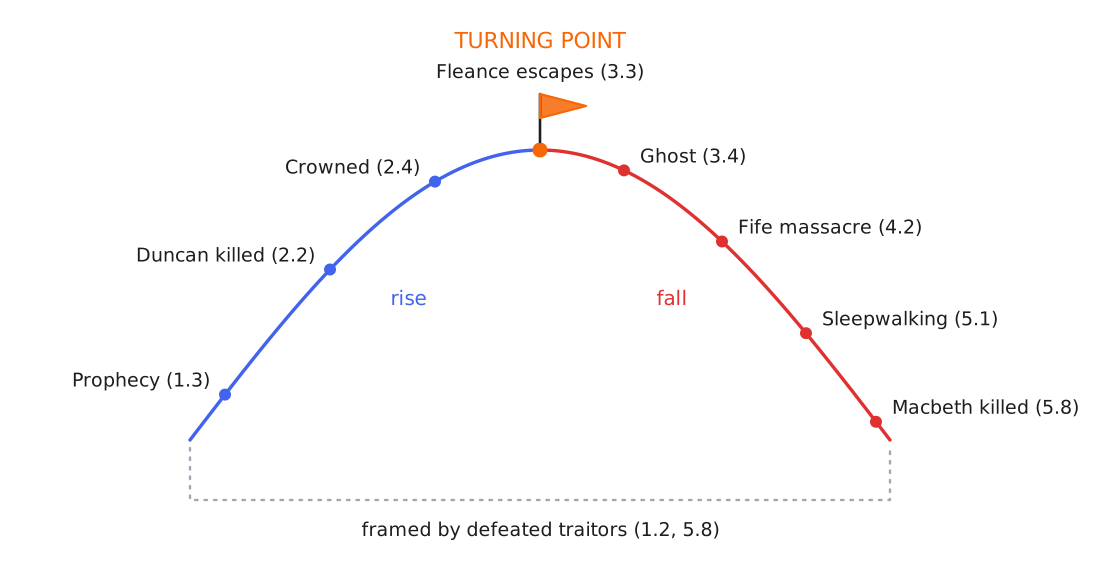
Diagram of Macbeth's rise and fall as an arch, with Fleance's escape at the peak