In short
- Macbeth is a tragedy: a great soldier falls through his own choices, and his death restores order.
- The form tracks the mind: verse for nobles, chants for the Witches, prose for Lady Macbeth's breakdown.
- Double meanings run the play, from the opening paradox to the apparitions' trick promises.
Tragedy and the tragic hero
Tragedy has a fixed shape: a great man falls through his own flaw, and order returns. The Captain's "brave Macbeth" (Act 1, Scene 2) starts him high, so the fall is long. He names his own hamartia (fatal flaw): "Vaulting ambition, which o’erleaps itself" (Act 1, Scene 7), a rider who leaps so hard he crashes.
Yet the fall is chosen: Banquo hears prophecies too, and does not kill. Malcolm's final "this dead butcher" (Act 5, Scene 8) is far simpler than the mind we have watched. Top answers argue in that gap.
Verse, prose and soliloquy
Nobles speak blank verse (unrhymed iambic pentameter), the voice of order. Macbeth's first line, "So foul and fair a day I have not seen." (Act 1, Scene 3), keeps that beat but echoes the Witches before he has met them. The Witches chant in rhyme, "Double, double, toil and trouble;" (Act 4, Scene 1), so they sound like a spell, outside human order.
Prose marks low status or a broken mind. Lady Macbeth gave orders in verse; sleepwalking, she manages only jagged prose: "Out, damned spot! out, I say!" (Act 5, Scene 1). The form shows her losing control.
Soliloquies chart Macbeth's change: debate in Act 1, Scene 7, cold calculation in "To be thus is nothing" (Act 3, Scene 1), despair in "Tomorrow, and tomorrow, and tomorrow," (Act 5, Scene 5). Dramatic irony bites early: Duncan says "There’s no art / To find the mind’s construction in the face:" (Act 1, Scene 4), and Macbeth walks straight in.
Structure
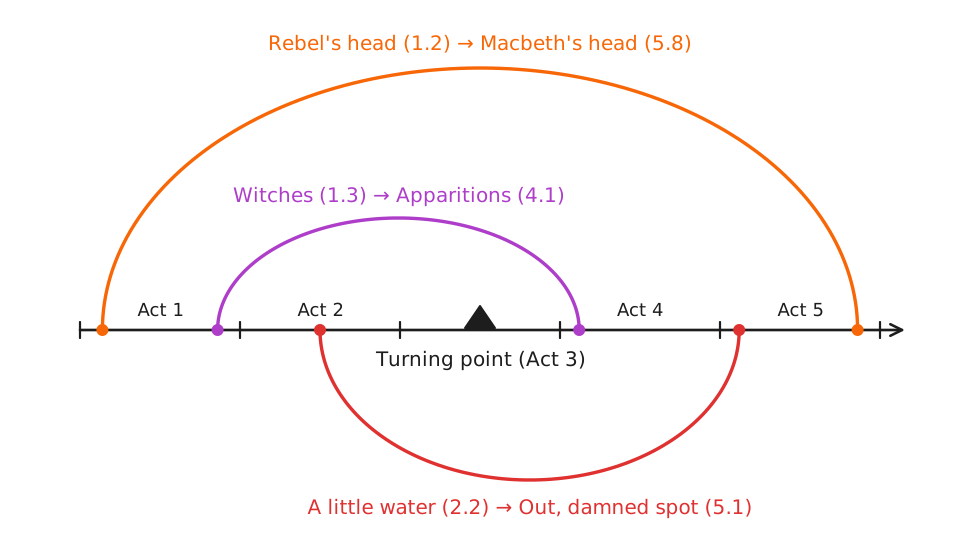
Duncan dies offstage, so the first murder is imagined, not seen. Later killings, Banquo (Act 3, Scene 3) and Macduff's son (Act 4, Scene 2), happen on stage as the tyranny grows. Act 3 is the turning point: Fleance escapes, and the banquet, a symbol of order, collapses around a ghost only Macbeth sees.
Lady Macbeth's "what’s done is done" (Act 3, Scene 2) returns as "What’s done cannot be undone." (Act 5, Scene 1): the added "cannot be undone" turns a shrug into despair. The ending is a circle. Macbeth fixed a rebel's "head upon our battlements" (Act 1, Scene 2); the play ends with "Th’ usurper’s cursed head" (Act 5, Scene 8). The man who executed traitors dies as one.
Imagery and double meanings
Blood turns from glory to guilt. After the murder, "Will all great Neptune’s ocean wash this blood / Clean from my hand?" (Act 2, Scene 2) sets a whole ocean against one hand: nothing can clean it.
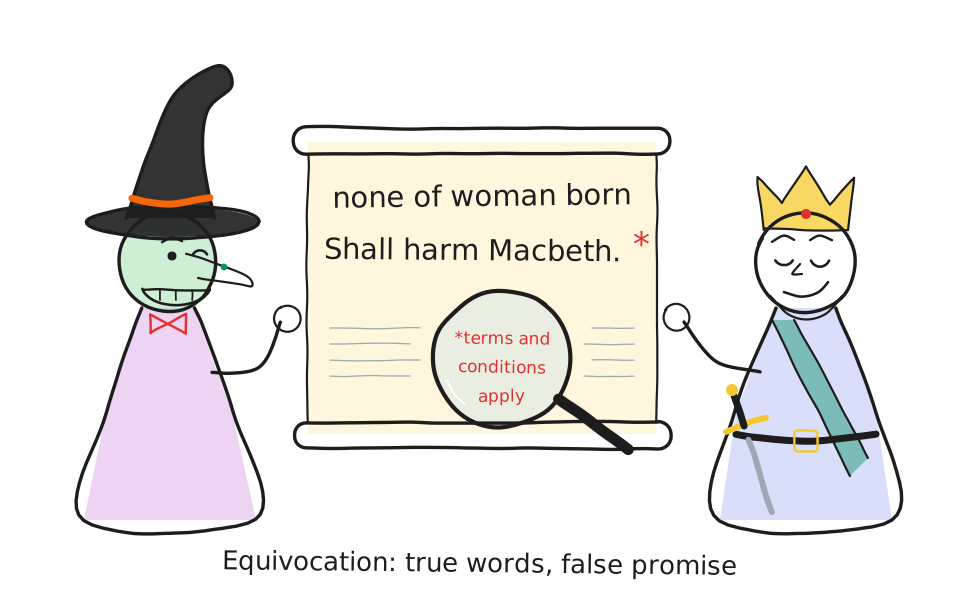
Double meanings run the play. "Fair is foul, and foul is fair" (Act 1, Scene 1) is a paradox: its mirrored words swap good and evil. The apparitions promise that "none of woman born / Shall harm Macbeth." (Act 4, Scene 1), yet Macduff was "Untimely ripp’d." (Act 5, Scene 8). This is equivocation: the truth, told to mislead. It was topical: at his 1606 Gunpowder Plot trial, the Jesuit Henry Garnet had defended equivocation.
Subject terminology
- Tragic hero: a great man destroyed by his own choices; "brave Macbeth" (Act 1, Scene 2).
- Hamartia: the hero's fatal flaw; "Vaulting ambition" (Act 1, Scene 7).
- Soliloquy: a character alone, thinking aloud; "To be thus is nothing" (Act 3, Scene 1).
- Aside: a line the other characters cannot hear; "Stars, hide your fires!" (Act 1, Scene 4).
- Dramatic irony: the audience knows more than a character; Duncan's "There’s no art" (Act 1, Scene 4).
- Blank verse: unrhymed iambic pentameter; "So foul and fair a day I have not seen." (Act 1, Scene 3).
- Trochaic tetrameter: four stressed-then-unstressed beats; "Double, double, toil and trouble;" (Act 4, Scene 1).
- Prose: speech without metre; "Out, damned spot!" (Act 5, Scene 1).
- Rhyming couplet: two rhyming lines that seal a moment; "By the pricking of my thumbs, / Something wicked this way comes." (Act 4, Scene 1).
- Paradox: a contradiction that holds a truth; "Fair is foul, and foul is fair" (Act 1, Scene 1).
- Equivocation: truth worded to mislead; "none of woman born" (Act 4, Scene 1).
- Hyperbole: deliberate exaggeration; "all great Neptune’s ocean" (Act 2, Scene 2).
- Motif: a repeated image that gathers meaning; "blood will have blood." (Act 3, Scene 4).
- Foil: a character who highlights another by contrast; Banquo's "allegiance clear" (Act 2, Scene 1).
- Apostrophe: addressing something absent or not human; "Come, thick night," (Act 1, Scene 5).
Why does Lady Macbeth speak in prose when she sleepwalks (Act 5, Scene 1)?
What makes the promise that "none of woman born" can harm Macbeth an example of equivocation?
The play opens with a rebel's head on the battlements and ends with Macbeth's head brought in. What does this circle suggest?
Macbeth admits his only motive is "Vaulting ambition, which o’erleaps itself" (Act 1, Scene 7). Which term best fits this line?