In short
- Four extracts, one from each stage of the story: Lady Macbeth calls on the spirits (Act 1, Scene 5), the minutes after the murder (Act 2, Scene 2), Banquo's Ghost (Act 3, Scene 4) and the sleepwalking (Act 5, Scene 1).
- Read them as one chain. She starts in total command while he shakes; by Act 5 his fear has hardened and the guilt she locked away has broken her.
- For each, know three or four phrases to zoom in on and three moments elsewhere to link to.
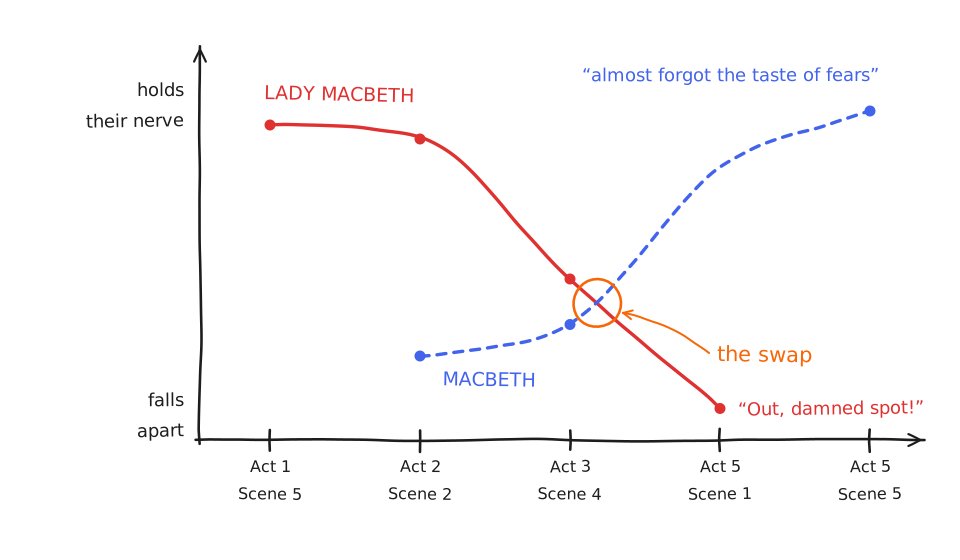
Extract 1: Act 1, Scene 5: Lady Macbeth calls on the spirits
Lady Macbeth has read her husband's letter about the Witches. Now she hears that Duncan will stay the night.
LADY MACBETH.
The raven himself is hoarse
That croaks the fatal entrance of Duncan
Under my battlements. Come, you spirits
That tend on mortal thoughts, unsex me here,
And fill me, from the crown to the toe, top-full
Of direst cruelty! make thick my blood,
Stop up th’ access and passage to remorse,
That no compunctious visitings of nature
Shake my fell purpose, nor keep peace between
Th’ effect and it! Come to my woman’s breasts,
And take my milk for gall, your murd’ring ministers,
Wherever in your sightless substances
You wait on nature’s mischief! Come, thick night,
And pall thee in the dunnest smoke of hell
That my keen knife see not the wound it makes,
Nor heaven peep through the blanket of the dark
To cry, “Hold, hold!”Enter Macbeth.
Great Glamis, worthy Cawdor!
Greater than both, by the all-hail hereafter!
Thy letters have transported me beyond
This ignorant present, and I feel now
The future in the instant.
Line by line
- "The raven himself is hoarse": the raven was a bird of death, and it has croaked itself hoarse. Duncan's death is announced before he even arrives. The phrase "my battlements" shows her claiming the castle, and the plan.
- "Come, you spirits / That tend on mortal thoughts, unsex me here,": the commands sound like a spell. She wants every soft feeling her society called womanly burned out, because it might stop the murder. England made calling on evil spirits a capital crime in 1604, so this was terrifying to hear.
- "Stop up th’ access and passage to remorse,": she pictures guilt as a passage she can brick up. The rest of the play tests that plan, and Act 5, Scene 1 shows it failing.
- "And take my milk for gall,": milk means nurture; gall is bitter poison. Earlier in the scene she said Macbeth was "too full o’ th’ milk of human kindness". Now she wants the milk gone from herself too.
- "Come, thick night, / And pall thee in the dunnest smoke of hell": a pall is the cloth over a coffin. She asks darkness to hide the deed from heaven, and knowingly wraps herself in hell's smoke to do it.
- "That my keen knife see not the wound it makes,": "my" shows she expects to strike the blow herself. Yet she wants the knife blind, as if part of her fears the sight.
- "Greater than both, by the all-hail hereafter!": she greets him with the Witches' titles and their "All hail". She has stepped into their role as his tempter.
Link it to the whole text
- The daring she prays for becomes her weapon: "When you durst do it, then you were a man;" (Act 1, Scene 7).
- Her "keen knife" is never used: "Had he not resembled / My father as he slept, I had done’t." (Act 2, Scene 2). It is the first crack in her cruelty.
- The woman who called for "thick night" ends up crying "Hell is murky!" (Act 5, Scene 1), with a candle kept beside her at all times.
Questions it could come up with
- Starting with this extract, explore how far Shakespeare presents Lady Macbeth as a powerful woman. Write about: how Shakespeare presents Lady Macbeth in this extract; how far Shakespeare presents Lady Macbeth as a powerful woman in the play as a whole.
- Starting with this extract, explore how Shakespeare presents ambition. Write about: how Shakespeare presents ambition in this extract; how Shakespeare presents ambition in the play as a whole.
Extract 2: Act 2, Scene 2: The Macbeths just after Duncan's murder
Macbeth has come back from Duncan's room still holding the daggers, which should have been left with the sleeping grooms.
MACBETH.
I’ll go no more:
I am afraid to think what I have done;
Look on’t again I dare not.LADY MACBETH.
Infirm of purpose!
Give me the daggers. The sleeping and the dead
Are but as pictures. ’Tis the eye of childhood
That fears a painted devil. If he do bleed,
I’ll gild the faces of the grooms withal,
For it must seem their guilt.[Exit. Knocking within.]
MACBETH.
Whence is that knocking?
How is’t with me, when every noise appals me?
What hands are here? Ha, they pluck out mine eyes!
Will all great Neptune’s ocean wash this blood
Clean from my hand? No, this my hand will rather
The multitudinous seas incarnadine,
Making the green one red.Enter Lady Macbeth.
LADY MACBETH.
My hands are of your colour, but I shame
To wear a heart so white. [Knocking within.] I hear knocking
At the south entry:—retire we to our chamber.
A little water clears us of this deed:
How easy is it then! Your constancy
Hath left you unattended.—[Knocking within.] Hark, more knocking.
Get on your nightgown, lest occasion call us
And show us to be watchers. Be not lost
So poorly in your thoughts.MACBETH.
To know my deed, ’twere best not know myself. [Knocking within.]
Wake Duncan with thy knocking! I would thou couldst!
Line by line
- "I am afraid to think what I have done;": the words are short and plain. The soldier who fixed a rebel's head on the battlements (Act 1, Scene 2) cannot look at one dead old man.
- "Infirm of purpose!": she attacks his willpower, not his morals. Her blunt command, "Give me the daggers", takes the weapons, and the crime, into her own hands.
- "’Tis the eye of childhood / That fears a painted devil.": she shrinks guilt to a child scared of a picture. Ironically, in Act 5 she is the one haunted by images in the dark.
- "I’ll gild the faces of the grooms withal, / For it must seem their guilt.": "I’ll gild the faces" (coat them in gold) puns on "their guilt". Blood becomes gold paint, the colour of the crown, and guilt becomes something to arrange on other people's faces.
- "Will all great Neptune’s ocean wash this blood / Clean from my hand?": not even the sea god's ocean can clean him. His answer swells into grand, Latin-based words ("multitudinous", "incarnadine"), then drops to plain ones: "Making the green one red." The huge idea lands as one terrible fact.
- "My hands are of your colour, but I shame / To wear a heart so white.": red hands against a white heart. She reads his pale fear as cowardice, measuring a man only by his nerve.
- "A little water clears us of this deed:": her understatement answers his ocean. It is the most ironic line she speaks, while the knocking at the gate hammers on like judgement arriving.
Link it to the whole text
- Her "little water" is answered in her sleep: "all the perfumes of Arabia will not sweeten this little hand" (Act 5, Scene 1). The word "little" has moved from the water to her own hand.
- His horror hardens into resolve: "I am in blood / Stepp’d in so far that, should I wade no more, / Returning were as tedious as go o’er." (Act 3, Scene 4).
- The partnership soon splits: he plans Banquo's murder alone, telling her "Be innocent of the knowledge, dearest chuck," (Act 3, Scene 2).
Questions it could come up with
- Starting with this extract, explore how Shakespeare presents the relationship between Macbeth and Lady Macbeth. Write about: how Shakespeare presents their relationship in this extract; how Shakespeare presents their relationship in the play as a whole.
- Starting with this extract, explore how Shakespeare presents guilt. Write about: how Shakespeare presents guilt in this extract; how Shakespeare presents guilt in the play as a whole.
Extract 3: Act 3, Scene 4: Banquo's Ghost appears at the banquet
Macbeth, now king, is hosting his lords and has just heard Banquo is dead. The stage directions seat the Ghost in Macbeth's own place, but only he can see it.
MACBETH.
Which of you have done this?LORDS.
What, my good lord?MACBETH.
Thou canst not say I did it. Never shake
Thy gory locks at me.ROSS.
Gentlemen, rise; his Highness is not well.LADY MACBETH.
Sit, worthy friends. My lord is often thus,
And hath been from his youth: pray you, keep seat;
The fit is momentary; upon a thought
He will again be well. If much you note him,
You shall offend him, and extend his passion.
Feed, and regard him not.—Are you a man?MACBETH.
Ay, and a bold one, that dare look on that
Which might appal the devil.LADY MACBETH.
O proper stuff!
This is the very painting of your fear:
This is the air-drawn dagger which you said,
Led you to Duncan. O, these flaws, and starts
(Impostors to true fear), would well become
A woman’s story at a winter’s fire,
Authoris’d by her grandam. Shame itself!
Why do you make such faces? When all’s done,
You look but on a stool.MACBETH.
Pr’ythee, see there!
Behold! look! lo! how say you?
Why, what care I? If thou canst nod, speak too.—
If charnel houses and our graves must send
Those that we bury back, our monuments
Shall be the maws of kites.[Ghost disappears.]
LADY MACBETH.
What, quite unmann’d in folly?
Line by line
- "Thou canst not say I did it.": he hides behind a technicality, since hired murderers struck the blows. Saying it aloud before the court turns private guilt into public exposure, and "gory locks" keeps the blood in view.
- "My lord is often thus, / And hath been from his youth:": she invents an illness on the spot. Her quick commands ("keep seat", "Feed, and regard him not") hold the room: she is still the expert in appearances.
- "Are you a man?": the question that won the argument in Act 1, Scene 7. Here it fails, because his terror comes from inside and cannot be shamed away.
- "Ay, and a bold one, that dare look on that / Which might appal the devil.": he redefines courage as staring at horror. In Act 1, Scene 7, "I dare do all that may become a man;" meant refusing to kill.
- "This is the very painting of your fear:": the repeated "This is the" hammers home that the Ghost is a hallucination, like the "air-drawn dagger". The word "painting" echoes her "painted devil" (Act 2, Scene 2). Yet the audience may see the Ghost, so Shakespeare leaves open whether it is real.
- "A woman’s story at a winter’s fire,": she mocks his fear as an old wives' tale, a gendered insult from the woman who asked to be unsexed.
- "What, quite unmann’d in folly?": "unmann’d" mirrors her "unsex me here" (Act 1, Scene 5). She wanted to lose her womanhood; now she accuses him of losing his manhood.
Link it to the whole text
- She ties the Ghost to the dagger he saw before the first murder: "Is this a dagger which I see before me, / The handle toward my hand?" (Act 2, Scene 1). Both visions come with killing.
- Exposure drives him to more blood, not repentance: "It will have blood, they say, blood will have blood." (Act 3, Scene 4). Soon he sends killers to Macduff's castle (Act 4, Scene 1).
- Her calm hides the damage. Sleepwalking, she is still soothing him about this night: "Banquo’s buried; he cannot come out on’s grave." (Act 5, Scene 1).
Questions it could come up with
- Starting with this extract, explore how Shakespeare presents the supernatural. Write about: how Shakespeare presents Macbeth's reaction to the Ghost in this extract; how Shakespeare presents the supernatural in the play as a whole.
- Starting with this extract, explore how Shakespeare presents ideas about masculinity. Write about: how Shakespeare presents ideas about masculinity in this extract; how Shakespeare presents ideas about masculinity in the play as a whole.
Extract 4: Act 5, Scene 1: Lady Macbeth sleepwalks
A Doctor and a Gentlewoman watch Lady Macbeth walk in her sleep with a candle, rubbing her hands as if washing them.
LADY MACBETH.
Yet here’s a spot.DOCTOR.
Hark, she speaks. I will set down what comes from her, to satisfy my remembrance the more strongly.LADY MACBETH.
Out, damned spot! out, I say! One; two. Why, then ’tis time to do’t. Hell is murky! Fie, my lord, fie! a soldier, and afeard? What need we fear who knows it, when none can call our power to account? Yet who would have thought the old man to have had so much blood in him?DOCTOR.
Do you mark that?LADY MACBETH.
The Thane of Fife had a wife. Where is she now?—What, will these hands ne’er be clean? No more o’ that, my lord, no more o’ that: you mar all with this starting.DOCTOR.
Go to, go to. You have known what you should not.GENTLEWOMAN.
She has spoke what she should not, I am sure of that: heaven knows what she has known.LADY MACBETH.
Here’s the smell of the blood still: all the perfumes of Arabia will not sweeten this little hand. Oh, oh, oh!DOCTOR.
What a sigh is there! The heart is sorely charged.GENTLEWOMAN.
I would not have such a heart in my bosom for the dignity of the whole body.DOCTOR.
Well, well, well.GENTLEWOMAN.
Pray God it be, sir.DOCTOR.
This disease is beyond my practice: yet I have known those which have walked in their sleep, who have died holily in their beds.LADY MACBETH.
Wash your hands, put on your nightgown; look not so pale. I tell you yet again, Banquo’s buried; he cannot come out on’s grave.DOCTOR.
Even so?LADY MACBETH.
To bed, to bed. There’s knocking at the gate. Come, come, come, come, give me your hand. What’s done cannot be undone. To bed, to bed, to bed.
Line by line
- "Yet here’s a spot.": the whole scene is in prose. The woman who commanded spirits in controlled verse now speaks in broken scraps, and the form shows her mind coming apart.
- "Out, damned spot! out, I say!": her commands once ordered spirits and a husband; now they are aimed at a stain nobody else can see. The word "damned" carries its full religious weight: she fears hell.
- "Hell is murky!": she once called for "the dunnest smoke of hell" to hide her (Act 1, Scene 5). Now its darkness terrifies her, and she keeps a candle by her at all times.
- "Yet who would have thought the old man to have had so much blood in him?": blood at its most literal. Calling Duncan "the old man" shrinks the King to a body, yet her shock at the blood is the very sight she prayed her "keen knife" would not see.
- "The Thane of Fife had a wife. Where is she now?": the singsong rhyme sounds like a nursery rhyme, as if her mind is sliding backwards. Lady Macduff's murder was Macbeth's crime alone, yet she carries that guilt too.
- "all the perfumes of Arabia will not sweeten this little hand": the horror moves from sight to smell, and "this little hand" shows a new frailty. It is her version of his "Neptune’s ocean", three acts late.
- "There’s knocking at the gate.": she relives Act 2, Scene 2: the knocking, the nightgown, the washing. "What’s done cannot be undone." reverses her own "what’s done is done" (Act 3, Scene 2): once it brushed guilt aside; now it admits there is no escape.
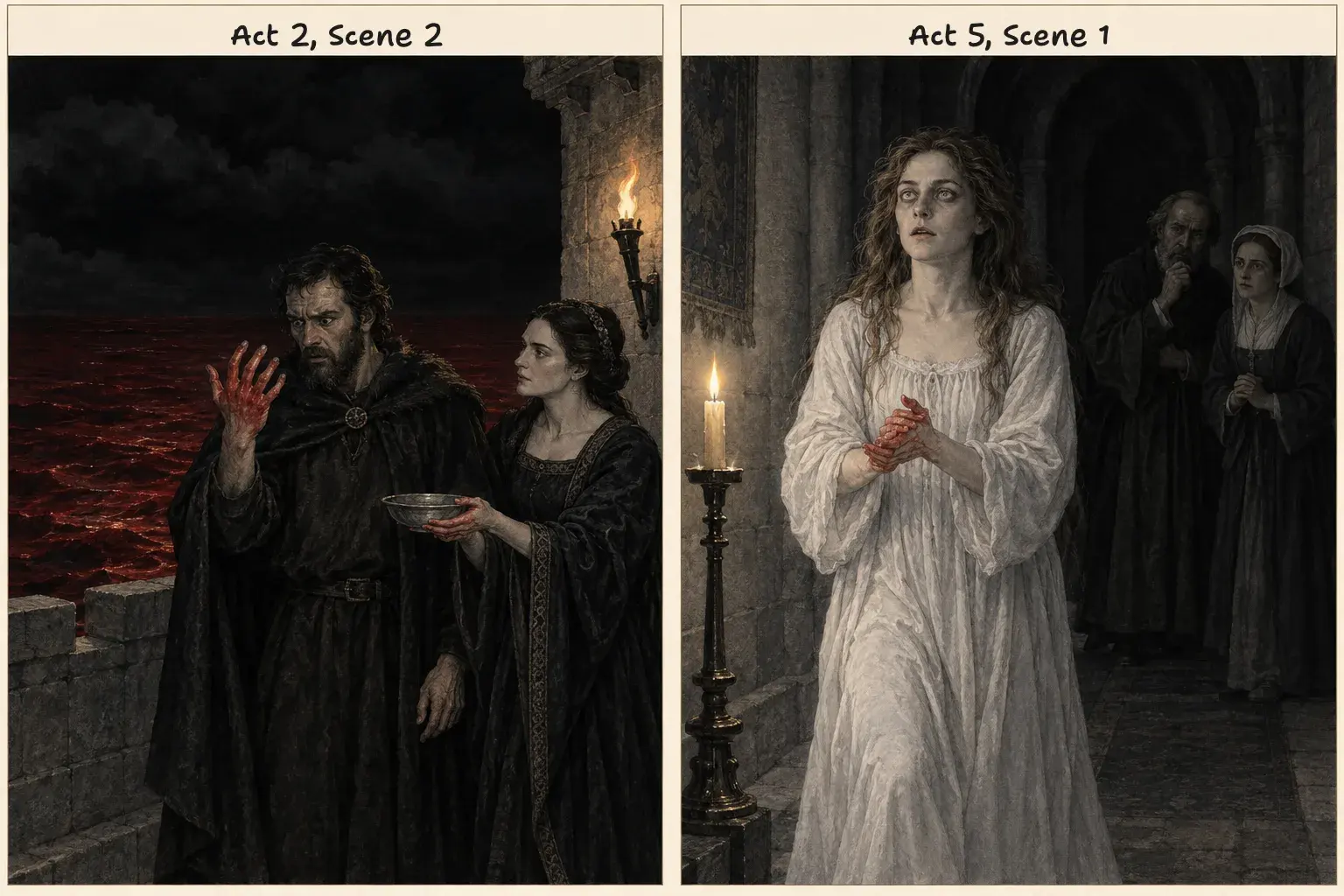
Link it to the whole text
- She was once sure that "A little water clears us of this deed:" (Act 2, Scene 2). The hand-washing here is that same action trapped on repeat.
- Macbeth begs the Doctor to cure "a mind diseas’d" (Act 5, Scene 3). The Doctor already knows her sickness is guilt, which no medicine reaches.
- Malcolm calls her a "fiend-like queen" (Act 5, Scene 8). This scene shows a suffering human being, and a top answer questions that label.
Questions it could come up with
- Starting with this extract, explore how far Shakespeare presents Lady Macbeth as a character who changes. Write about: how Shakespeare presents Lady Macbeth in this extract; how far Shakespeare presents Lady Macbeth as a character who changes in the play as a whole.
- Starting with this extract, explore how Shakespeare presents the consequences of the Macbeths' crimes. Write about: how Shakespeare presents their guilt in this extract; how Shakespeare presents the consequences of their crimes in the play as a whole.