At a glance
The Witches, called the Weird Sisters in the play, are three supernatural women who greet Macbeth with prophecies, and Shakespeare uses them to fill the play with evil and to leave open whether Macbeth's fate is written or chosen.
- Role in the plot: they open the play (Act 1, Scene 1), hail Macbeth and Banquo (Act 1, Scene 3), and show Macbeth apparitions that mislead him (Act 4, Scene 1). They never tell him to kill anyone.
- Defining traits:
- Turn order upside down: "Fair is foul, and foul is fair" (Act 1, Scene 1).
- Spiteful but limited: "Though his bark cannot be lost, / Yet it shall be tempest-tost" (Act 1, Scene 3).
- Speak in riddles that are true and misleading: "Lesser than Macbeth, and greater" (Act 1, Scene 3).
- Unsettling in body: their "beards forbid" Banquo to believe they are women (Act 1, Scene 3).
- Themes they carry: the supernatural, fate and free will, appearance and reality, evil and disorder, gender.
- Relationships and foils: Macbeth (tempted, then seeking them out); Banquo (the sceptic); Lady Macbeth (whose invocation echoes their spells).
Their journey
- Opening storm (Act 1, Scene 1). They meet in thunder, speak in riddles, and say "Macbeth" before any human character does.
- Prophecy (Act 1, Scene 3). They plot against a sailor whose wife insulted them, then hail Macbeth as Thane of Cawdor and future king, and Banquo as father of kings. They vanish, "Melted as breath into the wind".
- Hecate (Act 3, Scene 5). Their mistress scolds them for helping "a wayward son" who "Loves for his own ends, not for you", and plans illusions to draw him "to his confusion". This scene may be a later addition by Thomas Middleton.
- The cauldron (Act 4, Scene 1). Macbeth seeks them out. Three apparitions give him equivocal promises and a show of eight kings shows him Banquo's line. They dance and vanish, and are never seen again.
- Aftermath (Act 5). Macbeth curses "th' equivocation of the fiend, / That lies like truth" (Act 5, Scene 5) and the "juggling fiends" (Act 5, Scene 8) once the promises unravel.
In Act 1 they come to Macbeth; in Act 4 he goes to them, and that reversal measures how far he has chosen evil.
Key quotations
- "Fair is foul, and foul is fair: / Hover through the fog and filthy air." (Act 1, Scene 1). A chiasmus (a phrase reversed on itself) turns moral values upside down, and the heavy "f" alliteration sounds like a curse. It is the first taste of equivocation (words that are true in one sense and misleading in another), the Witches' main weapon. Macbeth's first words, "So foul and fair a day", echo it.
- "Though his bark cannot be lost, / Yet it shall be tempest-tost." (Act 1, Scene 3). A bark is a ship: they can torment the sailor, not sink him. The same may be true of Macbeth: they toss him about, but the wreck is his own doing. Their curse, "Sleep shall neither night nor day / Hang upon his pent-house lid", also foreshadows the sleep Macbeth murders (Act 2, Scene 2).
- "All hail, Macbeth! that shalt be king hereafter!" (Act 1, Scene 3). "Hereafter" gives no how or when. Macbeth fills the gap with murder. The word returns in Lady Macbeth's "all-hail hereafter" (Act 1, Scene 5) and in "She should have died hereafter" (Act 5, Scene 5), when the future has turned to ash.
- "By the pricking of my thumbs, / Something wicked this way comes." (Act 4, Scene 1). The rhyming chant is unchanged since Act 1, but "wicked" now names Macbeth as he arrives. He has become what they are, and now he seeks them out.
- "A deed without a name." (Act 4, Scene 1). Their answer to Macbeth's "What is't you do?" "Deed" echoes his "I have done the deed" (Act 2, Scene 2), and Macduff's horror that "Tongue nor heart" can "name" the murder (Act 2, Scene 3). Evil in this play is beyond language.
- "Be bloody, bold, and resolute. Laugh to scorn / The power of man, for none of woman born / Shall harm Macbeth." (Act 4, Scene 1). Spoken by the second Apparition, a bloody child, not by a Witch. The alliteration of "bloody, bold" urges violence. The promise is true in a way Macbeth cannot imagine, since Macduff was cut from his mother's womb.
How Shakespeare builds them
- The opening scene. The play begins with them, in thunder and lightning, so evil frames everything that follows.
- A different verse. They chant in short, rhymed lines with four stresses, such as "Double, double, toil and trouble" (Act 4, Scene 1), while nobles speak in blank verse. The rhythm itself marks them as outside human order.
- Appearing and vanishing. Stage directions make them simply vanish, so the audience, like Banquo, cannot be sure what was real.
- Echoes. Their words return in other mouths ("foul and fair", "hereafter", "hail"), so their influence spreads even when they are offstage.
Context
- King James and the North Berwick witches. A pamphlet, Newes from Scotland (1591), reported witches confessing that they sailed "in their riddles or Ciues" (sieves) and raised a tempest against the King's ship, which survived because his faith was stronger than their spells. Shakespeare's witch will sail "in a sieve" and toss a ship she cannot sink (Act 1, Scene 3), echoing the King's own story.
- Daemonologie (1597). The King's own book says witches can raise storms, but only within bounds "as God will permitte them". Their limited power in Act 1, Scene 3 fits the King's view exactly.
- The 1604 Witchcraft Act. In James's first year on the English throne, Parliament passed a harsher law against witchcraft, treating the conjuring of evil spirits as a capital crime. The first audiences would read the Witches, and Lady Macbeth's "Come, you spirits" (Act 1, Scene 5), as crimes in law, not just sins.
- Shakespeare made them stranger. Holinshed calls them perhaps "the goddesses of destinie, or else some nymphs or feiries". Shakespeare makes them bearded, riddling and ugly.
Interpretations
- Agents of fate, or of the Devil. They plan to meet Macbeth before he arrives (Act 1, Scene 1), Hecate plots his "confusion" (Act 3, Scene 5), and the apparitions are designed to mislead (Act 4, Scene 1). Read this way, Macbeth is trapped from the start.
- Catalysts, not causes. Bradley insists they are "not goddesses, or fates", and that Macbeth is "in the ordinary sense, perfectly free in regard to them". Evidence: they never mention murder, and Banquo hears prophecies without killing anyone.
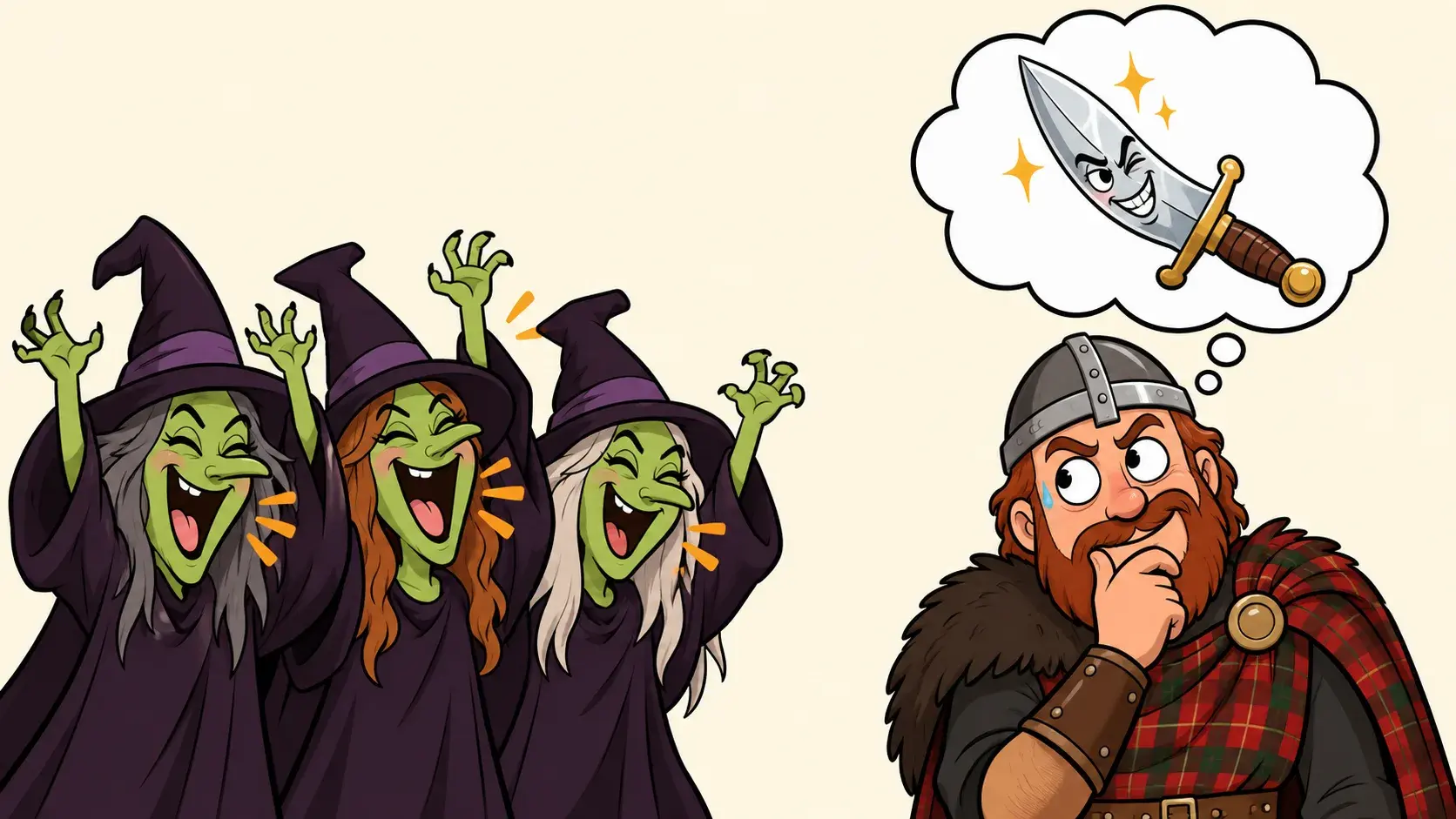
- Projections of fear about female power. Janet Adelman links them with Lady Macbeth as two faces of a male fear of powerful mothers. Productions reshape that fear: Polly Findlay's 2018 RSC production made them "a frightful trio of little girls in bright red dresses", and Rupert Goold's 2007 Chichester production made them military nurses who were "a presence throughout".
How to write about them
Three arguments a grade 9 answer could build:
- They are equivocation made flesh. Every prophecy comes true and every one misleads, so the play becomes a study of how people hear what they want to hear.
- They hand responsibility back to humans. They offer; Macbeth chooses. Banquo, given the same offer, shows it could be refused.
- They stage Jacobean fears of women, disorder and treason. Their disappearance after Act 4 lets the restored order of Act 5 belong to men and to God.
Moments to reach for:
- The supernatural: the storm and "Fair is foul" (Act 1, Scene 1), the prophecies (Act 1, Scene 3), the apparitions (Act 4, Scene 1).
- Fate and free will: Banquo's "instruments of darkness" and Macbeth's "suggestion" (Act 1, Scene 3), "Come what come may" (Act 1, Scene 3).
- Appearance and reality: "Lesser than Macbeth, and greater" (Act 1, Scene 3), "th' equivocation of the fiend" (Act 5, Scene 5), "juggling fiends" (Act 5, Scene 8).
Saying the Witches make Macbeth kill
The mistake: "The Witches tell Macbeth to murder Duncan" or "the Witches control him". They only predict; the idea of murder is his own, in an aside (Act 1, Scene 3). Also check who speaks: "none of woman born" belongs to an Apparition, not a Witch, and "Double, double" is Act 4, not Act 1. The fix: argue about how far they influence him.