At a glance
Lady Macbeth is Macbeth's wife, later his queen, and Shakespeare uses her to explore power, gender and a guilt that cannot be willed away.
- Role in the plot: she drives the first murder and its cover-up, is shut out of her husband's plans, sleepwalks, and dies offstage, reportedly by her own hand.
- Defining traits:
- Commanding: "Leave all the rest to me" (Act 1, Scene 5).
- Knows where to hurt him: "When you durst do it, then you were a man" (Act 1, Scene 7).
- Cool in a crisis, at first: "Infirm of purpose!" (Act 2, Scene 2).
- Less hard than she believes: Duncan "resembled / My father as he slept" (Act 2, Scene 2).
- Themes she carries: ambition, gender and power, appearance and reality, guilt, sleep.
- Relationships and foils: Macbeth (partners who swap places); Lady Macduff (the loving, powerless mother); the Witches (female power that unsettles men).
Their journey
- Decision (Act 1, Scene 5). Reading Macbeth's letter, she decides at once, calls on spirits to "unsex" her, and greets him like a Witch: "by the all-hail hereafter!"
- Persuader (Act 1, Scenes 6 and 7). She charms Duncan, then mocks her husband's manhood and supplies the plan: the turning point for both.
- Accomplice (Act 2, Scenes 2 and 3). She needs drink to feel "bold" and cannot kill a man who looks like her father, yet returns the daggers. Next morning she faints, for real or for show.
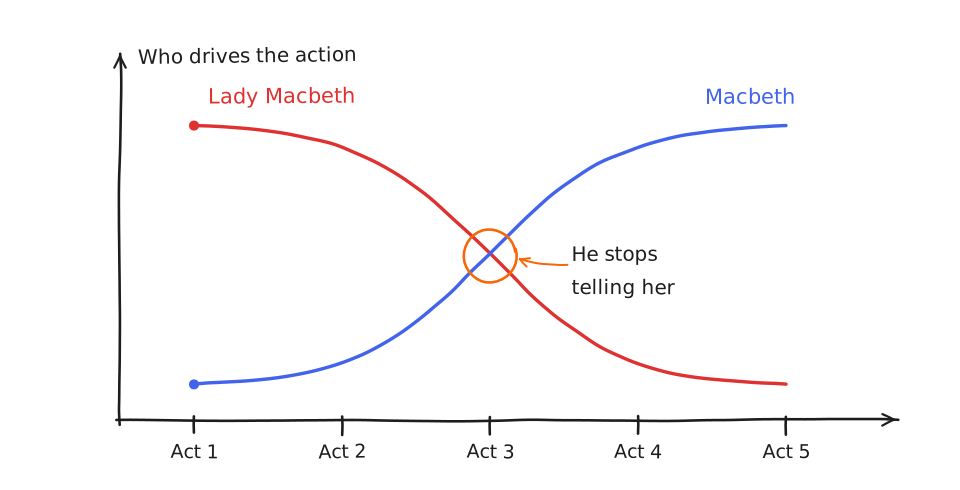
- Isolated (Act 3, Scenes 2 and 4). Privately she admits "Naught's had, all's spent". Macbeth plans Banquo's murder without her. She rescues the banquet, but the partnership is over, and she vanishes from Act 4.
- Collapse (Act 5). She relives the murder in broken prose (Act 5, Scene 1), dies offstage (Act 5, Scene 5), and took her own life, "as 'tis thought" (Act 5, Scene 8).
The conscience she sealed off returns through sleep, the one place her will cannot reach, so the woman who controlled every conversation ends in fragments.
Key quotations
- "It is too full o' th' milk of human kindness / To catch the nearest way." (Act 1, Scene 5). "Milk" suggests nursing: she makes his goodness feminine, and so, to her, weak.
- "Come, you spirits / That tend on mortal thoughts, unsex me here" (Act 1, Scene 5). Imperatives build a spell, and "unsex" asks for every womanly softness to be stripped out. One reading: a pact with darkness, like the Witches'. Another: she has to ask for cruelty, so it does not come naturally.
- "look like the innocent flower, / But be the serpent under't." (Act 1, Scene 5). The serpent recalls Eden, where the snake tempted Eve. She casts herself as tempter and teaches Macbeth the play's key skill: a false face.
- "I have given suck, and know / How tender 'tis to love the babe that milks me" (Act 1, Scene 7). The tenderness makes the next image, "dash'd the brains out", far more shocking. She would destroy what she loves rather than break a promise, so how can he break his?
- "A little water clears us of this deed" (Act 2, Scene 2). "Little" shrinks murder to a smudge. The dramatic irony lands in Act 5, Scene 1: "all the perfumes of Arabia will not sweeten this little hand". "Little" has moved from the water to her hand, from control to fragility.
- "Naught's had, all's spent, / Where our desire is got without content" (Act 3, Scene 2). Alone, she speaks in rhyming couplets built on paradox: they have everything and nothing. She hides this emptiness the moment Macbeth enters.
- "Out, damned spot! out, I say!" (Act 5, Scene 1). Still imperatives, but aimed at a stain no one else sees, and in prose, not verse. Her "What's done cannot be undone" in the same scene turns her brisk "what's done is done" (Act 3, Scene 2) into despair.
- "The Thane of Fife had a wife. Where is she now?" (Act 5, Scene 1). The nursery-rhyme jingle of "Fife" and "wife" shows a mind unravelling. She grieves a murder she was shut out of, so her conscience is wider than her crimes, and more humane than Malcolm's "fiend-like queen" allows.
How Shakespeare builds them
- An entrance with a letter. Her first reaction to the news is instant decision, and the letter shows Macbeth treats her as an equal: "my dearest partner of greatness".
- Verse into prose. She speaks controlled blank verse (unrhymed ten-syllable lines) until Act 5, Scene 1, where prose shows her mind breaking. The imperatives remain ("To bed, to bed, to bed") but command no one.
- Echoes and witnesses. The sleepwalking replays Act 2, Scene 2 (knocking, hands, blood) before the Doctor and Gentlewoman, an on-stage audience.
- Disappearing. She dominates Act 1, vanishes in Act 4, and dies offstage in one line.
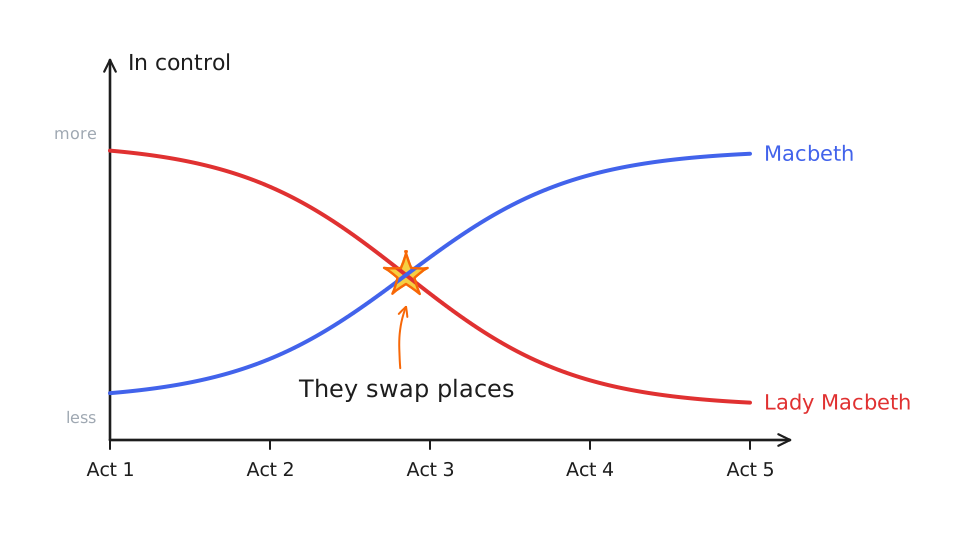
- The swap. "Leave all the rest to me" (Act 1, Scene 5) becomes his "Be innocent of the knowledge, dearest chuck" (Act 3, Scene 2), and her "Come, thick night" becomes his "Come, seeling night". He has learned her language and no longer needs her.
Context
- Her source is one sentence. Holinshed says only that Macbeth's wife "lay sore vpon him to attempt the thing, as she that was verie ambitious". Even the guards made senseless with drink come from another story, the murder of King Duff, done "through setting on of his wife". Her collapse is Shakespeare's invention.
- Women and the Devil. King James's Daemonologie (1597) says most witches are women because "that sexe is frailer then man is", as shown "by the Serpents deceiuing of Eua" (Eve). Calling on "spirits" and telling her husband to "be the serpent", she speaks the language the King used of witches.
- Power through a husband. Audiences remembered Elizabeth I, but a wife's power ran through her husband, so once Macbeth stops needing her (Act 3, Scene 2), hers drains away.
- The missing child. "I have given suck" (Act 1, Scene 7), yet no child appears; infant deaths were cruelly common. Compare the "fruitless crown" (Act 3, Scene 1).
Interpretations
- The "fiend-like queen". Malcolm's verdict (Act 5, Scene 8). Kate Fleetwood (Rupert Goold's Chichester production, 2007) played her as cold and cruel from her first entrance. Evidence: the invocation and the infanticide image (Act 1, Scenes 5 and 7).
- A human being who overestimates her hardness. Bradley argues that if she were "really utterly inhuman", "the Lady Macbeth of the sleep-walking scene would be an impossibility". He thinks her faint is real, but the stage direction "Lady Macbeth is carried out" was added later by the editor Rowe, so the play leaves it open.
- Power only through her husband, and perhaps a grieving mother. Justin Kurzel's 2015 film adds a baby's funeral to underline her lines about nursing, and the critic Janet Adelman reads the play as a male fantasy about the dangerous power of mothers, split between the Witches and Lady Macbeth.
How to write about them
Three arguments a grade 9 answer could build:
- Her strength is willed, not natural. She calls on spirits for it, drinks for it and looks away from a face like her father's. Will cannot reach sleep, so her conscience breaks out there.
- Her power is borrowed. She achieves everything through her husband; once he stops listening, she has nothing. The play shows the limits placed on women as much as one wicked woman.
- The Macbeths move in opposite directions. He learns to kill without thinking; she learns she cannot stop remembering.
Moments to reach for:
- "A female character who changes" (AQA, November 2020, on the sleepwalking scene): "unsex me here" with "this little hand"; "Come, thick night" with the light she keeps "continually"; "A little water" with "all the perfumes of Arabia"; "what's done is done" with "What's done cannot be undone".
- Gender: "unsex me here" (Act 1, Scene 5), Macbeth's admiring "Bring forth men-children only" (Act 1, Scene 7), "Are you a man?" (Act 3, Scene 4).
Calling her mad
AQA's examiners criticised labels like "mental" and "psycho" as "not conducive to a thoughtful and sensitive consideration of the character". The fix: describe a mind breaking under guilt, in the play's terms: "a mind diseas'd" (Act 5, Scene 3) that needs "the divine" more than "the physician" (Act 5, Scene 1). And check facts: she never kills Duncan, and she is in full control at the banquet.